Showing posts with label Veresov. Show all posts

Saturday, 12 September 2026

Bad Bertrich 50+ Game Six

                                                             Klidinger waterfall

I was upfloated.
Spanton (1997) - Martin Schopf (1909)
Veresov
1.d4 d5 2.Nc3 Nf6 3.Bg5 h6!?
Putting the question to the bishop is somewhat uncommon - sixth-most popular in ChessBase's 2026 Mega database, behind ...c5, ...c6, ...Bf5, ...e6 and especially ...Nbd7. But it is Stockfish18's top choice, fractionally ahead of the mainline...Nbd7, while Dragon1 comes to like it almost as much as ...Nbd7.
4.Bh4
The Trompowsky-like 4.Bxf6 is more usual, when the recapture 4...exf6 is the top choice of humans and engines.
4...Bf5
Developing the light-square bishop outside of the pawn-chain becomes a serious option when White cannot attack Black's centre/queenside with a combination of c4, Qb3 and Nc3.
5.e3 Nbd7 6.Bd3 Bxd3
6...e6? can be met by 7.Nxd5!
7.cxd3!?
The engines marginally prefer this over 7.Qxd3.
7...c6 8.Nf3 e6 9.0-0 Be7 10.Rc1 0-0
Now both sides have castled, how would you assess the position?
*****
*****
*****
*****
*****
White is slightly more developed, and has a half-open c file, but the game is equal, according to the engines.
11.Na4 Nh5!? 12.Bxe7 Qxe7 13.Nc5!?
This may be new. Héctor Rossetto - Miroslav Filip, Mar del Plata (Argentina) 1961, went 13.Qb3 Rab8 14.Qc3!? Nhf6 15.b4 Rfc8 16.Rb1 Nb8!? 17.Rfc1 Nd6 18.h3!?, when Dragon1 prefers White, but Stockfish18 calls the game equal (½–½, 38 moves).
13...Nxc5 14.Rxc5 Nf6 15.Ne5 Nd7 16.Nxd7 Qxd7
How would you assess this heavy-piece middlegame?
*****
*****
*****
*****
*****
The game is completely equal, according to Stockfish18, although Dragon1 awards White the better part of equality.
17.Qa4 a6 18.Rfc1 Rfd8!?
The engines are fine with this, but it does seem a mysterious rook move.
19.b4 g6 20.h3 Kg7 21.Qa5 Rdc8 22.a4 Qd8 23.Qxd8 Rxd8
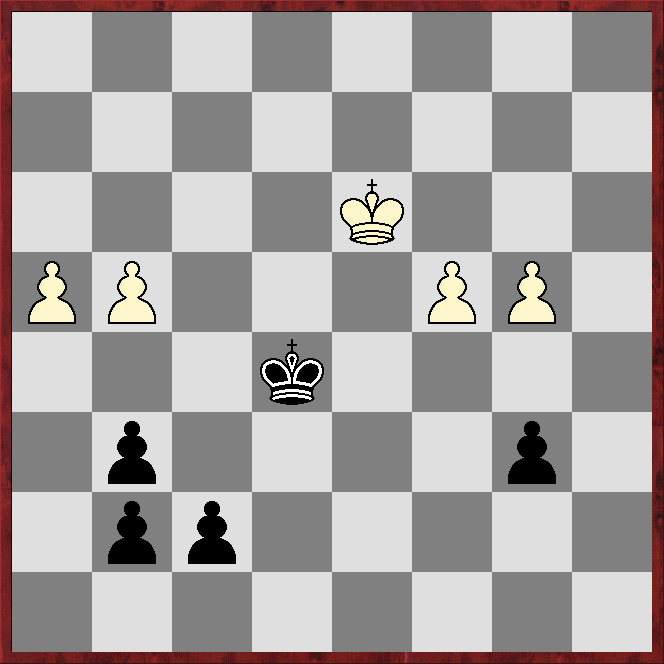
How would you assess this rook-and-pawn ending?
*****
*****
*****
*****
*****
Stockfish18 sticks with complete equality, while Dragon1 gives White a miniscule edge of under 0.1.
24.Kf1 Rd7 25.Ke2 Kf6 26.Kd2 Ke7 27.Kc3 Kd6
It is still possible for either side to blunder, eg 28.h4?? loses 28...b6.
28.Kb3 h5 29.h4 Ra7!?
Another somewhat strange-looking rook move, but again the engines are not bothered.
30.e4 f6 31.Re1 Re7 32.Rc2 b6!?
The engines react badly to this at first, but Stockfish18 comes to view it as OK, although Dragon1 is less sure.
33.e5+ fxe5
Stockfish18 suggests 33...Kd7!?, the engines agreeing 34.exf6 Rf7 is equal. However, Dragon1, but not Stockfish18, reckons 34.f4!? gives White a slight edge.
34.dxe5+ Kd7 35.Rec1 Rc7 36.d4
Black to play and avoid getting a difficult game
*****
*****
*****
*****
*****
36...b5
Black needed to play 36...Re8!, the point being to meet 37.b5 axb5 38.axb5 with 38...Rec8, giving complete equality, according to the engines.
37.f4?!
Better is 37.axb5 axb5, and now 37.f4, with play similar to the game.
37...Re8?
This is now bad, whereas 37...bxa4+ 38.Kxa4 Rf7 gives Black sufficient counterplay to compensate for having weak a and c pawns, according to the engines.
38.a5
Played to prevent Black getting possible counterplay down the a file after the action switches, as I intended, to the kingside. But the engines much prefer 38.axb5!? axb5 39.Ra2, taking the open file, a sample line continuing 39...Rf8 40.g3 Ke7 41.Kc2 Rd8 42.Kd3 Kf8 43.Ke3 Kg7 44.Rca1 Kf7 45.Ra7 Rdc8 46.Kf3 Kf7 47.Rxc7+ Rxc7 48.g4 Kf7 49.gxh5 gxh5 50.Ra8 Re7 51.Rh8, after which White wins either the h or c pawn.
38...Rf8 39.Rf2 Rcc8 40.Kc3 Rf7 41.Kd3 Rcf8 42.Ke3 Rf5 43.Rf3 R5f7
Black can do nothing but await White's activation of the 4-3 kingside majority, in sharp contrast to Black's immobile 4-3 queenside majority
*****
*****
*****
*****
*****
44.Rc2 Rf5 45.Rcf2 R5f7 46.Rg3 Rg8 47.Rff3 Rf5 48.Rg5 Rxg5?
This makes White's task easier.
49.fxg5 Ke7 50.Rf6 Rg7 51.Kf4 Rg8 52.g4 hxg4 53.Kxg4 Rg7 54.h5 gxh5+ 55.Kxh5 Rh7+
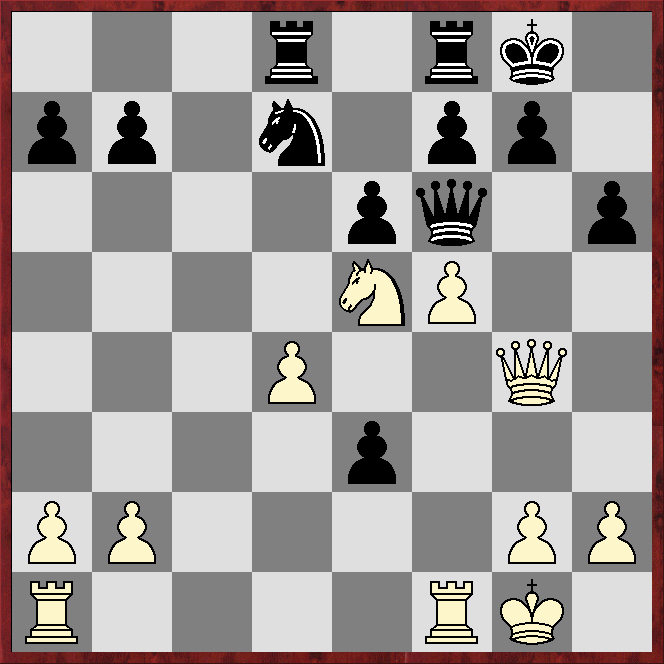
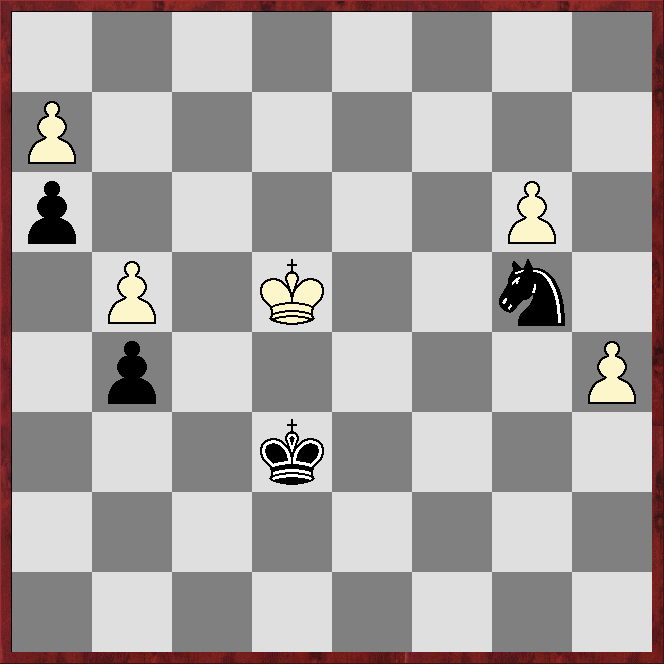
All three legal continuations win
*****
*****
*****
*****
*****
56.Kg4 Rh1 57.g6 Rb1 58.Rf7+ Ke8 59.Kg5 c5!?
This is Stockfish18's top choice, at least for a while, and Dragon1 comes to agree.
60.dxc5 d4 61.c6 Rc1 62.Rd7 Rxc6 63.g7!? Kxg7 64.g8=Q Kc7 65.Qf7+ 1-0

Monday, 6 July 2026

Magdeburg Round One

Klaus-Michael Hansch (1806) - Spanton (2039)
Veresov
1.d4 d5 2.Nc3 Nf6 3.Bg5 h6!?
Asking White: do you really want to give up the bishop-pair, and speed Black's development, for the sake of doubling pawns?
4.Bh4 c5 5.e3 e6 6.Nf3 Nc6 7.Be2 Be7 8.0-0 0-0
Now both sides have castled, how would you assess the position?
*****
*****
*****
*****
*****
The position is typical of the type that often arises in the Veresov, although this exact setup only occurs five times in ChessBase's 2026 Mega database. Stockfish18 and Dragon1 reckon Black is at least equal.
9.Re1 b6 10.Bf1!?
This retreat may be a novelty, but the engines are fine with it.
10...Bb7 11.Nb1!?
But they are not so happy about this, suggesting moves such as 11.h3, 11.Rc1!? and 11.a3.
11...Ne4!? 12.Bxe7 Qxe7 13.c3 Rad8 14.Nbd2 f5!?
This is probably OK, but Black needs to be careful about the number of black pawns accruing on light squares.
15.Bb5!
Moving this bishop for the third time, but the move is the top choice of the engines.
How should Black respond?
*****
*****
*****
*****
*****
15...Nb8!?
Avoiding a swop of bishop for knight, followed by Ne5. But the engines reckon that is no big deal, one of their lines running 15...Rc8!? 16.Bxc6 Bxc6 17.Ne5 Be8, although after 18.Nxe4 fxe4 there is a sharp divergence of opinion, with Stockfish18 giving White a slight edge, while Dragon1 prefers Black.
16.Ne5 Qh4?!
The engines reckon 16...a6!? 17.Ba4 Qc7 keeps White's advantage to a minimum.
17.Qe2
Possibly slightly stronger is the engines' 17.Nxe4 fxe4 18.Rf1!?
17...Qf6 18.f4!?
Fixing the centre. The engines also like 18.Nxe4.
18...Kh7 19.Rf1 Nd6 20.Bd3 Rg8 21.a4
The engines suggest immediate kingside play with 21.g4!? or 21.Ndf3.
21...c4!?
The engines prefer 21...g6, 21...Qe7 or 21...Nc6.
22.Bc2 a5 23.Rf3 Nf7 24.Nxf7!?
Probably stronger is increasing the pressure with 24.g4 g6 25.Rh3.
24...Qxf7 25.Rh3 Rh8 26.Nf3 Kg8 27.Ne5 Qf6
How should White proceed?
*****
*****
*****
*****
*****
28.Qh5
Even stronger is 28.g4, or preparing it with 28.Kf2 and Rg1, according to the engines.
28...Bc6 29.Nxc6?
The engines reckon this throws away almost all of White's advantage, which, according to them, would have remained substantial after, say, 29.Qe2.
29...Nxc6 30.Rg3 Ne7 31.Qe2 Kh7 32.Rh3 g6 33.Qe1 Rb8 34.Rf3 Rb7 35.Rf2 Rhb8 36.Ra2!? Ng8 37.Qe2?!
The engines reckon White should initiate queenside play with 37.b3 or 37.Qa1!?, eg 37.Qa1!? Qe7 38.b3 cxb3 39.Bxb3 Nf6 40.Bc2, albeit they give Black a slight edge.
37...h5 38.h3!?
The engines are OK with this, even though after ...
38...h4
.... White has a weak hole at g3.
39.Qf3 Rg7 40.Kh1 Nh6 41.Ra1 Rg8 42.Rg1 Kh8 43.Rgf1!? Qe7 44.Qe2 Rb8!?
Continuing to play on the kingside, eg with 44...Nf7, may well be better.
45.Bd1!? Ng8 46.Qc2 Nf6 47.Bf3 g5?!
But here the engines much prefer queenside play with 47...b5!?
48.fxg5 Rxg5 49.b3!?
The engines agree this is best.
49...Qc7 50.bxc4
How should Black recapture?
*****
*****
*****
*****
*****
50...dxc4?
This lets White open lines for White's better coordinated pieces. Instead, 50...Qxc4 51.Be2 Qc7 52.Rf4 Rc8 holds the balance, according to the engines.
51.e4 f4?
As so often happens, a mistake is immediately followed by another. However, even after, for example, 51...Re8 52.Qd2 Qg7 53.Qf4, Black is in big trouble, one line running 53...Qh6 54.exf5 exf5 55.d5, with an advantage for White worth much more than a minor piece, according to the engines.
52.e5 Nh7 53.Bg4 Rxg4!?
Desperation.
54.hxg4 Ng5 55.Qg5 Rg8 56.Qh6+ Nh7 57.Rxf4 h3!? 58.Qxh3 Qg7 59.Rf7 Qg6 60.R1f6 Qd3 61.Rxh7+!? 1-0

Saturday, 18 October 2025

4NCL

PLAYED on board two (of six) for Wessex B against Crowthorne B in Division Four of the Four Nations Chess League this afternoon.

Spanton (1889 ECF/1941 Fide) - Timothy Chapman (1648 ECF/1728 Fide)
Veresov
1.Nc3 d5 2.d4 Nf6 3.Bg5 Nbd7 4.f3!?
In many ways this is the quintessential Veresov move, but it is not liked by Stockfish17.1 or Dragon1, and is much less popular than 4.Nf3 in ChessBase's 2025 Mega database, and the latter scores two percentage points higher.
How should Black respond?
*****
*****
*****
*****
*****
4...h6
Slightly more common in Mega25 is 4...c6, while also popular are 4...c5!? and 4...e6.
5.Bh4 e6
The engines' top choice is 5...c5!?
6.e4 Be7 7.e5
Probably not 7.Bd3?! as Black has 7...Nxe4!? (the engines reckon 7...dxe4!? is also strong) 8.Bxe7 Nxc3 9.Bxd8 Nxd1 10.Bxc7 Nxb2, winning a pawn.
7...Nh7 8.Bf2
The engines reckon 8.Bxe7 Qxe7 9.f4 is even stronger.
8...c6!?
This seems new. Known moves are 8...c5, 8...0-0 and 8...a6.
9.Bd3 b6 10.f4 g6!?
The engines prefer queenside play, eg 10...c5, or castling.
11.Nf3 Bb7 12.g4 Qc7 13.f5 gxf5 14.gxf5 0-0-0!?
Now Black has castled, how would you assess the position?
*****
*****
*****
*****
*****
Black has connected rooks, but White's extra space makes for easier coordination. The engines agree White is positionally winning.
15.f6 Bb4 16.Qd2!?
The engines do not like this because it gives the black king's knight a chance to get into the game. They suggest 16.h4 or 16.Bxh7!? Rxh7 17.Rg1.
How should Black proceed?
*****
*****
*****
*****
*****
16...Bxc3
This looks tempting, but much better, according to the engines, is 16...Ng5!? 17.Nxg5 hxg5 18.Qxg5 Rdg8 19.Qf4 c5.
17.bxc3 Ng5!?
The same sacrificial idea, and again it is the engines' top choice, but they agree it is a lot less effective than on the previous move.
18.Nxg5 hxg5 19.Qxg5 Rdg8 20.Qf4 b5
Where should White's king go?
*****
*****
*****
*****
*****
21.Ke2!?
This is Stockfish17.1's top choice; Dragon1 prefers 21.Kd2!? Both engines also like 21.h4.
21...Nb6
Possibly better is 21...Qa5, when the engines suggest 22.Rag1!?, eg 22...Qxc3 23.Rg7!? Rf8 24.h4, after which the engines reckon White will decide matters on the kingside before Black can get at the white king.
22.Rag1
Now c3 can be defended by Be1, without disconnecting White's rooks.
22...Qd8
The engines suggest 22...Rf8!?, but White can start pushing the h pawn.
23.Rg7!? Qf8
Again the engines suggest ...Rf8.
24.Rhg1 Na4
Nothing appears to save Black, eg the engines' 24...Qe8!? can be met by 25.Rxg8 Rxg8 26.Rxg8 Qxg8 27.Qh6 Qg4+ (otherwise 28.Qg7, followed by Bh6-g8 and/or pushing the h pawn, wins easily) 28.Ke1 Nd7 29.Qg7 Qh5 30.Be2 etc.
25.Qg4!? Rxg7 26.fxg7 Nxc3+ 27.Kf1 1-0
Wessex B won the match 5-1.

Tuesday, 16 September 2025

Miniatures 11

IN this occasional series I am going through my decisive games of 20 moves or fewer.

J Barrett (ungraded) - Spanton (151 BCF)
Barbican (London) Rapidplay 1989
Veresov
1.d4 Nf6 2.Nc3 d5 3.Bg5 Bf5 4.f3 Nc6!?
This is Dragon1's second choice, at least for a while, behind the commonest continuation 4...Nbd7, but the text is not liked by Stockfish17.
5.e3!?
The thematic 5.e4 is, perhaps surprisingly, less popular in ChessBase's 2025 Mega database, and scores nine percentage points lower.
5...e6 6.Bd3 Be7!?
Apparently a novelty, and still not in Mega25. Known moves are 6...Bxd3, 6...Bg6 and 6...h6!?
How should White respond?
*****
*****
*****
*****
*****
7.Nge2
The engines marginally prefer capturing on f5.
7...0-0 8.g4!? Bxd3 9.Qxd3 Rc8 10.0-0-0!?
Now both sides have castled, how would you assess the game?
*****
*****
*****
*****
*****
I think these positions are very hard to judge, and are very dependant on who understands the ideas better. For what it is worth, Stockfish17 gives Black a slight edge, but Dragon1 is less sure.
10...Nb4 11.Qd2 c5 12.h4 Qa5 13.a3?!
This creates a target. Probably better is 13.Kb1.
13...Nc6 14.h5?!
In opposite-side castling, one of the trickiest decisions can be knowing when to proceed with your attack and when to react to the opponent's threats. Here the engines much prefer the latter, in the shape of 14.Kb1.
14...b5
The engines reckon even stronger is the prophylactic 14...h6, preventing White from playing 15.h6.
15.dxc5?!
Probably better is 15.h6.
15...Bxc5??
This turns a winning position, according to the engines, into a losing one. Both 15...h6 and 15...b4 are much better.
16.Bxf6??
Returning the compliment. Instead, 16.h6 leaves Black without a good answer, eg 16...b4 (16...gxh7? 17.Bxf6) 17.hxg7 Kxg7 18.Qe1! etc, or 16...Bxa3!? 17.bxa3 Qxa3+ 18.Kb1 Qb4+ 19.Ka1 Qa3+ 20.Na2, or 16...Ne5 17.hxg7 Kxg7 18.Bxf6+ Kxf6 19.Nxd5+!
16...gxf6 17.Nd4 b4 18.axb4?
Better, but still losing, is 18.Na2 bxa3 19.b3.
18...Nxd4??
An inexplicable blunder. Every capture on b4 wins, but most straightforward is 18...Qa1+ 19.Nb1 Nxb4 20.c3 Na2+ 21.Kc2 Rb8 22.b3 Rfc8 etc.
19.bxa5 20.Nxf3 Qe2 1-0
LESSON: if you play like Black did in this game, consider taking up draughts.

Sunday, 15 September 2024

Lessons From Torquay VII: Wide But Shallow v Deep But Narrow

OLD instructional books often emphasise the importance of knowing a limited opening repertoire in depth.
Frequently switching openings was regarded as a cardinal sin, and a sure bar to improvement.
Some grandmasters took this advice to extremes; Lev Alburt, for example, was (in)famous for his devotion to Alekhine's Defence.
But the advice made particular sense for club players, since nine times out of 10 an opponent would not know what you played.
In those circumstances, sticking to your tried and trusted routine was probably as much of a surprise to the opponent as playing something completely new.
The database age has changed all that, as exemplified by Magnus Carlsen, who plays a huge range of openings, including frowned-upon club favourites such as the Ponziani.
These days, having a limited opening repertoire, however deep, makes you a relatively easy target for an opponent's preparation.
In round seven at Torquay I had white against an opponent who, according to ChessBase's 2024 Mega database, almost always meets 1.e4 with 1...e5.
I opened 1.Nc3, partly hoping he would reply 1...e5, when 2.e4 transposes to double-e pawn openings, but 2.Nf3 is an interesting alternative.
Instead he played 1...d5, which is the most popular continuation.
I could have kept the game in independent lines with 2.e4!?, which is easily the top choice in Mega24, but preferred 2.d4, to which came 2...Nf6.
Popular today is 3.Bf4, the Jobava-Prié, but I played the 'traditional' 3.Bg5, ie the Veresov, to which I was pleased to see the reply 3...e6.
Objectively that is a perfectly reasonable choice, second in popularity only to 3...Nbd7, but it allowed me to continue with 4.e4, making the game a French Classical - hardly what a black double-e pawn player is likely to be looking for.
After the further moves 4...Be7 5.e5 Nfd7 6.h4!? we reached the starting point of the Alekhine-Chatard Attack.
6.h4!? is the top choice of Stockfish16.1 and Dragon1, albeit narrowly over 6.Bxe7, and scores an excellent 61% in Mega24
I cannot claim to be an expert on the variation - this was just my seventh time playing it - but I believe it to be one of those openings that, in the absence of much theoretical knowledge, is easier for the attacker to play.
As it turned out, my opponent told me after the game, which he lost on time at move 28, that he used to play the Alekhine-Chatard with white many years ago, but had forgotten the theory.
LESSON: databases mean having a narrow repertoire is a dangerous business. The player able to make best use of transpositional possibilities can place opponents at a substantial practical disadvantage.

Friday, 6 September 2024

Riviera Round Seven

Spanton (1931 ECF/1980 Fide) - Maurice Staples (1989 ECF/1967 Fide)
French Alekhine-Chatard
1.Nc3 d5 2.d4 Nf6 3.Bg5 e6 4.e4 Be7 5.e5 Nfd7 6.h4!?
How should Black respond to this popular gambit, first played by Adolf Albin in 1890?
*****
*****
*****
*****
*****
6...h6!?
This is second in popularity in ChessBase's 2024 Mega database, behind 6...a6, after which the mainline runs 7.Qg4 Bxg5 8.hxg5 c5 9.g6!? f5 10.Qf4 h6 11.Nf3, with the upper hand for White, according to Stockfish16.1 and Dragon1. The engines quite like accepting the gambit with 6...Bxg5 7.hxg5 Qxg5, but then the most popular continuation goes 8.Nh3 Qe7 9.Qg4 g6 10.0-0-0, with White getting at least enough compensation for a pawn, according to the engines.
7.Bxe7 Qxe7 8.f4!?
More popular in Mega24 is 8.Qg4, but the engines prefer the text.
8...Nb6!?
Normal is 8...a6.
9.Qg4 Kf8?!
The engines strongly dislike this, preferring 9...0-0 or 9...Rg8!?, albeit giving White the upper hand.
10.Bd3 Nc6 11.Nge2 Nb4 12.0-0-0 Bd7 13.Kb1 Nxd3
How should White recapture?
*****
*****
*****
*****
*****
14.cxd3!?
The engines slightly prefer 14.Rxd3, but I wanted to keep the remaining black knight off the c4 square.
14...f5 15.Qh5!?
The engines prefer 15.exf6, or retreating the queen to h3.
15...Be8!?
Keeping queens on, now it is possible to lock the kingside, after which the white king will become the more-threatened of the two monarchs.
16.Qf3 h5 17.Rc1 Rc8 18.g3 g6 19.Ng1!?
Heading for the g5 outpost.
19...Kg7 20.Nh3 Bd7 21.Ng5 c5!?
The engines much prefer keeping the c file half-closed, suggesting 21...a5 (both like this), or 21...Na8!? (Stockfish16.1), or 21...Na4 (Dragon1).
How should White reply?
*****
*****
*****
*****
*****
22.dxc5!
It is important not to let Black push the c pawn further, eg 22.Ne2 c4 equalises, according to the engines.
22...Rxc5
Capturing with the queen can be met, as in the game, by 23.Ne2.
23.Ne2 Rhc8 24.Qe3 Rb5?!
The engines suggest 24...Na4, but reckon both 25.Nd4 and 25.Qd2 give White at least the upper hand.
25.Rxc8 Bxc8 26.Nd4 Ra5
Not 26...Qc5? 27.Ndxe6+ etc.
27.Qd2 Ra6
Perhaps better is 27...Rc5, putting a major piece on the open file, but the engines reckon 28.Nb3 Rc6 29.Qa5 is winning.
28.Rc1 1-0 (Time)
The threat is 29.Rc7!, and if 28...Kg8 then 29.Qc3 leads to White occupying the seventh rank with deadly effect.

Thursday, 25 April 2024

Lessons From Tegernsee VII

THE following position arose in my round-seven game in which I had white against a 2068.
Black has just castled - how would you assess the position?
*****
*****
*****
*****
*****
*****
*****
*****
It arose from a Veresov, and is fairly typical of that opening in that Black has pressure on the queenside, while White seems well-placed in the centre and on the kingside.
Indeed, I felt I had promising chances against Black's king, not least thanks to Black having played ...h6.
Accordingly, having moved the white king to the corner, I continued 14.Rg1?!, but that is disliked by Stockfish16 and Komodo14.1.
They reckon Black's queenside attack is coming first, and so Stockfish16 suggests 14.Nd1, meeting 14...c5 with 15.c3.
Komodo14.1 is, if anything, even more defensive with its recommendation of 14.Rac1!?
I discussed the position later with someone who gave up the Veresov in favour of the Jobava-Prié (3.Bf4 instead of 3.Bg5).
He reckoned a main reason he gave up the former was because of the type of position I got, he having learnt by bitter experience that such positions tend to favour Black.

CONCLUSION: visually it is still not obvious to me that Black has a slight edge in the diagram, but such is the engines' verdict. Opposite-flank play is rarely easy to judge 100% correctly, but experience seems to show that in the Veresov, at least, Black is often ahead of White in terms of making an attack count.

Friday, 12 April 2024

Tegernsee Round Seven

Spanton (1886) - Detlev Schötzig (2068)
Veresov
1.d4 d5 2.Nc3 Nf6 3.Bg5 c6!?
More popular in ChessBase's 2024 Mega database are ...Bf5, ...e6 and especially ...Nbd7, but world champions Botvinnik, Karpov and Kramnik are among those who have played the text.
4.e3 Qb6 5.a3!?
Indirectly defending the b2 pawn as the black queen is trapped after 5...Qxb2?? 6.Na4.
5...Bf5 6.Bd3 Bxd3 7.Qxd3 Nbd7
Possible is 7...Qxb2!? 8.Rb1 Qxa3 as Stockfish16 and Komodo14.1 do not believe 9.Rxb7 gives White full compensation.
8.Nf3 e6
Again ...Qxb2 is possible, although this time the engines reckon White does have enough for a pawn.
9.0-0 h6 10.Bxf6!? Nxf6 11.Ne5 Rc8 12.f4 Bd6 13.Kh1!? 0-0
Now both sides have castled, how would you assess the position?
*****
*****
*****
*****
*****
Play is not particularly forcing, and there is a lot of play available, but, for what it is worth, the engines agree Black has a slight edge, or at least the better side of equality.
14.Rg1?!
Hoping to open lines on the kingside, but the plan is probably too slow. Among moves liked by the engines is 14.Nd1!?, the idea being to solidify the queenside with c3.
14...c5 15.Na4 Qa5 16.Nxc5 Bxc5 17.b4?
Black is only slightly better, according to the engines, after 17.dxc5 Qxc5 18.c3.
17...Bxb4 18.axb4 Qxb4
Even stronger is the engines' 18...Ne4!, eg 19.Qxe4 Qxa1 or 19.Rgf1 Nf2+. Best may be 19.Qe2, but after 19...Qxb4 Black can meet 20.Rxa7 with 20...Qb2.
19.Rxa7?
I originally intended the correct 19.Rgb1, but then I saw 19...Qc3, missing that 20.Rxa7 Qxc2 21.Qxc2 Rxc2 22.h3 is fine for White. However 19...Qe7 20.Rxa7 Ne4 21.Kg1 Nd6 gives Black the upper hand, according to the engines, presumably because c2 is weaker than b7, especially with White having the additional weakness of e3.
19...Ne4 20.Rf1 Qb2 21.Qb3
There is nothing better.
21...Rxc2 22.Qxb2
Not 22.Qxb7?? Nf2+ (the immediate 22...Rc1 23.Qa6 Nd2 also wins) 23.Kg1 Nh3+! 24.Kh1 Rc1 etc.
22...Rxb2 23.Rc1 g5?!
Black still has at least the upper hand after this, but calmer moves, eg 23...Nd6, were probably better.
24.fxg5 hxg5 25.h3!?
Perhaps 25.Kg1 is better.
25...Ng3+ 26.Kh2 Nf5 27.Ng4 Nh4 28.Rc7!?
The engines agree this is the best chance.
28...Rxg2+ 29.Kh1 Re2 30.Raxb7 Nf5 31.Rc3?
Better is 31.Kg1, meeting 31...Ra8 with 32.Ra7. However 32...Rxa7 33.Rxa7 Nxe3 34.Nh6 Kg7 35.Nxf7 Kf6 is winning, according to the engines.
31...Ra8 32.Rb1 Ng3+ 33.Raa2 0-1

Sunday, 10 December 2023

Benidorm U2000 Round Seven

FACED an Indian junior (born 2009).

Spanton (1743) - Pridhish Kumar (1241)
French Burn
1.Nc3 d5 2.d4 Nf6 3.Bg5 e6 4.e4 dxe4
Via an unconventional move-order the game has reached the starting point of the Burn Variation of the French Defence.
There are 15,256 examples of this position in ChessBase's 2024 Mega database
*****
*****
*****
*****
*****
5.Nxe4 Be7 6.Bxf6!?
Giving up the bishop-pair is slightly anti-intuitive, but is easily the most popular continuation in Mega24.
6...Bxf6 7.Nf3
White argues that the well-placed knight on e4, and an advantage in central space, outweigh Black's bishops.
7...Nd7 8.Qd2 0-0 9.Bd3 Qe7!?
This is a slightly awkward placing for the queen as it obstructs the black dark-square bishop. Stockfish16 and Komodo14.1 like the relatively rare 9...e5!?
10.g4!?
Stockfish16 suggests castling long; Komodo14.1 suggests castling short.
10...g6 11.Nxf6+ Qxf6 12.Be4
The engines give White a slight edge after 12.Qe3.
12...e5 13.g5 Qd6 14.0-0-0 exd4 15.Nxd4
Now both sides have castled, and the centre has been cleared of pawns, how would you assess the position?
*****
*****
*****
*****
*****
White is ahead on development, and Black has weak kingside dark squares. But it is not clear White can exploit these, and meanwhile White's kingside pawns are ragged. The engines reckon the position is equal.
15...Nc5 16.Bg2 c6?!
This may be too slow. The engines prefer 16...Bg4.
17.h4!?
White's attack will turn out to be less threatening than it may look. Instead White would get an initiative after the engines' 17.Qe3.
17...Bg4 18.f3 Bh5!?
The engines are happy with this side-lining of the bishop.
19.Ne2 Qxd2+ 20.Rxd2 Rfd8 21.Rhd1 Rxd2 22.Rxd2 Re8 23.Ng3 Rd1+ 24.Rd1 Rxd1+ 25.Kxd1
Very quickly the game has reached a minor-piece ending that the engines reckon slightly favours White
*****
*****
*****
*****
*****
25...Ne6 26.Nxh5?!
Almost certainly a positional misjudgment, as will be seen. The engines give 26.Kd2 with a slight edge for White.
26...gxh5
Black's kingside pawns are smashed, but White cannot save the h4 pawn.
27.Bh3 Nf4 28.Bc8 b6 29.Bb7 c5 30.Kd2 Ng6 31.Ke3 Nxh4 32.f4?!
This probably makes matters worse by creating another target for the black knight. Better is 32.Ke4.
32...Nf5+ 33.Kf2
Not 33.Ke4?? Nd6+ etc.
33...Kg7 34.Be4 Nd6 35.Bf3 Kg6 36.Be2 h6
Undoubling the black h pawns. Black is winning (Stockfish16) or at least has the upper hand (Komodo14.1).
37.Bd3+ Kg7 38.b3?!
Probably better is capturing on h6 as a white pawn on f4 will be easier to defend than one on g5.
38...hxg5 39.fxg5 f6
A simple solution to clearing a path for the black king. White is more-or-less forced to exchange.
40.gxf6+ Kxf6 41.Kf3 Kg5 42.c3 Nf5 43.a3 Nd6 44.b4 c4 45.Bf1 Nb5!?
The engines prefer 45...Kf5 or 45...h4.
46.Bxc4 Nxc3 47.Kg3 Ne4+ 48.Kg2
Not 48.Kf3?? Nd2+ etc.
48...Kf4 49.Be2 Nf6 50.a4 Ke3?
Komodo14.1 quite likes this, although it seems to throw away the win; both engines prefer 50...Nd5.
51.Bf1 Nd5 52.a5 Nxb4 53.axb6 axb6
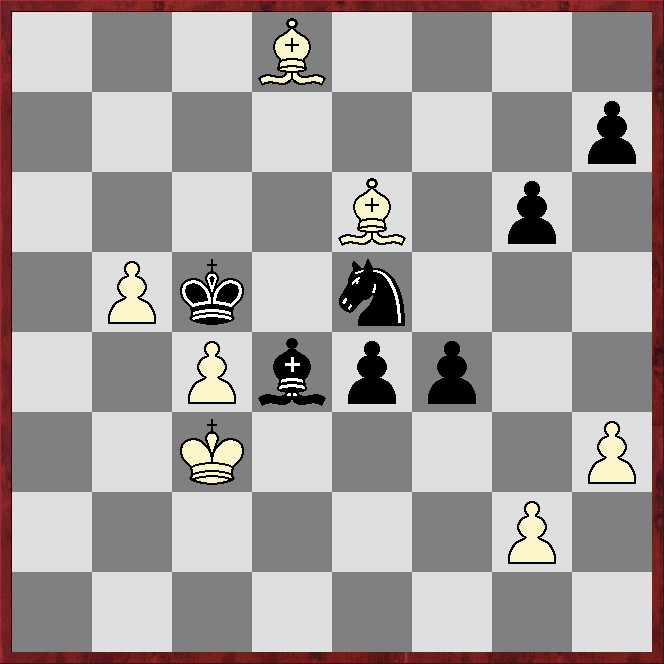
Is Black winning?
*****
*****
*****
*****
*****
Yes, says Komodo14.1; no, says Stockfish16. More importantly, Syzygy, the endgame tablebase, shows the position is drawn.
54.Kg3 Nd5 55.Kh4 Nf6 56.Bb5 Kf4 57.Bd3 Ke5 58.Bc4 Kd4 59.Bf1 Nd5 60.Kxh5 Nf4+ 61.Kg5 Nd3 62.Bh3 b5 63.Be6 b4 64.Kf5 Ne5 65.Ba2 Nc4 66.Ke6 Kc5 67.Kf5 Kd4 68.Ke6 Kc3 69.Kd5 Na3 70.Kc5 Nc2 71.Bg8
PK played on to move 84, but then conceded the draw

Thursday, 24 August 2023

Northumbria Round One

FACED a teen (born 2004).

Spanton (1858 Fide/1919 ECF) - Owen Crawford (no Fide/1740 ECF)
Veresov
1.Nc3 Nf6 2.d4 d5 3.Bg5 g6!?
This is only the seventh commonest continuation in ChessBase's 2023 Mega database, which is slightly surprising when one considers how popular kingside fianchetto systems are against 1.d4.
4.Qd2 Bg7 5.Bh6 Bxh6 6.Qxh6 c5 7.dxc5!? Qa5 8.0-0-0!? Qxc5 9.e3
How should Black proceed?
*****
*****
*****
*****
*****
9...a6!?
This apparent novelty - known moves are 9...Nc6 and 9...Bg4 - is the top choice of Stockfish16 and Komodo14.1.
10.Nf3 Bg4 11.Be2 Nbd7 12.h3 Bxf3 13.Bxf3 Rc8?
Over optimistic. The obvious 13...e6 is better, as is 13...Nb6,
How should White continue?
*****
*****
*****
*****
*****
14.Rd2?
Naturally not 14.Nxd5?? Qxc2#, but 14.Bxd5 safely wins a pawn. I rejected it because of 14...b5, missing that 15.Rd2, among other moves, is fine as 15...b4?! can be met by either 16.Ne4 or 16.Na4.
14...Qa5 15.Kb1 Ne5
What should White play?
*****
*****
*****
*****
*****
16.Rhd1?
This would have been the best reply to 15...Nc5?, but here it is disastrous. The engines reckon the game is equal after both 16.Rd4 and 16.Rxd5!?
How can Black punish White's error?
*****
*****
*****
*****
*****
16...Rxc3!
This is winning, according to the engines.
17.Rxd5!
The best try. After 17.Bxd5 Rc8 Black is piece-for-pawn up.
17...Nxd5?
The simple 17...Rc5 is much better. White can keep the game going with either 18.Rd8+!? Qxd8 19.Rxd8+ Kxd8 20.Bxb7, or 18.Rxc5 Qxc5 19.Bxb7, but in both cases Black's material advantage should tell.
18.Bxd5?
After 18.Qg7 Rf8 19.Qxe5 Rc8 20.Rxd5 White is the exchange down, but has a pawn and superior coordination.
18...Rd3!?
This may be better - the engines disagree - than the simple 18...Rc5.
19.cxd3 Qxd5
Black has emerged from the complications up a knight for a pawn, and White is doomed once the black rook gets into play
*****
*****
*****
*****
*****
20.Qg7 Rf8 21.e4
No improvement is 21.Qxh7 Qxg2.
21...Qb5 22.f4 Nc6 23.Qc3 Qa4 24.Rc1 Kd7 25.Qg7 Rc8!
White has found a way to quickly get the rook into play.
26.Qxf7
This sets up a beautiful finish, but White was lost anyway.
Black to play and finish in style
*****
*****
*****
*****
*****
26...Nb4! 27.Rxc8 Qd1+ 28.Rc1 Qd3+ 29.Ka1 Nc2+ 0-1

Friday, 18 August 2023

Olomouc 65+ Round Eight

FACED a Czech today.

Spanton (1858) - Alois Bartoš (1884)
Veresov
1.d4 Nf6 2.Nc3 d5 4.Bg5 c5 5.e4!?
This aggressive continuation is nowhere near as popular as 5.e3 and especially 5.Bxf6, but dates back to at least a 1934 game of Kurt Richter, after whom the opening is sometimes named.
4...Nxe4 5.Nxe4 dxe4 6.dxc5!?
Strong players have tended to prefer 6.d5, in Albin Countergambit-style, but Stockfish16 and Komodo14.1 like the text.
6...Qa5+ 7.Qd2 Qxd2+!?
The engines slightly prefer this to grabbing a pawn with 7...Qxc5, when they reckon White has sufficient compensation.
8.Bxd2 e5 9.b4  10.c3 Bf5
The engines prefer 10...Nc6 or 10...Be6, apparently wanting to leave the f5 square for the black f pawn.
11.Ne2
And they dislike this because Black can reply 11...Be6, meeting 12.Ng3 with 12...f5, so instead they suggest 11.Bc4.
11...Be7 12.Ng3 Bg6 13.Bb5+ Nc6 14.0-0 0-0
With both sides castled, how would you assess the position?
*****
*****
*****
*****
*****
Material is level, both sides have doubled pawns and both sides have a pawn-majority with two extra pawns (4-2 on the queenside for White; 5-3 on the kingside for Black). The engines reckon the position is equal.
15.Rfd1 Rfd8 16.Bc4?!
Probably better is 16.a4.
16...Rd7
The engines point out Black can get rid of his doubled pawns with 16...e3!, one point being 17.fxe3? runs into 17...Bc2 or, possibly even better, 17...axb4 18.cxb4 Bc2. White can play 17.Bxe3, but 17...axb4 18.cxb4 Nxb4 favours Black, or 17.Be1, but then 17...exf2+ 18.Kxf2 axb4 19.cxb4 Nd4 gives Black at least a slight edge, according to the engines.
17.Be1 Rad8 18.Rxd7 Rxd7 19.Bb5 Kf8 20.Ba4 Rd8 21.Rd1 Raxd1 22.Bxd1 Ke8
How should White proceed?
*****
*****
*****
*****
*****
23.b5?!
A little combination to undouble White's c pawns, but it frees Black's game, and at the end of the combination Black gets rid of his doubled pawns. Almost certainly better is 23.Bg4.
23...Nb8 24.c4 Bxc5 25.Bxa5 e3 26.fxe3 Bxe3 27.Kf1 Kd7?!
Black should probably bring the knight back into play with 27...Nd7.
28.Bg4+ Kd6
The engines prefer retreating with 28...Ke7!?
What should White play?
*****
*****
*****
*****
*****
29.Nf5+
This wins the bishop-pair, but the engines much prefer 29.Bf5!?, when 29...Bxf5?? loses a piece to 30.Nxf5+, and 29...Kc5?? loses a piece to 30.Bc7. Best, according to Stockfish16, is 29...b6 30.Bb4+ Bc5. Komodo14.1 also likes that line, and 30.Ne4+. In both cases White has an initiative, while after ...
29...Bxf5 30.Bxf5 g6 31.Bd3 Nd7
... Black's strong king seems to compensate for the bishop-pair.
32.Ke2 Bg1 33.h3 Kc5 34.a3 f5 35.Kd2 e5 36.Be2 b6 37.Bb4+ Kd4 38.a4 f4 39.a5 bxa5 40.Bxa5 Kc5 41.Kc3 Bf2 42.Bb4+ Kb6 43.Be7 Be3 44.Bg5 Kc5 45.Bg4 Ne5 46.Be7+ Kb6 47.Bd8+ Kc5 48.Be6 Bd4+
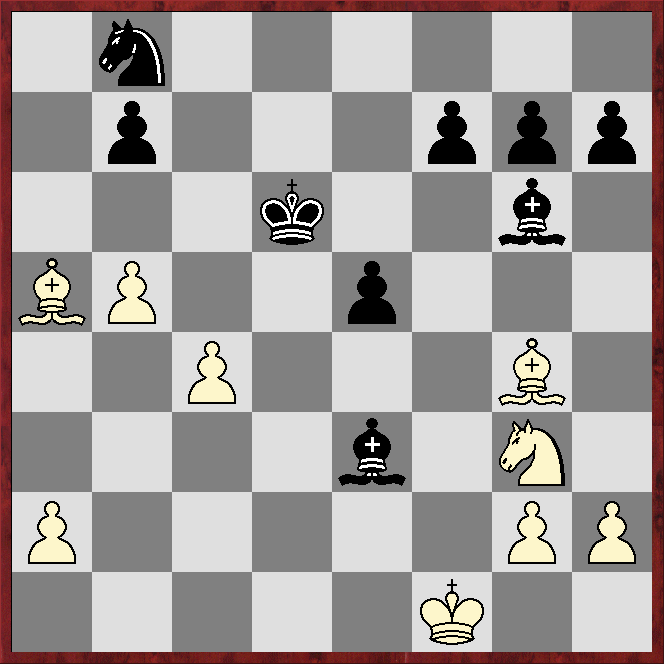
How should White continue?
*****
*****
*****
*****
*****
49.Kd2?
Drawing is 49.Kb3, and possibly 49.Kc2!?, as I will explain later.
49...Nxc4+ 50.Bxc4 Kxc4 51.b6 Kb5
If the white king were on c2 instead of d2, White could play 52.Bc7, winning the f pawn with good drawing chances (Stockfish16 reckons the position is equal, although Komodo14.1's evaluation of the upper hand for Black may be nearer the mark, at least in practical play).
52.b7
If 52.Bc7? then 52...Be3+ followed by 53...Kc6 wins.
52...Be5 53.Bf6 Bb8 54.Kc3 Kc6
The engines' 54...Kc5!? is probably even stronger, eg 55.Bg5 Be5+ 56.Kd2 Kc6 etc.
55.Kd4 e3 56.Kd3 Kxb7 57.g3 fxg3 58.Kxe3 Kc6 59.Kf3 Kd5 60.Bh4 Ke6 61.Bxg3?
The pawn-ending is trivially lost. Komodo14.1 reckons Black is also winning if the bishops stay on, but Stockfish16 reckons in that case Black only has a slight edge. What suggests it may indeed be drawn is that the engines' evaluations are exactly the same after most White moves, eg 61.Kg2, 61.Bd8 and 61.Bg5 (+2.2 for Black, according to Komodo14.1; +0.75, according to Stockfish16), which is often the sign of a position where a material advantage cannot be converted into a win with best play.
61...Bxg3 62.Kxg3 Kf5
Also winning is 62...Ke5, but pushing either pawn would only draw (Syzygy endgame tablebase).
63.h4 h6 64.Kf3 h5 65.Kg3 Ke4 0-1

Tuesday, 8 August 2023

Olomouc Highlights III

IT was in the last round of the 2014 Olomouc open that I first played Jiří Navrátil (the one born in 1966, that is - Fide has three other players with the same name).

Spanton (1976) - Navrátil (2087)
Veresov/Liberated Bishop
1.d4 d5 2.Nc3 Bf5 3.Bg4!?
With the black light-square bishop on f5, it probably makes sense to go after it with 3.f3, or go for a Jobava-Prié setup with 3.Bf4.
3...c6!?
This is the most popular move in ChessBase's 2023 Mega database, with 134 examples, ahead of the 116 examples of 3...h6. Perhaps surprisingly there are only 25 games with 3...f6.
4.e3 Nd7 5.Nf3 Ngf6 6.Bd3 Bg6 7.0-0
Kurt Richter, after whom the Veresov Opening is often also named, played 7.Qe2 in a game at the 1930 Olympiad.. But if he was thinking of castling long, he thought better of it after 7...Qb6, preferring 8.Rb1 Bh5 9.0-0.
7...e6 8.Ne5 Be7
How should White proceed?
*****
*****
*****
*****
*****
9.Nxg6!?
White gains the bishop-pair, but castling kingside and then half-opening the h file for the black king's rook is risky.
9...hxg6 10.Bf4!?
Stockfish16 and Komodo14.1 do not like this, although they do not agree on what White should play.
10...Nb6 11.a4 Bd6 12.Qf3 Qc7 13.Rfe1 a5 14.Ne2 0-0-0!?
Now the players have castled on opposite sides, how would you assess the middlegame?
*****
*****
*****
*****
*****
Neither king is immediately endangered, but neither is completely safe. Meanwhile White's bishop-pair is unlikely to be a factor, and is unlikely to exist much longer. The engines reckon the position is equal.
15.c3 g5 16.Bxd6 Qxd6 17.Qg3 Qxg3 ½–½
A strange time for a higher-rated player to be offering a draw, but perhaps it had something to do with this being the last round.

Two years later we again met in the Olomouc open, this time in the fifth round.
Spanton (1923) - Navrátil (2056)
Caro-Kann Classical
1.d4 d5 2.Nc3
Presumably I was satisfied with how the opening went in our previous game, but now JN varies.
2...c6!? 3.e4
I am fairly sure I knew my opponent normally met 1.e4 by playing the Sicilian, so it seemed sensible to switch to an e-pawn opening, namely the Caro-Kann, with which he might well be unfamiliar.
3...dxe4 4.Nxe4 Bf5
JN offered a draw, perhaps confirming my hope he was on unfamiliar ground.
5.Ng3 Bg6 6.Nf3 e6!?
The main continuation is 6...Nd7, but the text is also popular.
7.Ne5 Nd7 8.Nxg6
Winning the bishop-pair, much as in our previous encounter, but with a big difference - I have not castled.
8...hxg6 9.Bd3 Ngf6 10.c3 Qc7 11.Qf3 Bd6 12.Bg5
My notes show a game on an adjacent board reached the same position, but continued 12.h3.
What should Black play?
*****
*****
*****
*****
*****
12...Nh5!?
The engines strongly dislike this, preferring 12...c5, 12...Qb6 or 12...e5!?
13.Ne4 Be7!? 14.Bxe7 Kxe7 15.g3
More-or-less ensuring the black king's knight will have to spend a tempo going back to f6.
15...Qa5!? 16.h4 Qd5 17.0-0-0!?
Can Black safely grab the a2 pawn?
*****
*****
*****
*****
*****
17...Nhf6
This is the engines' second choice, behind 17...Qxa2!?, although after the latter is executed on the screen their evaluations fluctuate quite a bit. One line runs 18.Ng5 Nhf6 19.Rhe1 Rhe8 20.Kc2 Kf8 21.Ne4, when White has full compensation for a pawn, according to the engines.
18.Rhe1!?
Renewing the offer, but the engines reckon White is at least slightly better after 18.Kb1.
18...Nxe4
The engines again prefer immediately capturing the a2 pawn.
19.Bxe4 Qxa2 20.d5!? cxd5 21.Bxd5
The engines reckon Black has only one good continuation
*****
*****
*****
*****
*****
21...Qa5?
This is the worst of the four plausible queen moves, according to the engines. They give 21...Qa1+ 22.Kc2 Qa4+ 23.Kb1, after which they reckon White has a slight edge.
22.Bxb7
Missing 22.Bxe6!! fxe6 23.Rxd7+! Kxd7 24.Qcb7+ with a winning attack, eg 24...Kd6 25.Rd1+ Ke5 26.Qxg7+ Kf5 27.g4+ Kf4 28.Qd4+ Kf3 29.Qd3+ Kxg4 30.Rg1+ Kf4 31.Qd4+ Kf5 32.Rg5#.
22...Rad8 23.Qg4?
The engines reckon White may be slightly better after 23.Qc6.
23...Ne5?
Black is much better after 23...Rb8 as, if the bishop moves, Black has 24...Qa1+ followed by capturing on b2. If 24.Qf3, then 24...Nc5 wins. Perhaps best is the engines' 24.Qd4!? Rxb7 25.Rxe6+ fxe6 26.Qxg7+ Ke8! 27.Qxh8+, but after 27...Nf8 White does not have enough for a knight.
24.Qd4 Rxd1+ 25.Rxd1 Rd8 26.Rxd8 Kxd8 27.Qd4+ Ke7 28.f4 Nd7 29.Bc6 Nf6
How would you assess this ending?
*****
*****
*****
*****
*****
It is fairly well-known that queen and knight often make a better partnership than queen and bishop, but here the most important factor may be that neither king is very safe. Meanwhile White has a protected passed pawn, although it is unlikely to move far, if at all, while queens remain on the board. The engines reckon the position is equal.
30.g4!? Qb6!?
Both the text and 30...Nxg4 31.Qd7+ Kf6 32.Qd4+ are completely equal, according to the engines.
31.Qxb6 axb6
Is the position really still completely equal?
*****
*****
*****
*****
*****
It seems so, or at least the engines reckon it is. Ture, White no longer has a passed pawn, but rival pawn-majorities nearly always favour a bishop over a knight, and I cannot see why that is not the case here.
32.Bf3 Kd6 33.Kd2 Nd5!?
This is Stockfish16's top choice. Komodo14.1 at first condemns the move, but comes to agree the position remains completely equal.
34.Bxd5 Kxd5
Komodo14.1 prefers 34...exd5!?, but Stockfish16 reckons both moves keep the game level.
35.Kd3 e5 36.c4+ Kd6 37.fxe5+ Kxe5 38.b4
Black to play and draw
*****
*****
*****
*****
38...f6?
It seems Black had four drawing moves: 38...f5, 38...Ke6, 38...Kd6 and 38...Kf6. I expected 38...f5, eg 39.gxf5 gxf5, after which the two pawn-majorities cancel out each other.
White to play and win
*****
*****
*****
*****
*****
39.Ke3
It is that simple.
39...Ke6
After 39...f5 40.gxf5 gxf5 White wins with 41.h5!, eg 41...f4+ 42.Kf3 Kd4 43.Kxf4 Kxc4 44.Kg5 Kxb4 45.Kg6 Ka3 46.Kxg7 b5 47.h6, after which White gets a winning queen-v-pawn ending.
40.Kf4 Kd6 41.h5 f5
Or 41...gxh5 42.gxh5 Ke6 43.c5 etc.
42.hxg6 fxg4 43.Kxg4 Ke5 44.c5 bxc5 45.bxc5 1-0

The following year we met in round five of another CzechTour event, the Highlands Open in Třebíč, but with colours reversed..
Navrátil (2013) - Spanton (1858)
London System
1.d4 d5 2.Nf3 e6 3.c3!?
This may simply have been to get me out of book, but it has been played by grandmasters - indeed there are 1,123 examples of the move in Mega23.
3...Nc6!?
This scores just 28% in Mega23.
4.Bf4 Bd6 5.e3!?
This is the engines' top choice.
5...Nf6
The game has transposed to a position occurring 224 times in Mega23.
6.Nbd2 Nh5!?
This was probably a novelty, and apparently has not been repeated since - at least this game is the only example in Mega23.
7.g3!? Nxf4 8.exf4!? Qe7 9.Bd3 f6 10.Qe2 e5 11.fxe5 fxe5 12.Bb5?!
White should probably continue exchanging on e5.
12...e4 13.Nh4 0-0 14.0-0-0!?
Now both sides have castled, how would you assess the position?
*****
*****
*****
*****
*****
Positions with opposite-side castling are nearly always hard to judge as so much can hinge on a tempo gained or lost, but perhaps the most important factor is coming up with the right plan and executing it correctly. For what it is worth, the engines reckon Black is much better.
14...a6 15.Bxc6?!
Now Black gets a half-open file to White's king. The engines prefer 15.Ba4.
15...bxc6 16.Ng2
After making this move, JN pressed his clock and offered a draw.
16...a5 17.Ne1 Ba6 18.Qe3 Rab8 19.f3?
This allows a quick finish, but the engines reckon White is positionally lost anyway.
19...Ba3! 20.Nb1
Or 20.Nb3 a4 etc.
20...Rxb2!? 21.Nxa3 Qxa3 0-1

Thursday, 8 June 2023

Championship Chess

PLAYED on Tuesday evening in the Battersea club championship.

Spanton (1959) - Hugo Bassa (1704)
Veresov
1.Nc3 d5 2.d4 Nf6 3.Bg5 Bf5
More popular are 3...e6 and especially 3...Nbd7, but taking the chance to develop the light-square bishop outside the pawn-chain makes a lot of sense. Nevertheless Black's 48% score in ChessBase's 2023 Mega database with the text is two percentage points lower than with 3...Nbd7, albeit eight percentage points higher than with 3...e6.
4.e3
The mainline in Mega23 runs 4.f3 Nbd7 5.Nxd5!? Nxd5 6.e4 h6!? 7.Bh4 Ne3!? 8.Qd3 Nxf1 9.exf5 Nxh2 10.Rxh2 with the upper hand for White, according to Stockfish15.1 and Komodo14.1. However the engines reckon Black at least equalises with the little-played 7...N7f6!?
4...e6 5.Bd3 Bg6 6.Nf3 Nbd7 7.0-0 Be7 8.Ne5?!
Perhaps 8.Re1 is better. The problem with the text is that after ...
8...Nxe5 9.dxe5 Nd7
... White has nothing better than:
10.Bxe7 Qxe7 11.f4
White has more kingside space, but an awkward pawn-structure - the engines reckon Black is slightly better
*****
*****
*****
*****
*****
11...Bxd3?!
But this apparent-novelty improves the white structure and allows White a useful half-open c file.
12.cxd3 f5?! 13.exf6?!
White has the upper hand after 13.Nb5.
13...Nxf6 14.Qf3 0-0-0 15.Rac1 Kb8 16.Rf2?!
This is probably too slow, allowing Black a central initiative. The engines suggest 16.d4.
16...e5 17.Rfc2 Rhe8 18.d4 exf4 19.exf4 Qe3+ 20.Qxe3 Rxe3 21.Re2 Rxe2 22.Nxe2 Re8 23.Rc2 c6 24.h3 h5 25.Kf2 Kc7 26.Kf3 h4!?
White's kingside majority cannot easily be mobilised, but the black h pawn may prove a weakness
*****
*****
*****
*****
*****
27.Nc3 Kd6 28.Re2 Rxe2 29.Nxe2 c5 30.Ke3 cxd4+?
The game is completely equal after 50...Ne4 or 50...Nh5, according to the engines.
31.Nxd4 Kc5!?
This allows ...Ne6+, but leaving the king on d6 allows ...Nf5+ (and the inferior ...Nb5+).
32.Ne6+ Kc4 33.b3+??
This turns a probable win into a definite loss. Correct is 33.Nxg7, eg 33...d4+ 34.Kd2 Ne4+ 35.Kd1 etc.
33...Kc3 34.f5 b6 35.Nd4 a5 36.Ne6?!
Not much of an improvement is 36.Nb5+ Kb2.
36...Kb2 37.Nxg7 Kxa2 38.Ne6 Kxb3 39.Kd4 a4 40.Nc7 a3 41.Nxd5 a2 42.Ke5 a1=Q+ 43.Ke6 Nxd5 0-1

Sunday, 1 January 2023

Dama Negra Game Three

Spanton (1895) - Miguel Fernández Pérez (1186*)
Veresov
1.d4 d5 2.Nc3 Nf6 3.Bg5 Bf5
When Black develops the queen's bishop this way in double-d pawn games, a frequently recommended antidote is to attack the centre with c4, Nc3 and Qb3, but White's 2.Nc3 in the Veresov rules that out.
4.e3 e6 5.Bd3 Bg6 6.Nf3 Be7 7.Ne5!? Bxd3 8.cxd3!? h6
The text may be a novelty. Kurt Richter - Enrique Reinhardt, Telephone Team Match Berlin-Hamburg 1937, went 8...0-0 9.0-0 Nfd7!? 10.Bf4!? Nxe5 11.dxe5!? with a slight edge for Black, according to Stockfish15 and Komodo13.02 (but 1-0, 36 moves).
9.Bh4 Nbd7 10.0-0 0-0 11.f4 c5 12.dxc5 Nxc5 13.f5?!
This is probably overstretch.
How should Black respond?
*****
*****
*****
*****
*****
13...d4
An awkward move to meet since 14.exd4?? Qxd4+ forks the white king, king's knight and queen's bishop.
14.Ne4?
Best seems to be 14.Nb5, eg 14...exf5 15.Nxd4 Nd5 16.Bf2 g6, when the engines reckon Black may have a slight edge.
14...dxe3 15.Bxf6?!
Probably better is 15.Nxc5, although 15...Qd4!? looks a good reply, eg 16.Qe2 Qxe5 17.Bxf6 Bxf6 18.Nd7 Qxb2 19.Rae1 Rfe8 20.fxe6 Qxe2 21.Nxf6+ gxf6 22.exf7+ Kxf7 23.Rxe2 - a complicated line, but it leaves Black with a large advantage, according to the engines.
15...Bxf6 16.Nxf6+ Qxf6 17.d4 Rad8 18.Qg4 Nd7!?
Possibly even stronger is the simple 18...e2 19.Qxe2 Rxd4.
Can you find a promising combination for White?
*****
*****
*****
*****
*****
19.Nxf7?
Like many promising combinations, this works in all lines but one. Probably best is 19.Nxd7 Rxd7 20.fxe6 Qxe6 21.Qxe6 fxe6 22.Rae1 Rxf1+ 23.Kxf1 Rxd4 24.Rxe3, with Black emerging up a passed pawn, but in a rook-and-pawn ending.
19...h5
Immediately capturing the knight is met by capturing on e6, but this intermezzo wins for Black.
20.Qe4
There is nothing better. but now ...
20...Qxf7 21.fxe6
.... can be met by the pinning:
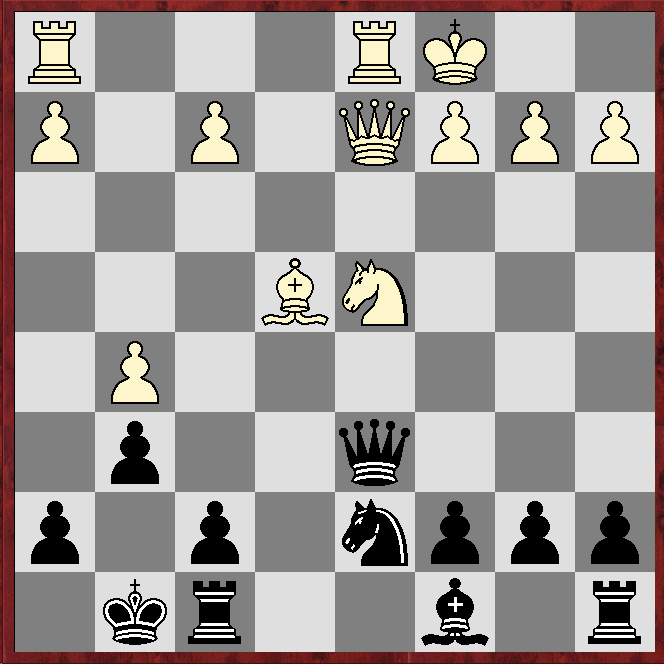
21...Qe7
After ...
22.Qxe3
... White, at least temporarily, has two pawns for a knight, but Black is winning, according to the engines.
22...Rxf1+!?
Black wants to immediately go after one of the passed white pawns, but this develops the white queen's rook for free.
23.Rxf1 Nf8?!
Not the best, according to the engines, who like the calmer 23...Nf6.
24.Rf7?!
Tempting, but inferior to 24.Rf5 and to 24.h3!?, according to the engines.
24...Qd6 25.Rxb7 Nxe6 26.Rxa7 Nxd4
White still has two pawns for a knight, but the pawns are a long way from queening
*****
*****
*****
*****
*****
27.Qe7?
This allows a mating sequence, although Black is also winning after the engines' 28.Re7.
27...Qxe7?
Black wins quickly with 27...Ne2+, eg 28.Kf2 Qf4+! 29.Ke1 (29.Kxe2? Rd2+ 30.Ke1 Qf2#) Qd2+ 30.Kf1 Ng3+! 31.hxg3 Qd1+ 32.Kf2 (32.Qe1 Rf8+ etc) Rd2+ 33.Ke3 Re2+ - quite a long variation, but most of the moves are forcing.
28.Rxe7 Kf8 29.Rb7 Nc6 30.a4 Rd4?!
Probably the wrong idea. The usual rule-of-thumb, that rooks belong behind passed pawns, seems to hold true, so 30...Rd1+ 31.Kf2 Ra1 gives White the upper hand, according to the engines.
31.b3 Rb4?!
After the coming exchange of rooks, Black's material advantage in pieces goes, using traditional values, from 8:5 to 3:0. That is a massive jump in terms of ratio, but a knight is hard pressed to deal with flank pawns, so Black should probably keep rooks on.
32.Rxb4 Nxb4 33.Kf2 g5 34.Ke3 Ke7 35.Kd4 Kd6 36.Ke4 Ke6 37.a5 h4 38.g3!?
Komodo13.02 prefers 38.h3, but Stockfish15 is happy enough with the text.
38...h3
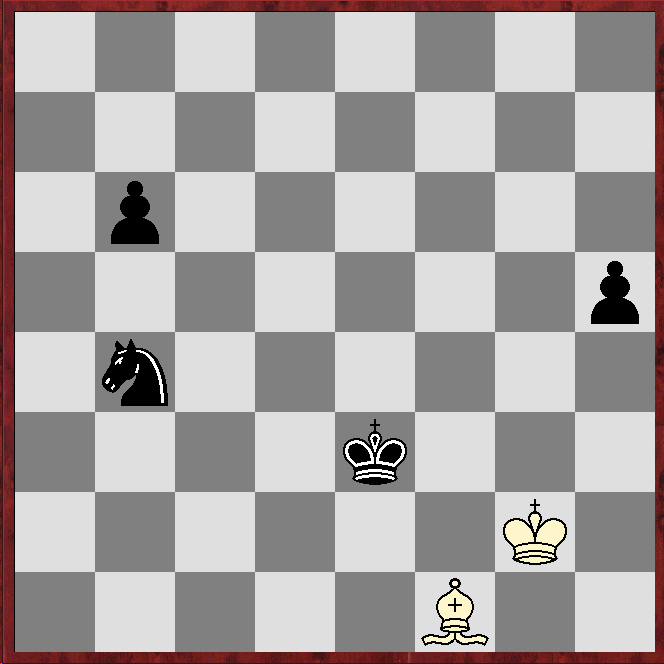
How should White proceed?
*****
*****
*****
*****
*****
39.g4?
This loses, as does 39.Kd4?, but both 39.Ke3 and 39.Kf3 draw, eg 39.Ke3 Kf5 40.Kd2!? (40.Kd4!? also draws, according to the engines, but 40.Kf3? loses to 40...g4+)  Ke4 41.Kc3 Nc6 42.a6 Kf3 43.b4 Na7 44.Kc4 Kg2 45.b5 Nc8! (45...Kxh2 loses) 46.Kc5 Kxh2 47.b6 Nxb6 48.Kxb6 Kg1 49.a7 h2 50.a8=Q h1=Q 51.Qa1+, after which the black king cannot escape being checked.
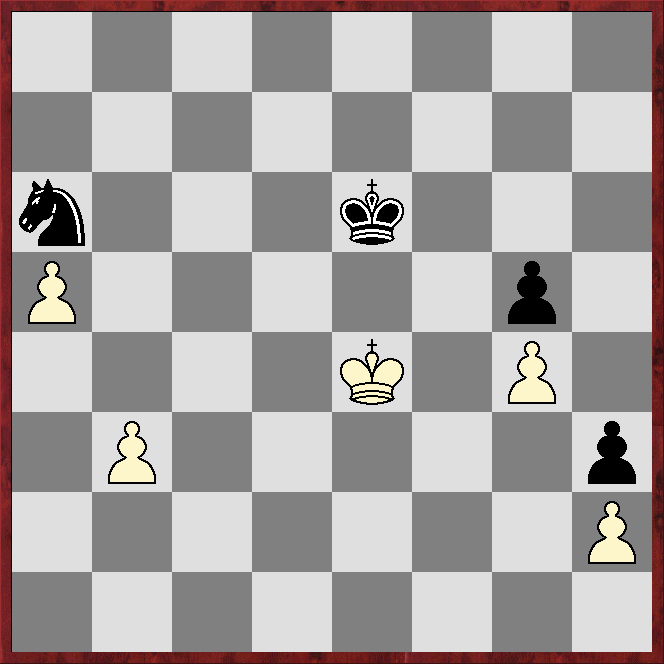
Black to play and win
*****
*****
*****
*****
*****
39...Na6
White is in zugzwang after 39...Kf6!, ie 40.Kd4 Nc6+ and 41...Nxa5, or 40.Ke3 Ke5 etc.
White to play and draw
*****
*****
*****
*****
*****
40.Kf3?
This loses by a tempo, whereas 40.Kd4 and 40.Kd3 draw, eg 40.Kd4 Kd6 (40...Nb4? 41.Kc5 wins for White) 41.Ke4.
40...Ke5 41.Kg3
If 41.Ke3, then 41...Nb4 wins.
41...Ke4 42.Kxh3 Kf3 43.b4 Nxb4 44.a6 Nd5 0-1
*Spanish rating.