Showing posts with label French Alekhine-Chatard. Show all posts

Sunday, 31 May 2026

Bad Neuenahr Round Five

Spanton (1911) - Harald Hiby (1857)
French Alekhine-Chatard
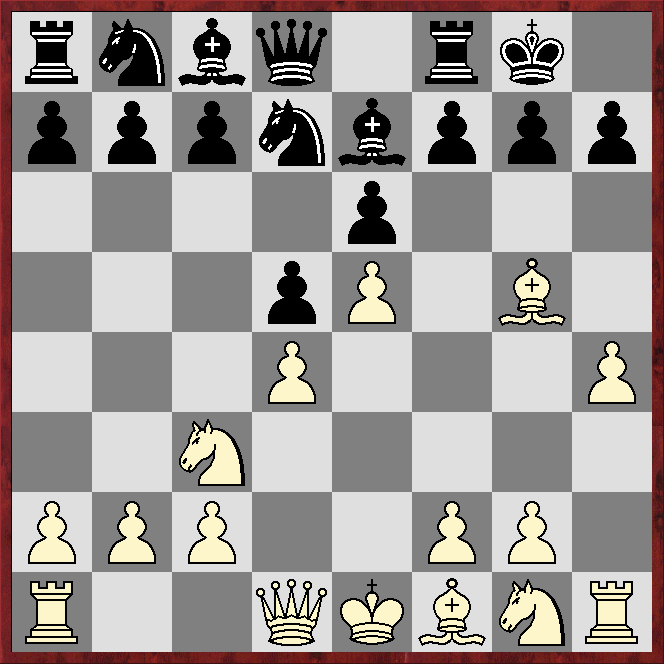
1.e4 e6 2.d4 d5 3.Nc3 Nf6 4.Bg5 Be7 5.e5 Nfd7 6.h4!?
How should Black meet this gambit?
*****
*****
*****
*****
*****
6...c5
Most popular in ChessBase's 2026 Mega database is 6...a6, the main idea of which is to prepare ...c5 without allowing the reply Nb5. Stockfish18 and Dragon1 recommend accepting the gambit, their main line running 6...Bxg5 7.hxg5 Qxg5 8.Nh3 (Albin, in the stem game, played 8.Nf3) Qh4!? (a rare continuation) 9.Nb5!? (9.g3 is more common)  Kd8 10.Qd2 a6 11.Nc3 c5 12.dxc5!? Nc6 13.0-0-0, and now they suggest an apparent novelty in 13...Kc7!? (the known move is 13...h6), albeit awarding White a slight edge.
7.Bxe7
The immediate 7.Nb5?!. although quite popular (300 examples of the move in Mega26), can be met by 7...f6!, eg 8.exf6 Nxf6, when the knight on b5 looks somewhat foolish. Alternatively, Dragon1's apparent-novelty, 8.Qh5+!?, continuing 8...g6 9.Qg7 fxg5 10.h5!?, can be met by 10...Bf8!? 11.Nd6+ Bxd6 12.exd6 Rg8!?, after which the engines agree White does not have enough for a piece.
7...Kxe7!?
Korchnoi and Short are among many who have played the obvious 7...Qxe7, but 8.Nb5 leaves Black with a difficult and unpleasant choice.
How should White proceed?
*****
*****
*****
*****
*****
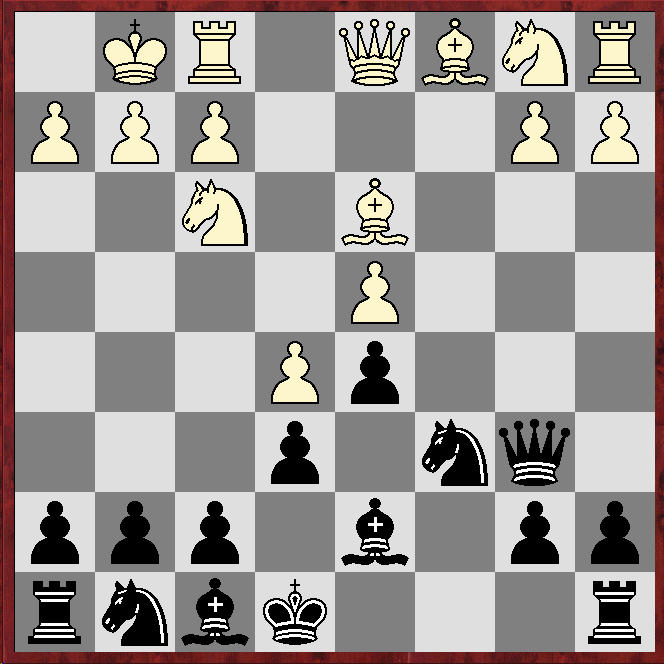
8.Qg4
The main line in Mega26 runs 8.f4 cxd4 9.Qxd4 Nc6 10.Qd2, with the upper hand for White, according to the engines. However, even in this short variation, there are major alternatives, with the engines agreeing one improvement for Black is 9...Qb6!? Stockfish18 likes 8.Qd2 or 8.dxc5, while Dragon1 prefers the popular 8.f4 or 8.Bb5 - testament to just how unclear these lines are.
8...Kf8
This is the main move, but the engines also suggest 8...Nc6, when they reckon White's best reply is 9.dxc5!?
9.Nf3 Nc6
Also interesting is 9...cxd4 10.Nb5!? Qa5+!? (another apparent-novelty) 11.Kd1!?
10.0-0-0!?
Possibly better is 10.Qf4 or 10.dxc5!?
10...cxd4 11.Nxd4!?
This is the only move in Mega26, but the engines suggest 11.Nb5 or 11.Rxd4!?, eg 11.Nb5 Ndxe5 12.Nxe5 Nxe5 13.Qxd4 a6!? 14.Qxe5 axb5 15.Kb1, when White may have enough for a pawn, or 11.Rxd4!? Ndxe5!? (11...Nxd4 12.Qxd4 gives White decent compensation for the exchange, according to the engines) 12.Nxe5 Nxe5 13.Qg3 Nc6 14.Rd2, when the engines reckon Black has the upper hand, but the position is far from easy for Black to play, one example of this being that after 14.Rd2 the engines agree Black has to find 14...h5!? to keep an advantage.
11...Ndxe5 12.Qg3 a6
This and 12...Qf6?! are known moves, but the engines do not like either, claiming Black has the upper hand after both 12...h5!? and 12...Nxd4.
13.h5!?
Seemingly a novelty, and perhaps a slight improvement on the known 13.f4.
13...h6 14.f4 Nxd4
Which knight should White capture?
*****
*****
*****
*****
*****
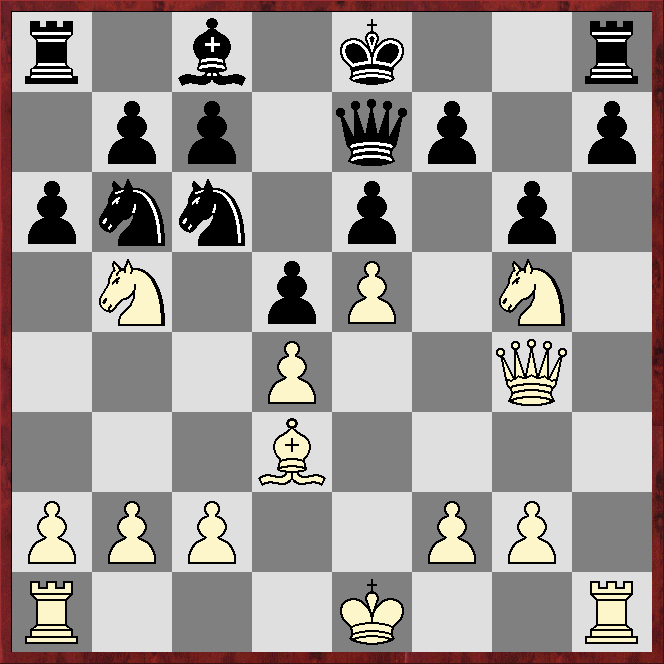
15.fxe5?
The engines reckon White has at least full compensation for a pawn after 15.Rxd4, eg 15...Nc6 16.Rd1 Qc7 17.Bd3 Nb4 18.Be2 Bd7 19.a3!? Nc6 20.Qf2, when Black remains a pawn up, but the king's rook is out of play.
15...Nf5 16.Qf2 Qg5+ 17.Kb1 Qe3
Not 17...Ng3? 18.Rh3, but 17...Ne3!? may be playable.
18.Qxe3 Nxe3 19.Rd3?
Necessary is 19.Re1, although the engines agree 19...Nxf1 20.Rhxf1 leaves White without enough for a pawn.
19...Nc4
What is White's best try?
*****
*****
*****
*****
*****
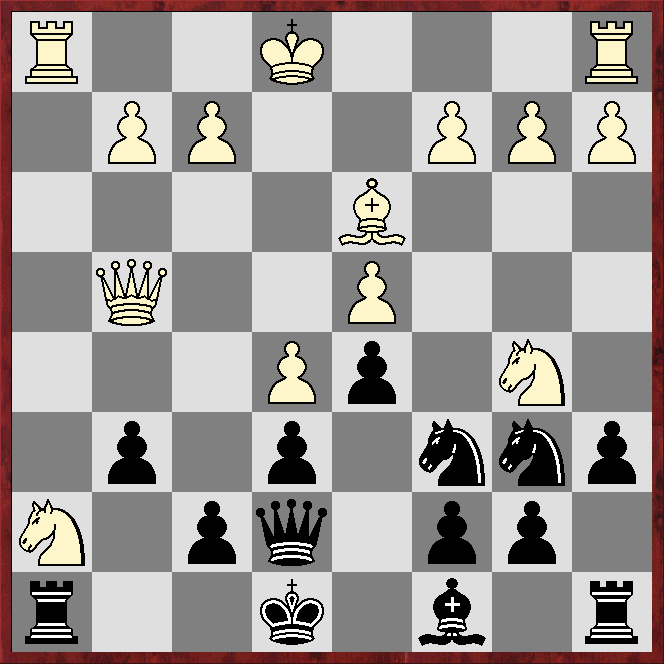
20.Nxd5!
Otherwise e5 drops, after which, with queens off the board, White is simply two pawns down.
How should Black respond?
*****
*****
*****
*****
*****
20...exd5
Almost certainly even stronger is 20...Nxe5 21.Nc7 Nxd3 22.Nxa8, when Black is a pawn up, and should soon get his rook into play.
21.Rxd5 Bxe6
White threatened 22.Rd8+ and 23.Rxh8.
22.Bxc4 Bxe6
This is obvious, at first glance, but the engines point out the superiority of 22...b5! 23.Bb3 Bxd5 24.Bxd5, and either 24...Rd8 or 24...Re8.
23.Bxd5
How would you assess this ending?
*****
*****
*****
*****
*****
White has a pawn for the exchange, the ability to stabilise the bishop in the centre with c4, and pressure against b7 and f7. Nevertheless, rooks are endgame pieces per excellence, and the engines reckon chances are equal.
23...Re8
Best, according to the engines, is 23...Ra7!?, intending a quick ...b5.
24.Bxb7 a5
The engines agree this is better than allowing White three connected passers with 24...Rxe5 25.Bxa6, but Dragon1, especially, fluctuates between the text and 24...Re6.
25.Re1 f6?
This is a serious mistake, according to the engines, as it allows White a passed pawn that can be easily protected by the bishop.
26.e6 Ke7 27.Bd5 Rhg8 28.Re3!? g5
White to play and win
*****
*****
*****
*****
*****
29.hxg6!
The only winning move, according to the engines, although they agree White is also better after 29.Ra3. However, they reckon 29.g4? f5! gives Black what is almost certainly a winning position, eg 30.gxf5 g4 31,Rg3 Rg5 32.Be4 Rd8 33.c3 Rd2 34.Kc1 Rf2 35.Bc2 Rxh5 36.Rxg4 Rh1+ 37.Bd1 Rxd5, when they reckon Black's advantage is roughly worth a minor piece.
29...Rxg6 30.Ra3 Rg5 31.c4
Also good is 31.Rxa5.
31...Rc8!?
Setting a 'trap'
*****
*****
*****
*****
*****
32.Rxa5!?
Except that the trap does not work. However, there was no way to save the a5 pawn.
32...Rxc4 33.Ra7+ 1-0

Monday, 20 April 2026

World Team 65+ Round Two

Bo.46
  England - 5
Rtg-33
  Ireland - 1
Rtg0 : 0
19.1
Freeman, Richard C P
1897-FM
Smith, Andrew Philip
2118
19.2CM
Stokes, Michael
1861-
Noone, Joe
1946
19.3
Spanton, Tim R
1908-CM
MacElligott, Gerard
1979
19.4
Marshall, Michael
1859-
Gaffney, Michael
1919

Spanton (1908) - Gerald MacElligott (1979)
French Alekhine-Chatard
1.e4 e6 2.d4 d5 3.Nc3 Nf6 4.Bg5 Be7 5.e5 Nfd7 6.h4!?
The starting position of the famous Attack, apparently first played by Adolf Albin in 1890
*****
*****
*****
*****
*****
6...h6
This is the second-most popular continuation in ChessBase's 2026 Mega database. Stockfish17.1 prefers accepting the gambit with 6...Bxg5 7.hxg5 Qxg5 8.Nh3 Qh4!?, while Dragon1 likes the text, and 6...0-0!?
7.Bxe7 Qxe7 8.Qg4
This is the commonest continuation, but the engines prefer 8.f4.
8...0-0 9.f4
Alekhine played 9.0-0-0 in a 1930 simul.
9...f5!?
The engines strongly dislike this, preferring the more popular 9...c5.
10.Qg6!?
White need not fear an exchange of queens. After 10...Qf7 11.Qxf7+ Rxf7 12.Nf3 the engines give White at least the upper hand.
10...Rd8!?
Seemingly a novelty. The engines at first suggest 10...c5, 10...Nc6 or 10...a6, albeit with advantage to White, but Dragon1 comes to prefer 10...Qf7, at least for a while.
11.Nf3
The engines reckon 11.g4!? Nf8 12.Qh5 leaves White with a positionally won game.
11...Nf8 12.Qg3 a6
The engines recommend 12...c5!?, not fearing Nb5-d6.
13.Qf2 c5!? 14.dxc5 Nbd7 15.Na4!?
White should play 15.Nd4 or 15.0-0-0, according to the engines.
15...b5
How should White proceed?
*****
*****
*****
*****
*****
16.Nd4?
Initiating a faulty combination. Instead 16.Nb6 Nxb6 17.cxb6 Qb4+ 18.c3! Qf4 19.h5 gives White a slight edge (Stockfish17.1) or at least equality (Dragon1).
16...bxa4 17.Nc6 Qe8
Also good is 17...Qxc5!? 18.Qxc5 Nxc5 19.Nxd8 Bd7.
18.Bd3 Bb7 19.Na5!?
How should Black proceed?
*****
*****
*****
*****
*****
19...Rdb8!
Black is winning after this, according to the engines, whereas they reckon 19...Rab8 20.c6 Ba8 (20...Bxc6?! 21.Nxc6 forks the black rooks) 21.c7 Rxb2 22.cxd8=Q Qxd8 23.Nb3! axb3 24.axb3 gives White at least equal chances. A little better is 19...Bc8 20.c6 Qe7 (20...Nb8? 21.c7 Rd7 22.Qb6) 21.cxd7 Bxd7, but the text is best.
20.Nxb7 Rxb7 21.c6 Rxb2 22.cxd7 Qxd7
Even stronger, according to the engines, is taking with the knight.
23.0-0
Now both sides have castled, how would you assess the position?
*****
*****
*****
*****
*****
Black's extra pawn is doubled, but the black king's rook is well-placed. The engines reckon Black is winning, or at least has the upper hand, but do not agree on how to go about maintaining Black's advantage.
23...Qa7
But they do agree exchanging queens is the wrong plan. Perhaps best is 23...Qf7!?, eg 24.a3!? Rab8!? 25.g4!? (25.Bxa6 Qe7 26.Bd3 Nd7 27.h5 Kh7) R8b3!? 26.Rad1!? Qg6!? 27.Qg2!? Qf7!? 28.gxf5 exf5, but I am far from understanding the ideas behind the vast majority of these engine moves.
24.Rfb1
The engines give 24.Qxa7 Rxa7 25.c4, but their evaluations of the resulting position differ markedly, and fluctuate.
24...Qxf2+ 25.Kxf2 Rab8
25...a3!? may be better, but the evaluations fluctuate wildly, with at one point Dragon1 claiming Black is winning while at the exact same moment Stockfish17.1 calls the game equal. Given plenty of time, their evaluations merge somewhat, eventually stabilising at the upper hand for Black (Dragon1) or equality (Stockfish17.1)
26.Rxb2 Rxb2 27.a3!
An important move that seems to give White equality, whereas allowing 27...a3 appears to leave Black with at least a slight edge.
27...Nd7 28.Ke3 Kf7 29.Kd4 Ke7?!
This allows White the upper hand, according to the engines.
What should White play?
*****
*****
*****
*****
*****
30.h5!
Fixing Black's h and g pawns, and preparing to open the kingside with g4. Black should have played 29...h5 or 29...g6, according to the engines.
30...Rb6
30...Nb8!? is suggested by the engines, but with the upper hand for White.
31.g4! fxg4 32.Rg1 Kf7 33.Rxg4 Rc6 34.Rg6 Nf8 35.Rg1 Nd7
35...Rb6 occupies the open file, but the engines agree White is winning, eg 36.f5 exf5 37.Bxf5 Rb5 38.Rg3!? a5 39.Rc3 Ne6+ 40.Bxe6+ Kxe6 41.Rc6+ Kf7 42.Rc7+ Kf8 43.e6 Rb8 44.Rf7+ Kg8 45.Ke5 Rc8 46.Rf2 etc.
36.Rb1 Nb6
Even worse is 36...Rb6? 37.Rxb6 Nxb6 38.Kc5!
37.Bxa6
With the number of pawns aside now equal, White's rook-and-bishop combo gives a large advantage
*****
*****
*****
*****
*****
37...Nc4 38.Rb7+ Kf8 39.Rb8+
More precise is 39.Bb5 Rc8 40.Bc7.
39...Ke7
If 39...Kf7, White needs to play 40.Rb7+ Kf8, and now 41.Bb5, as in the previous note, but with two extra moves thrown in.
40.Bb5 Rc7 41.Re8+ Kf7
White to play and win
*****
*****
*****
*****
*****
42.f5!
The only winning move, but plenty good enough.
42...exf5
The pawn ending after 42...Re7 43.Rxe7+ Kxe7 44.Bxc4 dxc4 45.fxe6 Kxe6 46.Ke4 is an easy win for White, eg 46...c3 47.Kd4 g5!? (47...Kf5 48.Kd5) 48.hxg6 h5 49.Ke4 h4 50.Kf4 h3 51.Kg3 etc (Black cannot capture on e5 without allowing the g pawn to queen).
43.Kxd5 Nb6+
Or 43...Nxa3 44.e6+ Kf6 45.Rf8+ Kg5 46.Bxa4 Nxc2 47.Rf7 Ne3+ 48.Kd6 Rc8 49.e7 etc.
44.Kd6 Rxc2 45.e6+ Kf6 46.Rf8+ Kg5 47.e7
Not 47.Rxf5+?? Kxf5 48.Bd3+ Kf6 49.Bxc2 as Black has 49...Nc4+, after which White cannot get out of check without losing the e pawn, eg 50.Kd5!? Ne3+ 51.Kd6 Nc4+ (51...Nxc2?? 52.e7) 52.Kd7 Ne5+.
47...Nc8+
Only one move maintains the win
*****
*****
*****
*****
*****
48.Rxc8!
After, say. 48.Ke6 Nxe7! 49.Kxe7 Rc3, the game is drawn, according to the engines.
48...Rxc8 49.e8=Q Rxe8 50.Bxe8
Black's kingside pawns are too far from queening to save the game
*****
*****
*****
*****
*****
50...f4 51.Bxa4 Kxh5 52.Bd1+ Kh4 53.Ke5 Kg3 54.Ke4 g5 55.a4 h5!? 56.Bxh5 g4 57.Kf5 f3 58.Bxg4 f2 59.Be2 1-0
Team Result
Freeman (1897) = Smith (2118)
Stokes (1861) 1-0 Noone (1946)
Spanton (1908) 1-0 MacElligott (1979)
Marshall (1859) = Gaffney (1919)
England 5 3-1 Ireland

Monday, 22 December 2025

All About That Bass V

MOST of us have an opponent against whom nothing seems to work.
When the opponent is considerably stronger, this is not surprising, but when ratings are not so different, the results are harder to explain.
My biggest bogeyman is probably John Bass, whose record against me is +6=1-0.
Seven games is not a huge sample, but such a poor performance on my part must signify something.
So in this mini-series I am looking at my games against JB to try to discover what is going on.
Fourteen years after my fourth defeat, we met again.

Spanton (1955) - Bass (1953)
Central London League Division Two 2022
French Alekhine-Chatard
1.e4 e6 2.d4 d5 3.Nc3 Nf6 4.Bg5 Be7 5.e5 Nfd7 6.h4
The gambit move 6.h4 scores 61% in ChessBase's 2026 Mega database, three percentage points more than the mainline 6.Bxe7
*****
*****
*****
*****
*****
6...Bxg5
Declining the gambit is much more popular, but this acceptance has been played by Korchnoi and other strong grandmasters.
7.hxg5 Qxg5 8.Nh3
This seems to have been Alekhine's innovation, varying from Albin's original 8.Nf3.
8...Qe7
Stockfish17.1 and Dragon1 suggest 8...Qh4!?, when 9.Nb5!? might be better than the commoner 9.g3.
9.Qg4
If you tend to think of Réti as a master of manoeuvre  rather than all-out attacker, it might be a revelation to you - it was to me - that the first two games with this move in Mega26 feature Réti as White.
9...g6 10.Bd3?!
A developing move, but without much purpose as the bishop does little here. The engines prefer 10.Ng5!? or 10.0-0-0.
10...Nc6 11.Nb5!?
This rare continuation - just two examples in Mega26 - is Stockfish17.1's top choice for quite some time, but it comes to agree with Dragon1 that, marginally marginally, better is the normal 11.0-0-0.
11...Nb6 12.Ng5 a6!
By transposition the game had reached a position occurring three times in Mega26, all of which saw 12...h5. The engines agree the text is an improvement.
How should White proceed?
*****
*****
*****
*****
*****
13.Nxh7?
Correct is 13.Nxf7! Qxf7 14.Bxg6! Qxg6 15.Qxg6 hxg6 16.Rxh8+ Kd7, with equal chances, according to the engines, which reckon 13...Kxf7!? 14.Bxg6+ Kg8 15.Bh5+ Qg7 16.Nxc7 Qxg4 17.Bxg4 gives White at least a slight edge.
What should Black play?
*****
*****
*****
*****
*****
13...Kd8??
Giving up the exchange with 13...Rxh7? is better than the text, according to the engines, but winning is 13...axb5!, the point being 14.Nf6+?! runs into 14...Qxf6! 15.exf6 Rxh1+, when, after 16.Bf1, Black has rook and two knights for a queen.
14.Nd6??
Giving up a piece for no good reason. After 14.Nc3 White has a positionally won game, according to the engines.
14...cxd6 15.exd6 Qxd6 16.0-0-0 Kc7 17.Nf6 Bd7 18.Kb1 Rad8
The black king is just as safe as White's, so the only significant difference between the two sides is Black's extra knight
*****
*****
*****
*****
*****
19.c3 e5!? 20.Nxd7 Nxd7 21.dxe5 Ndxe5 22.Qg3 Rxh1 23.Rxh1 Nxd3 24.Qxd3 Qf4 0-1
LESSON: sharp play was decided by back-to-back blunders, with the player of the next-to-last-blunder emerging victorious.

Monday, 18 August 2025

Czech 65+ Open Championship Round Two

THE first of today's double-round games.

Spanton (1982) - Petr Pešek (1853)
French Alekhine-Chatard
As far as I can recall, this is the first time I have faced an opponent with a Fide rating but no national one.
1.Nc3 e6 2.d4 Nf6 3.e4 d5 4.Bg5 Be7 5.e5 Nfd7 6.h4 c5!?
This has been played by Nigel Short, Victor Korchnoi and other top grandmasters, but more popular in ChessBase's 2025 Mega database are 6...Bxg5, 6...h6 and especially 6...a6.
How should White respond?
*****
*****
*****
*****
*****
7.Nb5?!
There are 290 examples of this move in Mega25, it scores 58% and has been played by grandmasters, but it is almost certainly a mistake.
Correct is 7.Bxe7, when 7...Qxe7 is strongly met by 8.Nb5, so Black should probably prefer 7...Kxe7!?, when 8.Nb5? Qa5+ leaves Black with the upper hand, according to Stockfish17 and Dragon1, but White has several promising alternatives to 8.Nb5?, including 8.Qd2, 8.dxc5!?, 8.f4 and 8.Nf3.
Black to play and refute Nb5
*****
*****
*****
*****
*****
7...Nc6?!
This is the engines' second choice, but almost certainly stronger is 7...f6, when White has nothing better than 8.exf6, after which 8...Nxf6 leaves Black with the upper hand, according to the engines.
8.Nd6+ Kf8 9.c3?!
Probably best is 9.Qh5 g6 10.Qh6+ (not in Mega25) Kg8 11.Bxe7 Qxe7 12.0-0-0!, when a likely line given by the engines runs 12...Nxd4 13.Qe3 Nf5 14.Nxf5 gxf5 15.Be2, which they reckon gives White more than enough for a pawn, although the position remains sharp.
Also promising is 9.Bxe7+, when 9...Qxe7?! 10.c3 is very good for White, according to the engines, but they reckon 9...Kxe7!? is not so clear, eg 10.c3? fails to 10...cxd4 11.cxd4 Qa5+ etc, so White should probably play 10.f4 or 10.Qg4, with about equal chances.
9...cxd4!?
This is an improvement over the known move 9...h6?, when 10.Bxe7+ would have left White with a knight firmly entrenched in Black's position, to the menace of the black king.
10.Bxe7+?
Better is 10.cxd4, when 10...Qa5+ is comfortably parried by 11.Bd2, followed by 12.Nxc8. Possibly Black should play 10...f6!?, when the engines disagree as to White's best response, but it may be 11.exf6 Nxf6 12.Nb5, when the chances seem to be roughly even.
10...Kxe7!
This is definitely best. After 10...Qxe7? White consolidates with 11.cxd4, and has a pleasant advantage in a stabilised position.
How should White proceed?
*****
*****
*****
*****
*****
11.f4!?
Objectively better, at least according to the engines, is 11.cxd4, but 11...Qa5+ 12.Qd2 (12.Ke2?! Qb6) Qxd2 13.Kxd2 Nxd4 leaves White a pawn down, without any compensation and with no hope of creating complications around Black's king.
11...Qa5+
Even stronger, according to the engines, is the 'greedy' 11...dxc3.
12.b4!?
PP offered a draw.
12...Qa3? ½–½
Black is winning after 12...Qb6!, according to the engines, eg 13.b5!? Ncxe5! 14.fxe5 dxc3!, when Black has three pawns and the initiative for a knight. That is a really difficult line, to both see and to properly assess, but after the text Black is lost.
Can you see why the final position is winning for White?
*****
*****
*****
*****
*****
The engines give 13.Nb5 Qb2 14.Rb1 Qxa2 15.cxd4!, after which Black has no good response to 16.Nc3 Qa3 17.Rb3, trapping the black queen.
In fact Black's objectively best try after 13.Nb5 is 13...Qa6!, eg 14.Nc7 can be met by 14...Qa3, when White's best is repeating the position with 15.Nb5 Qa6!, after which White should probably play 16.cxd4 (this could also have been played at move 14), when both 16...Nxb4 17.Kf2! and 16...Qb6 17.a4!? win for White, according to the engines, but it remains very complicated, and clearly both players were out of their depth for a godly proportion of the game's 12 moves.

Sunday, 15 September 2024

Lessons From Torquay VII: Wide But Shallow v Deep But Narrow

OLD instructional books often emphasise the importance of knowing a limited opening repertoire in depth.
Frequently switching openings was regarded as a cardinal sin, and a sure bar to improvement.
Some grandmasters took this advice to extremes; Lev Alburt, for example, was (in)famous for his devotion to Alekhine's Defence.
But the advice made particular sense for club players, since nine times out of 10 an opponent would not know what you played.
In those circumstances, sticking to your tried and trusted routine was probably as much of a surprise to the opponent as playing something completely new.
The database age has changed all that, as exemplified by Magnus Carlsen, who plays a huge range of openings, including frowned-upon club favourites such as the Ponziani.
These days, having a limited opening repertoire, however deep, makes you a relatively easy target for an opponent's preparation.
In round seven at Torquay I had white against an opponent who, according to ChessBase's 2024 Mega database, almost always meets 1.e4 with 1...e5.
I opened 1.Nc3, partly hoping he would reply 1...e5, when 2.e4 transposes to double-e pawn openings, but 2.Nf3 is an interesting alternative.
Instead he played 1...d5, which is the most popular continuation.
I could have kept the game in independent lines with 2.e4!?, which is easily the top choice in Mega24, but preferred 2.d4, to which came 2...Nf6.
Popular today is 3.Bf4, the Jobava-Prié, but I played the 'traditional' 3.Bg5, ie the Veresov, to which I was pleased to see the reply 3...e6.
Objectively that is a perfectly reasonable choice, second in popularity only to 3...Nbd7, but it allowed me to continue with 4.e4, making the game a French Classical - hardly what a black double-e pawn player is likely to be looking for.
After the further moves 4...Be7 5.e5 Nfd7 6.h4!? we reached the starting point of the Alekhine-Chatard Attack.
6.h4!? is the top choice of Stockfish16.1 and Dragon1, albeit narrowly over 6.Bxe7, and scores an excellent 61% in Mega24
I cannot claim to be an expert on the variation - this was just my seventh time playing it - but I believe it to be one of those openings that, in the absence of much theoretical knowledge, is easier for the attacker to play.
As it turned out, my opponent told me after the game, which he lost on time at move 28, that he used to play the Alekhine-Chatard with white many years ago, but had forgotten the theory.
LESSON: databases mean having a narrow repertoire is a dangerous business. The player able to make best use of transpositional possibilities can place opponents at a substantial practical disadvantage.

Friday, 6 September 2024

Riviera Round Seven

Spanton (1931 ECF/1980 Fide) - Maurice Staples (1989 ECF/1967 Fide)
French Alekhine-Chatard
1.Nc3 d5 2.d4 Nf6 3.Bg5 e6 4.e4 Be7 5.e5 Nfd7 6.h4!?
How should Black respond to this popular gambit, first played by Adolf Albin in 1890?
*****
*****
*****
*****
*****
6...h6!?
This is second in popularity in ChessBase's 2024 Mega database, behind 6...a6, after which the mainline runs 7.Qg4 Bxg5 8.hxg5 c5 9.g6!? f5 10.Qf4 h6 11.Nf3, with the upper hand for White, according to Stockfish16.1 and Dragon1. The engines quite like accepting the gambit with 6...Bxg5 7.hxg5 Qxg5, but then the most popular continuation goes 8.Nh3 Qe7 9.Qg4 g6 10.0-0-0, with White getting at least enough compensation for a pawn, according to the engines.
7.Bxe7 Qxe7 8.f4!?
More popular in Mega24 is 8.Qg4, but the engines prefer the text.
8...Nb6!?
Normal is 8...a6.
9.Qg4 Kf8?!
The engines strongly dislike this, preferring 9...0-0 or 9...Rg8!?, albeit giving White the upper hand.
10.Bd3 Nc6 11.Nge2 Nb4 12.0-0-0 Bd7 13.Kb1 Nxd3
How should White recapture?
*****
*****
*****
*****
*****
14.cxd3!?
The engines slightly prefer 14.Rxd3, but I wanted to keep the remaining black knight off the c4 square.
14...f5 15.Qh5!?
The engines prefer 15.exf6, or retreating the queen to h3.
15...Be8!?
Keeping queens on, now it is possible to lock the kingside, after which the white king will become the more-threatened of the two monarchs.
16.Qf3 h5 17.Rc1 Rc8 18.g3 g6 19.Ng1!?
Heading for the g5 outpost.
19...Kg7 20.Nh3 Bd7 21.Ng5 c5!?
The engines much prefer keeping the c file half-closed, suggesting 21...a5 (both like this), or 21...Na8!? (Stockfish16.1), or 21...Na4 (Dragon1).
How should White reply?
*****
*****
*****
*****
*****
22.dxc5!
It is important not to let Black push the c pawn further, eg 22.Ne2 c4 equalises, according to the engines.
22...Rxc5
Capturing with the queen can be met, as in the game, by 23.Ne2.
23.Ne2 Rhc8 24.Qe3 Rb5?!
The engines suggest 24...Na4, but reckon both 25.Nd4 and 25.Qd2 give White at least the upper hand.
25.Rxc8 Bxc8 26.Nd4 Ra5
Not 26...Qc5? 27.Ndxe6+ etc.
27.Qd2 Ra6
Perhaps better is 27...Rc5, putting a major piece on the open file, but the engines reckon 28.Nb3 Rc6 29.Qa5 is winning.
28.Rc1 1-0 (Time)
The threat is 29.Rc7!, and if 28...Kg8 then 29.Qc3 leads to White occupying the seventh rank with deadly effect.

Saturday, 25 November 2023

Famous But Not Well-Known

ARGUABLY the most famous gambit in the French Defence is the Alekhine-Chatard Attack.
It arises after the moves 1.e4 e6 2.d4 d5 3.Nc3 Nf6 4.Bg5 Be7 5.e5 Nfd7 6.h4!?
There are 6,724 examples of this position in ChessBase's 2023 Mega database
I write "arguably" because I suspect many people would regard the Milner-Barry Gambit as being more famous.
That arises after 1.e4 e6 2.d4 d5 3.e5 c5 4.c3 Nf6 5.Nf3 Qb6 6.Bd3 cxd4 7.cxd4 Bd7 8.0-0!?
There are 4,348 examples of this position in Mega23
I played the Alekhine-Chatard with white in round five at Cap Negret.
The gambit was apparently first played by Adolf Albin in 1890, and his name is sometimes appended to it, although Albin-Alekhine-Chatard is quite a mouthful.
The most popular reply in Mega23 is to decline the sacrifice with 6...a6!?
One of the points of ...a6 is that Black wants to play ...c5, but the immediate 6...c5?! runs into 7.Bxe7 Qxe7 8.Nb5.
However, Stockfish16 and Komodo14.1 come close to calling 6...a6!? a mistake, reckoning White has the upper hand (Stockfish16) or is at least slightly better (Komodo14.1) after 7.Qg4.
Accepting the gambit with 6...Bxg5 leads to very sharp play, but my opponent preferred the second-most popular method of declining, namely 6...h6!?
After 7.Bxe7 Qxe7 I continued with what is easily the commonest move in Mega23, 8.Qg4.
This scores a resounding 62%, but the engines reckon Black gets at least equality with 8...0-0.
Instead they recommend 8.f4!?, claiming a slight edge for White.
What this snapshot look at an opening suggests is that while the Alekhine-Chatard Attack is famous, the state of theory is not well-known, meaning there is plenty of scope for independent research.

Wednesday, 15 November 2023

Cap Negret Round Five

One of a series of distinctive artworks on Altea promenade
FACED an opponent who beat grandmaster Mihai Șubă in round one.

Spanton (1808) - José Virgilio Moya García (1453)
French Classical Alekhine-Chatard Attack
1.e4 e6 2.d4 d5 3.Nc3 Nf6 4.Bg5 Be7 5.e5 Nfd7 6.h4
There are 6,724 examples of this position in ChessBase's 2023 Mega database
*****
*****
*****
*****
*****
6...h6!?
Critical from a theoretical view is accepting the gambit with 6...Bxg5, but most popular in Mega23 is 6...a6!?
7.Bxe7
This is normal, and is Stockfish16's top choice, but Komodo14.1 for a long time prefers retreating with 7...Be3!? or 7...Bd2!?, before coming to fluctuate between the text and 7...Be3!?
7...Qxe7 8.Qg4
This is commonest, but the engines much prefer 8.f4!?
How should Black respond?
*****
*****
*****
*****
*****
8...f5?!
The calm 8...0-0 is normal. Without a dark-square bishop, it is not clear White is threatening very much.
9.Qg3
Most popular in Mega23 is 9.exf6 Nxf6 10.Qg6+ Qf7, after which the engines reckon 11.Qxf7+ Kxf7 12.Nf3 gives White at least a slight edge. However they reckon even better is 9.Qh5+ (or 9.Qg6+) Qf7 10.Qxf7+ Kxf7, claiming White has the upper hand after almost any reasonable continuation.
9...a6?!
Twelve out of 15 games in Mega23 saw this played, but the engines give castling as the only move to keep Black's disadvantage within acceptable bounds.
10.Be2?!
This may be a novelty, and probably not a good one. Strong is 10.Nge2, and if 10...0-0 then 11.Nf4 is winning, according to the engines.
10...Nc6?
Black is equal after 10...0-0, according to the engines.
11.Bh5+ Kd8 12.0-0-0 g5 13.Nh3 f4 14.Qf3
Probably even stronger is 14.Qg4.
14...b5
How should White meet Black's bid for counterplay?
*****
*****
*****
*****
*****
15.Nxd5!?
This initiates a forcing winning-sequence, according to the engines, but they prefer the simpler 15.hxg5 hxg5 16.Qg4.
15...exd5 16.Qxd5 Bb7 17.e6 Na5 18.Qxd7+ Qxd7 19.exd7
How should Black continue?
*****
*****
*****
*****
*****
19...Bc6?!
Possibly best is 19...Bxg2 20.Rh2 Bxh3 21.Rxh3 Kxd7 22.Bg4+ Kd6, but 23.Rdh1 gives Black a winning advantage, according to the engines.
20.hxg5 Bxd7?
This time capturing on g2 is definitely better.
21.g6 Nc6
21...Rf8 does not really change much, eg 22.Bf3 c6 23.g7 Rg8 24.Nxf4 with a large advantage for White.
22.Nxf4 Ne7 23.Rde1 Be8 24.Ne6+ Kd7 25.Nxc7
Black is busted
*****
*****
*****
*****
*****
The game finished:
25...Bxg6 26.Nxa8 Bxh5 27.Nb6+ Kc7 28.Rxh5 Kxb6 29.Rxe7 1-0

Wednesday, 26 October 2022

New Venue

PLAYED last night at Railsport's new venue, Enterprise House in Westbourne Terrace, W2, which has a playing room with plenty of space for a five-board match. I was on board two for Battersea 2 in division two of the Central London League.

Spanton (1955) - John Bass (1953)
French Alekhine-Chatard
1.e4 e6 2.d4 d5 3.Nc3 Nf6 4.Bg5 Be7 5.e5 Nfd7 6.h4!? Bxg5!?
Stockfish15 approves of accepting the gambit, although Komodo13.02 fluctuates between the text and declining with 6...h6 or 6...0-0. The mainline in ChessBase's 2022 Mega database runs 6...a6 7.Qg4 Bxg5 8.hxg5 c5 9.g6!? f5 10.Qf4 h6, which Komodo13.02 reckons equalises but Stockfish15 claims gives White has the upper hand.
7.hxg5 Qxg5 8.Nh3 Qe7 9.Qg4!?
Marginally more popular in Mega22 is 9.Nf4, but the engines prefer the text.
9...g6 10.Bd3?!
This bishop is not doing much here. The engines prefer 10.0-0-0 or 10.Ng5.
10...Nc6 11.Nb5!?
This forces Black to do something about the attack on c7. The main move is 11.0-0-0.
11...Nb6
This deflects the knight from the kingside, but it is hard to believe 11...Qd8?! or 11...Kd8?! is an improvement. However Black can flick in 11...h5 before moving the knight, possibly to f8.
12.Ng5 a6!?
Stockfish15 is keen on this apparent novelty, while Komodo13.02 likes it equally with the known 12...h5.
How should White proceed?
*****
*****
*****
*****
*****
13.Nxh7?
The engines point out 13.Nxf7!, eg 13...Qxf7 14.Bxg6 Qxg6 15.Qxg6 hxg6 16.Rxh8+ Kd7, with what they reckon is a completely equal position, or 13...Kxf7 14.Bxg6+ Kg8 15.Bh5+ Qg7 16.Nxc7, when Stockfish15 gives White at least a slight edge, but Komodo13.02 again calls the position completely equal.
How should Black respond?
*****
*****
*****
*****
*****
13...Kd8?
Correct is 13...axb5 14.Nf6+ Qxf6 15.exf6 Rxh1+ 16.Bf1, when Black has rook and two knights for a queen.
14.Nd6??
Somehow I thought Black could only capture once on d6. White is winning (Stockfish15) or at least has the upper hand (Komodo13.02) after 14.Nc3.
14...cxd6 15.exd6 Qxd6 16.0-0-0 Kc7 17.Nf6 Bd7
Black has a large advantage - Stockfish15 reckons +7.24 while Komodo13.02 gives +4.15.
The game finished:
18.Kb1 Rad8 19.c3 e5 20.Nxd7 Nxd7 21.dxe5 Ndxe5 22.Qg3 Rxh1 23.Rxh1 Nxd3 24.Qxd3 Qf4 0-1
The match finished 2.5-2.5.

Thursday, 4 August 2022

Lessons From Transylvania III

IN round three of the Brașov International I had white against an 1848.
The full game can be seen at B3 but here I want to look at Black's reaction to the Alekhine-Chatard Attack in the French.
The game began 1.e4 e6 2.d4 d5 3.Nc3 Nf6 4.Bg5 Be7 5.e5 Nfd7 6.h4.
The starting position of the Alekhine-Chatard Attack 
*****
*****
*****
*****
*****
After 6...Bxg5 7.hxg5 Qxg5 8.Nh3 the analysis engines Stockfish15 and Komodo13.02 reckon White has at least full compensation for a pawn.
Not surprisingly the gambit is more often declined, with the mainline in ChessBase's 2022 Mega database running 6...a6!? 7.Qg4 Bxg5 8.hxg5 c5 9.g6 f5 10.Qf4, reaching a position Komodo13.02 calls equal but Stockfish15 reckons favours White.
My game featured 6...h6!?, which is Black's second-most popular way to decline the gambit and is preferred by the engines over any other declining method.
Now Komodo13.02 likes 7.Be3!?, with both engines continuing 7...c5 8.Qg4, agreeing White is slightly better but not agreeing on how Black should meet the queen thrust. Komodo13.02 suggests 8...Kf8!? 9.f4 Nc6 10.Nf3 with a complicated middlegame. Stockfish15 likes 8...Rg8!? 9.f4 cxd4 10.Bxd4 Nc6 11.Nf3, again with a complicated position.
An interesting alternative is 7.Qh5!?, when 7...g6 8.Bxe7 Qxe7 9.Qe2 is good for White, according to the engines. They prefer 7...a6 or 7...c5, eg 7...a6 8.0-0-0 c5 9.dxc5 Nc6 10.Nf3 with an unclear position.
My game saw 7.Bxe7, which is the main continuation in Mega22. After 7...Qxe7 I attacked with 8.Qg4, which is the commonest move, but the engines much prefer 8.f4!?
Position after 8.f4!?
*****
*****
*****
*****
*****
After 8.f4!? Black could reply 8...0-0, but this may be castling into it as the engines like 9.g4!?, when 9...c5 10.dxc5!? looks promising, eg Stockfish15 continues 10...Qxc5 11.g5!? Qb4 12.Nge2 with attacking chances. Komodo13.02 varies with 11...Qe3+, but again 12.Nge2 seems effective (the black queen can be evicted with Rh3).
The main reply to 8.f4!? in Mega22 is 8...a6, when the engines give 9.Qd2 b5 10.Nf3 c5 11.Ne2 with Stockfish15 claiming at least a slight edge for White, but Komodo13.02 rating the position as equal.
CONCLUSION: challenging the white dark-square bishop at move six with ...h6 seems a decent try for Black. Continuations are arguably not as tactically sharp as many others in the Alekhine-Chatard, but can be positionally complicated with much for both sides to consider.

Tuesday, 26 July 2022

Brașov Round Three

FACED another Romanian junior (born 2008) in the first of today's double-round games.

Spanton (1889) - Ioan-Alexandru Iuga (1848)
French Alekhine-Chatard
1.e4 e6 2.d4 d5 3.Nc3 Nf6 4.Bg5 Be7 5.e5 Nfd7 6.h4 h6!?
Stockfish15 and Komodo13.02 reckon this is the best way to decline the gambit.
7.Bxe7 Qxe7 8.Qg4
This is the mainline in ChessBase's 2022 Mega database, but the engines prefer 8.f4!?
8...0-0
One of the advantages of the ...h6 defence is Black can usually castle kingside in comparative safety.
How should White proceed?
*****
*****
*****
*****
*****
9.Nh3?
The white centre is too fragile to allow this. Normal is 9.0-0-0 or 9.f4, in both cases with equal chances, according to the engines.
9...c5!
This is not in Mega22, which has 9...Qb4?! and 9...f6?! The former can be answered with 10.0-0-0 while the latter runs into 10.Nf4.
10.Bb5
10.Nb5 is well-countered by 10...a6 or 10...Nc6. The engines suggest 10.dxc5!?, but agree Black is winning after 10...Nxe5.
10...cxd4 11.Qxd4 Nc6 12.Bxc6 bxc6 13.0-0-0 c5 14.Qf4 f6?!
This looks natural but the engines reckon it throws away much of Black's advantage. They recommend 14...Rb8 or 14...Bb7.
15.exf6 Nxf6 16.Qd2?!
Almost certainly too passive. I rejected 16.Qe5 because of 16...Ng4?! 17.Nxd5 Qb7, missing that after 18.Ne7+ Qxe7 White has the forking 19.Qe4. Then 19...Rb8 20.Qxg4 leaves White a pawn up, but Black's pieces are so much more active that the engines reckon Black is better. This is somewhat academic, however, as the engines reckon both 16...d4 and 16...Nd7 leave Black well on top.
White's best chance, according to the engines, is 16.Rhe1, when White has pressure against Black's impressive-looking centre, although they reckon 16...Qb7 gives Black an advantage.
16...d4 17.Ne2 Ne4 18.Qe1
How should Black proceed?
*****
*****
*****
*****
*****
18...Qxh4?
Black should continue calmly with, for example, 18...e5, maintaining a large advantage, according to the engines.
19.g3?
White at least equalises with 19.Nef4, according to the engines, eg 19...Rxf4 20.g3, or 19...Nxf2 20.Rf1, and if 19...Nd6? then 20.Ng6.
19...Qe7 20.Nxd4!?
It is a sign of how bad Black's position is that the engines are OK with this move. However, after ...
20...cxd4
... my planned 21.Qxe4 is answered by 21...Bb7.
21.Rxd4 Nf6
Black has bishop for pawn but is effectively much more than a rook ahead, according to Stockfish15, although Komodo13.02 puts the advantage at 'just' than a minor piece
*****
*****
*****
*****
*****
22.Nf4 Qc5!?
Giving up a pawn in return for simplification. The engines prefer 22...e5, when 23.Ng6?! Qf7 24.Nxe5 is met by 24...Qxa2.
23.Nxe6 Bxe6 24.Qxe6+ Kh8 25.Rhd1 Rac8 26.Qe2 Qa5 27.Kb1 Rfd8 28.Qd3 Rxd4 29.Qxd4 Qc5 30.c3 Qxd4 31.Rxd4 Re8 32.Kc2 Re2+ 33.Rd2 Rxd2+ 34.Kxd2
How would you assess this ending?
*****
*****
*****
*****
*****
Black has the only piece (apart from kings) and has possibilities of creating a passed pawn on the h file, but White's extra two pawns on the queenside look menacing. The engines agree Black is winning, but this is one of those unusual imbalances - unusual in the sense of not occurring all that often, except when the position is trivially winning for the player with the minor piece - that is tricky to play over the board.
34...Kg8 35.Kd3 Kf7 36.Kd4 Ke6 37.c4 h5
I-AI said afterwards he should have played 37...g5 to prevent my next move, and I thought he was probably right, but the engines reckon both moves win easily.
38.f4
Otherwise 38...g5 with ...h4 to come.
38...Kd6?!
Black is still much better after this, but 38...Kf5 is stronger, eg 39.c5 Kg4 36.c6 Ne8 with ...Kxg3 to follow.
39.b4
Black is still on top, but suddenly there are serious chances to go wrong
*****
*****
*****
*****
*****
39...Nd7?
Both 39...Ke6!? and 39...g6 are winning, according to Stockfish15, although Komodo13.02 'merely' gives Black the upper hand.
What is White's drawing plan?
*****
*****
*****
*****
*****
White needs to exchange off the black queenside pawn, even if this costs all three white queenside pawns, while at the same time penetrating on the kingside with the white king.
40.c5+ Kc6 41.a4 a6
The engines reckon Black can get away with, for example, 41...g6!?, but after 42.b5+ the white pawn-juggernaut means Black has to be careful not to lose.
42.Ke4!
The key switch of direction. Stockfish15 reckons Kc4 also draws, but recognises its error as soon as the move is inputted on the board.
42...g6 43.Kd4
Black is effectively in a sort of zugzwang.
43...Nf6 44.Ke5 Nd5 45.b5+ axb5 46.axb5+ Kxc5 47.b6
Diverting the knight.
47...Nxb6 48.Kf6 h4 49.gxh4
I-AI offered a draw.
49...Nd5+ 50.Kxg6 Nxf4+ 51.Kf5 Nh5 52.Kg5 Ng7 53.Kg6 Ne6
An only-move, but not difficult to find.
54.Kf6 ½–½

Saturday, 16 July 2022

Lessons From South Wales

IN round one at the South Wales International I had white against an unrated.
The full game can be seen at S1 but here I will concentrate on the sharp opening.

Play began 1.e4 e6 2.d4 d5 3.Nc3 Nf6 4.Bg5.
My opponent continued with 4...Be7, the most popular move in ChessBase's 2022 Mega database.
At club level a commonly played alternative is 4...Bb4, the McCutcheon Variation, while at elite levels it is probably correct to say the main continuation these days is 4...dxe4, the Burn Variation.
Part of the popularity of the Burn with grandmasters is, I suspect, due to its recommendation by French Defence expert John Watson in the third edition of Play The French (Everyman Chess, 2003).
After 5.e5 Nfd7 (5...Ne4!? and 5...Ng8?! are also tried by strong players) the natural continuation is 6.Bxe7, but Garry Kasparov is among those who have preferred 6.h4!?
This gambit is credited to Adolf Albin, who played it at a Vienna tournament in 1890, but is usually known as the Alekhine-Chatard Attack.
Although Albin's 1890 opponent, Adolf Csank, took the offered pawn and obtained a draw, the gambit is usually declined.
Stockfish15 reckons the best way of declining is 6...h6, eg 7.Bxe7 Qxe7 8.f4 a6, albeit conceding White has at least a slight edge (Komodo13.02 reckons the position is equal).
The latter engine prefers to decline with the move my opponent chose, 6...0-0!?
How should White continue?
*****
*****
*****
*****
*****
The most popular line in Mega22 runs 7.Bd3 c5 8.Qh5 g6 9.Qh6, when Stockfish15 reckons White has a positionally won game but Komodo13.02 calls the position dead-equal.
I preferred the arguably more-direct 7.Qg4!?
White threatens 8.Bh6 - how should Black respond?
*****
*****
*****
*****
*****
7...Kh8
This is Komodo13.02's choice but most popular in Mega22 is 7...f5, although the engines reckon 8.Bxe7 Qxe7 9.Qg5 gives White at least a  slight edge.
Stockfish15 likes 7...f6!? despite the reply 8.Qxe6+. After the further moves 8...Kh8 9.exf6 Nxf6 Stockfish15 reckons Black's lead in development gives good compensation for a pawn.
I developed with 8.Nf3, and the engines agree with the game continuation of 8...c5, which attacks the white centre (8...f5?! also occurs in Mega22 but the engines strongly dislike it, reckoning any reasonable reply - 9.Qh5, 9.Qf4, 9.Qg3, 9.Bxe7 - gives White an advantage).
How should White proceed?
*****
*****
*****
*****
*****
9.Bd3!
This is possible, and good, since 9...c4? loses to a simple combination, ie 10.Bxh7 Kxh7 11.Bxe7 Qxe7 12.Qh5+ with mate to follow.
An interesting alternative is 9.Nb5, which is preferred by Stockfish15 for a short while. After 9...Nc6 the engine reckons 10.Bd3 gives White the upper hand, but Komodo13.02 calls the position dead-equal.
9...f5
The engines agree this is Black's best chance, and it has the practical advantage that the reply 10.exf6, which White normally wants to play in such positions, allows at least equality, according to the engines, after 10....Nxf6. Nevertheless 10.exf6 was played in three of the six games in Mega22 to reach the position.
I preferred 10.Qf4, which was met by 10...Nc6, continuing Black's pressure against the white centre.
Herman van Riemsdijk (2420) - Alfeu Bueno (2200), Festa da Uva Rapid (Caxias do Sul, Brazil) 2010, continued 11.g4? cxd4 12.Nxd4 Ndxe5 13.Nxc6 Nxd3+ 14.cxd3 bxc6 (0-1, 40 moves), but 11.0-0-0 was an easy-to-find improvement.
The opening can be thought to have ended and the middlegame begun as one side has connected rooks - how would you assess the position?
*****
*****
*****
*****
*****
White has a substantial lead in development and more space in the centre, but the position is closed and Black has obvious counterplay on the queenside. The inclusion of opposite-side castling adds to the difficulty of being sure of any evaluation, but Stockfish15 gives White the upper hand, while Komodo13.02 reckons White has a slight edge.
CONCLUSION: the Alekhine-Chatard Attack is a sharp system in which Black is under early pressure. The conflicting assessments of the engines are various points is testament to how complicated play can be.