Showing posts with label French Burn. Show all posts

Tuesday, 15 September 2026

Bad Bertrich 50+ Game Nine

Heron (or similar)
I was upfloated two points to top board against the No1 seed, an international master who had won his first eight games.
Spanton (1997) - Dieter Pirrot (2321)
French Burn
1.e4 e6 2.d4 d5 3.Nc3 Nf6 4.Bg5 dxe4!?
This lags behind 4...Be7 in popularity in ChessBase's 2026 Mega database, but is fashionable, and is preferred by Stockfish18 and Dragon1.
5.Nxe4 Be7 6.Nxf6+!?
The main move in Mega26 is 6.Bxf6, after which Black chooses between 6...Bxf6, which can transpose to the game, and 6...gxf6, when Black keeps the bishop-pair, at the expense of a damaged kingside pawn-structure.
6...Bxf6
6...gxf6!? seems to make less sense now, as Black no longer gains the bishop-pair, but it has been played by grandmasters
7.Bxf6 Qxf6 8.Nf3 0-0 9.Qd3!?
The engines prefer this, marginally, over the much more common 9.Bd3.
9...c5 10.0-0-0!?
This is the point behind 9.Qd3!?
Now both sides have castled, how would you assess the position?
*****
*****
*****
*****
*****
White has a slight lead in development, which may be enough for an edge, although the engines' evaluations fluctuate, with Stockfish18 starting off by giving White a slight edge, whereas at the same moment Dragon1 calls the game completely equal. But slowly the two engines' evaluations converge, and briefly Dragon1 is more fond of White's position than is Stockfish18.
10...Rd8 11.Qe3?!
White has problems after this. Probably best is 11.Qe4, and if, as in the game, 11...Nc6, White has time for 12.Bd3, when Kramnik has tried 12...Nxd4!? 13.Qxh7+ Kf8, but the engines give White at least a slight edge. They prefer 12...Qh6+ 13.Kb1, and either 12...cxd4 or 12...Nxd4, winning a pawn, but with White having good compensation, eg 12...Nxd4 (Stockfish18's top choice) 13.Rhe1!? Rb8!? (apparently a novelty) 14.Nxd4 cxd4 (14...Rxd4? 15.Qe5) 15.Qe5 Bd7 16.Be4 Qf6!? 17.Qxf6 gxf6 18.Rxd4, when White has regained the pawn, and has the better structure.
11...Nc6 12.d5!?
Maksim Chigaev (2632) - Vladimir Kramnik (2753), Chess.com Blitz 2023, went 12.Bd3?! cxd4 13.Qe4 g6 14.Rhe1 Bd7, with the upper hand for Black, according to the engines (0-1, 42 moves).
12...exd5
How should White proceed?
*****
*****
*****
*****
*****
13.Qxc5
Possibly better is 13.Rxd5!? Be6 (13...Rxd5?? 14.Qe8#) 14.Rxd8+ Rxd8, and now either 15.a3 or 15.Bd3, but in each case the engines reckon Black has at least the better part of equality.
13...Bf5!?
This apparent-novelty, targeting c3, is the top choice of Dragon1, for a while, but it comes to concur with Stockfish18 in preferring the known 13...Bg4, when 14.Be2 Rac8 gave Black an initiative in Aspasia Giaidzi (2360) - Susan Lalić (2320), Athens Scheveningen (Women) 1992 (0-1, 47 moves), and Gyula Mészáros (2419) - Kornél Szalai (2315), Hungarian Team Championship 2006 (1-0, 44 moves).
14.Nd4!
If 14.Bd3, Black has 14...Bg4!?, when White has nothing better than 15.Be2, transferring to the previous note.
14...Nxd4 15.Qxd4 Rac8 16.c3 Qh6+
The engines suggest 16...Qg5+!? 17.f4, and now 17...Qh6, claiming Black is at least slightly better, one point being 18.Bd3 (this is best, according to the engines) can be met by 18...Be4!?, when f4 is hanging, along with g2.
17.Qd2?
White has no problems after 17.Rd2, according to the engines.
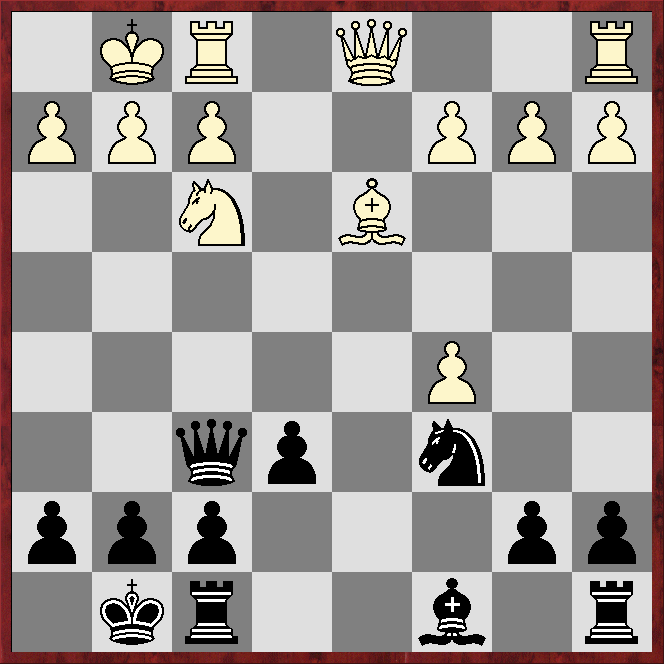
Black to play and gain what the engines reckon is a positionally won game
*****
*****
*****
*****
*****
17...d4?
White does not have a satisfactory answer to 17...Qg6!, according to the engines, the threat being 18...d4. White can stop this with 18.Qd4, but 18...Bb1 threatens both mate and the a2 pawn. White can stop both of these with 19.Bd3, but 19...Bxd3 20.Qxd3 allows 20...Qxg2, when the half-open g file is not of much use to White, with only heavy pieces on the board. Other queen moves by Black are also better than the text.
18.Qxh6 gxh6 19.Bd3 Be6 20.Bb1
Not 20.Kb1 dxc3 21.bxc3, as Stockfish18 points out the possibility of 21...Rxd3!! 22.Rxd3 Bf5 23.Kc2 Rd8 24.Rhd1 b5, when it is only now Dragon1 sees the danger. The point is that the black rook and bishop are holding all three white pieces in place, meaning Black has a free piece in the shape of the king. A sample line runs 25.Rd1 Kg7 26.Rd2 h5 27.Rd2 h4 28.Rd1 Kh6 29.Rd2 Kg5 30.h3 Be4 31.Rd1 Kf4 f5 32.Rd1 Ke5 33.Rd2 f4 34.f3 Bxd3+ 35.Rxd3 Rxd3 36.Kxd3 Kd5, when Black's reserve tempi make this an easily won pawn ending, eg 37.a3 a5 38.Kd2 Kc4 39.Kc2 a4 etc.
20...b5 21.Rd3 dxc3
If 21...b4, then 22.Rhd1 bxc3 23.bxc3, when both black further captures on c3 lose.
22.Rxd8+ Rxd8 23.bxc3
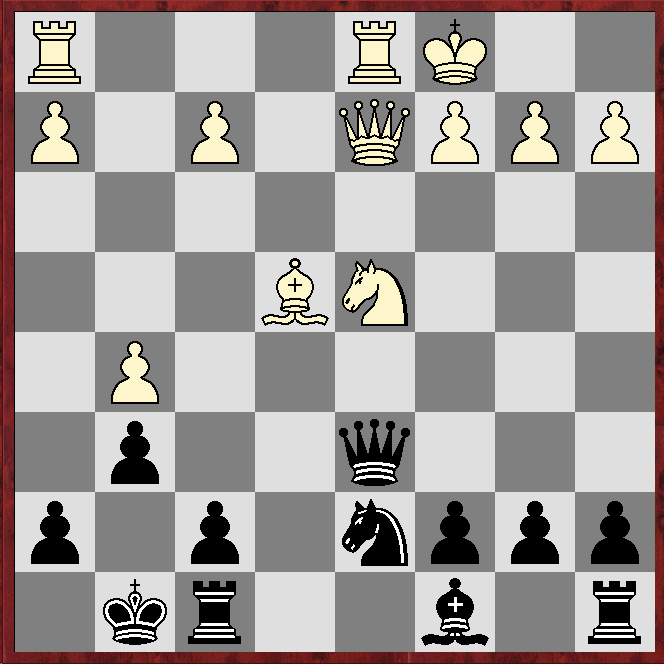
Who, if anyone, has the advantage in this rook-and-bishop ending?
*****
*****
*****
*****
*****
Neither side, it seems - the engines call the game completely equal.
23...Bc4
The engines suggest 23...Rc8 or 23...Rb8!?
24.Re1
Both engines are at first are quite enthusiastic about 24.Rd1, but Stockfish18 soon changes its assessment to equal, although Dragon1 persists in awarding White a slight edge.
24...Rd6 25.Re3 Rf6 26.f3 Ra6 27.Kb2 Rd6 28.Kc1 Kg7 29.a3 Ra6 30.Kb2 Rd6 31.Kc1 Ra6 ½–½

Sunday, 10 December 2023

Benidorm U2000 Round Seven

FACED an Indian junior (born 2009).

Spanton (1743) - Pridhish Kumar (1241)
French Burn
1.Nc3 d5 2.d4 Nf6 3.Bg5 e6 4.e4 dxe4
Via an unconventional move-order the game has reached the starting point of the Burn Variation of the French Defence.
There are 15,256 examples of this position in ChessBase's 2024 Mega database
*****
*****
*****
*****
*****
5.Nxe4 Be7 6.Bxf6!?
Giving up the bishop-pair is slightly anti-intuitive, but is easily the most popular continuation in Mega24.
6...Bxf6 7.Nf3
White argues that the well-placed knight on e4, and an advantage in central space, outweigh Black's bishops.
7...Nd7 8.Qd2 0-0 9.Bd3 Qe7!?
This is a slightly awkward placing for the queen as it obstructs the black dark-square bishop. Stockfish16 and Komodo14.1 like the relatively rare 9...e5!?
10.g4!?
Stockfish16 suggests castling long; Komodo14.1 suggests castling short.
10...g6 11.Nxf6+ Qxf6 12.Be4
The engines give White a slight edge after 12.Qe3.
12...e5 13.g5 Qd6 14.0-0-0 exd4 15.Nxd4
Now both sides have castled, and the centre has been cleared of pawns, how would you assess the position?
*****
*****
*****
*****
*****
White is ahead on development, and Black has weak kingside dark squares. But it is not clear White can exploit these, and meanwhile White's kingside pawns are ragged. The engines reckon the position is equal.
15...Nc5 16.Bg2 c6?!
This may be too slow. The engines prefer 16...Bg4.
17.h4!?
White's attack will turn out to be less threatening than it may look. Instead White would get an initiative after the engines' 17.Qe3.
17...Bg4 18.f3 Bh5!?
The engines are happy with this side-lining of the bishop.
19.Ne2 Qxd2+ 20.Rxd2 Rfd8 21.Rhd1 Rxd2 22.Rxd2 Re8 23.Ng3 Rd1+ 24.Rd1 Rxd1+ 25.Kxd1
Very quickly the game has reached a minor-piece ending that the engines reckon slightly favours White
*****
*****
*****
*****
*****
25...Ne6 26.Nxh5?!
Almost certainly a positional misjudgment, as will be seen. The engines give 26.Kd2 with a slight edge for White.
26...gxh5
Black's kingside pawns are smashed, but White cannot save the h4 pawn.
27.Bh3 Nf4 28.Bc8 b6 29.Bb7 c5 30.Kd2 Ng6 31.Ke3 Nxh4 32.f4?!
This probably makes matters worse by creating another target for the black knight. Better is 32.Ke4.
32...Nf5+ 33.Kf2
Not 33.Ke4?? Nd6+ etc.
33...Kg7 34.Be4 Nd6 35.Bf3 Kg6 36.Be2 h6
Undoubling the black h pawns. Black is winning (Stockfish16) or at least has the upper hand (Komodo14.1).
37.Bd3+ Kg7 38.b3?!
Probably better is capturing on h6 as a white pawn on f4 will be easier to defend than one on g5.
38...hxg5 39.fxg5 f6
A simple solution to clearing a path for the black king. White is more-or-less forced to exchange.
40.gxf6+ Kxf6 41.Kf3 Kg5 42.c3 Nf5 43.a3 Nd6 44.b4 c4 45.Bf1 Nb5!?
The engines prefer 45...Kf5 or 45...h4.
46.Bxc4 Nxc3 47.Kg3 Ne4+ 48.Kg2
Not 48.Kf3?? Nd2+ etc.
48...Kf4 49.Be2 Nf6 50.a4 Ke3?
Komodo14.1 quite likes this, although it seems to throw away the win; both engines prefer 50...Nd5.
51.Bf1 Nd5 52.a5 Nxb4 53.axb6 axb6
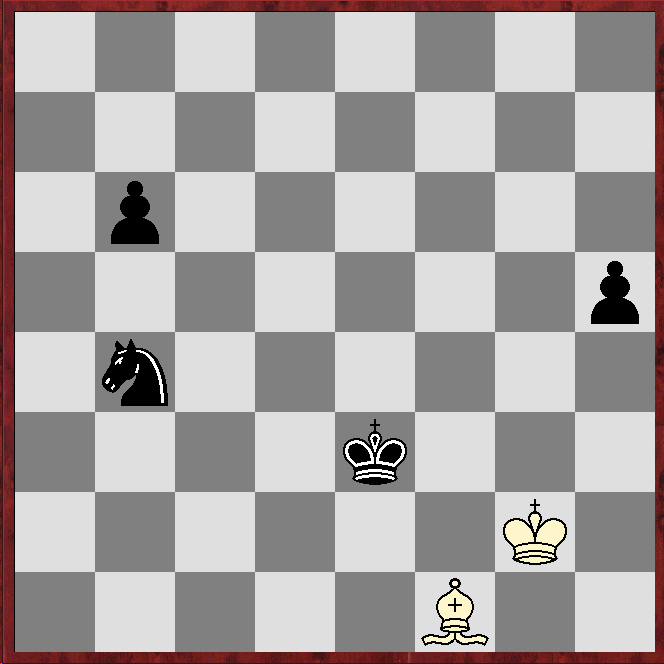
Is Black winning?
*****
*****
*****
*****
*****
Yes, says Komodo14.1; no, says Stockfish16. More importantly, Syzygy, the endgame tablebase, shows the position is drawn.
54.Kg3 Nd5 55.Kh4 Nf6 56.Bb5 Kf4 57.Bd3 Ke5 58.Bc4 Kd4 59.Bf1 Nd5 60.Kxh5 Nf4+ 61.Kg5 Nd3 62.Bh3 b5 63.Be6 b4 64.Kf5 Ne5 65.Ba2 Nc4 66.Ke6 Kc5 67.Kf5 Kd4 68.Ke6 Kc3 69.Kd5 Na3 70.Kc5 Nc2 71.Bg8
PK played on to move 84, but then conceded the draw

Monday, 14 August 2023

Olomouc 65+ Round Four

FACED a Czech today.

Spanton (1858) - Stanislav Sysala (1690)
French Burn
1.Nc3 d5 2.d4 e6 3.e4 Nf6 4.Bg5 dxe4 5.Nxe4 Be7 6.Nxf6+!?
The main move is 6.Bxf6, when the commonest reply in ChessBase's 2023 Mega database is 6...Bxf6, although fashionable recently has been 6...gxf6!?, Black accepting a damaged pawn-structure in return for keeping the bishop-pair. The variation with 4...dxe4 is named after Hull's Amos Burn, and the two games in Mega 23 in which he reached the position after 6.Bxf6 saw him recapture with the g pawn, which was normal in the early days of the variation, until supplanted by the bishop recapture.
6...Bxf6
Here 6...gxf6!? makes less sense on the face of it as White has not given up bishop for knight. However it has been played by grandmasters, and scores 51% in Mega23, just one percentage point less than the text, both scores being good for Black.
7.Bxf6 Qxf6
After the flurry of exchanges on f6, how would you assess the position?
*****
*****
*****
*****
*****
Black has the only developed piece but White has a fourth-rank central pawn against a third-rank one. Stockfish16 and Komodo14.1 reckon White may have a slight edge.
8.Bd3!?
Setting a rather transparent trap. The mainline in Mega23 runs 8.Nf3 0-0 9.Bd3 c5, which transposes to the game.
8...0-0
Guess how many players in Mega23 fell for 8...Qxd4?? 9.Bb5+ etc?
*****
*****
*****
*****
*****
None.
9.Nf3 c5 10.0-0 Nc6!?
The engines prefer 10...cxd4, which may have been first played in Gyula Breyer - Savielly Tartakower, Gothenburg (Sweden) 1928. After 11.Nxd4 Rd8 12.Nb5 Nc6 Black was slightly better, according to the engines, although a draw was quickly agreed.
11.dxc5!?
How should Black respond?
*****
*****
*****
*****
*****
11...Ne5?
Critical is 11...Qxb2, when 12.Bxh7+? Kxh7 13.Ng5+ fails to 13...Kg8! as 14.Qh5 is simply met by 14...Qxc2. Instead Fred Yates - Tartakower, Merano (Italy) 1926, went 12.Qd2 Qf6 13.Ng5 g6 14.Rab1 with a slight edge for White, according to the engines (½–½, 33 moves). Also better than the text is 11...Qe7!?
12.Nxe5 Qxe5 13.b4
Not only is White a pawn up, albeit a doubled one, but Black has problems completing development
*****
*****
*****
*****
*****
13...a5
Both 13...Bd7? and 13...Rd8?? are met by 14.Bxh7+ etc.
14.a3 axb4 15.axb4 Bd7? 16.Rxa8 Rxa8 17.Bxh7+ Kxh7 18.Qxd7 Qf4 19.Rb1
Not 19.Qxb7? Rb8 etc.
19...Ra2
There is no back-rank mate after 19...Qxb4?? 20.Qd3+ and 21.Rxb4.
20.g3 Qf6 21.Qxb7 1-0

Friday, 25 March 2022

Central London League

PLAYED on board one (of five) last night for Battersea 2 against Pimlico Bishops in Central London League Division One.

Spanton (2016) - Christopher Russell (2334)
French Burn
1.Nc3 e6 2.d4 d5 3.e4 Nf6 4.Bg5 dxe4 5.Nxe4 Be7 6.Bxf6 gxf6!?
This is a popular alternative to 6...Bxf6, and better-scoring, at least in ChessBase's 2022 Mega database.
7.Nf3 f5 8.Ned2!?
The main line in Mega22 runs 8.Nc3 a6!? 9.g3, which Stockfish14.1 and Komodo12.1.1 reckon slightly favours White.
8...c5 9.Bb5+!? Bd7!?
This gives up the bishop-pair but accelerates Black's development, as after ...
10.Bxd7+ Nxd7
... both players have two pieces developed, whereas two moves earlier White had two pieces developed against Black's one.
11.c3
The engines like 11.d5!?, which is not in Mega22, meeting 11...exd5 with the calm 12.0-0, claiming a slight edge for White.
11...Qc7 12.Qe2
Bearing in mind what comes next, 12.0-0 may be better.
How should Black proceed?
*****
*****
*****
*****
*****
12...cxd4 13.Nxd4 Qe5!
This comes to be Stockfish14.1's main sequence, the point being an exchange of queens benefits Black more than White as the white king can find a safer haven than is available to the black king.
14.Qxe5 Nxe5 15.0-0
The engines' 15.Ke2!? deserved serious consideration.
15...Rd8 16.N2f3 Nc4 17.b3 Nd6 18.Rfe1
Hoping to create something along the e file, but a damage-limitation exercise was in order, hence the engines preferring 18.Rfd1 or 18.Rad1.
18...Ne4 19.Rac1 Bf6 20.Kf1 0-0 21.Re2 Rd7 22.h3
This comes to be Komodo12.1.1's top choice for a while, but eventually the engines agree best is 22.Rec2, albeit giving Black at least the upper hand after 22..Rc8.
22...Rc8 23.Rec2 a6 24.Ke2?!
The engines prefer 24.g4 (the main reason for playing 22.h3) or 24.Ne2.
24...b5 25.Ke3 Rcd8 26.Nc6 Rc8 27.Ncd4
If 27.Nce5 then 27...Rdc7 28.c4 Bg7!? 29.Ke2 Bh6 with continuing pressure, although no immediate breakthrough.
27...Bg7!?
How should White proceed?
*****
*****
*****
*****
*****
28.Nd2?
Necessary is 28.g4, meeting 28...Bh6+ with 29.g5, when 29...Nxg5? runs into 30.Rg1. However the engines reckon Black is winning after 29...Bf8, eg 30.Ne5 Rd5 31.Nec6 Ba3.
28...Nxc3 29.N2f3 Bh6+ 0-1
The match was drawn 2.5-2.5.

Thursday, 24 September 2020

Chess Evolution: The French Defence (part eight)

BLACK had one other major choice in the French Classical: 1.e4 e6 2.d4 d5 3.Nc3 Nf6 4.Bg5, instead of 4...Bb4 and 4...Be7, and that is 4...dxe4.
The move goes back to at least 1878, but it was English master Amos Burn who popularised it in the late 1880s and the 1890s.
Carl Schlechter - Amos Burn
Berliner SG 70th Anniversary (Berlin) 1897
French Burn
1.e4 e6 2.d4 d5 3.Nc3 Nf6 4.Bg5 dxe4 5.Nxe4 Nbd7
Today 5...Be7 is considered the main move, but Burn scored much better with the text.
6.Nf3 Be7 7.Nxf6+ Nxf6 8.Bd3 c5!?
Burn castled in a round-four win over Rudolf Charousek, as indeed he had done nine years earlier in a win over Charles Locock. But in round five of this tournament, against Richard Teichmann, he switched to the text and lost. This game against Schlecter was in round eight.
9.dxc5!?
Tecihmann preferred 9.c3.
9...Qa5+ 10.c3 Qxc5 11.Qe2
Magnus Carlsen played 11.0-0 in a 2006 win over Ulf Andersson, but the text scores very well in ChessBase's 2020 Mega database.
11...Bd7
Both players are being cagey about their castling intentions, reminding me of the dictum attributed to Pillsbury: "Castle because you will or because you must, but not because you can."
12.Ne5 Rd8
Petrosian played 12...Bc6 in a draw with Spassky in their 1966 world championship match.
13.0-0
Somewhat speculative-looking is 13.0-0-0!? but it seems playable.
13...0-0?
The analysis engines Stockfish11 and Komodo11.01 suggest 13...h6 or 13...Bd6!? The text loses material, but can you see how?
Position after 13...0-0?
*****
*****
*****
*****
*****
14.Rad1?
The position after 13...0-0? appears 12 times in Mega20 but only Ludwig Rellstab - Kurt Richter, Berlin Championship 1932, saw 14.Bxf6 Bxf6 15.Bxh7+ Kxh7 16.Qd3+ Kg8 17.Nxd7 and 18.Nxf6+. If 16...Kh8, White still emerges a pawn up after 17.Nxd7 thanks to having a queen check at h3.
14...Bc6 15.c4 Qb6 16.Qc2 h6 17.Bh4 Rd4 18.Bg3 Rfd8 19.Qe2?!
Black gets something of an initiative after this. Safer was 19.Nxc6.
19...Be4 20.Bxe4 Nxe4 21.Rxd4 Qxd4 22.Qh5 Rf8
Black has been obliged to go passive with his rook, but he commands the centre of the board.
23.b3 Bc5 24.Qe2
The engines suggest 24.Ng4 Nxg3 25.hxg3, but prefer Black after 25...f5 or 25...g6!?
24...Rd8 25.Qh5
Schlechter makes a tacit draw offer, but Burn wants more.
25...f6?
Better is 25...g6, one point being that 26.Qxh6?? loses to 26...Nxg3 and 27...Qxe5.
26.Ng4?!
Schlechter presumably saw he had a draw with 26.Qf7+ Kh7 27.Qg6+, but must have thought Burn's last move left him with winning chances.
26...e5?!
It is hard to know what both players missed as Black seems comfortably better after the simple 26..Nxg3.
27.Qg6?!
Here the engines give 27.Bh4 Ng5 25.Bxg5 hxg5 26.Ne3 with what they reckon is just a small edge for Black.
27...Kf8 28.Ne3 Nc3
Very good for Black, according to the engines, is 28...Qd3, eg 29.Nf5 Rd7 30.Qg4 Nc3, when White can hardly defend his queenside.
29.Qh7?
Correct is 29.Nf5, threatening mate and attacking the black queen at the same time. After 29...Qd7 30.Qh7 Black has no time to go after the white queenside pawns with 30...Nxa2?? as 31.Qh8+ Kf7 32.Qxg7+ Ke6 33.Qg4 leaves him busted.  Best, according to the engines, is 30...Ne2+ 31.Kh1 Qf7 with what they reckon is dead-equality.
29...Ne2+ 30.Kh1 Qd3! 31.Qxd3 Rxd3
With queens off the board, there is no longer any danger to the black king, and Black's pieces are much better coordinated than White's.
32.Rd1 Rxd1+ 33.Nxd1 Bd4 34.f3
Or 34.Ne3 Nc1 etc.
34...Nxg3+ 35.hxg3 f5 36.g4 e4 0-1
Schlechter resigned as the black e pawn will cost White his knight.

Friday, 23 November 2018

Update On Last Night's Game

HERE is the Central London League game from yesterday that I rather badly misevaluated during play.
Spanton (Battersea 3 - 167) - Paul Kennelly (TfL - 159)
French Defence, Burn Variation (by transposition)
1.Nc3 d5 2.d4
The tricky 2.e4 is much more popular but I do not believe it poses an aware-Black any problems.
2...Nf6 3.Bg5 e6 4.e4
By an unusual move-order, we have reached a mainline French, and PK chooses a variation popularised by Amos Burn.
4...dxe4 5.Nxe4 Be7 6.Bxf6
The mainline: White gives up the bishop-pair but has more space in the centre and a well-placed knight on e4.
6...Bxf6 7.Nf3 Nd7
Immediate castling is more common, but the text has been recommended by French Defence guru John Watson.
8.Bd3 b6 9.0-0 Bb7 10.Re1 0-0 11.c3 Be7!?
Preserving the bishop-pair at this point comes to be the analysis engine Stockfish9's first choice.
12.Qe2 c5 13.Rad1 Qc7
White has completed development while Black has no piece beyond the second rank, but who stands better?
*****
*****
*****
*****
*****
*****
I was confident I was much better here thanks to dangerous kingside threats, but Stockfish9 and my other main engine Komodo9 reckon any White edge is worth less than a fifth of a pawn.
14.Bb1
Hoping to set up a battery on the b1-h7 diagonal seemed natural to me but it may be too slow. Komodo9 gives 14.Neg5 Bxg5 15.Nxg5 Nf6 with equality.
Stockfish9 gives 14.dxc5 Nxc5 15.Nxc5 Qxc5, again with equality.
14...Rfe8
This may be a novelty. 14...h6 was played in a drawn game at the 1986 Jersey Open.
The engines give 14...cxd4 15.Nxd4 Rad8 with approximate equality, although Komodo9 prefers Black.
15.Nfg5?!
Wrong knight, it seems.
The point is Black can now play 15...h6 16.Nf3 cxd4, maintaining the bishop-pair in a position that is opening up. The try 16.Nxf7?? Kxf7 17.Qh5+ wins for White after 17...g6? 18.Nd6+!, as I had seen in the game, eg 18...Bxd6 19.Qxg6+ Kf8 20.Qxh6+ Kf7 21.Bg6+ with a massive attack. However, Black has the simple 17...Kg8, when White's attack has run out of steam.
After 15.Neg5 Black cannot drive the knight away with 15...h6? as 16.Nxf7! is devastating, eg 16...Kxf7 17.Qxe6+ Kf8 18.Bg6.
15...g6!?
This looks weakening but Black can easily cover the apparently-weak dark squares.
16.h4!?
Hoping to weaken Black's king's position (I thought I was still better), but it was perhaps time to think about equalising.
The engines at first give 16.dxc5, eg 16...Nxc5 17.Nxc5 bxc5!? 18.Nf3 (18.Nxf7?! does not seem to work) Rab8, when White has no attack but Black has the bishops and queenside pressure.
But given enough time, Komodo9 comes to prefer my choice (Stockfish9 strongly disagrees).
16...cxd4
The classic central answer to a flank attack.
17.Rxd4 Rac8 18.Red1
Battersea 3's captain Howard Groves, who was watching the game quite closely as his opponent failed to show, thought this was too slow, and he may be right (the engines are not too bothered, but prefer 18.h5).
18...Red8
Wrong rook? The engines prefer 18...Rcd8 with a comfortable game for Black.
19.h5
19.Nd6 Bxd6 20.Rxd6 Nc5 seemed to give White nothing, and it doesn't, but it may have been the safest course.
Komodo9 very narrowly prefers 19.Nxe6!? fxe6 20.Nd6 Nf8 (20...Bxd6?? 21.Qxe6+ wins for White) 21.Nxc8 Bxc8 22.Rxd8 Bxd8 with an unclear position, although Stockfish9 reckons Black is better.
19...Bxe4?!
Giving up the bishop-pair makes the position dead-equal, according to the engines, who prefer a knight move, but cannot agree on which one, flitting from 19...Nc5 to 19...Nf8 to 19...Ne5, in each case evaluating the position as slightly better for Black.
20.Ne4 Nf8 21.Qf3 Rxd4 22.Rxd4 Qe5 23.hxg6 hxg6
Black is threatening to take over the initiative
24.Rd1?
Defending my back-rank weakness, but the correct way to do this was with 24.Qd1.
24...Rd8
The engines point out 24...Qb5, when White is on the back foot, but should hold on with accurate play.
The text allows ...
25.Rxd8 Bxd8 26.Qd3
… when White's difficulties are over.
(½-½, 51 moves)