Showing posts with label Berlin Wall. Show all posts

Thursday, 29 October 2026

English 65+ Round Five

Orton Mere
Philip Bonafont (2122 ECF/1956 Fide) - Spanton (1944 ECF/2035 Fide)
Spanish Berlin
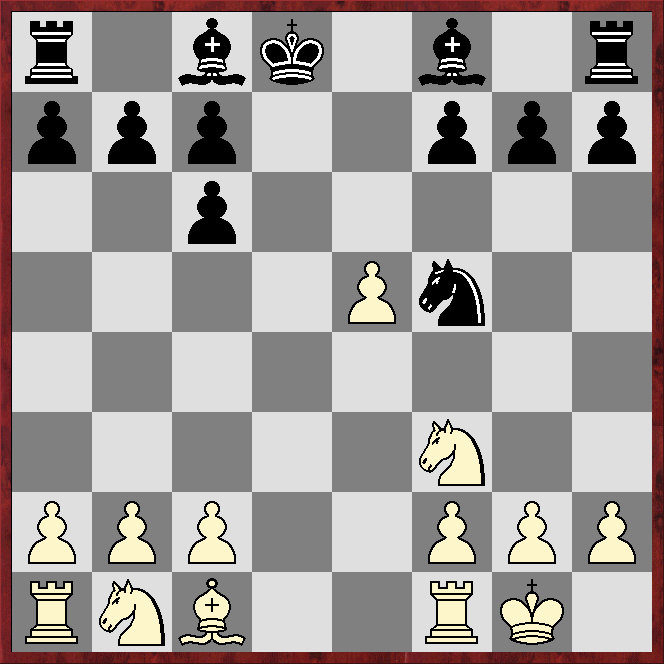
1.e4 e5 2.Nf3 Nc6 3.Bb5 Nf6 4.0-0 Nxe4 5.d4 Nd6 6.Bxc6 dxc6 7.Qxd8+ Kxd8 9.Nc3 Be7!?
A relatively rare continuation, lagging in popularity behind ...Ne7, ...Bd7, ...h6 and especially ...Ke8.
How should White respond?
*****
*****
*****
*****
*****
10.g4!?
The main move in ChessBase's 2026 Mega database is 10.h3, which is liked by both Stockfish19 and Dragon1, along with 10.Rd1+ (Stockfish19) and 10.a4 (Dragon1).
10...Nh4 11.Nxh4 Bxh4 12.h3 h5 13.f3 Bg3?
Apparently a novelty, and not a good one as the e5 pawn cannot be safely won. The engines suggest 13...Ke7, 13...Be6 or 13...b6!?
14.Bg5+ Ke8 15.Rad1?
Correct is 15.Kg2 Bxe5 (15...h4?! is even worse, according to the engines, eg 16.f4 Be6 17.Rad1, when Black's pieces have very little play) 16.Rae1 f6 17.Bf4, one line running 17...Kf7 18.Bxe5 fxe5 19.Rxe5 Be6 20.Rfe1 Rae8 21.Kg3, with an advantage for White that the engines reckon is worth more than two pawns.
15...Be6 16.f4 hxg4 17.hxg4 Bxg4
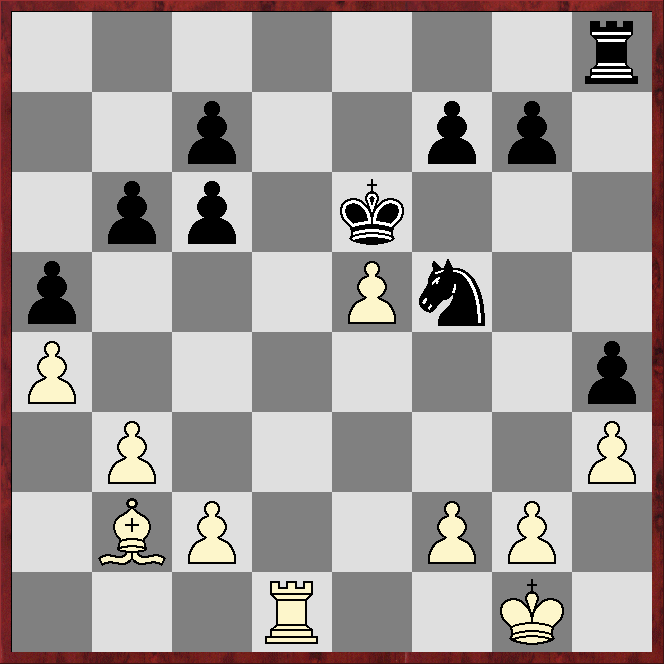
How should White proceed?
*****
*****
*****
*****
*****
18.Rd3?
White has enough compensation for a pawn after several moves, according to the engines, but not the text. Perhaps best is 18.Rd2, when the game's 18...Bh4?? is a blunder, thanks to 19.Rh2, so Black should perhaps play 18...Bf5, when 19.Rg2 f6!? 20.exf6 gxf6 21.Bxf6 Rh3 seems equal.
18...Bh4 19.Bxh4 Rxh4 20.f5 Rd8??
This turns a winning position into a losing one. After 20...Rh5, White has nothing better than 21.f6, when 21...g6 solidifies the black kingside, leaving Black with an advantage worth about a piece, according to the engines.
21.Rf4 Rxd3 22.cxd3 g5 23.fxg6 fxg6 24.Ne4
The bishop cannot be saved.
24...Ke7 25.Nf2 g5 26.Rxg4 Rxg4+ 27.Nxg4 Ke6 28.Kf2 Kf5 29.d4!? Ke6 30.Ke3 b6 1-0

Sunday, 4 February 2024

Mariánské Lázně Lesson 9: Attacked Pawns Do Not Have To Be Defended

THE following Berlin Wall position, which apparently was first reached 23 years ago in a Kasparov-Kramnik clash, arose in my round-nine game.
My opponent has just recaptured on g5
*****
*****
*****
*****
*****
*****
*****
Kramnik played 12...h6, which Stockfish16 and Komodo14.1 agree is best.
I preferred 12...Nd4!?, somewhat naively excepting the reply 13.Rac1?!, after which 13...Bf5 looks strong, at least at first glance, as 14.Nge4?? loses to 14...Bxe4 15.Nxe4 Ne2+ etc.
But White circumvented all this with 13.Rad1!, when 13...Nxc2? loses to 14.a3, so instead there came 13...Ne6 14.Nxe6 Bxe6, after which the apparent novelty 15.f4!? gave White at least a slight edge, according to the engines.
LESSON: some 'forcing' moves, such as attacking an undefended pawn, may not be so forcing after all.

Sunday, 21 January 2024

Mariánské Lázně Round Nine

Fresh overnight snow
FACED my fifth Czech in the last round.

Jan Židů (1835) - Spanton (1736)
Spanish Berlin
1.e4 e5 2.Nf3 Nc6 3.Bb5 Nf6 4.0-0 Nxe4 5.d4 Nd6 6.Bxc6 dxc6 7.dxe5 Nf5 8.Qxd8+ Kxd8
This Berlin-Wall tabiya occurs 7,386 times in ChessBase's 2024 Mega database
*****
*****
*****
*****
*****
9.Nc3 Ke8
This is easily the most-popular continuation.
10.h3 Be7 11.Bg5 Bxg5 12.Nxg5
How should Black proceed?
*****
*****
*****
*****
*****
12...Nd4!?
This looks promising at first, but White has a strong reply. Stockfish16 and Komodo14.1 recommend 12...h6, and if 13.Nf3 then 13...h5!?
13.Rad1! Ne6
Not 13...Nxc2 14.a3!
14.Nxe6 Bxe6 15.f4!?
This may be a novelty. The engines prefer it over the known move 15.Ne4.
15...Rd8
The engines find it hard to decide whether the text or 15...g6 is better, but bad is 15...h5? 16.f5 Bc4 17.Rf4 Ba6 18.Rfd4.
16.Rxd8+ Kxd8 17.g4 h5 18.f5
Where should the bishop go?
*****
*****
*****
*****
*****
18....Bc8
The engines reckon 18...Bd5! equalises as 19.Rd1 Ke7 20.Nxd5 cxd5 21.Rxd5 can be met by 21...hxg4 22.hxg4 Rh4 23.Rd4 g6.
19.Kg2
The engines reckon 19.Kf2!? is stronger, although I have not been able to work out why. After both moves the king usually ends up on g3, which it can reach just as easily from g2 as from f2. In practical play, 19.Kf2!? has the advantage that it sets a positional trap, viz 19...hxg4 20.hxg4 Rh2+?! 21.Kg3 Rxc2?!, after which 22.Rh1 is very strong, eg 22...Ke7 23.Rh7 Rxb2 24.Rxg7 Bd7 25.Ne4 Rb5 26.Ng5 Rxe5 (26...Be8?! 27.f6+) 27.Kf4 Re2 28.Rxf7+ Ke8 29.Rh7. Black is a pawn up, but White has much the more dangerous play, one line running 29...Rxa2 (not 29...Re7?? 30.Rh8#) 30.Ke5 Re2+ 31.Kf6 Kd8 32.Nf7+ Kc8 33.Rh8+ Re8 34.Rxe8+ Bxe8 35.g5 etc.
19...Re8 20.Re1
The engines reckon White gets an advantage with a line that involves sacrificing three pawns: 20.Rd1+ Bd7 21.e6!? fxe6 22.f6!? gxf6 23.Ne4 hxg4 (not 23...Rf8? 24.Nc5) 24.h4! Their main continuation runs 24...f5 25.Nc5 b6!? (25...Re7?! 26.h5 Rh7 27.Rxd7+ Rxd7 28.Nxd7 Kxd7 29.h6 etc) 26.Nxd7 Ke7 27.Kg3 Rd8 28.h5!
20...g6?!
Black is equal after 20...hxg4 21.hxg4 g6 22.fxg6 fxg6, according to the engines.
21.fxg6
Apparently winning is the pawn sacrifice 21.e6!?, eg 21...fxe6 22.fxg6 hxg4 23.h4. The engines reckon a better defence is 21...gxf5, but agree 22.exf7 Rf8 (forced) 23.gxh5!? Rxf7 gives White the upper hand after 24.Ne2.
21...hxg4?
Better is 21...fxg6 with what the engines reckon is an equal position.
22.gxf7 gxh3+ 23.Kh2 Rf8 24.e6 Ke7 25.Ne4!
There is no defence
*****
*****
*****
*****
*****
25...Kxe6
The bishop is lost after 25...Bxe6.
26.Ng5+ Kf6?!
Slightly better is 26...Kd7, but after 27.Kxh3 the f pawn is too strong.
White to play and win
*****
*****
*****
*****
*****
27.Re8?
The simple fork 27.Nh7+ wins, eg 27...Kxf7 28.Rf1+, or 27...Kg7 28.Nxf8 Kxf7 (28...Kxf8 29.Re8+)  29.Nh7 Kg6 30.Re7.
27...Kg7 28.Re7 Kf6 29.Re8
JŽ offered a draw in my time (just).
29...Kg7 30.Re7 Kf6 ½–½

Tuesday, 15 August 2023

Olomouc 65+ Round Five

FACED a Czech today.

Jiří Bříza (1830) - Spanton (1858)
Spanish Berlin
1.e4 e5 2.Nf3 Nc6 3.Bb5 Nf6 4.0-0 Nxe4 5.d4 Nd6 6.Bxc6 dxc6 7.dxe5 Nf5 8.Qxd8+ Kxd8
The starting tabiya of the Berlin Wall
*****
*****
*****
*****
*****
9.Ng5!?
There are eight more-popular moves in ChessBase's 2023 Mega database, but the text has also been played by players rated over 2300, one point being Black is stopped from going for a setup with the king on the queenside (eg after ...Bd7, ...b6, ...Kc8 etc).
9...Ke8 10.Nbd2 Be7 11.Ndf3 h6 12.Ne4 Be6 13.b3 a5 14.a4 b6 15.Bb2 Rd8 16.Rfd1 Rd7!?
The idea is to create a route to the queenside for the black king, which might then go via b7 to c6 (after ...c5 is played).
17.h3 h5!?
Discouraging g4 but losing control of the g5 square.
18.Neg5 Bxg5 19.Nxg5 h4!?
This more-or-less fixes the the white g pawn, but leaves the black h pawn potentially weak.
20.Rxd7 Kxd7 21.Rd1+ Ke7 22.Nxe6 Kxe6
Who stands better after the flurry of exchanges?
*****
*****
*****
*****
*****
White has the better minor piece for cooperating with a rook, but the e pawn is weak and obstructs the bishop. The knight has a strong outpost, but developing the black rook will not be simple. Neither pawn-majority is ideal for creating a passed pawn. Stockfish16 and Komodo14.1 reckon the position is equal.
23.Kf1 Ne7 24.c4 c5
The engines reckon 24...Ng6 can be met by 25.Ke2!?, and if 25...Nxe5 then 26.Bxe5 Kxe5 27.Rd7 is fine for White.
25.f4!?
This defends e5 but further restricts the bishop and creates holes in the white kingside. The engines prefer 25.Ke2.
25...g6
Maybe 25...Nc6 gives a better chance of an edge, eg 26.Bc3!? (the engines reckon there is nothing better) Nd4 27.Kf2 (not 27.Bxd4? Rd8) Nxb3, but the engines still call the game equal.
26.Kf2 Nf5 27.Kf3 Rg8 28.Kf2 Ke7!?
How should White meet Black's plan of offering an exchange of rooks?
*****
*****
*****
*****
*****
29.e6!?
A positional pawn sac to bring the bishop to life. The sacrifice appears to be sound, but the engines reckon allowing an exchange of rooks is also fine.
29...fxe6 30.Be5 Nd6 31.Rd3 g5 32.g4
One of several moves to maintain complete equality, according to the engines.
32...hxg3+ 33.Kxg3 gxf4+ 34.Kxf4 Rf8+ 35.Ke3!?
This may be OK but simpler seems to be 35.Kg4 and 35.Kg3.
35...Rf5 36.Bg3 Rh5 37.Ke2?!
This may be a mistake. The engines like h4 or Kf2, eg 37.h4!? Nf5 38.Kg3 does not lose a pawn as 38...Nxh4+?? fails to 39.Kg4. Similarly 37.Kf2 is fine as 37...Rxh4?? 38.Bxd6+ is a disaster for Black.
The text also indirectly protects the h pawn, but after ...
37...e5 38.Bf2 Nf5
... Black is making progress, and the bishop is no longer much of a threat to the black queenside pawns.
39.Kd2?!
The engines strongly dislike this, preferring 39.h4. But then 39...Nxh4!? 40.Rh3 Ng2 41.Rxh5 Nf4+ 42.Kf3 Nxh5 is winning, according to Komodo14.1, although Stockfish16 reckons Black only has a slight edge.
39...e4 40.Rd5!?
The horribly passive 40.Rc3 may objectively be slightly better, according to the engines.
40...Ke6 41.h4 c6?!
This wins a pawn but seems to throw away the full point. After 41...Rh8 Black threatens to trap the white rook with 42...c6, so White has to move the king, with 42.Ke2 for example, when the engines reckon 42...Rg8! wins, one line running 43.Rd1 Rg2 44.Kf1 Rh2 45.Kg1 Rh3 followed by ...Rxb3 or ...Nxh4.
42.Rd8 Nxh4 43.Re8+ Kf5 44.Rf8+ Kg4 45.Ke3 Nf5+ 46.Kxe4 Nd6+ 47.Kd3 Rh3+ 48.Be3 Nf5 49.Rg8+ Kf3 50.Rf8 Kg4
I offered a draw, but I do not think JB noticed.
51.Rg8+ Kf3 52.Rf8 ½–½

Sunday, 11 September 2022

Lessons From Newcastle VI

IN round six of the Northumbria Challengers (U2000 Fide) I had black against a player rated 2010 ECF/1937 Fide.
The full game can be seen at N6 but here I want to concentrate on an instructive moment in the opening, which was a Berlin Defence to the Spanish.
It began 1.e4 e5 2.Nf3 Nc6 3.Bb5 Nf6 4.0-0 Nxe4 5.d4 Nd6 6.Bxc6 dxc6 7.dxe5 Nf5 8.Qxd8+ Kxd8.
The main tabiya of the Berlin Wall
*****
*****
*****
*****
*****
The main continuation in ChessBase's 2022 Mega database is 9.Nc3, while Stockfish15 likes 9.h3 and Komodo13.02 prefers 9.Rd1+.
The game saw 9.Bg5+!?, which at first glance may seem a good move - after all White has developed a minor piece with tempo.
In addition, after 9...Ke8 - the main reply in Mega22 - the black king can no longer go the queenside, at least in the short and medium term.
This can be argued as an achievement for White in that there are important lines in the Berlin Wall in which Black develops the light-square bishop, plays ...Kc8 and later, after playing ...b6 and ...c5, redeploys the king via b7 to the active square c6.
So far, so promising, but the position is rather more complicated than this makes it seem.
The game continued 10.Rd1 Be6, and now came 11.b3, the point being to meet 11...h6 with 12.Bc1.
Position after 12.Bc1
Now compare this with the line 9.Rd1+ Ke8 10.b3.
Position after 10.b3
White's set-up in the two diagrams is exactly the same, but Black in the game position has two extra tempi: ...Be6 and ...h6.
The former is obviously a useful developing move, while the latter is a defensive move often played by Black in the Berlin Wall to control g5.
None of this is fatal for White's chances, but it does help show why 9.Bg5+ appears 157 times in Mega22 while 9.Rd1+ occurs 804 times.
The latter has been tried by Carlsen, Caruana, Kamsky and many other top players, while the highest rated player to try 9.Bg5+ is a 2382, although admittedly it was reasonably popular with quite strong players in the pre-elo era.

Monday, 29 August 2022

Northumbria Challengers (U2000 Fide) Round Six

PLAYED today.
The Holy Name Roman Catholic church, Jesmond

Robert R Sanders (2010 ECF/1937 Fide) - Spanton (1949 ECF/1852 Fide)
Spanish Berlin
1.e4 e5 2.Nf3 Nc6 3.Bb5 Nf6 4.0-0 Nxe4 5.d4 Nd6 6.Bxc6 dxc6 7.dxe5 Nf5 8.Qxd8+ Kxd8
The main tabiya of the Berlin Wall - how would you proceed?
*****
*****
*****
*****
*****
9.Bg5+!?
Developing a piece with tempo is something beginners' books tend to stress, but for the most part here strong players here have tended to choose something else. The mainline in ChessBase's Mega 2022 database runs 9.Nc3 Ke8 10.h3 h5 11.Bf4 Be7 12.Rad1 Be6 13.Ng5 Rh6!?, when Stockfish15 and Komodo13.02 reckon White is slightly better.
9...Ke8 10.Rd1 Be6 11.b3!?
Preparing to fianchetto the light-square bishop, which is very likely to be hit by ...h6, which generally is a useful move for Black in the Berlin Wall.
11...h6 12.Bc1 a5 13.a4 Be7 14.Ba3 Bxa3 15.Nxa3 Rd8 16.Rxd8+ Kxd8 17.Rd1+ Kc8 18.Kf1
Each side has fewer than 13 points in pieces, using the traditional system of Q=9/R=5/B=3/N=3, which I regard as making this an endgame - how would you assess it?
*****
*****
*****
*****
*****
White has the superior pawn-majority and has more pieces in play, although the knight on a3 will require at least two tempi to redeploy somewhere useful. Black has the only bishop, and it might be able to usefully target White's queenside pawns. Meanwhile the e pawn could prove over-extended. Stockfish15 gives Black the upper hand; Komodo13.02 gives Black a slight edge.
18...Re8 19.Nb1 Ne7!?
White's knight retreat is aimed at getting the knight into a generally more useful position; Black's knight retreat has a more-aggressive aim.
20.Nc3?!
I was expecting the knight to go to d2 to support the f3 knight in defending e5. On c3 it is almost as irrelevant to the critical point of the battle as it was on a3.
20...Bg4 21.Rg3 Ng6
Without making an obvious error, but by probably playing a series of slightly sub-optimal moves, White faces losing the e pawn
*****
*****
*****
*****
*****
22.h3!?
This is Komodo13.02's top choice. Stockfish15 gives best-play as 22.Re3 c5 23.Ke1!? Nf4 24.Kf1 Rd8, but reckons Black is positionally winning.
22...Bxf3 23.Rxf3 Nxe5 24.Re3 Re7 25.Ke2 Ng6 26.g3 Rxe3+ 27.Kxe3 Kd7 28.f4
As I was thinking about my next move, RS offered a draw
*****
*****
*****
*****
*****
Clearly, barring blunders, there are only two possible outcomes - a draw or a black win. Stockfish15 reckons Black is winning, but Komodo13.02 gives Black 'only' the upper hand.
28...Ne7 29.Ke4 Ke6 30.Ne2 f5+ 31.Kd3 b6 32.Nd4+ Kd5 33.c4+ Kd6 34.Kc3 c5 35.Nf3
Stockfish15 reckons Black is the equivalent of more than four pawns ahead, which I find hard to believe, but even the more-conservative Komodo13.02 reckons Black is winning (+1.8)
*****
*****
*****
*****
*****
35...Nc6
The problem with such engine evaluations is that, in the absence of obvious positional compensation, engines tend to overvalue material considerations, not appreciating the difficulty of converting a material-plus well beyond their event horizons.
36.Kd3 Ke6 37.Kc3 Kf6 38.h4!?
The engines are OK with this, at least at first, but it creates a weakness at g4. However Black was threatening ...g5, which is also problematic for White.
38...Kg6 39.Kd3
How should Black proceed?
*****
*****
*****
*****
*****
39...Kf6
This does not spoil anything, but 39...Kh5 40.Ke3 Nd4! wins. I rejected it because after 41.Nxd4 cxd4+ 42.Kxd4 Kg4 43.Kd5 Kxg3 44.Kc6 Kxf4 45.Kxc7 Ke5 46.Kxb6 f4 47.c5 f3 48.c6 f2 49.c7 f1=Q White also queens and is at least equal. I missed that Black has 45...g5!, which wins as 46.Kxb6 g4 47.c5 g3 48.c6 g2 49.c7 g1=Q+ prevents White usefully queening, eg 50.Kb7 Qg7+ 51.Kb8 Qe5 52.Qb7 Qd5+ etc.
40.Ke3
RS offered a draw.
40...Ke6 41.Kd3 Nd8 42.Ne5 Nb7
Not 42...Nf7? as 43.Nxf7 is surely a draw, as Stockfish15 agrees, although Komodo13.02 at first insists Black is winning, before eventually settling on giving Black the upper hand (+1.4).
43.Nf3 Nd6 44.Nd2 Kf6 45.Ke3 Kg6 46.Kf3 Kh5 47.Kg2 Ne4 48.Nxe4?
The engines reckon 48.Nf1 is better, and certainly Black would still have plenty of work to do.
48...fxe4 49.Kh3
Or 49.Kf2 Kg4 50.Ke3 Kxg3 etc.
Black to play and win ... or lose
*****
*****
*****
*****
*****
49...g5??
Winning is 49...Kg6 as 50.g4 is met by 50...h5, and if 51.Kg3 then 51...Kf6.
50.g4+ Kg6 51.fxg5 hxg5 52.h5 (1-0, 58 moves).

Tuesday, 2 July 2019

Boring Chess?

IT is far from uncommon for people today to complain that the Berlin Defence (1.e4 e5 2.Nf3 Nc6 3.Bb5 Nf6), or rather the variation of this defence dubbed the Berlin Wall (5.0-0 Nxe4 6.d4 Nd6 7.Bxc6 dxc6 7.dxe5 Nxf5 8.Qxd8+), is boring chess.
It could be counter-argued that there is no such thing as a boring game of chess - only boring people who do not understand some games.
Be that as it may, I was reminded of a time not so long ago when another double-e pawn opening, the Petrov Defence (1.e4 e5 2.Nf3 Nf6), was all the rage at the elite level and similarly faced accusations of being boring.
What prompted my memory was flicking through an old copy of Chess Life, the magazine of the US Chess Federation, from April 2003.
Grandmaster Michael Rohde devoted his Game Of The Month column to Topalov - Anand from Wijk aan Zee 2003, while fellow grandmaster Robert Byrne devoted his 65th Square column to Bologan - Kasimdzhanov from Pamplona 2002.
Both games were Petrovs, and both featured White sacrificing a bishop on h6, but there the coincidences ended  - Black won the former game, White the latter.
You can easily find the games online, and both are included with notes in ChessBase's 2019 Mega database.
Looking at my own practice, I see the Petrov has occurred in 26 games - in some I was Black, but mostly White - with just seven of the games ending as draws.
Here is a correspondence example against the German player Reinhard Sperrer.
Spanton - Sperrer
IECG Cup Preliminaries 2005
1.e4 e5 2.Nf3 Nf6 3.Nxe5 d6 4.Nf3 Nxe4 5.c4!?
This strange-looking move was recommended by international master (now grandmaster) Larry Kaufman in his famous 2004 repertoire book The Chess Advantage In Black And White. But I am fairly sure I did not buy the book until quite some time after it came out, so I must have got the idea of 5.c4!? from somewhere else (I also used it two years later in the IECG World Championship Semi-Final against IECG international master Eric Noire, drawing in 30 moves). Kaufman says 5.c4!? "is closely related to the slightly more fashionable 5.Nc3 as both moves can lead to doubled c pawns."
It has been tried by some famous players, including Leko and Karjakin, and in Mega19 has a better scoring-percentage than the more-popular alternatives d4, Nc3, Qe2 and d3.
5...Be7
The commonest reply - Noire preferred 5...Nc6.
6.d4 0-0
First played, it would seem, by Blackburne in a win against Winawer in 1880, although in that game White transposed his fifth and sixth moves.
7.Bd3 Nf6 8.h3
My main analysis engines Stockfish10 and Komodo9 prefer 8.0-0, which is slightly more popular in Mega19 and was chosen by Yangyi Yu (2759) in a Chinese Championship blitz game last year. But give the engines long enough and they switch to 8.Nc3, with the text becoming Stockfish10's second choice.
8...Nc6 9.a3
Defending against …Nb4, but also preparing possible further queenside expansion with b4. The two most-recent Mega19 games, one featuring a 2466 and the other a 2581, saw 9.Nc3.
9...d5 10.Nc3 dxc4
The engines' choice, and probably the most-combative line as an IQP usually leads to sharp play.
11.Bxc4 a6
Stockfish10 prefers 11...h6, while Komodo9 gives 11...Bd6, in each case with a slight edge to White.
12.0-0 Bf5 13.d5
I see from my notes I seriously considered five moves here, including the engines' choice 13.Re1, without being especially happy with any of them.
13...Na7
Stockfish10 reckons this gives Black equality. The idea, at least the way my opponent plays it, is to re-route the knight via c8 to either blockade my IQP on d6 or to attack it from b6. The drawback is that this takes time in an open position.
14.Re1 Nc8 15.Bg5 Re8 16.Bd3!?
A controversial choice. Stockfish 10 reckons the coming exchange gives Black a slight edge, but Komodo9 reckons it is White who gets a slight edge.
16...Bxd3 17.Qxd3
White has developed all his pieces, except for the queen's rook. Meanwhile Black still has to redevelop his queen's knight, as well as getting his queen's rook into play, the latter being unlikely until after his queen finds a good square.
Black to make his 17th move, and start to catch up in development
*****
*****
*****
*****
*****
17...Nb6?!
This puts pressure on d5, but that is easily parried by White developing his queen's rook to its obvious square. There is a danger the knight will be out of play if White can generate kingside threats.
The engines prefer 17...h6, which I see from my notes I was planning to meet with 18.Bh4, with what I thought was a slight edge. Stockfish10 more-or-less agrees, although at first it goes with Komodo9's suggestion of 18.Be3.
18.Rad1 Qd7?!
Black keeps developing, but this lets my king's knight come to e5 with tempo. The engines again prefer ...h6, but believe White to be on top after 19.Bh4.
19.Ne5 Qd6
Retreating the queen to d8 or c8 was a lesser evil, according to the engines, but is certainly unappetising.
20.Qf5 h6?
The engines give 20...Rf8, when my notes only have the line 21.Nc6!? bxc6 22.dxc6 Qc5 23.Re5 Qxc6 24.Rxe7 Ne8 25.Bf4 "with the upper hand." However, the engines seem to improve Black's play with 22...g6!? 23.Qxf6 Bxf6 24.Rxc5, when White is a pawn up, and Black has two isolanis, but there is a lot of play left.
21.Bxh6!
The same sacrifice as in the two grandmaster games in Chess Life.
21...gxh6?
The sacrifice should be declined, but then Black is a pawn down and with the worse position.
22.Ne4 1-0
Black resigned because 22...Nxe4 loses to 23.Qxf7 Kh8 24.Ng6+, while 22...Qd8 fails to a rook lift along the third rank.

Sunday, 18 February 2018

Berlin Shocker

PLAYED in the revived Northumbria Masters, held in an upstairs function room at The Chillingham pub, Newcastle.
My score of +1=3-5 was enough to shed 25.8 Fide elo.
I had a stinking cold, complete with hacking cough; but, then again, I was not the only one under the weather.
The most memorable moment, at least for me, was when I was on the end of a shocking finish in a Berlin Wall.
White to play his 25th move in Robin Nandi (1815) - Spanton (1901)
At first glance, Black's position may not look too bad. True, White has the better pawn-majority, but Black's active bishop-pair gives some compensation.
Indeed, after a "normal" move such as 25.Kf4, analysis engines reckon White's advantage is fairly small (but real enough).
Instead, RN uncorked 25.Nf6+!, after which a strong player would have resigned immediately.