Showing posts with label French Steinitz. Show all posts

Saturday, 21 December 2024

What Do The Engines Say? 2. French Defence

MODERN computer programs are revolutionising how we approach openings.
This first became noticeable when supposedly refuted moves started making a comeback as engines showed resources that had evaded the world's top players.
But more recently, as engines grow in strength, there has been a trend in the opposite direction, at least at the highest level.
Grandmaster Nigel Davies summed this up in a post at chesspublishing.com, where he recounted a conversation with Canadian GM Kevin Spraggett, who "opined to me that ancient openings are making a comeback because engines are finding flaws in the more risky ones."
Davies added: "I think there is a lot of truth in this, which is confirmed by the migration of top players to strictly classical openings."
Engines are still far from the stage of knowing all there is too known about openings.
Their play in that stage of the game is not on a par with their abilities in tactical middlegames.
We cannot expect engines to tell us move-by-move how to play our favourite opening variations,
But their opinions on what we should be looking at - the moves that show the most promise - are certainly well worth considering.
So in this series I will be looking at what the engines say about mainline opening positions.

WHEN hot-favourite Gukesh Dommaraju sat down with the white pieces for the first game of the world championship match, he was probably not expecting the champion, Liren Ding, to play the French Defence.
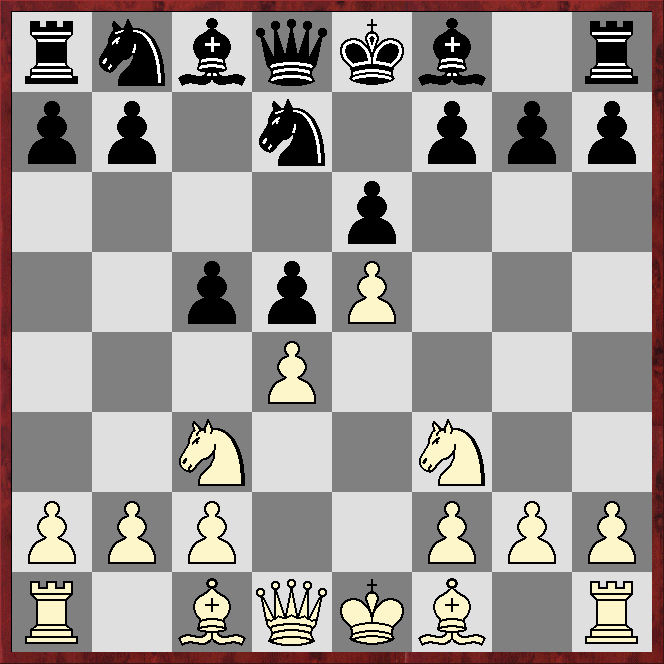
Gukesh met 1.e4 e6 2.d4 d5 with 3.Nc3, and, when Ding replied 3...Nf6, continued with the Steinitz Variation, ie 4.e5.
Stockfish17 and Dragon1 fluctuate between 3.Nc3 and 3.e5 (the fashionable - after a long time in the doldrums - Advance Variation), but come to settle on the former, albeit marginally.
After 3...Nf6 Stockfish17 agrees with 4.e5, but Dragon1, although at first also preferring that move, comes to give the edge to the more popular 4.Bg5.
Both engines reckon their move gives White a slight edge, while claiming the other move leaves the game equal.
However, allow Dragon1 a lot more time to consider the position, and it too comes to prefer 4.e5, albeit marginally.

Tuesday, 22 October 2024

Sant Jordi Round Three

FACED a Taiwanese.

Spanton (2013) - Sung-Jui Yang (1882)
French Steinitz
1.Nc3 d5 2.d4 e6 3.e4 Nf6 4.e5 Nfd7 5.Nf3
Tarrasch's recommendation.
5...c5 6.dxc5
This is far and away the commonest continuation in ChessBase's 2024 Mega database, but Stockfish17 and Dragon1 suggest 6.Ne2!?, although it scores 12 percentage points fewer.
6...Nc6 7.Bf4 Nxc5!?
The main move is 7...Bxc5, but the text scores 59%, a very high score for Black, and much better than 7...Bxc5's 47%.
How should White respond?
*****
*****
*****
*****
*****
8.Bd3!?
This is the main move in Mega24, but it means White will likely lose the bishop-pair and be left with a bishop that is at least semi-bad (central white pawn on a dark square).
8...Be7 9.Qe2?!
White should probably hold back on developing the queen.
9...Nxd3+ 10.Qxd3!?
The engines agree this is better than recapturing with the c pawn, but it means White has lost a tempo in having already moved the queen.
10...Bd7 11.0-0
How should Black proceed?
*****
*****
*****
*****
*****
11...g5!
S-JY spent in the region of 30 minutes on this move, but it is approved of by the engines, thus proving an exception to John Nunn's rule that taking more than 20 minutes on a single move is counter-productive.* The idea is known in similar lines, but appears to be a novelty here, although the diagrammed position usually arises with White to move.
12.Bg3 h5 13.h3 g4!?
Opening lines to the black king, although possibly at the cost of giving up a pawn. The move is Stockfish17's top choice for quite some time, but Dragon1 prefers 13...Qb6, and Stockfish17 comes to agree with that verdict.
14.hxg4 hxg4 15.Nh2 Rg8?
An overly cautious continuation. Instead the engines reckon 15...Qb6!? gives Black the upper hand.
16.Qh7 Rg6?
The engines suggest 16...Rf8!?, claiming White is at best slightly better.
17.Qh8+ Bf8
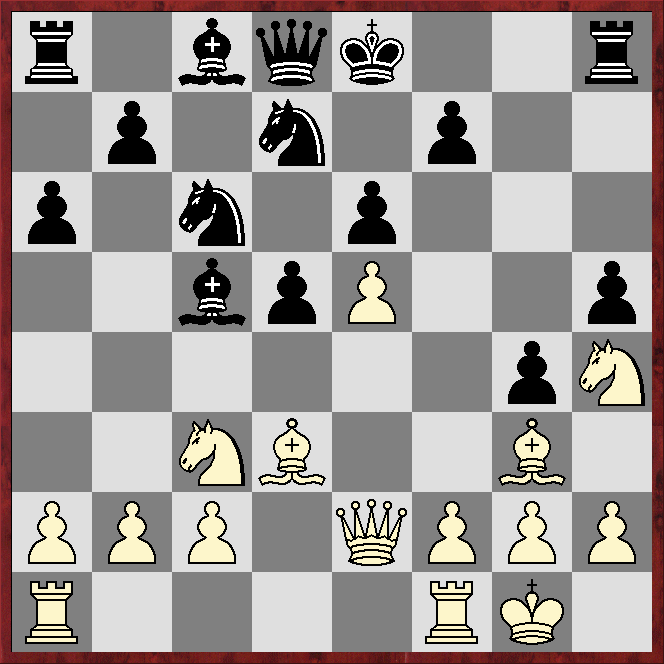
White to play and gain a winning advantage
*****
*****
*****
*****
*****
18.Bh4??
After this move Black, rather than White, is winning, according to the engines, which reckon Black has no good answer to 18.Nb5, with Bh4 and/or Nd6+ to come.
18...Qb6
Black threatens ...Rh6 and ...Qxb2+.
19.Bf6 Ne7?
Black has several strong continuations, including 19...g3, 19...Qxb2 and 19...Nd4.
20.Bxe7 Kxe7 21.Qh4+ Ke8 22.Nxg4 Qxb2 23.Ne2
What should Black play?
*****
*****
*****
*****
*****
23...Bb5?
This was a good time to sacrifice the exchange. After 23...Rxg4! 24.Qxg4 Qxe5 Black has a pawn and the bishop-pair for a rook, which, other things being equal, is normally considered an even balance of material. Stockfish17 agrees the position gives equal chances, but Dragon1 slightly prefers White.
24.Rfb1?!
Almost certainly stronger is 24.Rab1. The text gives Black a second chance to sac the exchange, albeit in less favourable circumstances than on the previous move.
24...Rxg4!?
After 24...Qxc2?! both 25.Nd4 and 25.Rxb5 seem good for White, as Nf6+ is to come.
25.Qxg4 Qxe5 26.Nd4 Ba6 27.Re1
Missing 27.Nxe6! fxe6 28.Re1, after which Black is busted, eg 28...Qg7 29.Qxe6+ Be7 30.Rad1 Qf7 31.Qe5! Rd8 32.Rd4! Kd7!? 33.Rf4! (much stronger than 33.Rxd5+) Qe8 34.Qe6+ Kc7 35.Rf7 etc.
27...Qg7! 28.Qf4
White seems to have a perpetual, or at least complete equality, after 28.Rxe6+, eg 28...fxe6 29.Qxe6 Qe7 30.Qg6+ Kd7 31.Qg4+ Kc7 32.Ne6+ Kb6 33.Qd4+ Kc6 34.Qa4+ Kd6 35.Qf4+ Kxe6 36.Re1+ Kd7 37.Rxe7+ Bxe7 38.Qg4+ Kc6 39.Qe6+ Bd6 40.g4!? - completely equal, according to the engines, but clearly very imbalanced.
The engines instead suggest 28.Qd1!?, claiming equal chances.
28...Kd7!
The engines reckon this is forced (castling is illegal as the black king has already moved), assessing the resulting position as completely equal.
29.Nf3 Bd6 30.Ne5+ Ke7 31.Qe3?
Better is developing the queen's rook with 31.Rad1, or putting the king's rook on the third rank, ie with 31.Re3.
31...Rg8
Even stronger seems to be 31...Rh8.
32.g3 b6!? 33.Nc6+ Kd7 34.Nd4 Rh8
The engines reckon both 34...Bb7 and 34...Qg4!? give at least the upper hand.
35.Kg2 Qh6 36.Qxh6 Rxh6
Now queens are off, how would you assess the position?
*****
*****
*****
*****
*****
Black has the bishop-pair and a pawn for the exchange, and fewer pawn-islands - equal (Stockfish17) or slightly better for White (Dragon1).
37.Rh1 Rf6 38.Rh5 Bc4!?
The engines dislike this, suggesting 38..Bc5 or 38...e5.
39.a4
White has at least a slight edge after 39.f4!?, according to the engines.
39...Bb4
Again the engines suggest ...Bc5 or ...e5.
40.Rb1 a5 41.Rbh1
The engines reckon White is better after 41.f4, which holds up ...e5 and blunts the activity of the black rook.
41...Bc5 42.Nf3 Kd6 43.Rh6!?
How should Black respond to this invitation to exchange a pair of rooks?
*****
*****
*****
*****
*****
43...Rf5??
Black's queenside play is very promising after 43...Rxh6 44.Rxh6 b5, but after the text Black is losing.
44.R1h5??
White is well on top after 44.g4 Rf4 45.Kg3 Re4 46.Ng5.
44...Rxh5 45.Rxh5 b5
S-JY offered a draw in my time - should I have accepted?
*****
*****
*****
*****
*****
Yes - Black's coming passed pawn on the queenside gives at least the upper hand, according to the engines.
46.axb5 a4 47.Rh1!
The engines come to agree that this passive-looking rook move is better than the apparently active 47.Rh8?!, and indeed is White's best chance. Both moves lead to the rook attacking the a pawn, but from a1 the rook also covers the queening rank and is less easy to get at than on a8.
47...a3?!
The engines prefer the calm 47...Bxb5 or 47...d4!?
48.Ra1
White has complete equality after 48.Nd2!?, according to the engines.
48...Bb4
The engines suggest 48...d4!?, eg 49.Nd2 Bd5+ 50.Kf1 Bb4 51.Ke2 Kc5, although White also has the intriguing possibility of 49.Nxd4!? Bxd4 50.Rxa3.
49.c3! Bc5?
Black has equal chances after 49...Bxc3 50.Rxa3 d4, according to the engines.
50.Nd4??
Both 50.Nd2 and 50.b6 win, according to the engines.
50...Bxd4?
Both 50...Kc7 and 50...a2 win, according to the engines.
51.cxd4 a2 52.Kf3 Kc7 53.Kf4?
White has the upper hand (Dragon1) or at least is not losing (Stockfish17) after 53.Ke3, eg 53...Kb6 54.Kd2 Kxb5 55.Kc3 Kc6, and it is hard to see how either side can make progress, although Dragon1 still gives White the upper hand.
53...f6?
Winning is 53...Kb6, eg 54.Ke5 Kxb5 55.Kf6 Kb4 56.Kxf7 Kc3 57.Kxe6 Kxd4! 58.f4 Kc3 59.f5 d4+ 60.Ke7 Kb2 etc.
54.g4 Kb6 55.g5
Possibly better is 55.Ke3!? Kxb5 56.f4 etc.
55...fxg5+ 56.Kxg5 Kxb5?
Now White is winning again. Instead 56...e5!? seems to draw.
57.f4?
But now Black is holding, whereas 57.Kf6 wins easily.
57...Bb3
Possibly slightly better, or at least posing more problems for White, is 57...Kb4!? 58.Kf6 Kc3 59.Kxe6 Kxd4! 60.Kd6 (60.f5? Kc3 wins for Black) Bb3, when White has to find the only-move 61.Rc1!, one continuation being 61...Kd3 62.Kc5! d4 63.Kb4 Bd5 64.Ka3, when White seems to be drawing, but the position is much easier for Black to play.
58.Kf6 Kc4 59.Kxe6?
Drawing is 59.Ke5, eg 59...Kc3 60.Re1 Kb2 61.Kxe6 Bc4 (61...a1=Q? 62.Rxa1 Kxa1 63.f5 Bc2 64.f6 Bg6 65.Kxd5 wins for White) 62.f5 Bd3 63.f6 Bb1! 64.f7 a1=Q 65.f8=Q Bf5+ 66.Qxf5 Qxe1+.
59...Kxd4! 60.f5 Kc3 61.f6
Black to play and win
*****
*****
*****
*****
*****
61...Kb2?
Simplest is 61...d4+, but 61...Bc4 also wins.
White to play and draw
*****
*****
*****
*****
*****
62.Ke5?
Both 62.Rxa2+!? and 62.f7 d4+ 63.Ke5! draw.
Black to play and win
*****
*****
*****
*****
*****
62...d4?
Winning is 62...Kxa1 63.f7 (63.Kd4 Kb1) Kb1 64.f8=Q a1=Q+ 65.Ke6 (otherwise the white queen drops) d4+ 66.Kd7 Qa4+ 67.Kc7 Qc4+ etc.
63.Rxa2+ ½–½
This is probably the most extraordinary game I have been involved with, when it comes to switches of fortune and the number of what in tennis would be called unforced errors.
*John Nunn: "I have observed that if a player spends more than 20 minutes over a move, the result is almost always a mistake" - Secrets Of Practical Chess (Gambit, 1998).

Monday, 23 October 2023

Interesting Opening Play

Spanton (1864) - Niels Feijen (1689)
Calvià U2350 Round Seven
French Steinitz
1.e4 e6 2.d4 d5 3.Nc3 Nf6 4.e5 Nfd7 5.Nf3!?
Siegbert Tarrasch's recommendation.
5...c5 6.dxc5!?
This is easily the main move in ChessBase's 2023 Mega database.
6...Nc6 7.Bf4 Bxc5 8.Bd3 a6!?
This is a popular alternative to the mainline, which runs 8...f6 9.exf6 Nxf6 10.0-0 0-0 11.Ne5 Bd7 12.Qe2 Qe7, with equality, according to Stockfish16 and Komodo14.1
9.0-0 h6!?
Black's slow play looks provocative, but the engines are happy with it
*****
*****
*****
*****
*****
10.Qe2 g5 11.Bg3 g4!? 12.Nh4 h5
How should White proceed?
*****
*****
*****
*****
*****
13.Nxd5!? exd5 14.e6
How should Black respond?
*****
*****
*****
*****
*****
14...Nf8!?
The engines at first reckon this is an improvement over 14...Nf6, when Martine Dubois (2003) - Federico Coppola (1904), Bratto (Lombardy, Italy) 2014 continued 15.exf7+ Kxf7 16.Rfe1 b5 17.Rad1 Ra7!? 18.Bg6+ Kg7 with an unclear position (Stockfish16 gives Black a slight edge; Komodo14.1 gives White a slight edge; Black won in 32 moves). However, if given enough time, the engines come to rate both the text and 14...Nf6 as giving a completely balanced position.
15.exf7+ Kxf7 16.Rfe1
The engines prefer 16.c4!?
16...Rh6
They reckon Black is better after 16...Be7!?
17.Rad1 Re6 18.Qd2 Qf6 19.Kh1!? Bd7 20.Rf1 Rae8 21.f3?
White has at least a slight edge after 21.Bf5, which attacks the e6 rook and unveils an attack on d5.
21...Be3
There is no satisfactory answer to this, and after ...
22.Qc3 Qxc3 23.bxc3 Rf6
... the black king is out of danger, leaving White with insufficient compensation for the sacrificed knight (0-1, 47 moves).

Monday, 12 September 2022

Lessons From Newcastle VII

IN round seven of the Northumbria Challengers (U2000 Fide) I had white against a player rated 1932 ECF/1752 Fide.
The full game can be seen at N7 but here I want to look at a key moment in the opening, which was a Steinitz Variation of the French Defence.
The game began 1.Nc3 d5 2.d4 e6 3.e4 Nf6 4.e5 Nfd7 5.Nf3 c5, reaching a position occurring 7,874 times in ChessBase's 2022 Mega database.
How should White proceed?
*****
*****
*****
*****
*****
I played 6.dxc5, which occurs 4,908 time in Mega22. That is 62.3% of the time, but is there a reasonable alternative that does not capture away from the centre and helps Black's development?
An obvious try is 6.Be3, which occurs 832 times in Mega22 and has been played by Igors Rausis (2515). The game Rausis - Emmanuel Bricard (2485), Philidor Memorial (Paris) 1995, continued 6..Nc6 7.Bb5 cxd4 8.Nxd4!? Qc7 9.f4 with an equal position, according to Stockfish15 and Komodo13.02 (½–½, 23 moves). But the engines reckon Black has a major improvement in 8...Ndxe5!?, the idea being to meet 9.f4 with 9...a6, eg 10.fxe5 axb5 11.Ncxb5. Now 11...Nxe5 12.Bf4 gives White good play for a pawn, according to the engines, but they reckon Black is at least slightly better after getting on with development by 11...Bd7 or 11...Be7.
The immediate 6.Bb5 occurs 747 times in Mega22 and was a favourite of Georgian grandmaster Bukhuti Gurgenidze, who has 10 games in Mega22, scoring +6=3-1. After 6...Nc6 7.0-0 Gurgenidze's games do not feature 7...cxd4!?, which may be Black's best continuation. The point is 8.Nxd4 again allows 8...Ndxe5!?, when Walter Arencibia Rodríguez (2485) - Alexey Dreev (2570), World Team Championship (Luzern, Switzerland) 1993, saw 9.f4 Nd7 10.f5!? Bc5 11.Bxc6 bxc6 12.fxe6 fxe6 13.Na4 Bxd4+ 14.Qxd4 with at least a tiny pull for White (but 0-1, 44 moves). However the engines reckon 9...a6!? is a major improvement, giving Black a slight edge. Black can also play 7...a6, when Gurgenidze scored three-out-of-three with 8.Bxc6 bxc6 9.Na4, although he did not meet 9...cxd4 10.Qxd4 c5, which Komodo13.02 reckons gives Black a slight edge (Stockfish15 reckons 11.Qg4 equalises).
Developing the other bishop with 6.Bg5 occurs 415 times in Mega22, with Black usually replying 6...Qb6, leading to sharp play. The mainline runs 7.dxc5 Bxc5 8.Qd2, when the greedy 8...Qxb2? is punished by 9.Rb1 Qa3 10.Nb5 Qxa2 11.Nc7+ Kf8 12.Rc1 with Nxa8 to come. Rather than grabbing a pawn Black should probably develop with 8...Nc6, when 9.0-0-0!? ups the ante. After 9...Bxf2!? 10.Na4 Qb4 11.Qxf2 Qxa4 White had reasonable compensation in Dejan Marjanović (2157) - Dragan Kosić (2528), Bosnia & Herzegovina Team Championship (Jahorina) 2012, and went on to split the point despite being massively outrated. Black can also win a pawn by 9...N(either)xe5 10.Nxe5 Nxe5, but 11.Na4 gives good compensation, according to the engines. Perhaps Black's best is 9...Qa5, when the engines suggest the novelty 10.Be3!?, one line running 10...Be7!? 11.Kb1 0-0 12.Qe1!? a6 13.h4 with an unclear position.
The move the engines like most is 6.Ne2!?, which occurs 337 times in Mega22. After 6...Nc6 White can hold the centre with 7.c3, transposing to a mainline position appearing 1,408 times in Mega22. Analysing such a position is outside the scope of this post, but for what it is worth the engines' chief variation continues 7...Be7 8.a3 0-0, which the engines reckon is equal but which scores an excellent 63% for White in Mega22. Black can cut across White's reinforcing plan with 6...cxd4!?, when 7.Nexd4 Nc6 is equal, according to the engines.
CONCLUSION: Siegbert Tarrasch recommended 5.Nf3, rather than the commoner 5.f4, to which he attached a question mark in his 1931 book Das Schachspiel, although as far as I can discover he only played 5.Nf3 once, it an 1892 club match. Over-the-board he usually played 5.f4 before famously giving up on 3.Nc3 in favour of 3.Nd2. After 5...c5 the reply 6.dxc5 is automatic for many players and is certainly what most blacks will expect. But I think the analysis in this post shows White has viable alternatives, even if blacks have little to fear from a theoretical view as long as they avoid risky pawn-grabbing.

Wednesday, 31 August 2022

Northumbria Challengers (U2000 Fide) Round Seven

Spanton (1949 ECF/1852 Fide) - Jack Erskine-Pereira (1932 ECF/1752 Fide)
French Steinitz
1.Nc3 d5 2.d4 e6 3.e4 Nf6 5.e5 Nfd7 6.Nf3
This is Siegbert Tarrasch's recommendation, but it scores just 44% in ChessBase's 2022 Mega database.
6...c5 7.dxc5
Played to prevent White's whole centre collapsing. Stockfish15 and Komodo13.02 narrowly prefer the somewhat unusual 7.Nce2!?
7...Nxc5!?
This occurs much-less frequently than 7...Bxc5, but scores 12 percentage points more in Mega22.
8.Bd3 Be7 9.0-0 g5!?
This pawn-thrust is quite common in lines of the French where White has a bishop on f4 supporting a potentially vulnerable pawn on e5.
10.Bg3 h5 11.h3
How should Black proceed?
*****
*****
*****
*****
*****
11...a6
Contrary to initial appearances, 11...g4!? may be possible, After 12.hxg4 hxg4 13.Nh2 Stockfish15 and Komodo13.02 continue calmly with 13...Qb6 or 13...Bd7, eg Graham Mooney (1880) - Yannick Pelletier (2578), Olympiad (Tromsø, Norway) 2014, saw 13...Qb6 14.Nxh4 Bd7, with the engines suggesting 15.Nf6+!? Bxf6 16.exf6 followed by long castling by Black, either immediately or after 16...a6. Stockfish15 gives Black the upper hand, but Komodo13.02 reckons the position is balanced.
12.a3 b5?!
This may be a novelty, and probably not a good one, as after ...
13.b4!?
... Black faces problems getting his light-square bishop into play.
13...Nxd3 14.cxd3 Qb6 15.Qd2 Rg8 16.Rfd1!?
This looks passive but I wanted to close the a7-g1 diagonal.
16...g4 17.hxg4 Rxg4 18.Bf4!?
Black threatened 18...Rxg3, but probably a better way to foil this is the consistent 18.d4.
18...Nd4?
This may look aggressive but the black queen is dragged onto an awkward square.
19.Nxd4 qxd4 20.Ne2 Qb6 21.Qe3?
White is positionally winning (Stockfish15) or at least has the upper hand (Komodo13.02) after 21.d4.
21...d4!
A sound pawn-sacrifice, liberating Black's light-square bishop.
22.Nxd4 Bb7 23.f3?
After 23.g3 Black has good compensation for a pawn, but no more.
23...Rxf4!
Suddenly Black is completely winning.
24.Qxf4 Rd8 25.Rac1 Rxd4 26.Qh6
If 26.Qe3 then 26...Bg5!
26...Bg5!?
Anyway, although the engines reckon the simple 26...Rxb4+ is even stronger.
27.Qh8+ Ke7 28.Rc5 Rd8 29.Qxh5 Be3+ 30.Kf1 Bxc5
The game finished:
31.Qh4+ Kd7 32.bxc5 Qxc5 33.Qf4 Ke8 34.Rc1 Qxa3 35.Rc7 Qxd3+ 36.Kg1 Rd7 0-1

Monday, 10 January 2022

Positional Pawn Sacrifice

MY round-eight game at Alicante, the full moves of which can bee seen at https://beauchess.blogspot.com/2021/12/alicante-round-eight.html, featured an interesting transposition from Alekhine's Defence to a French.
This came about via 1.e4 Nf6 2.Nc3 d5 3.e5 Nfd7 4.d4 c5 5.Nf3 e6.
However here I want to look at what happens if White sacrifices a pawn at move four by playing 4.e6!?, which dates back to at least 1930.
Black is more-or-less obliged to reply 4...fxe6, after which the black position is clearly compromised, but is that enough compensation?
Position after 4...fxe6
It can be dangerous relying on analysis engines early in the opening, but for what it is worth Stockfish14.1 gives White a slight edge while Komodo12.1.1 gives a slight edge to Black.
What makes these evaluations particularly interesting is that often it is Komodo12.1.1 which gives more value to positional matters while Stockfish14.1 is often more coldly materialistic.
In this case, giving the engines more time sees the evaluations converging somewhat, although still with Stockfish14.1 favouring White and Komodo12.1.1 favouring Black.
The first thing to note is that the continuation 5.Qh5+? is not only easily met by 5...g6 but actually helps Black prepare a development square for the black king's bishop.
Similarly 5.Bd3?!, hoping for something like 5...c5?? 6.Qh5+ g6 7.Qxg6+ hxg6 8.Bxg6#, is wildly optimistic.
So it is hardly surprising that 354 out of 366 games in ChessBase's 2022 Mega database see 5.d4.
Black already has to be a little careful, eg the plausible 5...e5? 6.dxe5 Nxe5? 7.Qxd5 was played in Rauno Järvinen (2119) - Vitālijs Samoļins (2426), Tartu (Estonia) Rapid Under-26 2010, after which 7...Nf7 8.Be3 e6 9.Qxd8+ Nxd8 10.Nf3 left White well on top (1-0, 41 moves).
Three moves in reply to 5.d4 have been tried by grandmasters and appear frequently enough in Mega22 to deserve serious consideration.

A) 5...Nf6 (54 games) returns the king's knight to its normal development square and covers h5.
After 6.Nf3 it is clear Black is likely to have to fianchetto the black king's bishop at some point, which is why Black's commonest response is the sensible-looking 6...g6, when Liviu-Dieter Nisipeanu (2515) - Csaba Horváth (2540), Balatonberény (Hungary) 1996, continued 7.h4!? Bg7 8.Bd3 c5 9.dxc5 Nc6 10.h5!? gxh5 11.Bf4 Qa5 12.Qd2 Bd7 13.0-0-0 0-0 with an unclear position that, according to the engines, quickly saw several mistakes before a draw was somewhat prematurely agreed at move 17.

B) 5...g6 (70 games) is another way to quickly develop the king's bishop while protecting the h5 square.
After 6.h4!? the most-popular reply in Mega22  is 6...Nf6?!, but this is probably a mistake as White has 7.h5!, when Juan Manuel Bellón López (2324) - Vlatko Kovačević (2454), Karlovac (Yugoslavia) 1979, continued 7...Nxh5 8.Rxh5 gxh5 9.Qxh5+ Kd7, when 10.Nxd5! would have given White a large advantage, eg 10...exd5 11.Qxd5+ Ke8 12.Qh5+ Kd7 13.Nf3, after which White is down rook for pawn but is crushingly winning, according to the engines, best-play apparently running 13...c6 14.Bf4 Bg7!? 15.Qg4+ Ke8 16.Qxg7 Rf8 17.Bg5 with obvious compensation.
The engines prefer capturing on h5 with the pawn, ie 7...gxh5, but reckon 8.Be2 Bg7 9.Bxh5+, as in Maximiliano Preuss (2114) - Aldo Emilio Seidler (2330), Benko Memorial (Buenos Aries) 2010, is good for White.
That game continued 9...Kf8 10.Nf3 Nxh5!? (the engines prefer 10...c5) 11.Rxh5 Nd7 12.Bh6 with a strong attack (1-0, 23 moves).

C) 5...c5 (212 games) is easily most-popular and probably best.
The reply 6.Bd3?! looks overly optimistic in view of 6...g6, when 7.h4? cxd4 must be good for Black, so White should probably choose between 6.dxc5 and 6.Nf3.
C1) After 6.dxc5 Nc6 7.Nf3 g6 the engines like the slightly unusual 8.Nd4!?, when the commonest reply, 8...Nf6, can be met by 9.Bb5, with the engines continuing 9...Qc7 10.0-0 Bg7 11.Re1!? (this would seem to be a potential novelty), claiming a sizeable advantage for White.
The engines reckon a better try for Black is 8...Nde5!?, when 9.f4 Nf7 10.Bb5 Bd7 (better than 10...Qc7, according to the engines) 11.Be3 Bg7 12.Qd2 0-0 13.0-0-0 is given as equal, but looks very unclear to me and may well be easier for White to play.
C2) 6.Nf3 is the main move in Mega22, after which Black usually replies 6...Nc6, when 7.dxc5 transposes to C1.
However the engines very slightly prefer 6...g6, when 7.h4 Bg7 8.h5 can be calmly met by 8...Nc6.
The engines suggest what would be an apparent novelty in 7.dxc5!?. If then 7...Bg7, which they reckon is best, they come to like 8.h4, after which the line splits.
C2a) 8...Nf6 9.h5!? Nxh5 is unclear, with 10.Rxh5, 10.Bd3 and 10.Ng5 all seeming promising for White. Also unclear is 9...gxh5, eg 10.Bb5+ Bd7 11.Qe2 a6 12.Bxd7+ Nbxd7 13.Be3, when White has more than enough compensation for a pawn, according to the engines.
C2b) 8...Nc6 is preferred by the engines, when they reckon it is worth spending a tempo on protecting the c5 pawn with 9.Be3!? rather than immediately pushing on with the h pawn. Again the position is unclear, but may slightly favour Black after Komodo12.1.1's 9...Qa5!?
In the light of this White may be well-advised to try the less-popular 6.dxc5, ie C1. Several black moves in the main continuations are hard to find and it is easy for the second player to go wrong, eg 6...Nxc5?! is plausible, when all five games in Mega22 continue 7.Nf3 Nc6 8.Bb5, with Stockfish14 claiming White has at least the upper hand and is possibly positionally winning. Komodo12.1.1 is less enthusiastic about White's chances, but the Black kingside does look vulnerable.

CONCLUSION: The pawn-sac 4.e6!? gives White a promising game and could come as a nasty surprise for opponents, especially as in several lines Black has to be careful to avoid intuitive moves that give White the upper hand.

Thursday, 30 December 2021

Alicante Round Eight

PLAYED a Swede this morning.

Spanton (1829) - Matts Unander (2018)
II Open Internacional de Ajedrez Dama Negra
French Steinitz
1.e4 Nf6 2.Nc3 d5
This is Black's commonest response to White using 2.Nc3 to avoid mainline Alekhine Defence positions.
3.e5 Nfd7 4.d4
4.Nxd5 Nxe5 5.Ne3 is equal, according to Stockfish14.1 and Komodo12.1.1, although Nimzowitsch used the line to beat Réti at Baden-Baden 1925. The most-popular alternatives to the text are 4.f4 and 4.e6!? fxe6 5.d4.
4...c5 5.Nf3
The main move in ChessBase's 2022 Mega database is 5.f4, while a popular alternative is 5.dxc5!? Also played are 5.Nxd5?! (but 5...cxd4 seems a strong reply) and 5.e6!?
5...e6
By an unusual move-order the game has reached the starting position of a line Tarrasch recommended in the Steinitz Variation of the French Defence. An independent continuation is 5...cxd4, which is usually followed by 6.Qxd4 e6, whereupon Stockfish14.1 recommends 7.Qf4!?, a move not in Mega22.
After 5...e6 the game has transposed from an Alekhine to a French Steinitz
6.dxc5 Bxc5 7.Bd3 Nc6 8.Bf4 Qb6!?
There are 469 examples of this tempting move in Mega22, but the main continuations are 8...f6 and 8...a6.
9.0-0
Not 9.Na4?? Qb4+ 10.c3 Qxf4.
9...Qxb2?!
There are 240 examples of this capture in Mega22, but it is almost certainly a mistake.
10.Nb5 Rb8!?
This is the engines' choice. Most popular in Mega22 is 10...0-0, but that fails to 11.Bxh7+! Kxh7 12.Ng5+ Kg6 13.Qd3+.
11.Bd2
If a draw is all that is needed, it is there for the asking with 11.Rb1 Qxa2 12.Ra1 Qb2 13.Rb1 etc.
11...d4
Not 11...Bb4? 12.Rb1 Qxa2 13.Bxb4 Nxb4 14.Rxb4.
12.Qe2 a6 13.Rfb1 Qxa1
Marginally better, but still losing, is 13...Qxb1+.
14.Nc7+ Kd8 15.Nxe6+ fxe6 16.Rxa1
Position after 16.Rxa1, when Black has rook and knight for queen but is also behind in development and has the less-safe king
16...Nb6
Black could save the h pawn by playing 16...h6, but that is not an improvement on the text, according to the engines.
17.Ng5 Kc7 18.Nxh7 Bd7 19.Ng5 Rbf8 20.Rb1 Nd5 21.Nf3 Be8 22.Ng5 Bd7 23.h3
Protecting the sensitive h2 square before planning to proceed with Ne4 and, possibly, Nd6, but the engines reckon Ne4 can be played immediately.
23...Ncb4 24.Ne4 Be7 25.Nd6
Cutting off one of the supporters of the b4 knight.
25...Nc6
Even worse is 25...Nxd3 26.Rxb7+, when 26...Kd8 allows a mate-in-two starting with 27.Ba5+, while 26...Kc6 only delays mate a few moves after 27.Qxd3.
26.Rxb7+ Kd8 27.Bxa6 Bxd6 28.cxd6 Nc3 29.Bg5+
Simple and strong is 29.Bxc3 dxc3 30.Bb5, but the text is fine too.
The game finished:
29...Ke8 30.Qd3 Rf5 31.f4 Rhf8 32.g4 Rxg5 33.fxg5 Kd8 34.Bb5 1-0

Tuesday, 2 November 2021

Lessons From Scarborough II

Spanton (1979 ECF/1731 Fide) - James M Wheeler (1938 ECF/no Fide)
Scarborough Round Two
French Classical Steinitz
1.e4 e6 2.d4 d5 3.Nc3 Nf6 4.e5 Nfd7 5.Nf3!?
This move, recommended by Tarrasch, scores just 45% in ChessBase's 2021 Mega database, while 5.Nce2 scores 56% and 5.f4 scores 57%.
5...c5 6.dxc5
The engines give 6.Ne2!? as an interesting alternative to the overwhelmingly more-popular text.
6...Nc6 7.Bf4 Bxc5 8.Bd3 a6 9.0-0 b5 10.Qe2 h6 11.Rfe1 Nb6
Can you find a winning combination for White?
*****
*****
*****
*****
*****
No.
12.Rad1
Not 12.Bxb5? axb5 13.Qxb5 Qe7 14.Qxc6+ Bd7, when the engines reckon best is 15.Qb7 0-0 16.Be3 Rfb8 17.Qc7 Bxe3 18.fxe3 Nc4 19.a4 (19.b3 Rc8 20.Qb7 Na5 etc) Rxb2, which they rate as giving Black much the better game.
12...b4 13.Nb1 Na4 14.Bc1?!
Almost certainly too passive. White has an advantage after 14.c4, which seeks to open lines for White's better-developed pieces.
14...Qb6 15.c4 bxc3 16.Nxc3 Nxc3 17.bxc3 a5 18.Bf4?!
The engines like 18.Nd4!?, the point being 18...Nxd4 19.cxd4 Bxd4 20.Ba3 looks promising for White.
18...0-0
JW explained after the game that he changed his mind about playing 18...Ba6 because of Rb1 followed by Bb5, but the engines show 19.Rb1? is punished by 19...Bxf2+!
19.Rb1
This looks natural, but quite possibly better is 19.Bb1!?, the point being to threaten to set up a bishop-queen battery on the b1-h7 diagonal. The engines continue 19...Ne7 20.Nd4, claiming a slight edge for White.
19...Qc7 20.Qd2 Be7?!
A better defensive try may be 20...Ba6.
Can you find a winning combination for White?
*****
*****
*****
*****
*****
21.Bxh6! gxh6 22.Qxh6 f5 23.Qg6+ Kh8 24.Re3 Bc5
This is Black's best move, according to the engines, but White is winning.
25.Nd4 Qg7?!
Probably better is 25...Qh7!? 26.Rh3 Qxh3 27.gxh3 Rg8, but 28.Qxg8+ Kxg8 29.Nxc6 leaves White with two extra pawns, albeit all the white pawns are isolated and two of them are doubled. Black also has the bishop-pair, but the engines reckon Black is lost.
26.Rh3+ Kg8 27.Qh5?
Much better is the simple 27.Qxg7+ Kxg7 28.Nxc6, when White is up two good pawns.
27...Nxe5 28.Rg3 Qxg3??
Black should play 28...Ng4, when best-play, according to the engines, runs 29.h3 Bd6 30.Nxf5! exf5 31.Rxg4! fxg4 32.Qxd5+ Rf7 33.Qxa8 with what they reckon is a balanced position, although it is one in which it would be easy for either player to go wrong.
29.hxg3 Nxd3 30.Rd1
Missing a mating attack with 30.Qg6+ Kh8 31.Rb7! Bxb7 32.Nxe6 etc.
30...Nb2?
Better is 30...Ne5, although the engines reckon White is better after 31.Re5.
31.Qg6+ Kh8 32.Qh6+ Kg8 33.Nxe6 Bxe6 34.Qxe6+ Kg7 35.Rxd5
Materially Black is doing OK with rook, bishop and knight for queen and three pawns, but the black pieces are uncoordinated and the black king is wide open to attack.
35...Rad8!?
Setting a trap. All other continuations also lose easily, according to the engines.
36.Rxd8
Not 36.Rxc5?? Rd1+ 37.Kh2 Rh8+ and mate.
36...Rxd8 37.Qe5+ Kg6 38.Qxc5 Rd1+ 39.Kh2 Nd3 40.Qxa5 Nxf2 41.Qb6+ 1-0