Showing posts with label John Nunn. Show all posts

Sunday, 30 August 2026

European 65+ Team: Game Four


Cemetery chapel in the village of Koutouloufari
England 3 v England 2
Spanton (2003) - Paul Townsend (2102)
French Winawer
1.e4 e6 2.d4 d5 3.Nc3 Bb4 4.e5 Ne7
This is a popular alternative to the mainline 4...c5. Often the moves transpose.
5.Bd2 b6 6.a3 Bxc3 7.Bxc3 c5 8.Bb5+
The start of a well-known manoeuvre that costs a tempo, but avoids an exchange of light-square bishops.
8...Bd7 9.Bd3 Nbc6
Stockfish18 and Dragon1 reckon this is better than pushing on with 9...c4!?
10.Nf3 Qc7 11.0-0
PT spent 25 minutes over his next move, flying in the face of John Nunn's 20-minute rule
*****
*****
*****
*****
*****
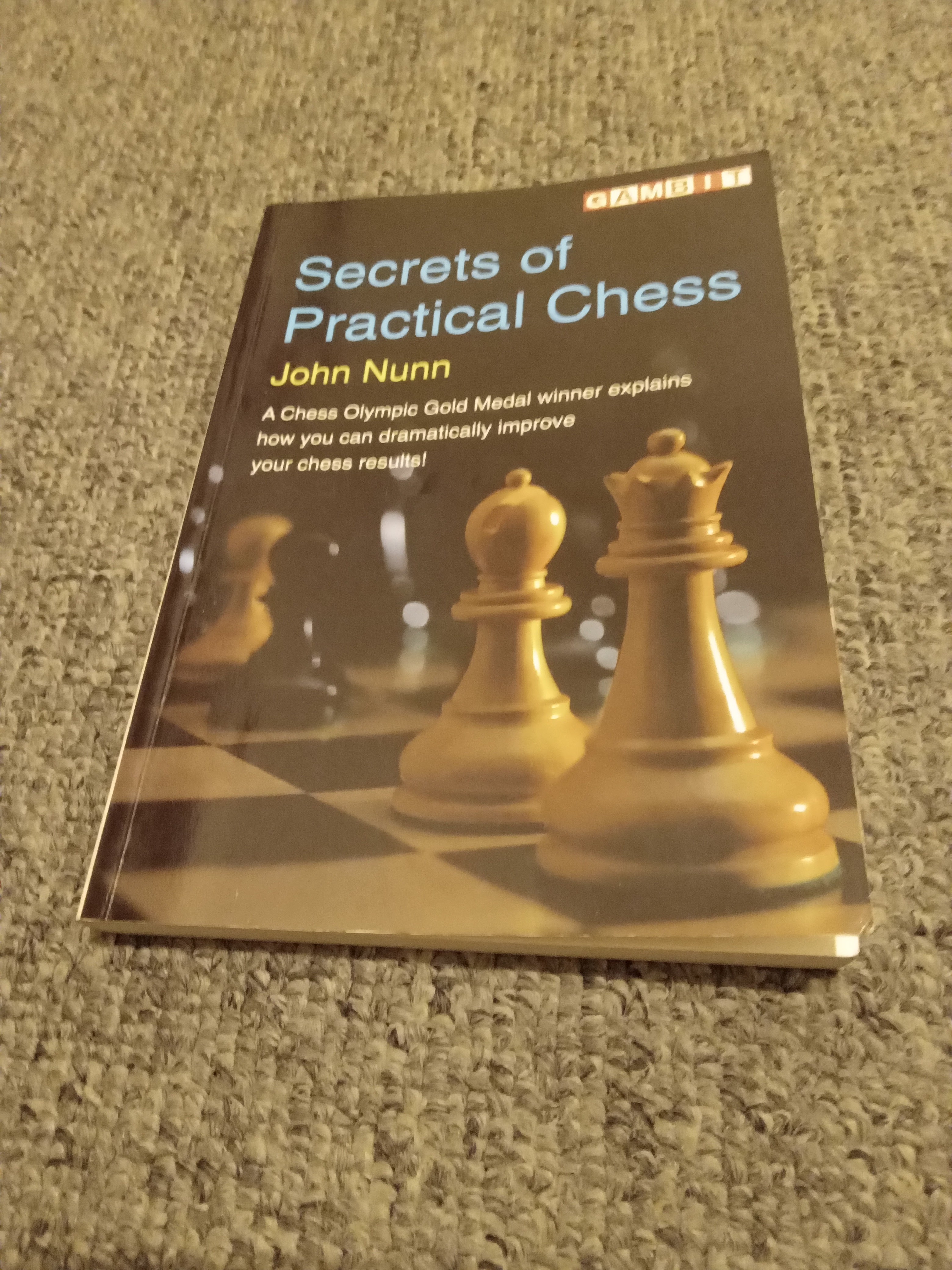
Nunn wrote in Secrets Of Practical Chess (Gambit 1998): "I have observed that if a player spends more than 20 minutes over a move, the result is almost always a mistake."
11...Ng6!?
The engines are not keen on this, preferring 11...cxd4 or 11...h6!? Note that 11...0-0?! allows a version of the Greek Gift sacrifice, ie 12.dxc5! (better than immediately capturing on h7) bxc5 13.Bxh7+! Kxh7 14.Ng5+, when the engines continue 14...Kg6 15.Qg4 f5 16.exf6 gxf6 17.Nxe6+, with a large advantage for White. After the engines' top choice, 11...cxd4, they reckon best-play runs 12.Nxd4!? (12.Bxd4? Nxd4 13.Nxd4 Qxe5 is good for Black) Nxe5 13.Nb5, when White has good compensation for a pawn after both 13...Bxb5 and 13...Qb8.
12.Re1 0-0
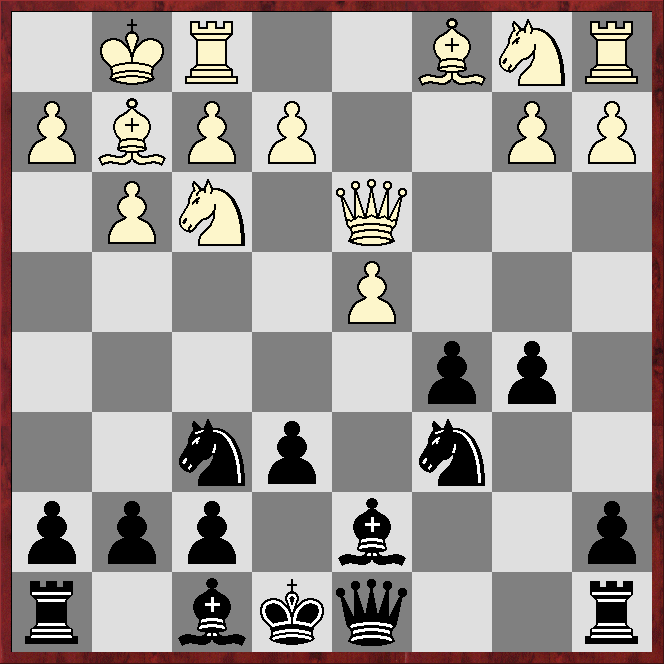
Now both sides have castled, how would you assess the position?
*****
*****
*****
*****
*****
Black has strong pressure against White's centre, but the centre gives White kingside attacking chances, and the engines agree White has the upper hand.
13.h4!?
Apparently a novelty, which the engines reckon is an improvement on Dimitrios Mastrovasilis (2621) - Alexei Shirov (2705), European Team Championship (Porto Carras, Greece) 2011, which went 13.Qd2 a5 14.Qe3!? Nce7!? 15.g3 Nef5 16.Qd2, with at least a slight edge for White, according to the engines (½–½, 63 moves). However, the engines reckon that better than both moves is another apparent-novelty in 13.dxc5!?, the idea being to meet 13...bxc5 with 14.b4!?
13...h6
On 13...cxd4 the engines agree 14.Bb4!? is strong, eg 14...Nxb4 15.axb4 h6 16.h5!? Nf4 17.Bf1 Nxh5 18.Qxd4 g5!? 19.Ra3!?, with an attack worth more than the pawn sacrificed. A possible improvement for Black is 14...Ngxe5!? 15.Nxe5 Nxe5 16.Bxf8 Rxf8 17.Bxh7+ Kxh7 18.Qh5+ Kg8 19.Qxe5 Qxe5 20.Rxe5 f6, although the engines reckon Black does not have enough for the exchange.
14.Bf1!? cxd4 15.Bxd4 Nxd4 16.Qxd4 Qxc2
How should White proceed?
*****
*****
*****
*****
*****
17.Rac1
This is enough for a slight edge, according to the engines, but they reckon Rac1 should be preceded by 17.h5!? Ne7.
17...Qa4 18.Qxa4!? Bxa4 19.Rc7
The engines reckon 19.Ba6!? gives White at least enough for a pawn.
19...Rfc8 20.Rec1 Rxc7 21.Rxc7 Bd1!? 22.h5!?
The engines agree this is best.
22...Nf4
What should White play?
*****
*****
*****
*****
*****
23.Ba6?
After 23.Nd4 Bxh5 24.g3 Ng6 25.f4, the engines reckon White has full compensation for being two pawns down.
23...Bxf3 24.gxf3 Nxh5
Rook and bishop usually make a better team than rook and knight, but here White is two pawns down and has a chronically weak kingside
*****
*****
*****
*****
*****
25.Rd7!?
Black can meet 25.Bb7 with 25...Rd8, getting behind the passed pawn.
25...Nf4 26.Bb7 Rb8 27.Ba6 Ng6 28.Rxa7 Nxe5 29.f4 Ng6 30.f5!?
The best try, but completely inadequate.
30...exf5 31.Bd3 Nf4 32.Bxf5 Rd8 33.Rd7!? Rxd7 34.Bxd7 Kf8 35.b4 Ke7 36.Ba4 Kd6 37.f3 Ke5 38.Bd1 Kd4 39.a4 Kc4 40.b5 Kb4 41.Bc2 g5 42.Kf2 h5 43.Kg3 d4 0-1
TEAM RESULT
Bo.13
  England 3
Rtg-8
  England 2
Rtg2 : 2
5.1
Spanton, Tim R
2003-
Townsend, M Paul
21020 - 1
5.2
Freeman, Jon A
1950-
Hewson, Brian W R
19960 - 1
5.3
Guilfoyle, John M
1921-AFM
Higgie, Charles L
19801 - 0
5.4
Wilson, Edgar
1903-
Noyce, Robert C
20121 - 0

Monday, 4 May 2026

4NCL Round 11

PLAYED on board one (of six) for Wessex B against Oxford 3 today.

Philip Neatherway (1835 ECF/1804 Fide) - Spanton (1940 ECF/1911 Fide)
Sicilian Accelerated Dragon
1.e4 c5 2.Nf3 g6 3.d4 cxd4 4.Nxd4 Nc6 5.Nc3 Bg7 6.Be3 Nf6 7.Bc4 0-0 8.Bb3 d5!?
8...d5!? is the 'new' move I blogged about last month while playing at the world team 65+ championship in Albania
*****
*****
*****
*****
*****
9.Nxc6!?
Varying from Neatherway (1806) - Jacques Parry (1596), London Classic Open 2017, which went 9.exd5 Na5 10.d6?!, when the simple 10...Qxd6 would have given Black a slight edge, according to Stockfish17.1 and Dragon1 (they also like 10...Ng4!?).
The main line in ChessBase's 2026 Mega database runs 10.0-0 Nxb3 11.Nxb3 b6 12.Qd2 Bb7 13.Rad1 Qd7, when Black has sufficient compensation for a pawn, according to the engines, but the whole variation is in its (relative) infancy, and a consensus has not emerged as to how White should proceed.
9...bxc6 10.exd5 cxd5 11.0-0!?
After 11.Nxd5 Nxd5 12.Qxd5 Bxb2 Black has at least equalised, according to the engines, and if 12.Bxd5, they reckon both 12...Bxb2!? and 12...Qa5+ at least equalise.
11...Bb7 12.h3!?
This may be too slow. The engines do not agree on how White should play, but they suggest 12.Bd4, 12.Re1 and 12.Na4!?
The position after 12.h3!? was also reached in Chinmay Kulkarni (2215) - Dammaraju Gukesh (2320), Aeroflot Open B (Moscow) 2018, but there it was White to play as the game followed a different variation in which Black plays ...d6 and later ...d5 (1-0, 30 moves)
*****
*****
*****
*****
*****
12...e5!?
This may be a novelty, and anyway is probably an improvement on the known move 12...Qa5.
13.Bg5
The engines suggest attacking Black's centre immediately with 13.f4!, when their main line runs 13...d4 14.fxe5 dxe3 15.exf6, and either 15...Bh6 or 15...Qb6!?, claiming Black has more than enough for a pawn. Also possible is 13.Bc5, as long as White does not meet 13...Re8 with 14.Ba4?!, when Black has 14...d4! as 15.Bxe8 Qxe8 16.Ne2 fails to 16...Qc6!
13...d4 14.Ne2 Qb6 15.Ng3 Qc6 16.f3 Nd5 17.Bxd5!?
The engines do not like this, preferring 17.Qd2.
17...Qxd5 18.c3 d3!?
The d pawn may never queen, but it is unlikely to be endangered either as Black has the only light-square bishop
*****
*****
*****
*****
*****
19.Qd2 f6 20.Be3
The engines prefer getting rid of the bishop-pair with 20.Bh6.
20...f5 21.Bf2 h5!? 22.Rfe1 Kh7 23.Nf1 Bh6 24.Be3 f4!?
The engines agree both the text and 24...Bg7!? are better than swopping bishops.
25.Bf2 Rfe8 26.Rad1 Red8?!
This gives away much of Black's advantage, according to the engines. They prefer offering the a7 pawn with 26...Rad8, meeting 27.Bxa7 with 27...g5!?, 27...Rd7 or 27...Qxa2, eg 27...g5!? 28.Nh2 Bg7!? 29.Ra1!? Qa5 30.Bf2 e4!? 31.fxe4 Bxe4, when they reckon Black has a positionally won game.
27.Nh2?!
This does not seem to achieve anything, whereas the engines' 27.c4!? offers counterplay, eg 27...Qd6 28.Qa5, with pressure. Perhaps Black should try 27...Qxc4, but 28,Rxe5 Rd7 29.Qa5 again offers counterplay.
27...a5 28.c4!?
With the same idea as at move 27, but the inclusion of Nh2 and ...a5 favours Back.
28...Qd6 29.Qc3 Bg7 30.Qb3
How should Black proceed?
*****
*****
*****
*****
*****
30...Rd7
The engines give 30...Rab8!?, and if 31.Ba7, then 31...e4! 32.Bxb8 Rxb8, when Black has obvious compensation for the exchange, and, they reckon, is winning comfortably.
31.c5 Qd5 32.Qxd5 Rxd5
How would you assess this queenless middlegame?
*****
*****
*****
*****
*****
White's queenside pawns give counterplay, but Black's extra space, bishop-pair and dangerous passer on d3 add up to a winning advantage, according to the engines.
33.Nf1 Ba6
The engines give 33...g5 34.Nd2 g4!? 35.fxg4 hxg4 36.hxg4, after which Black's central pawn-mass is very threatening.
34.Nd2 Rb8 35.b3 a4?!
The wrong plan, according to the engines. They give 35...g5, and if, as in the game, 36.Re4, then 36...g4!? 37.hxg4 hxg4 38.g3!?, awarding Black at least the upper hand after 38...gxf3 or 38...Rf8. Perhaps 36.Nc4 is better, but then 36...a4, among other moves, also gives Black at least the upper hand, according to the engines.
36.Re4 axb3 37.axb3 Bf8 38.Ra4 Bb7?!
Probably better is 38...Bb5.
39.b4
White is winning (Dragon1) or at least has the upper hand (Stockfish17.1)
*****
*****
*****
*****
*****
39...Bc6 40.Ra7+
Even stronger, according to the engines, is 40.Ra6!?, eg 40...Bb5 41.Ra5 Rdd8 42.Ne4 Kg8 43.Ra7 Bg7 44.Be1!? Ra8 45.Rxa8 Rxa8 46.Nd6 Bc7 47.Rxd3.
40...Kh6 41.Rb1 Rd7 42.Ra6
White is at least slightly better after 42.Rxd7 Bxd7 43.Ne4, according to the engines.
42...Bb5 43.Re6 Re7 44.Rxe7
PN offered a draw.
Objectively speaking, should Black accept?
*****
*****
*****
*****
*****
Black has the bishop-pair, but White has a connected pair of passed pawns. However, both Black's passer and the white duo are easily blockaded, and the position is equal, according to the engines.
44...Bxe7 45.Kf1?!
But the position is not equal anymore. White should almost certainly have stopped Black taking the open file. After 45.Ra1, the engines reckon the position is completely equal, one sample line running 45...Bc6 46.Ra6 Bd5 47.Ra7 Bf8 48.Rd7 Bc6 49.Rxd3 Rxb4.
45...Ra8 46.Ke1?
Immediate king centralisation is not right in this situation. The engines suggest improving the knight with 46.Ne4, meeting 46...Ra3 (46...Ra2?? 47.Nc3) with 47.Ke1, when they agree Black has a slight edge, but no more.
46...Ra2
PN spent about 21 minutes on his next move, thus flouting grandmaster John Nunn's 20-minute rule
*****
*****
*****
*****
*****
Nunn wrote in Secrets Of Practical Chess (Gambit 1998): "When analysing a given position, it is fair to say that one almost always sees more in the first five minutes than in the next five minutes. The five minutes after that is even less productive, and so on. I have observed that if a player spends more than 20 minutes over a move, the result is almost always a mistake. The normal decision-making process should not take longer than this, even in fairly complex situations."
However, the move my opponent came up with is, for a while, the top choice of Stockfish17.1, although not of Dragon1.
47.c6!?
The engines come to more-or-less settle on 47.Rd1, but continue 47...Ba4 48.Rb1 Bb8!?, eg 49.Ne4 g5 50.g4!? fxg3 51.Bxg3 g4! 52.hxg4  hxg4 53.Bxe5 Re2+ 54.Kf1 gxf3 with what they reckon is a large advantage for Black. Note that 47.Ne4, trying to get the same sort of position as in the line 46.Ne4 Ra3 47.Ke1, runs into 47...Re2+, with fatal consequences whichever way the king moves, eg 48.Kf1 Rc2 49.Ke1 g5, when one line continues 50.Rd1 g4!? 51.hxg4 hxg4 52.Rd2 (52,fxg4? Re2+) Rc1+!? 53.Rd1 Rc4 54.Rb1 g3 55.Bg1 Rc2 56.Nd2 e4! 57.fxe4 Bf6. These are long, and not simple, lines, but the engines' verdict always strongly favours Black.
47...Rc2?!
There is no need for this 'cleverness'; 47...Bxc6 is both simple and good.
48.Bc5!?
This seems White's best try.
48...Bxc5
Apparently much stronger, but also more complicated, is the engines' 48...Bh4+!? 49.Kd1 Ba4 50.Rb3!? e4!? (50...Bxb3? 51.Nxb3, when 51...Bd8 is forced, but 52.Nc1!? completely equalises, according to the engines) 51.fxe4 f3! 52.gxf3 Bg5 53.c7 Rxd2+ 54.Ke1 Bd7 55.b5 Be6 56.Rc3 Rc2!? 57.Bf8+ Kh7 58.Rxd3 Bh4+ 59.Kd1 Rxc7, after which Black is winning on material.
49.bxc5 Bxc6 50.Rb3 Rxc5 51.Rxd3
How would you assess this rook-and-minor-piece ending?
*****
*****
*****
*****
*****
Black is a pawn up, and has the generally better minor piece for cooperating with a rook, but all the pawns are on one side of the board. Stockfish17.1 for quite some time gives Black only a slight edge, while Dragon1 reckons Black has the upper hand. However, given longer to calculate, the engines reverse their positions, with Stockfish17.1 giving Black the upper hand, but Dragon1 calling White only slightly worse.
51...Bb5 52.Rd6 Rc1+ 53.Kf2 Rc2 54.Rd5 Bc6 55.Rd6 Kg7
Nevertheless, it is one of those positions where the better side can keep probing, knowing there should only be two possible outcomes (short of Black falling for a knight fork).
56.Ke1 Kf7 57.Kd1 Rc3 0-1 (Time)
PN said afterwards he thought White is lost. However, the engines disagree, but only if White plays 58.h4!, when they reckon Black probably has just a slight edge. Other plausible moves seem to lose, eg 58.Ke1 g5!? 59.Kf1 g4!? 60.hxg4 hxg4 61.fxg4 Rc1+ 62.Kf2 Ke7 63.Rd3 Rc2 64.Kg1 e4 etc.
Wessex B won the match 3.5-2.5, finishing 13th of the 30 teams that entered Division Four.

Tuesday, 27 January 2026

Lessons From Mariánské Lázně II

GRANDMASTER John Nunn tells an amusing, and instructive, anecdote in Secrets Of Practical Chess (Gambit 1998) about a blitz match he played against an opponent rated around 2300.
Nunn won the series 88-12, despite having a time handicap, but the interesting thing is his opponent's comment about halfway through: "I thought I would see lots of advanced strategic concepts in these games, but actually all I have learnt is LPDO."
Or, to put it another way, loose pieces drop off.
Nunn comments: "During the remaining games I saw what he meant. Most of the games were decided by relatively simple tactics involving undefended pieces, when the LP would duly DO."
I was reminded of the story during my round-two game at Mariánské Lázně, where I had black against Poland's Ewa Balcerczak (1537).
This position arose after White played 21.Nb1-c3
*****
*****
*****
*****
*****
A peculiarity of the position is that both white rooks are loose - neither is protected by a fellow piece or pawn.
The looseness of the king's rook might seem unimportant, but look what happens over the next few moves.
I began with 21...Qe7, taking advantage of the undefended queen's rook to reposition my queen with tempo.
EB had to do something about the rook, and chose to play 22.Qb3?! (Stockfish17.1 and Dragon1 prefer 22.Qc1 or 22.Ra1).
The problem with the game's choice is it allows 22...Nc5! (better than the tempting 22...Nxf2+ 23.Bxf2 Bxf2, when 24.Nd5 keeps White in the game).
EB counterattacked with 23.Nd5? (23.Qd1!? is better), but that allowed me to take advantage of White's other undefended rook by playing 23...Qe2!, when my opponent could have resigned on the spot, and did so anyway after a further three moves.
LESSON: loose pieces drop off.

Tuesday, 22 October 2024

Sant Jordi Round Three

FACED a Taiwanese.

Spanton (2013) - Sung-Jui Yang (1882)
French Steinitz
1.Nc3 d5 2.d4 e6 3.e4 Nf6 4.e5 Nfd7 5.Nf3
Tarrasch's recommendation.
5...c5 6.dxc5
This is far and away the commonest continuation in ChessBase's 2024 Mega database, but Stockfish17 and Dragon1 suggest 6.Ne2!?, although it scores 12 percentage points fewer.
6...Nc6 7.Bf4 Nxc5!?
The main move is 7...Bxc5, but the text scores 59%, a very high score for Black, and much better than 7...Bxc5's 47%.
How should White respond?
*****
*****
*****
*****
*****
8.Bd3!?
This is the main move in Mega24, but it means White will likely lose the bishop-pair and be left with a bishop that is at least semi-bad (central white pawn on a dark square).
8...Be7 9.Qe2?!
White should probably hold back on developing the queen.
9...Nxd3+ 10.Qxd3!?
The engines agree this is better than recapturing with the c pawn, but it means White has lost a tempo in having already moved the queen.
10...Bd7 11.0-0
How should Black proceed?
*****
*****
*****
*****
*****
11...g5!
S-JY spent in the region of 30 minutes on this move, but it is approved of by the engines, thus proving an exception to John Nunn's rule that taking more than 20 minutes on a single move is counter-productive.* The idea is known in similar lines, but appears to be a novelty here, although the diagrammed position usually arises with White to move.
12.Bg3 h5 13.h3 g4!?
Opening lines to the black king, although possibly at the cost of giving up a pawn. The move is Stockfish17's top choice for quite some time, but Dragon1 prefers 13...Qb6, and Stockfish17 comes to agree with that verdict.
14.hxg4 hxg4 15.Nh2 Rg8?
An overly cautious continuation. Instead the engines reckon 15...Qb6!? gives Black the upper hand.
16.Qh7 Rg6?
The engines suggest 16...Rf8!?, claiming White is at best slightly better.
17.Qh8+ Bf8
White to play and gain a winning advantage
*****
*****
*****
*****
*****
18.Bh4??
After this move Black, rather than White, is winning, according to the engines, which reckon Black has no good answer to 18.Nb5, with Bh4 and/or Nd6+ to come.
18...Qb6
Black threatens ...Rh6 and ...Qxb2+.
19.Bf6 Ne7?
Black has several strong continuations, including 19...g3, 19...Qxb2 and 19...Nd4.
20.Bxe7 Kxe7 21.Qh4+ Ke8 22.Nxg4 Qxb2 23.Ne2
What should Black play?
*****
*****
*****
*****
*****
23...Bb5?
This was a good time to sacrifice the exchange. After 23...Rxg4! 24.Qxg4 Qxe5 Black has a pawn and the bishop-pair for a rook, which, other things being equal, is normally considered an even balance of material. Stockfish17 agrees the position gives equal chances, but Dragon1 slightly prefers White.
24.Rfb1?!
Almost certainly stronger is 24.Rab1. The text gives Black a second chance to sac the exchange, albeit in less favourable circumstances than on the previous move.
24...Rxg4!?
After 24...Qxc2?! both 25.Nd4 and 25.Rxb5 seem good for White, as Nf6+ is to come.
25.Qxg4 Qxe5 26.Nd4 Ba6 27.Re1
Missing 27.Nxe6! fxe6 28.Re1, after which Black is busted, eg 28...Qg7 29.Qxe6+ Be7 30.Rad1 Qf7 31.Qe5! Rd8 32.Rd4! Kd7!? 33.Rf4! (much stronger than 33.Rxd5+) Qe8 34.Qe6+ Kc7 35.Rf7 etc.
27...Qg7! 28.Qf4
White seems to have a perpetual, or at least complete equality, after 28.Rxe6+, eg 28...fxe6 29.Qxe6 Qe7 30.Qg6+ Kd7 31.Qg4+ Kc7 32.Ne6+ Kb6 33.Qd4+ Kc6 34.Qa4+ Kd6 35.Qf4+ Kxe6 36.Re1+ Kd7 37.Rxe7+ Bxe7 38.Qg4+ Kc6 39.Qe6+ Bd6 40.g4!? - completely equal, according to the engines, but clearly very imbalanced.
The engines instead suggest 28.Qd1!?, claiming equal chances.
28...Kd7!
The engines reckon this is forced (castling is illegal as the black king has already moved), assessing the resulting position as completely equal.
29.Nf3 Bd6 30.Ne5+ Ke7 31.Qe3?
Better is developing the queen's rook with 31.Rad1, or putting the king's rook on the third rank, ie with 31.Re3.
31...Rg8
Even stronger seems to be 31...Rh8.
32.g3 b6!? 33.Nc6+ Kd7 34.Nd4 Rh8
The engines reckon both 34...Bb7 and 34...Qg4!? give at least the upper hand.
35.Kg2 Qh6 36.Qxh6 Rxh6
Now queens are off, how would you assess the position?
*****
*****
*****
*****
*****
Black has the bishop-pair and a pawn for the exchange, and fewer pawn-islands - equal (Stockfish17) or slightly better for White (Dragon1).
37.Rh1 Rf6 38.Rh5 Bc4!?
The engines dislike this, suggesting 38..Bc5 or 38...e5.
39.a4
White has at least a slight edge after 39.f4!?, according to the engines.
39...Bb4
Again the engines suggest ...Bc5 or ...e5.
40.Rb1 a5 41.Rbh1
The engines reckon White is better after 41.f4, which holds up ...e5 and blunts the activity of the black rook.
41...Bc5 42.Nf3 Kd6 43.Rh6!?
How should Black respond to this invitation to exchange a pair of rooks?
*****
*****
*****
*****
*****
43...Rf5??
Black's queenside play is very promising after 43...Rxh6 44.Rxh6 b5, but after the text Black is losing.
44.R1h5??
White is well on top after 44.g4 Rf4 45.Kg3 Re4 46.Ng5.
44...Rxh5 45.Rxh5 b5
S-JY offered a draw in my time - should I have accepted?
*****
*****
*****
*****
*****
Yes - Black's coming passed pawn on the queenside gives at least the upper hand, according to the engines.
46.axb5 a4 47.Rh1!
The engines come to agree that this passive-looking rook move is better than the apparently active 47.Rh8?!, and indeed is White's best chance. Both moves lead to the rook attacking the a pawn, but from a1 the rook also covers the queening rank and is less easy to get at than on a8.
47...a3?!
The engines prefer the calm 47...Bxb5 or 47...d4!?
48.Ra1
White has complete equality after 48.Nd2!?, according to the engines.
48...Bb4
The engines suggest 48...d4!?, eg 49.Nd2 Bd5+ 50.Kf1 Bb4 51.Ke2 Kc5, although White also has the intriguing possibility of 49.Nxd4!? Bxd4 50.Rxa3.
49.c3! Bc5?
Black has equal chances after 49...Bxc3 50.Rxa3 d4, according to the engines.
50.Nd4??
Both 50.Nd2 and 50.b6 win, according to the engines.
50...Bxd4?
Both 50...Kc7 and 50...a2 win, according to the engines.
51.cxd4 a2 52.Kf3 Kc7 53.Kf4?
White has the upper hand (Dragon1) or at least is not losing (Stockfish17) after 53.Ke3, eg 53...Kb6 54.Kd2 Kxb5 55.Kc3 Kc6, and it is hard to see how either side can make progress, although Dragon1 still gives White the upper hand.
53...f6?
Winning is 53...Kb6, eg 54.Ke5 Kxb5 55.Kf6 Kb4 56.Kxf7 Kc3 57.Kxe6 Kxd4! 58.f4 Kc3 59.f5 d4+ 60.Ke7 Kb2 etc.
54.g4 Kb6 55.g5
Possibly better is 55.Ke3!? Kxb5 56.f4 etc.
55...fxg5+ 56.Kxg5 Kxb5?
Now White is winning again. Instead 56...e5!? seems to draw.
57.f4?
But now Black is holding, whereas 57.Kf6 wins easily.
57...Bb3
Possibly slightly better, or at least posing more problems for White, is 57...Kb4!? 58.Kf6 Kc3 59.Kxe6 Kxd4! 60.Kd6 (60.f5? Kc3 wins for Black) Bb3, when White has to find the only-move 61.Rc1!, one continuation being 61...Kd3 62.Kc5! d4 63.Kb4 Bd5 64.Ka3, when White seems to be drawing, but the position is much easier for Black to play.
58.Kf6 Kc4 59.Kxe6?
Drawing is 59.Ke5, eg 59...Kc3 60.Re1 Kb2 61.Kxe6 Bc4 (61...a1=Q? 62.Rxa1 Kxa1 63.f5 Bc2 64.f6 Bg6 65.Kxd5 wins for White) 62.f5 Bd3 63.f6 Bb1! 64.f7 a1=Q 65.f8=Q Bf5+ 66.Qxf5 Qxe1+.
59...Kxd4! 60.f5 Kc3 61.f6
Black to play and win
*****
*****
*****
*****
*****
61...Kb2?
Simplest is 61...d4+, but 61...Bc4 also wins.
White to play and draw
*****
*****
*****
*****
*****
62.Ke5?
Both 62.Rxa2+!? and 62.f7 d4+ 63.Ke5! draw.
Black to play and win
*****
*****
*****
*****
*****
62...d4?
Winning is 62...Kxa1 63.f7 (63.Kd4 Kb1) Kb1 64.f8=Q a1=Q+ 65.Ke6 (otherwise the white queen drops) d4+ 66.Kd7 Qa4+ 67.Kc7 Qc4+ etc.
63.Rxa2+ ½–½
This is probably the most extraordinary game I have been involved with, when it comes to switches of fortune and the number of what in tennis would be called unforced errors.
*John Nunn: "I have observed that if a player spends more than 20 minutes over a move, the result is almost always a mistake" - Secrets Of Practical Chess (Gambit, 1998).

Saturday, 12 October 2024

Lessons From Crete II: Party Time!

THE following position arose in my round-two game from the Amateur Chess Organization's 50+ 'world championships' at Fodele Beach, Crete.
White has just played 9.Qc4-d3
*****
*****
*****
*****
*****
This position occurs 696 times in ChessBase's 2024 Mega database.
The vast majority - 637 games - feature 9...c4 or 9...Rc8.
After 9...c4 the commonest continuation is 10.Qd1 Rc8 11.Bg5 Be7, when Stockfish17 and Dragon1 reckon Black has fully equalised.
After 9...Rc8 the commonest continuation is 10.dxc5 Bxc5, when Stockfish17 again reckons Black has equalised, although Dragon1 fluctuates between equality and giving White a slight edge.
As well as 9...c4 and 9...Rc8, grandmasters have also played 9...Qb6, but no one over 2399 has tried my choice, 9...Nb4.
After 10.Qd1 Bc6 I thought I was doing well - White's queen has been driven back to its starting square, and the 'Catalan' bishop on g2 has an opposing bishop on the h1-a8 diagonal.
But after 11.a3 Na6 (11...Nbd5 12.e4 is worse, according to the engines) alarm bells started ringing as I had two hangers, ie two pieces (the queenside minors) unprotected by other black pieces or pawns.
The whole sequence reminds me of two of grandmaster John Nunn's axioms.
1. Invite everyone to the party.
Nunn particularly applies this to the build-up of an attack on the king.
The point is to get as many pieces as possible into the action as an attack with just two or three pieces is less likely to succeed unless the opponent's position is very bad.
Inviting everyone to the party can apply equally well to a queenside attack, which is what I had in my game, hence why ...Rc8, or ...c4 followed by ...Rc8, is the best continuation in the above diagram.
2. Loose pieces drop off.
Nunn turned this into an initialism, LPDO, for easy memorisation.
By "loose pieces" he meant any piece, or a pawn for that matter, not protected by a colleague.
After 11...Na6 I have two such pieces, at c6 and a6, while White has none.
The game continued 12.Bg5 cxd4 13.b4 h6 14.Bxf6 Qxf6 15.Qxd4 Be7 16.Nbd2 Qxd4 17.Nxd4 Bxg2 18.Kxg2 Bf6 19.N2b3 0-0, reaching the following position.
Black still has two 'loose pieces', or hangers as I like to call them, on a6 and b5
*****
*****
*****
*****
*****
White is winning, according to the engines, as there is no good answer to 20.Rac1.
LESSON: try to ensure your party is well-attended, and keep an eye out for lonely wallflowers who may need your assistance.

Saturday, 6 July 2024

Bad Herrenalb Round Two

Spanton (1928) - Heinz-Dieter Gierse (2063)
English Nimzowitsch
1.c4 e5 2.Nc3 Nf6 3.Nf3 Nc6 4.e4!?
This gives White a grip over d5, but at the expense of leaving a hole at d4. It was pioneered by Aron Nimzowitsch, and later refined by Mikhail Botvinnik, who developed the king's knight to e2 (or e7 when using the formation with black).
4...Bc5
Slightly more popular in ChessBase's 2024 Mega database is 4...Bb4, but the text has been played by many top grandmasters, including Fabiano Caruana and Vladimir Kramnik.
5.Nxe5!? Bxf2+?!
There are 194 examples of this move in Mega24, but it is probably a mistake. The mainline runs 5...Nxe5 6.d4 Bb4 7.dxe5 Nxe4 8.Qf3 Nxc3 9.bxc3 Ba5 10.Bf4, which is completely equal, according to Dragon1, although Stockfish16.1 gives White an edge.
6.Kxf2 Nxe5 7.d4 Neg4+ 8.Kg1
White has lost castling rights, but has the bishop-pair and dominates the centre
*****
*****
*****
*****
*****
8...d6 9.Be2
This appears to be a novelty, although it transposes to a known position, albeit one that only occurs once in Mega24. Normal is 9.h3.
9...c5!?
The engines agree this is an improvement on the known 9...Rg8?!
10.dxc5 dxc5 11.Qxd8+ Kxd8 12.Bf4 Be6
DH spent 31 minutes on this move. John Nunn has a theory that someone who spends more than 20 minutes on a move almost always plays a mistake. The theory does not quite hold up here - the text is the engines' second choice, although they prefer 12...Re8.
13.Rd1+ Kc8
Again this is the engines' second choice. They prefer 13...Nd7.
14.h3 Nh6 15.g4 Ne8 16.g5 Ng8 17.Kh2
White has connected rooks, while Black has only one piece developed, and is lost, according to the engines
*****
*****
*****
*****
*****
17...Ne7 18.Nd5 Nc6 19.Bf3 Nd4 20.Bg2 Kd7!?
The engines fluctuate between this and 20...b6.
21.Be3 Bxd5 22.Bxd4 cxd4 23.Rxd4 Rd8?!
The engines' 23...h6 seems better.
24.Rxd5+ Kc7 25.Rxd8 Kxd8 26.Rd1+ Ke7 27.e5!? b6?!
Probably better are the engines' 27...Nc7 and 27...f6.
28.Bc6 h6 29.Rd7+ Ke6 30.gxh6 gxh6 31.Rd8 Rg8?
This makes it easy for White, but not much more difficult is 31...Ke7 32.Rxe8+ Rxe8 33.Bxe8 Kxe8 34.Kg3 etc.
32.Rxe8+ 1-0

Tuesday, 9 January 2024

All Change!

I TOLD last month how Fide planned to boost the ratings of players rated U2000, using a formula designed to combat what is seen as deflation in the elo system.
Grandmaster Keith Arkell has been complaining about deflation for several years.
Certainly some players, who once were comfortably rated in the 1900s, find themselves struggling to stay in the 1700s.
Some might put this mainly down to ageing, but chess statistical experts think otherwise.
Originally the boost, which I detailed in my blog, was to take place on New Year's Day, but quite a few officials claimed this was too soon.
Accordingly the change will now occur on March 1, along with other anti-deflationary measures, including moving the rating floor from 1000 to 1400, which will mean many weaker players losing their international rating.
Sometimes being close to a subject makes it hard to see what exactly is going on - a bit like being unable to see the wood for the trees.
One person who can take a much more detached view is grandmaster John Nunn, who, although never a Candidate, was rated in the world's top 10.
In other words he was a big fish in a big (chess) pond.
Nunn, as he puts it himself "more or less" retired from playing chess about 20 years ago.
But recently he has started competing in a string of 65+ seniors' events, where once again he is a big fish, albeit in a smaller pond.
To him the most noticeable change in the game in the intervening period has not been a decrease in ratings, but an increase in (legitimate) computer use, including "extensively" among 65+ seniors.
"This has certainly affected the way players tackle the openings," he wrote in December's issue of Chess magazine.
"The practical effect seems to be that players are reluctant to repeat an opening line and they tend to prepare 'one-off' opening variations which they have not played before, solely to evade the pre-game scrutiny of engines."
Another big change over the past two decades, or perhaps even longer, is the vast increase in chess literature.
There was a time when a handful of books might be published in a year; now many more than a handful are published every month.
Faster time limits are another change that is noticeable, along with digital clocks almost totally replacing analogue ones.
Which of these changes is the most significant is arguable, but chess is thriving, at least if the number of international tournaments is anything to go by.

Monday, 30 January 2023

Lessons From Mariánské Lázně: Loose Pieces Drop Off

GRANDMASTER John Nunn popularised the phrase "loose pieces drop off," sometimes abbreviated to LPDO.
Position in my round-five game after Black captured on d5
*****
*****
*****
*****
*****
I was thinking about Nunn's aphorism as I considered my reply in this game, but that did not stop me playing 16.Bg5?! as I felt it was important to prevent a black rook going to d8, and at the same time I was developing a piece.
Stockfish15 and Komodo13.02 reckon getting the queen off the e file, while also attacking d5, is better, which is why they suggest 15.Qf3.
After my move the game continued 16...h6 17.Bh4 Rfe8, at which point I probably should have played 18.Qb5 or 18.Qb3.
Instead I chose 18.Qd2, which gives the white knight a second defender, but Black took advantage of the loose bishop with 18...Qg4.
I unloosed the bishop, as it were, by playing 19.Bg3?, only to be hit by 19...Bxd4 20.Qxd4 Re1+ 0-1.
Better were 19.h3!? Qxh4 20.Nf3 Qb4 21.Qxd5 Re2 and 19.Nf3 Nf4 20.Bg3 Ne2+ 21.Kh1 Qc4, although in both cases the engines give Black a large advantage.

Friday, 23 December 2022

Practical Secrets

TWICE while writing up my games from Benidorm I referred to Secrets Of Practical Chess by John Nunn (Gambit, 1998).
This prompted me to read through the book again - something I have not done for several years.
I was pleasantly surprised to find advice I had forgotten, or perhaps had absorbed subconsciously without realising where it came from.
Memory jerker
Nunn may have written more-important books - he certainly has written more-advanced ones - but I doubt he has written anything as entertaining.
What I had definitely forgotten is a new, enlarged edition of Secrets Of Practical Chess came out last December.
I regard re-reading the edition I have as an early Christmas present to myself. I only wish I were not too mean to splash out on the updated version.

Saturday, 17 December 2022

Benidorm: Typical Mistakes & How To Avoid Them (Part Four)

I FAILED to hold a drawn rook-and-pawn ending in round four of the Benidorm (Meliá) U2000 against Rajesh Aaadith (1714).
White has just played 73.f6+
*****
*****
*****
*****
*****
*****
*****
*****
I played the losing 73...Kg8?, and there followed 74.Re5 Rf1 75.Rg5+ Kh7 76.Kf7 Kh6 77.Rg8 Kh7 78.Rg2 (threatening mate in one) Kh6 79.Rh2+ Kg5 80.Kg7 Kf5 81.f7 1-0.
Correct is 73...Kg6, after which 74.Re1 can be met by 74...Ra2. Then 75.Rg1+ Kh7 76.f7 does not win, thanks to 76...Ra7+ with continuous checks from the flank.
This is all fairly basic. My one consolation is that John Nunn in Secrets of Practical Chess (Gambit 1998) calls rook-and-pawn endings "genuinely complicated," and states: "The ability to play rook-and-pawn endings well is a great distinguishing feature between a master player and a club player."
Clearly if I had known the right technique in the diagram position I should have drawn the ending quite routinely. But some clear thinking, and a little calculation, would also have found the correct continuation.
For starters it can be seen both 73...Kg8? and 73...Kg6 prevent 74.f7+? The former prevents it since Black replies 74...Rxf7+; the latter because the forced 74...Kg7 enables Black to capture the pawn next move.
It is also easily comprehensible that after either 73rd move by Black, White's only real winning try is to move the rook along the e file with intent to check on the g file, thus driving the black king away from the pawn.
One point is after 73...Kg6 74.Re1 Black cannot capture the pawn with 74...Rxf6?? as that loses to 75.Rg1+ etc. In that respect there is little difference between 73...Kg6 and 73...Kg8? as Black cannot capture the pawn after either move.
So far the moves seem similar, but here comes the big difference. The move 73...Kg8? gives White an extra resource in that, if the black rook leaves the f file, pushing the f pawn will come with check if the black king is still on g8.
So 73...Kg8? 74.Re1 Ra2 (planning to check from the flank) is hopeless in the face of 75.f7+ and 76.f8=Q(+).
However after 73...Kg6 74.Re1 Ra2 75.f7 Ra7+ 76.Ke6 Ra6+ (Black must keep checking as 76...Rxf7?? loses to 77.Rg1+ etc) White cannot both escape the checks and hold on to the pawn.
So Black's drawing plan in the diagram position is to threaten to capture the pawn, and, when that is no longer feasible, to perpetually check the white king.
The latter part of the plan only works if the pawn cannot advance with tempo, hence why 73...Kg8? is a mistake but 73...Kg6 draws.

Wednesday, 14 December 2022

Benidorm: Typical Mistakes & How To Avoid Them (Part Two)

ARTURO López Heras (1715), my round-two opponent in the Benidorm (Meliá) U2000, played the King's Gambit, but was clearly caught by surprise on move three: 1.e4 e5 2.f4 Bc5 3.Nf3 d5!?
He spent about 24 minutes thinking before coming up with 4.d4?, and Black was already better after 4...dxe4?!, although almost certainly stronger is 4...exd4.
Either way, ALH's choice was a mistake, confirming a rule expounded by grandmaster John Nunn in Secrets Of Practical Chess (Gambit 1998).
Nunn wrote (emphasis added): "When analysing a given position, it is fair to say that one almost always sees more in the first five minutes than in the next five minutes.
"The five minutes after that is even less productive, and so on. I have observed that if a player spends more than 20 minutes over a move, the result is almost always a mistake.
"The normal decision-making process should not take longer than this, even in fairly complex situations."
Nunn points out there will be exceptions to his rule, and it is reasonable to suppose the chances of coming up with a bad move increase dramatically in a position requiring a lot of thinking time.
Nevertheless I believe Nunn's 20-minute rule is well worth remembering. Indeed I am always a little surprised when an opponent breaks the rule and does not come up with an error.
So what can be done about this thinking mistake?
Nunn stated: "If you have thought about a position for some time and are still unsure what to play, it is essential to be ruthlessly pragmatic.
"Suppose your lengthy cogitation is the result of indecision; for example, say there are two moves, both of which have roughly equal merit.
"If you have not been able to decide between them up to now, it is reasonable to suppose that there is in fact little to choose between them.
"Considerable further thought might eventually reveal some difference, but it is rare that this expenditure of time is worthwhile.
"First of all, it is easy to be wrong when dealing with such fine distinctions and secondly, gaining an infinitesimal advantage is of little value if the result is that you run into time-trouble and blunder away a piece."
He added: "My advice is to obey your instinctive feeling as to which of the two moves is better or, if you don't have any preference, just choose at random.
"I have occasionally been tempted to toss a coin at the board, but despite the undoubted psychological impact on the opponent, this does seem rather unsporting."