Showing posts with label French Winawer. Show all posts

Saturday, 10 October 2026

Calvià Round One


Playing hall before tonight's first round
Spanton (2035) - Josep Santandreu Tost (1701)
French Winawer
1.e4 e6 2.d5 d5 2.Nc3 Bb4 4.e5 Ne7 5.Bd2 0-0!?
More common is 5...b6 and especially 5...c5.
6.a3 Bxc3 7.Bxc3
Stockfish18 and Dragon1 at first prefer 7.bxc3!?, the former more than the latter, but Stockfish18 comes to prefer the text, while at the same time Dragon1's enthusiasm for 7.bxc3!? grows. However, later Dragon1 flips between the two moves.
7...Nd7 8.f4 c5 9.Nf3 b6 10.Bd3 Ng6
Not 10...c4? 11.Bxh7+!, eg 11...Kxh7 12.Ng5+ Kg6 13.Qg4 f5 14.Qg3, with a large advantage for White.
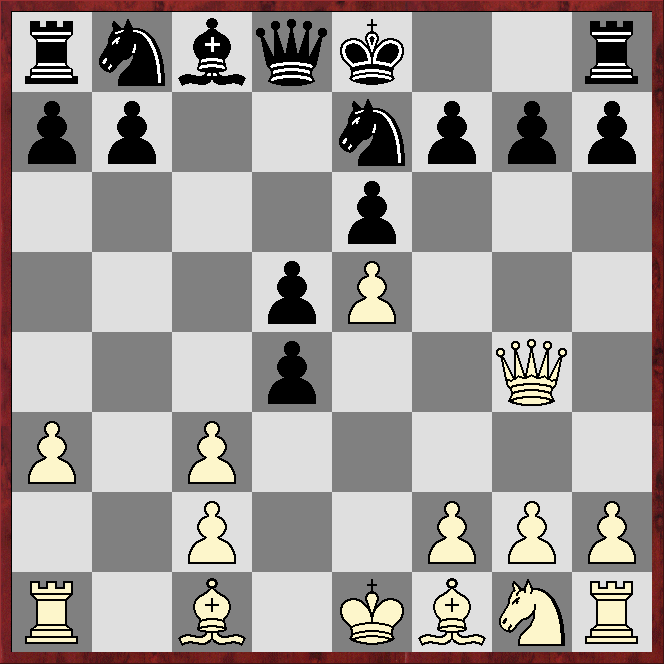
11.Qd2 c4!?
The engines strongly dislike 11...c4!?, which has the usual effect of challenging White's light-square bishop, but taking pressure off White's extended centre
*****
*****
*****
*****
*****
12.Be2
The engines like 12.Bxg6!?, meeting 12...hxg6 with 13.h4, and 12...fxg6!? with 13.Bb4 Re8 14.h4.
12...f5 13.h4
White often likes to capture en passant when Black plays ...f5 in the French, but here 13.exf6?! Nxf6 loses most of White's advantage.
13...a5 14.h5 Nh8!? 15.Ng5 Qe7 16.Kf2!? Nf7 17.Nf3 Bb7 18.Rag1 Nh6 19.Nh4 Qf7 20.Ke1!? Ng4
21.Nf3
The engines like 21.Bxg4!? fxg4 22.Rf1 Qxh5 23.f5, with a strong attack.
21...h6 22.Qd1 b5!?
On 22...Ne3 I intended 23.Qc1 Ng4 24.Bd2.
23.Qd2!?
How should Black proceed?
*****
*****
*****
*****
*****
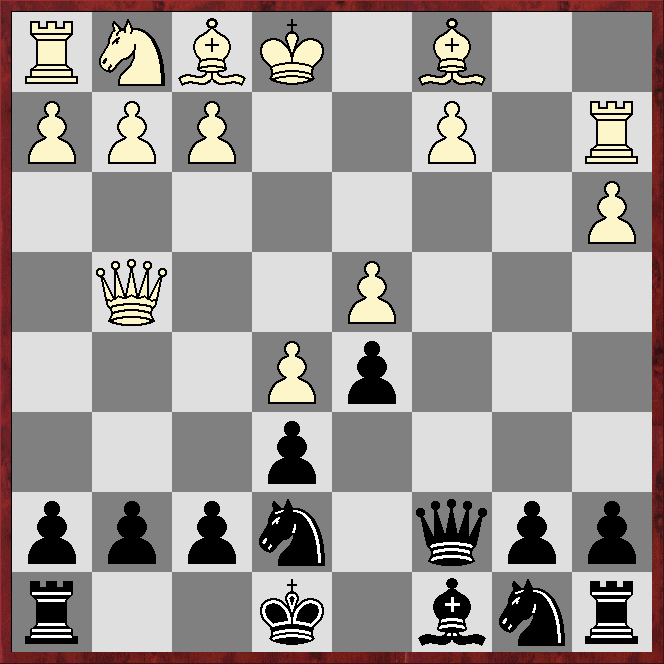
23...b4!
This pawn sacrifice gives Black interesting play, and the engines agree it is the best continuation.
24.axb4 axb4 25.Bxb4 Ra1+ 26.Bd1 Rfa8
How should White proceed?
*****
*****
*****
*****
*****
27.Ke2?
Better is 27.Nh2 - getting rid of the g4 knight makes the white king a lot safer.
27...c3!
A second pawn sacrifice, and again it is the engines' top choice.
28.Bxc3 Ba6+ 29.Ke1 Nb6?
Black has at least the upper hand, according to the engines, after both 29...Rb1 and 29...Bb5!?, eg 29...Rb1 30.b3 Bb5 31.Rh3 Ra2 32.Rgh1 Nb8!? 33.Ng1 Qa7, with strong pressure that the engines reckon much more than compensates for being two pawns down. If 30.Nh2, the engines give the spectacular 30...Ndf6!! 31.exf6 Nxf6, eg 32.Nf3 Ne4 33.Ne5 Qe8, when the white queen cannot be saved as 34.Qe3 is met by 34...Qa4, and if 35.b3, then 35...Qa2, when one line runs 36.Nd3 Qxc2 37.Nf2 Nxf2 38.Qxe6+ Kh8 39.Bd2 Nxh1 40.Rxh1 Qxd1+ 41.Kf2 Qxd2+ 42.Kg3 Rxb3+ 43.Kh2 Qxf4+ 44.g3 Qxg3#.
30.b3 Ra2 31.Be2?
The engines reckon White has the upper hand after 31.Rh3, and other moves also leave White with at least an edge.
31...Qc7 32.Bxa6 R2xa6 33.Bb4?
The position is equal after 33.Qd3, 33.Ke2 or 33.Rh3, according to the engines.
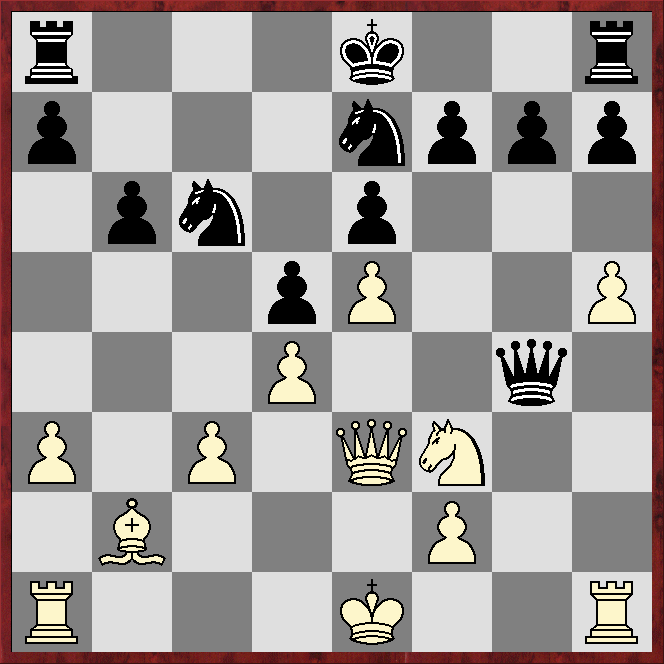
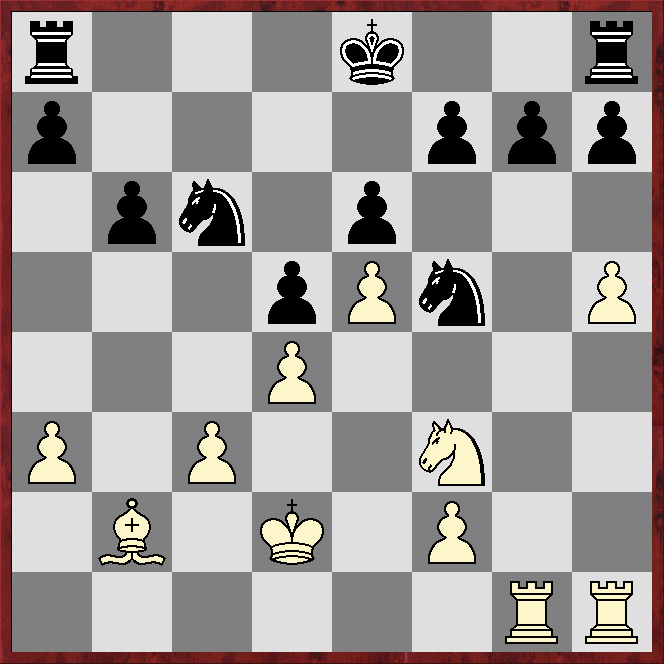
Black to play and gain a winning advantage
*****
*****
*****
*****
*****
33...Ra2!
If 33...Rc8, White is fine with, for example, 34.Bc5.
34.Bc5 Nd7?!
Black is still better after this, according to the engines, but they reckon strongest is 34...Qc6, when, among other things, Black threatens 35...Nc4! 36.bxc4 Qa4, with ...Rxc2 to come.
35.b4?
After 35.Ke2!? Nxc5 36.dxc5 d4! 37.Rc1!? Qxc5 38.Qd3 Qd5 Black has more than enough for a pawn, according to the engines, but the game continues. However, if 37.Nxd4, one line runs 37...Qxc5 38.Rh3 Qd5! (threatens 39...Qe4+) 39.Qd3 Ra1 40.Rhh1 Rd1!! 41.Qxd1 (41.Rxd1 Qxg2+ 42.Ke1 Qf2#) Qe4+ 42.Kf1 Qe3 43.Qe1 Ra1! 44.Qxa1 Qf2#.
35...Qb7 36.Ke2
Best may be 36.Rh4!?, but 36...Nxc5 37.dxc5 R8a3 leaves White unable to meet the twin threats of ...Re3+ and ...Ra1+.
36...Qb5+ 37.Kd1
Or 37.Qd3 Rxc2+ 38.Nd2 Rxd2+ 39.Kxd2 Ra2+ 40.Qc2 Qc4! (even stronger than 40...Rxc2+) 41.Rc1 Nxc5 42.bxc5 Qd4+ 43.Ke1 Qe3+ 44.Kf1 Qxf4+ 45.Kg1 Rxc2 46.Rxc2 Qd4+ and 47...Qxf2#.
37...Ra1+ 38.Qc1 Rxc1+ 39.Kxc1 Nxc5 40.bxc5 Qb4 0-1

Sunday, 30 August 2026

European 65+ Team: Game Four


Cemetery chapel in the village of Koutouloufari
England 3 v England 2
Spanton (2003) - Paul Townsend (2102)
French Winawer
1.e4 e6 2.d4 d5 3.Nc3 Bb4 4.e5 Ne7
This is a popular alternative to the mainline 4...c5. Often the moves transpose.
5.Bd2 b6 6.a3 Bxc3 7.Bxc3 c5 8.Bb5+
The start of a well-known manoeuvre that costs a tempo, but avoids an exchange of light-square bishops.
8...Bd7 9.Bd3 Nbc6
Stockfish18 and Dragon1 reckon this is better than pushing on with 9...c4!?
10.Nf3 Qc7 11.0-0
PT spent 25 minutes over his next move, flying in the face of John Nunn's 20-minute rule
*****
*****
*****
*****
*****
Nunn wrote in Secrets Of Practical Chess (Gambit 1998): "I have observed that if a player spends more than 20 minutes over a move, the result is almost always a mistake."
11...Ng6!?
The engines are not keen on this, preferring 11...cxd4 or 11...h6!? Note that 11...0-0?! allows a version of the Greek Gift sacrifice, ie 12.dxc5! (better than immediately capturing on h7) bxc5 13.Bxh7+! Kxh7 14.Ng5+, when the engines continue 14...Kg6 15.Qg4 f5 16.exf6 gxf6 17.Nxe6+, with a large advantage for White. After the engines' top choice, 11...cxd4, they reckon best-play runs 12.Nxd4!? (12.Bxd4? Nxd4 13.Nxd4 Qxe5 is good for Black) Nxe5 13.Nb5, when White has good compensation for a pawn after both 13...Bxb5 and 13...Qb8.
12.Re1 0-0
Now both sides have castled, how would you assess the position?
*****
*****
*****
*****
*****
Black has strong pressure against White's centre, but the centre gives White kingside attacking chances, and the engines agree White has the upper hand.
13.h4!?
Apparently a novelty, which the engines reckon is an improvement on Dimitrios Mastrovasilis (2621) - Alexei Shirov (2705), European Team Championship (Porto Carras, Greece) 2011, which went 13.Qd2 a5 14.Qe3!? Nce7!? 15.g3 Nef5 16.Qd2, with at least a slight edge for White, according to the engines (½–½, 63 moves). However, the engines reckon that better than both moves is another apparent-novelty in 13.dxc5!?, the idea being to meet 13...bxc5 with 14.b4!?
13...h6
On 13...cxd4 the engines agree 14.Bb4!? is strong, eg 14...Nxb4 15.axb4 h6 16.h5!? Nf4 17.Bf1 Nxh5 18.Qxd4 g5!? 19.Ra3!?, with an attack worth more than the pawn sacrificed. A possible improvement for Black is 14...Ngxe5!? 15.Nxe5 Nxe5 16.Bxf8 Rxf8 17.Bxh7+ Kxh7 18.Qh5+ Kg8 19.Qxe5 Qxe5 20.Rxe5 f6, although the engines reckon Black does not have enough for the exchange.
14.Bf1!? cxd4 15.Bxd4 Nxd4 16.Qxd4 Qxc2
How should White proceed?
*****
*****
*****
*****
*****
17.Rac1
This is enough for a slight edge, according to the engines, but they reckon Rac1 should be preceded by 17.h5!? Ne7.
17...Qa4 18.Qxa4!? Bxa4 19.Rc7
The engines reckon 19.Ba6!? gives White at least enough for a pawn.
19...Rfc8 20.Rec1 Rxc7 21.Rxc7 Bd1!? 22.h5!?
The engines agree this is best.
22...Nf4
What should White play?
*****
*****
*****
*****
*****
23.Ba6?
After 23.Nd4 Bxh5 24.g3 Ng6 25.f4, the engines reckon White has full compensation for being two pawns down.
23...Bxf3 24.gxf3 Nxh5
Rook and bishop usually make a better team than rook and knight, but here White is two pawns down and has a chronically weak kingside
*****
*****
*****
*****
*****
25.Rd7!?
Black can meet 25.Bb7 with 25...Rd8, getting behind the passed pawn.
25...Nf4 26.Bb7 Rb8 27.Ba6 Ng6 28.Rxa7 Nxe5 29.f4 Ng6 30.f5!?
The best try, but completely inadequate.
30...exf5 31.Bd3 Nf4 32.Bxf5 Rd8 33.Rd7!? Rxd7 34.Bxd7 Kf8 35.b4 Ke7 36.Ba4 Kd6 37.f3 Ke5 38.Bd1 Kd4 39.a4 Kc4 40.b5 Kb4 41.Bc2 g5 42.Kf2 h5 43.Kg3 d4 0-1
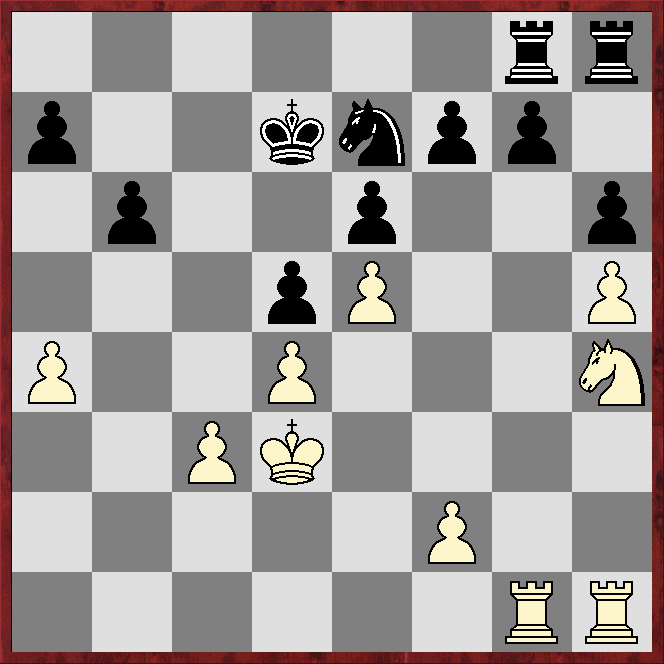
TEAM RESULT
Bo.13
  England 3
Rtg-8
  England 2
Rtg2 : 2
5.1
Spanton, Tim R
2003-
Townsend, M Paul
21020 - 1
5.2
Freeman, Jon A
1950-
Hewson, Brian W R
19960 - 1
5.3
Guilfoyle, John M
1921-AFM
Higgie, Charles L
19801 - 0
5.4
Wilson, Edgar
1903-
Noyce, Robert C
20121 - 0

Monday, 17 August 2026

Czech 65+ Round Three

Mausoleum built by the Czechoslovak-Yugoslav League to honour soldiers from what would become Yugoslavia who were killed in WW1
The second of today's double-round games.
Spanton (2003) - Jindřich Papay (1945)
French Winawer
1.e4 e6 2.d4 d5 3.Nc3 Bb4 4.e5 c5 5.Bd2 Bd7!?
Several other continuations are more common, including 5...cxd4 and especially 5...Ne7, but the text has been played by grandmasters.
6.a3!?
The engines agree this is stronger than the more popular moves 6.Qg4 and 6.Nb5.
6...cxd4?!
Black should probably prefer 6...Bxc3.
7.axb4 dxc3 8.Bxc3
Black has ceded the bishop-pair and given White a useful half-open a file, factors which add up to White having a positionally won game, according to Stockfish18 and Dragon1
*****
*****
*****
*****
*****
8...Ne7 9.Bd3 Ng6 10.Nf3 Nf4!? 11.Bf1!? g5?!
This type of thrust is rarely good, and this position is almost certainly not an exception.
12.Qd2 Rg8 13.h4 h6 14.h5 d4!?
Giving up a pawn, so the king's knight has a retreat square in the event of White playing g3.
15.Bxd4 Bc6!?
The engines agree this active move is the best chance in a bad position.
16.b5!? Be4 17.c4!? Kf8?
The engines reckon Black should play 17...Bxf3!? 18.gxf3 Nd7, or 17...a6, with ...Nd7 to come.
18.Bc5+
Even stronger are 18.Rd1, 18.Qe3 and 18.0-0-0.
18...Kg7 19.Bd6 Nd7?!
Exchanging on f3 is probably better.
20.Qe3 f5?!
And here the engines reckon Black should settle for 20...Bxf3 21.Qxf3 a6!?, despite White having 22.g3.
21.exf6+ Nxf6 22.Be5 Nd3+ 23.Bxd3 Qxd3
How should White proceed?
*****
*****
*****
*****
*****
24.Qxd3
Even stronger is the engines' 24.Qc5!, when Qe7+ and Rd1 cannot both be met.
24...Bxd3 25.0-0-0 Rgd8
Not 25...Bxc4?? 26.Rd7+.
26.b3 Kf7 27.Bc7!? Rdc8
Not 27...Rd7?? 28.Ne5+.
28.Ne5+ Ke8 29.Rxd3 Rxc7 30.f3!?
Restricting the black knight.
30...Nd7 31.Nxd7 Rxd7 32.Rhd1 Rxd3 33.Rxd3
How would you assess this rook-and-pawn ending?
*****
*****
*****
*****
*****
White is a pawn up, has the open file, and has fewer pawn-islands, advantages worth more than +4.00, according to the engines.
33...Ke7 34.Kc2 a6!?
This lets White undouble the b pawns, but activating the black rook is the engines' top choice.
35.bxa6 Rxa6 36.Kc3 Rc6 37.b4 Ra6 38.c5 b5 39.Kd4
The engines agree with not taking en passant.
39...Ra4 40.Rb3 Ra1 41.Rd3 Rb1 42.Kc3 Rc1+ 43.Kb2 Rg1
What should White play?
*****
*****
*****
*****
*****
44.c6?
Impatience, throwing away nearly all of White's advantage. Best is 44.Rd2, but 44.g4 also wins.
44...Rxg2+ 45.Kb3 Rg1 46.c7!?
There is no longer any win, whatever White plays.
46...Rc1 47.Rc3 Rxc3+ 48.Kxc3 Kd7 49.Kd4 Kxc7 50.Ke5!?
Or 50.Kc5 e5!, when 51.Kxb5? loses to 51...e4!, so White has to play 51.Kd5 Kd7 52.Kxe5, but 52...Kd7 draws.
50...Kd7 51.Kf6 Kd6 52.Kg6 Ke5
This draws easily enough, but the engines reckon Black has at least a slight edge after 52...e5!? 53.Kxh6 e4!? 54.Kxg5 (54.fxe4? g4 wins for Black) exf3 55.h6 f2 57.h7 f1=Q, although 58.h8=Q gives White a tablebase draw.
53.Kxh6 Kf6 54.Kh7 Kf7 55.Kh6
Not 55.h6? e5 etc, eg 56.Kh8 e4! 57.fxe4 g4 58.e5 g3 59.e6+ Kxe6 60.Kg8 g2 61.h7 g1=Q 62.Kh8 (hoping for stalemate) Qa7 63.Kg8 Qf7+ 64.Kh8 Qf8#.
55...Kf6 ½–½

Tuesday, 2 June 2026

Bad Neuenahr Round Seven

Spanton (1911) - Michael Negele (2149)
French Winawer
1.e4 e6 2.d4 d5 3.Nc3 Bb4 4.e5 c5 5.Bd2
This is second in popularity to the mainline 5.a3.
5...Ne7
This is a normal way to the develop the black king's knight in the Winawer Variation of the French Defence, but here it has the added point that, in the event of Nb5, Black can castle before White continues with Nd6+
6.a3
Even so, the commonest continuation in ChessBase's 2026 Mega database is 6.Nb5, when 6...Bxd2+ 7.Qxd2 0-0 8.f4 a6!? (8...cxd4 is also popular) 9.Nd6 cxd4 10.Nd4, gives a game with equal chances, according to Stockfish18 and Dragon1.
6...Bxc3
How should White recapture?
*****
*****
*****
*****
*****
7.Bxc3
This is overwhelmingly most popular, but the engines fluctuate between it and 7.bxc3!?, which was played by Lajos Steiner in a win against Aron Nimzowitsch  in the 1928 stem game.
7...cxd4
The engines suggest 7...Nbc6 or 7...b6.
8.Bxd4
The engines prefer the much more successful 8.Qxd4, meeting 8...Nbc6 with 9.Qg4!?, claiming the upper hand for White, one point being 9...d4?! can be met by 10.0-0-0, and, if 10...Nf5, then 11.Nf3.
8...Nbc6 9.Nf3 0-0 10.Bd3
Preserving the bishop-pair with 10.Bc3 is recommended by the engines.
10...Nxd4 11.Nxd4 Ng6
The engines suggest 11...Nc6, or David Howell's 11...Qb6.
12.Bxg6!
Apparently a novelty, and much liked by the engines. Carles Díaz Camallonga (2467) - George Stoleriu (2349), Chess.com Blitz 2020, went 12.Nf3 Nf4!? 13.0-0 Bd7 14.Re1, with a slight edge for White, according to the engines (but 0-1, 80 moves).
How should Black recapture?
*****
*****
*****
*****
*****
12...fxg6!
The engines agree this is one of those rare occasions when capturing away from the centre is better, even though here it weakens e6.
13.0-0
Now both sides have castled, how would you assess the position?
*****
*****
*****
*****
*****
White has an unchallengeable knight on d4, and fewer pawn-islands, which combine to give the upper hand, according to Stockfish18, although Dragon1 only awards White a slight edge.
13...Bd7 14.Qd2 Rc8 15.c3 g5!?
The engines like this.
16.h3 h6 17.Rfe1 Qe8 18.Re3 Qg6 19.Qd3 Qxd3 20.Rxd3 Rf4 21.Re1 Rcf8 22.Rf3 Rxf3 23.Nxf3
How would you assess this ending?
*****
*****
*****
*****
*****
White has the better pawn-structure, and has good-knight-v-bad-bishop. But rook-and-bishop is nearly always a stronger partnership than rook-and-knight, especially with play over the whole board, so any opening up of the game could work in Black's favour, at least as long as rooks stay on the board. However, both engines give White the upper hand.
23...Kf7 24.Nd4 Ke7 25.Re3 a6!? 26.Kf1 Rf4 27.g3
Not 27.Rf3?, as both 27...Re4 28.Re3 Rxe3 29.fxe3, and 27...Bb5+!? 28.Ke1 Re4+ 29.Re3 Rxe3+ 30.fxe3, leave the game equal, according to the engines.
27...Rf8 28.Rf3 Rc8
The engines reckon White is only slightly better after 28...Rxf3!? 29.Nxf3, but it looks an unpleasant position for a human to defend.
29.Ke2 Be8 30.Re3 Bh5+ 31.f3 Rf8 32.Nb3 Be8 33.Nd4 h5!?
This is the engines' top choice.
34.Kf2 Bg6
On 34...g4 I intended 35.h4, with what the engines agree is a slight edge.
35.Ke2 Bb1 36.Nb3
The engines suggest 36.g4!?
36...b6 37.Nd4 Kd7 38.Kf2 a5!?
This is not liked by the engines. They prefer 38...g4 or 38...Bf5.
39.Ke2
White is much better after 39.Re1, according to the engines, one of their lines running 39...Bf5 40.g4 hxg4 41.hxg4 Bg6 42.Ne2!? Rh8 43.Kg3 Kc6 44.Rd1 Kc5 45.Nd4 Re8, although there is a lot of play left in the position, and there were many reasonable alternatives for both sides along the way.
39...a4!?
The engines are happy with this, even though it puts another pawn on a light square. I suppose the point is it restrains White's queenside, and anyway the pawn is hard for Black to get at.
40.Kf2 Ba2?!
MN strongly criticised this afterwards, saying the bishop was "so powerful" on the b1-h7 diagonal; the engines agree.
How should White proceed?
*****
*****
*****
*****
*****
41.Re1
Keeping the bishop off b1-h7, and freeing e3 for the white king.
41...Bc4 42.Ke3 Rh8 43.h4!?
With Black unable to create counterplay on the queenside (or in the centre), it is a good time to try to make gains on the kingside, especially with the bishop somewhat out of play.
43...gxh4
Not 43...g4? 44.fxg4 hxg4 45.Kf4!, eg 45...Rf8+ 46.Kxg4 Rf2 47.Re3 Rxb2 48.Kg5 Ra2 49.Rf3, when White's kingside play is much quicker than Black's on the queenside.
44.gxh4 Ke7 45.Rg1 Rg8?
Black had to play 45...Kf7, when the engines give White the upper hand, or at least a slight edge (Stockfish18 is less enthused than Dragon1). However, it is far from clear White can make progress, although White can keep probing, without much risk of losing.
46.Rg6
Winning a pawn, and the game.
46...Kf7 47.Rxe6 g5 48.Rf6+ Ke7 49.hxg5 Rxg5 50.Rf5 Rg2 51.Rxh5 Rxb2
Black is 'only' one pawn down, but White's e pawn wins easily
*****
*****
*****
*****
*****
52.Rh7+ Ke8 53.e6 Rb1 54.Kf4 Re1 55.Nf5!? 1-0

Wednesday, 27 May 2026

Bad Neuenahr Round One

Spanton (1911) - Stefan Becker (1721)
French Winawer
1.e4 e6 2.d4 d5 3.Nc3 Bb4 4.e5 Ne7!? 5.a3 Bxc3+ 6.bxc3 c5
Via a minor transposition, we have reached a position occurring 27,241 times in ChessBase's 2026 Mega database
*****
*****
*****
*****
*****
7.Nf3!?
Fischer tried this twice against Uhlmann, scoring +0=1-1, but otherwise played 7.a4!? Stockfish18 and Dragon1 like the mainline 7.Qg4, and also 7.h4!?
7...Nbc6
This is the commonest reply in Mega26.
8.Be2
There is no consensus about White's best continuation, but more popular are 8.Bd3!? and 8.h4!?
8...Qc7
The engines suggest 8...Qa5 or 8...h6!?
9.0-0 Bd7 10.a4 0-0
More common are 10...b6 and especially 10...f6!?
Now both sides have castled, how would you assess the position?
*****
*****
*****
*****
*****
Black is slightly more developed, and has no pawn weaknesses, but White's centre-kingside space advantage and bishop-pair are probably more significant. The engines give White the upper hand.
11.Bf4!?
This seems to be a novelty. The logical follow-up to 10.a4 is 11.Ba3, when 11...cxd4 12.cxd4 seems good for White. The engines suggest 11...b6!? 12.dxc5, and now an apparent-novelty in 12...Rfc8!?, but continue to give White the upper hand.
11...b6
Probably not 11...cxd4 12.cxd4 Nb4?!, as the engines' 13.Qd2!? is strong.
12.Qd2 a6?!
This may be too slow, and seems weakening. The engines suggest 12...Na5 or 12...Rac8.
13.h4!?
This is the engines' top choice.
13...h5!?
This gives an odd impression, especially once White's reply is seen, but the engines are OK with it, although they prefer 13...Qd8!?, albeit reckoning that after 14.h5 h6 15.g4 White has a positionally won game.
How should White proceed?
*****
*****
*****
*****
*****
14.Nh2
Even stronger, according to the engines, are 14.Ng5 and 14.Bd3, but the text is also winning.
14...g6?!
Possibly best is 14...cxd4 15.cxd4 Nf5!?, even though, after 16.Bxh5, the reply 16...Nfxd4 leaves White well on top after both 17.Bg4 and 17.Bd1!?, according to the engines.
15.Bh6
How should Black respond?
*****
*****
*****
*****
*****
15...Nf5!?
This is Stockfish18's top choice, and for a long time Dragon1 agrees, although it comes to prefer giving up the exchange in another way, by 15...Kh7!? Allow both engines even longer, and they start fluctuating with moves such as 15...cxd4 and 15...Rfc8
16.Bxf8 Rxf8 17.Nf3
Black has no long-term compensation for the exchange, although in the short term the knight at f5 looks attractive
*****
*****
*****
*****
*****
17...c4!?
This is the engines' top choice, narrowly ahead of 17...a5, the idea being to make it difficult for White to open files for the rooks.
18.Qg5 Qd8!? 19.Rfb1 Qxg5 20.hxg5 Rb8 21.Nh2 h4!? 22.Ng4 1-0
There is still quite a long way to go before White's advantage can be converted into a trivial win. But the engines reckon White's advantage is the equivalent of being at least a piece up, and, with queens off the board, it would take a most unlikely blunder for White not to win eventually.

Thursday, 18 December 2025

All About That Bass

MOST of us have an opponent against whom nothing seems to work.
When the opponent is considerably stronger, this is not surprising, but when ratings are not so different, the results are harder to explain.
My biggest bogeyman is probably John Bass, whose record against me is +6=1-0.
Seven games is not a huge sample, but such a poor performance on my part must signify something.
So in this mini-series I intend to look at my games against JB and try to discover what is going on.
We first met at the annual Easter congress in Sutton, Surrey, not long after I had moved to London for work.

Bass (163 BCF) - Spanton (unrated)
Sutton 1989
French Winawer
1.e4 e6 2.d4 d5 3.Nc3 Bb4 4.e5 c5 5.a3 Bxc3+ 6.bxc3 Ne7 7.Nf3
This is the most popular positional alternative to the attacking 7.Qg4.
7...Qa5 8.Qd2 Bd7
Stockfish17.1 and Dragon1 recommend 8...b6, claiming Black is at least equal.
9.Be2 Ba4 10.Rb1 Nbc6!?
A gambit-move that does not appear in ChessBase's 2026 Mega database. Known moves are 10...b6 and 10...Qc7.
How should White respond?
*****
*****
*****
*****
*****
11.Rxb7
Cold-blooded acceptance. The engines prefer 11.dxc5 Qxc5 12.0-0.
11...0-0-0?!
Probably the wrong plan. After 11...0-0 Black has full compensation for a pawn, according to the engines.
12.Rb1 f6?!
The engines suggest trying to keep lines closed with 12...c4.
13.exf6 gxf6 14.0-0
With both sides castled, how would you assess the position?
*****
*****
*****
*****
*****
The main factor may be king safety, in that White's king is far safer than Black's. However, White also has an extra pawn, and the bishop-pair, and the engines agree White is winning.
14...Nf5 15.Qf4!?
The engines prefer 15.Bd3 or 15.dxc5.
15...Bxc2?
Black is still in the game after 15...c4.
16.Rb5 Qa4 17.Rxc5 a6
More-or-less forced, but White gets another tempo to build up against the black king's position.
18.Bd2 Rhg8 19.Rc1 h5 20.Rxc2?!
This will cost White his queen. White will still be winning, according to the engines, but other moves are much clearer, eg 20.Ne1 or 20.c4.
20...Rg4 21.Rb2 Rxf4 22.Bxf4
White has rook, two bishops and a pawn for queen and knight
*****
*****
*****
*****
*****
Materially, there is not much in it, but White continues to have much-the-safer king.
22...Kd7 23.Nd2?
Much stronger is 23.Rb7+ Ke8 24.Ne1.
23...e5 24.Rb7+ Kd6 25.Bg3?
White still has an edge after 25.Rb6!?, according to the engines.
Black to play and win
*****
*****
*****
*****
*****
25...h4
Even stronger is 25...N(either)xd4!
26.c4?
Other moves are better, including 26.Bh5 and 26.Rb6.
26...Nfxd4
This time, which knight makes the capture is important. The text is good for Black, but not as good as 26...Nxcxd4!
27.Rxd5+ Ke6
If I had captured with the other knight at move 26, Black would now have 27...Kc6.
28.Bg4+ f5 29.Ne4
What should Black play?
*****
*****
*****
*****
*****
29...Rxd5??
A queen move is mandatory, preferably 29...Qxc4.
30.cxd5+ Kxd5 31.Nc3+ 1-0
LESSON: the game was decided by tactics, with the winner, classically, being the player who made the next-to-last mistake.

Thursday, 1 May 2025

Summer Club

AM playing in the summer daytime tournament organised by Surrey's Coulsdon Chess Fellowship.
It takes place on 10 Wednesday afternoons, the time control being 90 minutes with a 30-second increment.
I will not be able to play every Wednesday - indeed I might only be able to play seven games, but since the entry fee is £22, that is still good value.
Here is yesterday's game.

Frank Gillespie (1530 ECF/1682 Fide) - Spanton (1985 ECF/1922 Fide)
French Winawer
1.e4 e6 2.d4 d5 3.Nc3 Bb4 4.e5 c5 5.a3 Bxc3+ 6.bxc3 Ne7 7.dxc5!?
A known move, but not popular.
How should Black respond?
*****
*****
*****
*****
*****
7...Qc7
By no means the only decent continuation.
8.Nf3 Nbc6
This may be a novelty. Known moves are 8...Nd7 and 8...Qxc5.
9.Bb5 0-0 10.Bxc6!? Nxc6 11.Bf4 f6 12.Qe2 fxe5 13.Bxe5 Nxe5 14.Nxe5
Stockfish17 and Dragon1 prefer 14.Qxe5, reckoning 14...Qxc5 15.Qd4 is equal.
14...Qxc5 15.Qd2!?
In view of Black's reply, White should probably prefer 15.0-0, although the engines reckon Black is slightly better after 15...Qxc3.
How should Black proceed?
*****
*****
*****
*****
*****
15...Rxf2!
This is the only way for Black to keep an advantage, according to the engines.
16.Qxf2 Qxc3+ 17.Ke2 Qxc2+??
Correct is 17...Qxe5+, with at least a slight edge for Black, according to the engines.
18.Kf3??
White has rook for three pawns after 18.Kf1.
18...Qe4+ 19.Kg3 Qxe5+ 20.Qf4 Qc3+
Not 20...Qxf4+?, after which the white king is safe and well-placed for an ending.
21.Kh4
If 21.Qf3, then 21...Qc7+.
21...e5 22.Rac1!?
The engines reckon this is best, but losing.
22...Qb2
Not 22...Qxa3? 23.Qxe5, after which Black's king is probably as vulnerable as White's.
23.Qg3?
Better is 23.Qe3, but 23...Bd7 leaves Black well on top.
23...Qd4+ 24.Kg5?!
Black also mates after 24.Kh5, but not as quickly.
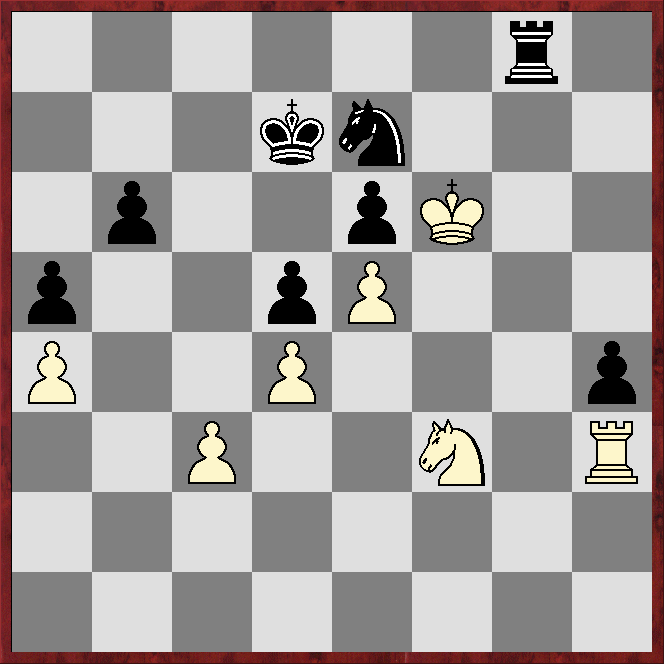
24...Qd2+ 0-1
Tuesday, 28 January 2025

Winning Chess

IN addition to the main swisses at Mariánské Lázně, there were three round-robin norm events - two for would-be international masters, and one for potential grandmasters.
The GM norm tournament featured four Fide masters, three international masters and three grandmasters.
Top seed was Ukrainian Anton Korobov, whose 2627 rating put him more than 100 elo clear of the field.
His score of +4=5-0 won the tournament by a half-point, but cost him 6.5 elo (since he has a K factor of 10, that is the equivalent of most rated players losing 13 elo, ie scoring 0.65 points less than expected).
Second was Indian international master G B Harshavardhan, whose score +5=2-2 gained 15 elo (since he also has a K of 10, that means he scored 1.5 points points more than expected).
Their round-six game proved pivotal.

Harshavardhan (2405) - Korobov (2627)
French Winawer
1.e4 e6 2.d4 d5 3.Nc3 Bb4 4.e5 c5 5.a3 Bxc3+ 6.bxc3 Ne7 7.Qg4 cxd4!?
Much more popular are 7...0-0 and especially 7...Qc7. The text can easily transpose into the latter, but both sides have chances for independent play.
How should White respond?
*****
*****
*****
*****
*****
8.cxd4!?
The main line in ChessBase's 2025 Mega database runs 8.Qxg7 Rg8 9.Qxh7 Qc7 10.Ne2 Nbc6 11.f4 Bd7 12.Qd3 dxc3 13.Nxc3, with a slight edge for White, according to Stockfish17 and Dragon1.
8...Qc7 9.Ra2!?
An awkward-looking defence of c2 that, at least for a while, is the top choice of Dragon1.
How should Black respond?
*****
*****
*****
*****
*****
9...Nf5
The engines reckon Black has equalised.
10.Nf3 Nc6 11.Bb2!?
This scores 75%, albeit from a very small sample (just six games) in Mega25, but is strongly disliked by the engines, which prefer 11.Bd3 and 11.Kd1!?
11...Qa5+ 12.c3 b6 13.Qf4!?
Apparently a novelty, the point of which will become clear next move. The engines prefer the known 13.Nd2.
13...Ba6 14.g4!? Nfe7 15.h4 Qa4!?
Black is better after this, according to the engines, but they reckon stronger is 15...Bxf1.
16.Bxa6 Qxa6 17.h5 Qd3!? 18.Ra1
The engines prefer 18.Nd2.
18...Qc2 19.Qd2 Qe4+ 20.Qe3 Qxg4
Black has won a pawn, and has at least the upper hand, according to the engines, but the position looks murky, at least to me
*****
*****
*****
*****
*****
21.Ke2 Qf5 22.Rag1 Qc2+ 23.Qd2 Qe4+ 24.Qe3 Qc2+ 25.Qd2 Qxd2+ 26.Kxd2 Nf5
Black has consolidated the extra pawn, and has got queens off the board; White has some kingside pressure, but needs to somehow get the bad bishop into play
*****
*****
*****
*****
*****
27.Kd3 h6 28.a4 Kd7 29.Ba3 Rag8 30.Nh4 Nce7!? 31.Bxe7 Nxe7
With the bishop gone, how big would you assess Black's advantage?
*****
*****
*****
*****
*****
White has a fair bit of compensation for a pawn, according to the engines, which give Black just a slight edge.
32.Rg4
The engines prefer 32.Ng2!?, intending Ne3, or 32.Rb1, intending a5.
32...g6 33.hxg6 fxg6 34.f4 g5 35.Nf3?!
The engines point out that 35.Ng2 threatens to equalise with fxg5, and after 35...gxf4 36.Rxg8 Rxg8 37.Nxf4 the white knight is well-placed to restrain the h pawn and pressure e6.
35...Rf8 36.Ke3 Rxf4 37.Rxf4 gxf4+ 38.Kxf4 Rf8+ 39.Kg4 Nf5!?
Even stronger may be first 39...Rg8+ and then ...Nf5.
40.Nh4 h5+!? 41.Kg5 Rg8+ 42.Kf6 Ne7!?
The engines at first strongly dislike this, preferring 42...Ng3, or 42...Rf8+ and then ...Ng3. However the text comes to be Dragon1's top choice, although Stockfish17 continues to prefer the alternatives.
43.Rh3 a5!?
This gives Black a backward b pawn, but is the engines' immediate top-choice, although Stockfish17 comes to prefer 43...Rg1 and 43...Rg4. The idea, I am fairly sure, is to create the threat of ...b5, followed, after axb5, by a quick advance of the a pawn.
44.Nf3?
The engines suggest 44.Rh2!? or 44.Rh1!?
44...h4!
Also very strong is 44...b5!
How should White continue?
*****
*****
*****
*****
*****
45.Nxh4
Walking into a pin, but the move seems forced, eg 45.Rxh4? loses the knight to 45...Rf8+ etc, while moving the knight away, eg 45.Nd2?, allows a quick mate starting with 45...Ke8! Finally, withdrawing the rook to h2 or h1 also loses the knight to 45...Rf8+ etc.
45...Rh8 46.Rh2
Black to play and win
*****
*****
*****
*****
*****
46...Nf5?
There is only one winning move: 46...Rh5!, when, unlike in the game, 47.Nf3? loses to 47...Rf5+ etc. If White instead shuffles the rook, for example to h3, then 47...Nf5 wins, while 47.Kf7 (best, according to the engines) runs into 47...Nf5 48.Nf3 Nd6+! 49.exd6 Rf5+ 50.Kg6 Rxf3 with a winning rook-and-pawn ending.
47.Rb2?
Incredible. I suspect most club players would play the correct 47.Nf3, even if they could not work out whether it really does draw. In fact after 47...Rxh2 48.Nxh2 b5!? 49.axb5 a4, presumably the sequence Harshavardhan feared, both 50.Nf3 and 50.Nf1 draw, eg 50.Nf3 a3 51.Nd2 a2 52.Nb3, or 50...Ne3 51.Nd2 (among other moves, 51.Ng5!? also draws, according to the engines), and here Black has to be careful as 51...Nd1?? loses to 52.Nb1, thanks to the deflecting power of pushing the b pawn, eg 52...Ne3 53.b6 etc.
47...Rxh4 48.Rxb7 Rf4!
Other moves also win, but the engines agree this is best.
49.Rb7+
Or 49.Kg5 Rf3, winning the c pawn.
49...Kc6 50.Ra7 Nxd4+ 51.Ke7 Nb3 52.Ra6+ Kc7 53.Ra7+
Little better is 53.Rxe6, when several moves win, including the simple 53...Rxa4, eg 54.Rd6 d4!? 55.cxd4 Rxd4 56.Ra6 a4 57.e6 Kb7 etc.
53...Kb6 54.Ra8 Nc5 55.Kd6 Rxa4 56.Rb8+ Ka7 57.Rc8 Rc4!? 58.Rxc5!?
There is nothing better, but the pawn-ending is lost.
58...Rxc5 59.Kxc5 Ka6!?
The key move - easy to find here, but difficult to see from afar.
60.Kd6
Or 60.c4 dxc4 61.Kxc4 Kb6 etc.
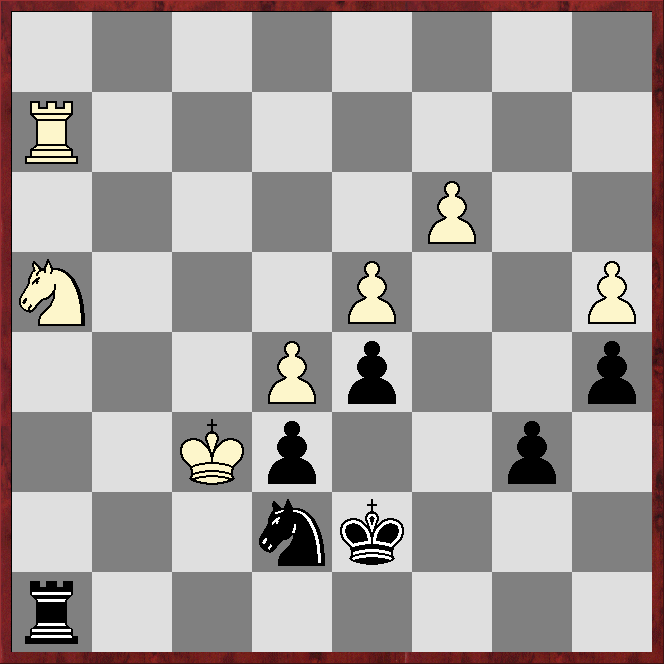
60...a4 61.Kxe6 a3 62.Kf7 a2 63.e6 a1=Q 64.e7 Qf1+ 65.Ke6 Qe2+ 66.Kd7 Kb5 0-1
Wednesday, 9 October 2024

Crete Round Nine

UPFLOATED  against a German.

Manfred Gradwohl (1911) - Spanton (2013)
Amateur Chess Organization 50+ World Championship Group C
French Winawer
1.d4 e6 2.e4 d5 3.Nc3 Bb4 4.e5 b6!?
This move is third in popularity in ChessBase's 2024 Mega database, behind 4...Ne7 and especially 4...c5.
How should White respond?
*****
*****
*****
*****
*****
5.a3
Stockfish17 and Dragon1 like the text, which is the commonest move, and they also like the rare 5.h4!?
5...Bf8!?
This is part of the main idea behind 4...b6!? - preserving Black's good dark-square bishop while seeking to swop off White's good light-square bishop. The engines prefer 5...Bxc3+ and 5...Be7, albeit awarding White the upper hand.
6.f4
This has been played by many grandmasters, but more popular is 6.Nf3.
6...Nh6!? 7.Nf3 c5 8.Bd3!?
This move, which is the top choice of the engines, appears to be a novelty. Known moves are 8.Be3, 8.Bb5+ and 8.Ne2!?
8...Ba6 9.Bxa6 Nxa6 10.Qd3
How should Black proceed?
*****
*****
*****
*****
*****
10...c4!?
This is nearly always a controversial move in the Winawer Variation of the French Defence, even when, as here, it comes with tempo. The move gains space and ensures the white d pawn remains for the foreseeable future on a dark square - the same colour complex as the white bishop - but takes pressure off the white centre.
11.Qe2 Nf5 12.0-0 h5 13.g3!? Be7 14.Nd1
The knight heads to e3 to challenge the black king's knight.
14...b5 15.c3 Nb8 16.Kg2 Nc6 17.h3?
Consistent with earlier play is 17.Ne3, when Stockfish17 reckons Black has an edge after both 17.Nxe3 and 17.g6!? Dragon1 also marginally favours Black.
17...h4! 18.Nxh4
The engines prefer 18.g4 or 18.gxh4.
18...Bxh4!?
This is better than capturing with the knight, which is well-placed in the vicinity of the white king.
19.gxh4 Qxh4 20.Qg4 Qe7?!
The engines agree with avoiding an exchange of queens, but reckon e7 is the worst of the four possible retreat squares.
21.Ne3 Nh6
The engines prefer 21...g6 or 21...Nxe3.
22.Qf3!?
This is the engines' top choice, threatening both 23.f5 and 23.a4.
22...Na5 23.Bd2 Nb3 24.Rad1 0-0-0
Now both sides have castled, how would you assess the position?
*****
*****
*****
*****
*****
The black king cuts something of a lonely figure on the queenside, but it is hard for White to exploit this. Meanwhile the white king could find lines being opened to it, and White has a bad bishop. The engines give Black the upper hand.
25.Be1 Rdg8?!
Probably better is 25...g6.
26.f5 Na5 27.Kh2 Nc6 28.Rd2 Qd8?
Vacating e7 for the queen's knight is a good idea, but it should be done so ...Ne7 does not allow a pin on the h4-d8 diagonal.
29.Rg2 Ne7?!
It was almost certainly better to spend a tempo moving the queen to d7 or e8.
30.Bh4 Qe8 31.Bxe7 Qxe7 32.Rfg1 Rh7 33.f6 Qf8 34.fxg7
Even stronger, according to the engines, is 34.Nxd5!? exd5 35.Qxd5, eg 35...Nf5 36.Qf3!? g6 37.Qxf5+!, or 35...Qd8 36.Qa8+ Kc7 37.Qxa7+.
34...Rhxg7 35.Qf6?
Winning is 35.Rxg7 Rxg7 36.Nxd5!? exd5 37.Qxd5
35...Rxg2+ 36.Rxg2 Rxg2+ 37.Kxg2 Qg8+ 38.Kh2 Qg6? 39.Qh8+
After 39,Qxg6 fxg6 40.Kg3 White has a winning knight-and-pawn ending.
39...Kb7 40.Qf6 Qxf6? 41.exf6 Kc7 42.Kg3 Kd6 43.Kf4 a5 44.Kg5 Ng8 45.Ng4 Kd7 46.h4 Kc6 47.h5 b4
Desperation.
48.axb4 axb4 49.h6 Nxh6 50.Nxh6 e5 51.Nxf7 exd4 52.Ne5+ Kd6 53.cxd4 c3 54.f7 Ke7 55.bxc3 b3 56.Nxd3 Kxf7 57.Kf5 1-0

Monday, 30 October 2023

Bavarian International Round Three

Spanton (1858) - Andriy Manucharyan (2058)
French Winawer
1.e4 e6 2.d4 d5 3.Nc3 Bb4 4.Ne2!?
This seems to have been first played by Géza Maróczy in 1924. Alexander Alekhine used the move to beat Aron Nimzowitsch in 1931, and Emanuel Lasker similarly scored over José Capablanca four years later, the same year Alekhine won with it against Max Euwe in their first world championship match. The move scores a decent 56% in ChessBase's 2023 Mega database.
How should Black respond?
*****
*****
*****
*****
*****
4...dxe4
This is easily the commonest reply in Mega23, but 4...Nf6!? and 4...Nc6!?, which have also been played hundreds of times, score much higher percentagewise.
5.a3 Bxc3+
This is popular, but the main move in Mega23 is 5...Be7.
6.Nxc3 Nc6
Nimzowitsch played 6...f5!? against Alekhine at Bled (Yugoslavia) 1931. The game continued 7.f3 exf3 8.Qxf3 Qxd4!? 9.Qg3 Nf6!? 10.Qxg7 Qe5+ 11.Be2 Rg8 12.Qh6 Rg6 13.Qh4, when Stockfish16 awards White the upper hand, but Komodo14.1 is at first less keen on White's position, albeit coming to give White a slight edge (1-0, 19 moves).
7.Bb5 Ne7 8.Be3
The mainline in Mega23 runs 8.Bg5 f6, and then 9.Be3, with an equal game, according to the engines.
8...0-0 9.Nxe4?!
Stockfish16 prefers the most popular move, 9.Qd2, continuing 9...f5!? 10.0-0-0 with an unclear position. Komodo14.1 suggests 9.Bxc6!? Nxc6 10.Qd2 Qe7!? 11.Nxe4, rating the position as equal.
9...f5 10.Ng5 f4 11.Bd2
Not 11.Nxh7? Kxh7 12.Qh5+ Kg8 13.Bd3 as Black has 13...Nf5, while 11.Qh5?? h6 leaves two white pieces en prise.
11...Qd5!
Forcing White to give up the bishop-pair.
12.Bxc6 Nxc6 13.Nf3
How should Black proceed?
*****
*****
*****
*****
*****
13...Qe4+?!
Komodo14.1 likes the simple 13...Nxd4 14.Nxd4 Qxd4 15.Bc3 Qe4+ 16.Qe2 Qxe2+ 17.Kxe2, reckoning 17...e5! gives Black the upper hand.
Stockfish16 gives 13...e5!? 14.dxe5 Bh3!, the idea being 15.gxh3? fails to 15...Nxe5 16.Nxe5 Qxh1+ 17.Ke2 Qe4+ 18.Kf1 Qxe5. Better is 15.c4!, but 15...Qe4+ 16.Qe2 Qxe2+ 17.Kxe2 Bxg2 is good for Black.
14.Qe2 Qxc2 15.0-0!?
This seems a slight improvement over the known move 15.Rc1, after which 15...Qxb2 favours Black, according to the engines.
15...Bd7
Grabbing a second pawn with 15...Qxb2?! can be met by the forcing 16.Qc4 Qb6 17.Rab1 Qa6 18.Qxa6 bxa6 19.Rfc1, with what the engines reckon is at least enough compensation for two pawns.
16.Rfc1 Qg6 17.Rc5 Rae8 18.Bc3
What should Black play?
*****
*****
*****
*****
*****
18...e5!?
The engines approve of this returning the pawn for an attack, although they reckon 18...h6 is also equal.
19.dxe5 Bg4
Interesting is 19...Bh3, but White is fine replying 20.Qf1 (but not 20.Ne1? as both 20...Bxg2 and 20...f3 are strong).
20.Qc4+ Kh8 21.Ne1 f3 22.g3 Rf5?!
Black is slightly better after 22...Be6!?, according to the engines.
23.Qe4
Even stronger, according to the engines, is 23.Nd3, with Nf4 to come.
23...Re7?!
Preparing to gang up on the e pawn, but it is almost certainly too slow. The engines suggest 23...Rf7!?, although after 24.Qxg6 hxg6 the white king is no longer in danger, and White's pieces are a little more active.
24.Rd1 h5?
The engines recommend covering the back rank with 24...Re8!?, but much prefer White.
White to play and win
*****
*****
*****
*****
*****
25.h4
White is better after this, but the engines point out the forcing 25.h3! Bxh3 26.Rxc6! bxc6 (or 26...Qxc6) 27.Qh4, forking bishop and rook. White emerges with bishop and knight for rook and pawn, and has a large advantage, according to the engines.
25...Qe8 26.Nd3 Rf8
Black has no adequate answer to the threat of Nf4-d5, eg the engines reckon best is 26...Nd8!?, but 27.Nf4, followed by doubling rooks on the d file wins, and if 27...c6, to stop this, then 28.Nxh5! is strong and 28.e6!! is even stronger.
27.Nf4 Bf5 28.Qxf3 Kg8
The engines prefer 28...Bg4, but 29.Ng6+ Kg8 30.Qd5+ (30.Qxf8+!? is also good) Be6! 31.Qe4! wins the exchange.
29.Qd5+ Kh7 30.e6! Bg4
Or 30...Bxe6, when 31.Qd3+ Kg8 32.Rxh5 wins as 32...g6 loses to 33.Rh8+ Kf7 34.Qxg6#.
31.Qe4+ g6
White to play and lose
*****
*****
*****
*****
*****
32.Rd7??
White is roughly the equivalent of a queen up after 32.Rdd5, according to the engines, but other moves also win, including the simple 32.Re1.
The game finished:
32...Rxd7 33.Nxh5? Rd1+ 34.Be1 Qxe6 0-1
AM: "Sorry."