Showing posts with label Secrets Of Practical Chess. Show all posts

Tuesday, 27 January 2026

Lessons From Mariánské Lázně II

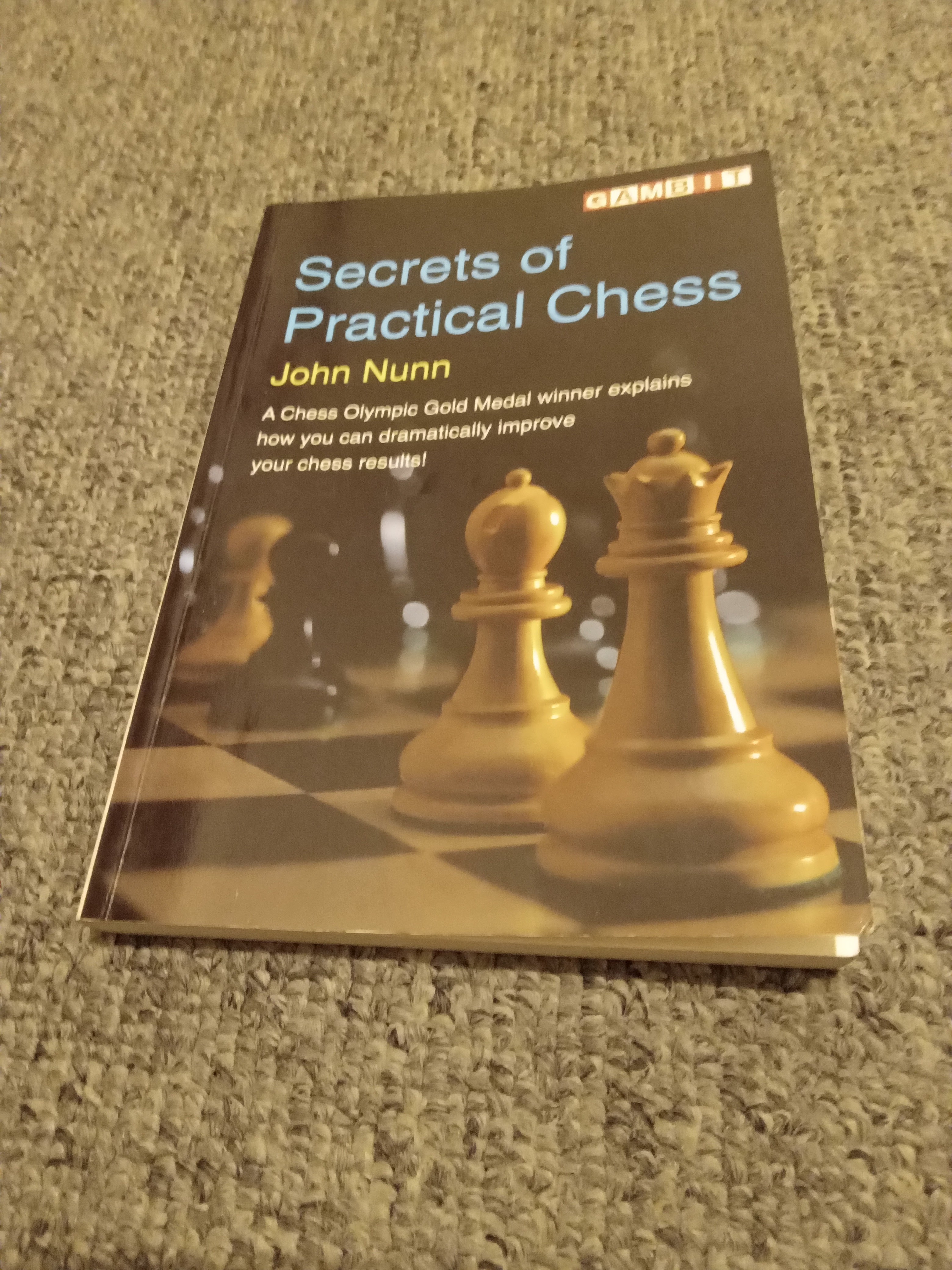
GRANDMASTER John Nunn tells an amusing, and instructive, anecdote in Secrets Of Practical Chess (Gambit 1998) about a blitz match he played against an opponent rated around 2300.
Nunn won the series 88-12, despite having a time handicap, but the interesting thing is his opponent's comment about halfway through: "I thought I would see lots of advanced strategic concepts in these games, but actually all I have learnt is LPDO."
Or, to put it another way, loose pieces drop off.
Nunn comments: "During the remaining games I saw what he meant. Most of the games were decided by relatively simple tactics involving undefended pieces, when the LP would duly DO."
I was reminded of the story during my round-two game at Mariánské Lázně, where I had black against Poland's Ewa Balcerczak (1537).
This position arose after White played 21.Nb1-c3
*****
*****
*****
*****
*****
A peculiarity of the position is that both white rooks are loose - neither is protected by a fellow piece or pawn.
The looseness of the king's rook might seem unimportant, but look what happens over the next few moves.
I began with 21...Qe7, taking advantage of the undefended queen's rook to reposition my queen with tempo.
EB had to do something about the rook, and chose to play 22.Qb3?! (Stockfish17.1 and Dragon1 prefer 22.Qc1 or 22.Ra1).
The problem with the game's choice is it allows 22...Nc5! (better than the tempting 22...Nxf2+ 23.Bxf2 Bxf2, when 24.Nd5 keeps White in the game).
EB counterattacked with 23.Nd5? (23.Qd1!? is better), but that allowed me to take advantage of White's other undefended rook by playing 23...Qe2!, when my opponent could have resigned on the spot, and did so anyway after a further three moves.
LESSON: loose pieces drop off.

Friday, 23 December 2022

Practical Secrets

TWICE while writing up my games from Benidorm I referred to Secrets Of Practical Chess by John Nunn (Gambit, 1998).
This prompted me to read through the book again - something I have not done for several years.
I was pleasantly surprised to find advice I had forgotten, or perhaps had absorbed subconsciously without realising where it came from.
Memory jerker
Nunn may have written more-important books - he certainly has written more-advanced ones - but I doubt he has written anything as entertaining.
What I had definitely forgotten is a new, enlarged edition of Secrets Of Practical Chess came out last December.
I regard re-reading the edition I have as an early Christmas present to myself. I only wish I were not too mean to splash out on the updated version.

Saturday, 17 December 2022

Benidorm: Typical Mistakes & How To Avoid Them (Part Four)

I FAILED to hold a drawn rook-and-pawn ending in round four of the Benidorm (Meliá) U2000 against Rajesh Aaadith (1714).
White has just played 73.f6+
*****
*****
*****
*****
*****
*****
*****
*****
I played the losing 73...Kg8?, and there followed 74.Re5 Rf1 75.Rg5+ Kh7 76.Kf7 Kh6 77.Rg8 Kh7 78.Rg2 (threatening mate in one) Kh6 79.Rh2+ Kg5 80.Kg7 Kf5 81.f7 1-0.
Correct is 73...Kg6, after which 74.Re1 can be met by 74...Ra2. Then 75.Rg1+ Kh7 76.f7 does not win, thanks to 76...Ra7+ with continuous checks from the flank.
This is all fairly basic. My one consolation is that John Nunn in Secrets of Practical Chess (Gambit 1998) calls rook-and-pawn endings "genuinely complicated," and states: "The ability to play rook-and-pawn endings well is a great distinguishing feature between a master player and a club player."
Clearly if I had known the right technique in the diagram position I should have drawn the ending quite routinely. But some clear thinking, and a little calculation, would also have found the correct continuation.
For starters it can be seen both 73...Kg8? and 73...Kg6 prevent 74.f7+? The former prevents it since Black replies 74...Rxf7+; the latter because the forced 74...Kg7 enables Black to capture the pawn next move.
It is also easily comprehensible that after either 73rd move by Black, White's only real winning try is to move the rook along the e file with intent to check on the g file, thus driving the black king away from the pawn.
One point is after 73...Kg6 74.Re1 Black cannot capture the pawn with 74...Rxf6?? as that loses to 75.Rg1+ etc. In that respect there is little difference between 73...Kg6 and 73...Kg8? as Black cannot capture the pawn after either move.
So far the moves seem similar, but here comes the big difference. The move 73...Kg8? gives White an extra resource in that, if the black rook leaves the f file, pushing the f pawn will come with check if the black king is still on g8.
So 73...Kg8? 74.Re1 Ra2 (planning to check from the flank) is hopeless in the face of 75.f7+ and 76.f8=Q(+).
However after 73...Kg6 74.Re1 Ra2 75.f7 Ra7+ 76.Ke6 Ra6+ (Black must keep checking as 76...Rxf7?? loses to 77.Rg1+ etc) White cannot both escape the checks and hold on to the pawn.
So Black's drawing plan in the diagram position is to threaten to capture the pawn, and, when that is no longer feasible, to perpetually check the white king.
The latter part of the plan only works if the pawn cannot advance with tempo, hence why 73...Kg8? is a mistake but 73...Kg6 draws.

Wednesday, 14 December 2022

Benidorm: Typical Mistakes & How To Avoid Them (Part Two)

ARTURO López Heras (1715), my round-two opponent in the Benidorm (Meliá) U2000, played the King's Gambit, but was clearly caught by surprise on move three: 1.e4 e5 2.f4 Bc5 3.Nf3 d5!?
He spent about 24 minutes thinking before coming up with 4.d4?, and Black was already better after 4...dxe4?!, although almost certainly stronger is 4...exd4.
Either way, ALH's choice was a mistake, confirming a rule expounded by grandmaster John Nunn in Secrets Of Practical Chess (Gambit 1998).
Nunn wrote (emphasis added): "When analysing a given position, it is fair to say that one almost always sees more in the first five minutes than in the next five minutes.
"The five minutes after that is even less productive, and so on. I have observed that if a player spends more than 20 minutes over a move, the result is almost always a mistake.
"The normal decision-making process should not take longer than this, even in fairly complex situations."
Nunn points out there will be exceptions to his rule, and it is reasonable to suppose the chances of coming up with a bad move increase dramatically in a position requiring a lot of thinking time.
Nevertheless I believe Nunn's 20-minute rule is well worth remembering. Indeed I am always a little surprised when an opponent breaks the rule and does not come up with an error.
So what can be done about this thinking mistake?
Nunn stated: "If you have thought about a position for some time and are still unsure what to play, it is essential to be ruthlessly pragmatic.
"Suppose your lengthy cogitation is the result of indecision; for example, say there are two moves, both of which have roughly equal merit.
"If you have not been able to decide between them up to now, it is reasonable to suppose that there is in fact little to choose between them.
"Considerable further thought might eventually reveal some difference, but it is rare that this expenditure of time is worthwhile.
"First of all, it is easy to be wrong when dealing with such fine distinctions and secondly, gaining an infinitesimal advantage is of little value if the result is that you run into time-trouble and blunder away a piece."
He added: "My advice is to obey your instinctive feeling as to which of the two moves is better or, if you don't have any preference, just choose at random.
"I have occasionally been tempted to toss a coin at the board, but despite the undoubted psychological impact on the opponent, this does seem rather unsporting."