Showing posts with label English Nimzowitsch. Show all posts

Wednesday, 3 December 2025

Benidorm Bali Round Seven

FACED a Malaysian junior (born 2010).

Spanton (1896) - Taj Prasshad Nambiyar Chanthiran (1518)
English Four Knights
1.c4 e5 2.Nc3 Nf6 3.Nf3 Nc6 4.e4!?
Nimzowitsch pioneered this move, and the associated pawn-formation with a grip over d5, but a hole at d4. Botvinnik is credited with refining the idea by playing e4 before developing the king's knight, which then went to e2, in conjunction with a kingside fianchetto.
How should Black respond?
*****
*****
*****
*****
*****
4...Bb4
This was a popular reply from the beginning, along with 4...Bc5, and has today established itself as the main continuation.
5.d3 h6!?
Nakamura and other grandmasters have played this, but more popular are 5...0-0 and especially 5...d6.
6.Be2 d6 7.Bd2 Bc5!?
A known idea, but apparently a novelty in this exact position. The move is liked by Stockfish17.1 and Dragon1, along with another apparent-novelty, 7...a5!?
8.0-0 0-0
Now both sides have castled, how would you assess the position?
*****
*****
*****
*****
*****
*****
White has more space on the queenside and has a grip over d5, but a hole at d4. Both white bishops are passive, while Black's dark-square bishop is technically bad, in that Black's centre pawns are on dark squares, but is outside the pawn-chain and is the most active piece on the board. The engines reckon the game is completely equal.
9.Na4 Qe7 10.a3 a5 11.Rb1 Ba7 12.b4 axb4 13.axb4 Nd4 14.Nc3 Nxe2+!?
Black wins the bishop-pair, but swops off White's bad bishop.
15.Qxe2 Bg4 16.h3 Bh5 17.Be3 c6
Maintaining the bishop-pair with 17...Bb8!? does not look appealing, and 17...b6? is simply bad after 18.Ra1 or 18.b5!?
18.b5 Bxe3
Black is slightly better after this, according to the engines, but they reckon 18...Bd4!? is stronger.
19.fxe3!?
It is hard to say which recapture is better - the engines are split on the matter - but I thought this was the less-drawish choice.
19...c5?!
Black is slightly better after 19...Nd7 or 19...Qd8, according to the engines, but they reckon the text leaves White slightly better.
20.g4 Bg6 21.Nh4!?
Black cannot exploit this tactically, because White threatens Nxg6, which in turn threatens Nxe7+, but they reckon White should be playing on the queenside with 21.Ra1 or 21.Qb2.
21...Bh7 22.Nf5 Bxf5 23.Rxf5 Nh7 24.Qf2 Ra3!?
Counterplay, but the engines reckon 24...g6!? gives complete equality, despite the hole at f6.
25.Nd5 Qd7 26.Rd1
Black to play and lose
*****
*****
*****
*****
*****
26...Rfa8??
Black is only slightly worse after 26...g6!? or 26...Qd8, according to Stockfish17.1, although Dragon1 awards White the upper hand.
27.Nb6 Qe7 28.Nxa8 Rxa8 29.Kh2 f6 30.Qf1 Nf8 31.Ra1 Rxa1!?
The engines are not overly critical of this, although swopping rooks when the exchange down is rarely a good idea.
32.Qxa1 Ne6 33.Qa8+ Kh7 34.Qc8
How should Black proceed?
*****
*****
*****
*****
*****
34...Nf4?!
This 'clever' combination wins back the exchange, but at the cost of allowing White to swop off into an easily won pawn ending. However, Stockfish17.1 reckons White's advantage is anyway worth almost a rook, and Dragon1 is even more effusive.
35.exf4 g6 36.fxe5 gxf5 37.Qxf5+ Kg8 38.Qg6+ Qg7 39.Qxg7+
The game finished:
39...Kxg7 40.exd6 Kf7 41.Kg3 Ke6 42.Kf4 Kxd6 43.Kf5 Ke7 44.Kg6 b6 45.h4 1-0

Friday, 7 February 2025

League Chess

PLAYED on board four (of five) for Battersea against Railsport in Central London League Division Two last night.

Spanton (1980) - John Bass (1932)
English Nimzowitsch
1.c4 e5 2.Nc3 Nf6 3.Nf3 Nc6 4.e4!?
Aron Nimzowitsch pioneered this formation, which Mikhail Botvinnik refined by developing the white king's knight at e2 and fianchettoing the king's bishop.
4...Bb4
This is the main response, although 4...Bc5 is also popular.
5.d3 0-0 6.Be2
Here too fianchettoing the king's bishop is possible.
6...d6 7.0-0
Both sides having castled early, how would you assess the position?
*****
*****
*****
*****
*****
White has a hole at d4, but a grip on d5, with more space on the queenside. Both king's bishops are technically bad (friendly central pawns on the same colour), but Black's is active while White's is passive. Stockfish17 and Dragon1 call the game equal.
7...h6 8.h3 Bxc3!?
In these lines White often provokes this capture with a3.
9.bxc3 Re8!?
By putting latent pressure on e4, Black discourages any advance of the white d pawn.
10.Rb1 Ne7 11.c5!? Ng6 12.cxd6 Qxd6!? 13.Qc2 b6 14.Rd1 Bb7 15.Be3 Rad8 16.Nh2 c5 17.Ng4 Nxg4 18.Bxg4 Qc7 19.Bh5 Nf4!? 20.Bxf4 exf4
Who has the advantage in this middlegame?
*****
*****
*****
*****
*****
No one, according to the engines, which reckon the position is completely equal.
21.Bf3 Re7 22.Qa4 Bc6 23.Qc4 Bb7 24.a4 Qc8!? 25.Bg4 Qc7
After 25...Ba6 26.Bxc8 Bxc4 27.dxc4 Rxc8 28.f3 White is slightly better (Dragon1), or at least has the better part of equality (Stockfish17).
26.Ra1 Bc8 27.Bxc8 Qxc8 28.a5? f3!?
The opening of the white king's position will objectively give Black only a slight edge, according to the engines, but in practical terms makes the defence very tricky for a human
*****
*****
*****
*****
*****
29.axb6?
The engines reckon 29.Re1! keeps White's disadvantage to a minimum, but they also prefer 29.d4!? over the text.
29...axb6?!
The engines much prefer 29...fxg2.
30.Kh2?
Again the engines reckon Re1 is best.
30...fxg2 31.Rg1?
The engines still prefer Re1, but by now agree Black is winning anyway.
31...Qc7+ 32.Kxg2 Qf4 33.Rad1 Re6 34.Qa2 Rg6+ 35.Kf1 Rxg1+ 36.Kxg1 Qf3 37.Rd2 Rxd3 38.Rxd3 Qxd3 39.Qa8+ Kh7 40.Qd5!?
This is Dragon1's top choice - Stockfish17 suggests 40.Qc8 - but, as usual, swoping off into a pawn-ending when inferior does not work out well.
40...Qxd5 41.exd5 Kg6 42.c4
This was my idea - creating a protected passer - but it is not enough to save the game
*****
*****
*****
*****
*****
42...Kf6 43.f4 g5 44.Kf2!? gxf4 45.Kf3 Ke5 46.h4 b5!? 47.cxb5 Kxd5 48.Kxf4 c4 49.Ke3 Kc5 0-1
Battersea won the match 3-2.

MY BATTERSEA SEASON 2024-5
DATE.....EVENT...........................COL..RATING..OPP'S RATING..SCORE..SEASON PERF
12/9/24..Central London League....W......1933..........1886................1............2286
26/9/24..Central London League....B.......1933..........2112................1............2399
15/10/24.Club Championship.........W......1968..........1578................1............2259*
31/10/24.Central London League...B.......1968..........1867.................0...........2061*
19/11/24.London League...............W......1957..........1991................1............2127*
21/11/24.Central London League....B.......1957..........2035................=...........2112*
27/11/24.London League...............W......1957..........1723................=...........2056*
12/12/24.Central London League....B.......1965..........2153................0...........2018*
7/1/25.....Club Championship.........B.......1958..........1785................1...........2037*
9/1/25.....Central London League....B.......1958..........1851................0...........1978
14/1/25....Eastman Cup.................B.......1958..........2052................1............2021*
28/1/25....London League..............B.......1958..........1766................1............2033*
4/2/25......London League..............B.......1980..........1757................1............2043*
6/2/25......Central London League..W.......1980..........1932................0............2006*
*My season's performance is slightly better than this, the point being my win against a 1578 counts as a 1978 performance, lowering my average despite winning the game.

Wednesday, 17 July 2024

Lessons From Bad Herrenalb II

MY round-two game in the Baden-Württemberg 60+ championship began as a Nimzowitsch System in the English: 1.e4 c5 2.Nc3 Nf6 3.Nf3 Nc6 4.e4!?
There are 4,666 examples of this position in ChessBase's 2024 Mega database
*****
*****
*****
*****
*****
*****
*****
Black replied 4...Bc5, which occurs 1,630 times in Mega24, second only to 4...Bb4's 1,748 times.
I continued 5.Nxe5!?, which, judging by body language, caught my opponent by surprise, although, since his rating is 2063, I am sure he is familiar with the basic idea.
When Black plays ...Nxe4, intending, after Nxe4 to play ...d5, forking the knight on e4 and a bishop on c4, it is with the idea of equalising the game.
When, as in this game, White plays the similar Nxe5, it is usually in the hope of achieving a slight plus.
The difference can be explained by White enjoying the advantage of the move, which is normally more potent in the early stages of a game.
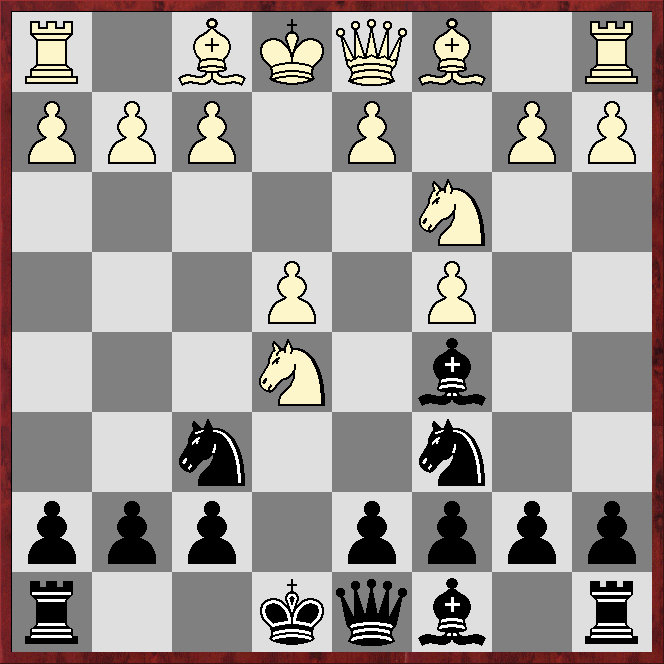
Position after 5.Nxe5!?
*****
*****
*****
*****
*****
The mainline in Mega24 runs 5...Nxe5 6.d4 Bb4 7.dxe5 Nxe4 8.Qf3 Nxc3 9.bxc3 Ba5 10.Bf4, which at best gives White a tiny edge (Dragon1 calls the position completely equal).
My opponent played 5...Bxf2!?, which is clearly tempting as it occurs 194 times in Mega24 and has been the choice of 14 players rated over 2300.
However after 6.Kxf2 Nxe5 7.d4 White has the bishop-pair and the centre.
True, White has lost castling rights, and after 7...Neg4+ 8.Kg1 has difficulties developing the king's rook.
But the advanced black knight is easily driven away, and the white king is not in danger, so it is not so surprising that Dragon1 and Stockfish16.1 reckon White has a positionally won game.
LESSON: allowing the well-known forking combination Nxe5 (...Nxe4 for Black) can be embarrassing, but lashing out with ...Bxf2+ (Bxf7+ for White) is rarely a good idea. Losing the bishop-pair and control of the centre is much more significant than depriving the opponent of castling rights.

Saturday, 6 July 2024

Bad Herrenalb Round Two

Spanton (1928) - Heinz-Dieter Gierse (2063)
English Nimzowitsch
1.c4 e5 2.Nc3 Nf6 3.Nf3 Nc6 4.e4!?
This gives White a grip over d5, but at the expense of leaving a hole at d4. It was pioneered by Aron Nimzowitsch, and later refined by Mikhail Botvinnik, who developed the king's knight to e2 (or e7 when using the formation with black).
4...Bc5
Slightly more popular in ChessBase's 2024 Mega database is 4...Bb4, but the text has been played by many top grandmasters, including Fabiano Caruana and Vladimir Kramnik.
5.Nxe5!? Bxf2+?!
There are 194 examples of this move in Mega24, but it is probably a mistake. The mainline runs 5...Nxe5 6.d4 Bb4 7.dxe5 Nxe4 8.Qf3 Nxc3 9.bxc3 Ba5 10.Bf4, which is completely equal, according to Dragon1, although Stockfish16.1 gives White an edge.
6.Kxf2 Nxe5 7.d4 Neg4+ 8.Kg1
White has lost castling rights, but has the bishop-pair and dominates the centre
*****
*****
*****
*****
*****
8...d6 9.Be2
This appears to be a novelty, although it transposes to a known position, albeit one that only occurs once in Mega24. Normal is 9.h3.
9...c5!?
The engines agree this is an improvement on the known 9...Rg8?!
10.dxc5 dxc5 11.Qxd8+ Kxd8 12.Bf4 Be6
DH spent 31 minutes on this move. John Nunn has a theory that someone who spends more than 20 minutes on a move almost always plays a mistake. The theory does not quite hold up here - the text is the engines' second choice, although they prefer 12...Re8.
13.Rd1+ Kc8
Again this is the engines' second choice. They prefer 13...Nd7.
14.h3 Nh6 15.g4 Ne8 16.g5 Ng8 17.Kh2
White has connected rooks, while Black has only one piece developed, and is lost, according to the engines
*****
*****
*****
*****
*****
17...Ne7 18.Nd5 Nc6 19.Bf3 Nd4 20.Bg2 Kd7!?
The engines fluctuate between this and 20...b6.
21.Be3 Bxd5 22.Bxd4 cxd4 23.Rxd4 Rd8?!
The engines' 23...h6 seems better.
24.Rxd5+ Kc7 25.Rxd8 Kxd8 26.Rd1+ Ke7 27.e5!? b6?!
Probably better are the engines' 27...Nc7 and 27...f6.
28.Bc6 h6 29.Rd7+ Ke6 30.gxh6 gxh6 31.Rd8 Rg8?
This makes it easy for White, but not much more difficult is 31...Ke7 32.Rxe8+ Rxe8 33.Bxe8 Kxe8 34.Kg3 etc.
32.Rxe8+ 1-0

Sunday, 18 June 2023

4NCL Daventry Game Three

Spanton (1959 ECF/1824 Fide) - Tom Brown (1989 ECF/1944 Fide)
English Nimzowitsch
1.e4 e5 2.Nc3 Nc6 3.Nf3 Nf6 4.e4
Aron Nimzowitsch pioneered this setup. Mikhail Botvinnik refined it by first playing e4 (...e5 with black) and then developing the king's knight to e2 (e7).
4...Bc5
Marginally more common in ChessBase's 2023 Mega database is 4...Bb4, after which the mainline runs 5.d3 d6 6.a3 (Nimzowitsch preferred 6.g3) Bc5 7.b4 Bb6, when Stockfish15.1 and Komodo14.1 reckon the position is equal, although the former comes close to giving White an edge.
5.Nxe5!?
Capturing the e pawn in circumstances like these is usually thought of as an equalising manoeuvre, but here White is playing it in the hope of gaining an advantage.
5...Nxe5
Almost certainly not 5...Bxf2+?! 6.Kxf2 Nxe5 7.d4.
6.d4 Bb4 7.dxe5 Nxe4 8.Qd4
Nimzowitsch preferred 8.Qc2.
8...Nxc3 9.bxc3 Be7
How should White proceed?
*****
*****
*****
*****
*****
10.Bf4!?
The main move in Mega23 is 10.Qg4, after which 10...g6 and 10...Kf8!? are almost equally popular, and the position is roughly balanced, according to the engines.
10...b6!?
This apparent-novelty is liked by the engines, along with the known move 10...0-0.
11.Bd3 Bb7 12.Be4
Not 12.0-0?? Bc5.
12...Bxe4 13.Qxe4 0-0 14.0-0 Qc8!? 15.Rfd1 Rd8 16.Rd3 d6 17.Rad1
17.exd6 Bxd6 18.Bxd6 Rxd6 19.Rxd6 cxd6 is completely equal, according to the engines.
17...Qe6 18.Qc6 dxe5 19.Qxe6 fxe6 20.Bxe5 Rxd3 21.Rxd3 Rd8 22.Rd4 c5 23.Rxd8+ Bxd8
How would you assess this bishop-and-pawn ending?
*****
*****
*****
*****
*****
White's queenside pawn-structure is wrecked, but the white bishop is active and all Black's queenside pawns are on dark squares, making them targets for the white bishop. Stockfish15.1 gives White a slight edge, but Komodo14.1 calls the position equal.
24.f4!?
Sticking a pawn on a dark square, but gaining space and restricting the ability of the e pawn to advance.
24...Kf7 25.Kf2 Bf6 26.Bb8
Also equal is 26.Bxf6, according to the engines.
26...a6 27.Ba7 Bd8 28.Bb8 Bf6 29.Ba7 Bd8 30.Bb8 Bf6 ½–½

Tuesday, 28 September 2021

Lessons From North Shields II

Spanton (1965 ECF/1747 Fide) - David A Patrick (1881 ECF/1882 Fide)
Northumberland Open Round 2
English Nimzowitsch
1.c4 e5 2.Nc3 Nf6 3.Nf3 Nc6 4.e4!?
More popular in ChessBase's 2021 Mega database are 4.g3, 4.e3, 4.d4 and 4.d3, but the text, which was pioneered by Aron Nimzowitsch, is also popular with grandmasters.
4...Bb4 5.d3 h6!?
The main move is 5...d6.
6.Be2
The chief alternative is 6.g3. After fianchettoing the king's bishop, White would have a formation that Mikhail Botvinnik refined by developing the king's knight to e2.
6...0-0 7.0-0 Re8 8.Be3 b6!?
I intended meeting 8...Ng4 by playing 9.Bd2, with h3 to come, but Stockfish14 and Komodo12.1.1 suggest 9.Nd5, meeting 9...Nxe3 with 10.fxe3.
9.Nd5 Bc5 10.Qd2 Ng4
The engines prefer 10...a5!?
11.Bxc5 bxc5 12.h3 Nf6 13.Qe3 Nd4 14.Nxf6+ Qxf6 15.Nxd4 exd4
The engines slightly prefer 15...cxd4, although this allows White a pawn-lever with f4.
16.Qg3 d6 17.f4 Rb8 18.b3
Who stands better?
*****
*****
*****
*****
*****
The black queen's rook is more active than its white counterpart, and Black has the better bishop, but the black pawn-structure is less flexible and White has the possibility of a kingside initiative. The engines slightly prefer White.
18...Bd7 19.Rae1 a5 20.Bd1 a4 21.e5 Qg6
The engines slightly prefer 21...dxe5. one point being 22.fxe5 can be met by 22...Qg5 23.Qxg5 hxg5, when the pawn at g5 looks weak but White does not have the possibility of creating a passed e pawn.
22.Qxg6 fxg6 23.bxa4!
This looks like a beginners' move, but it poses Black unexpected difficulties.
How should Black reply?
*****
*****
*****
*****
*****
23...dxe5?!
This gives White a central passed pawn to go with the queenside passer(s). The engines prefer 23...Bf5 24.Be2!? dxe5 25.g4 Bd7 26.Bf3 exf4 27.Bd5+ Kh7 28.Rxe8 Bxe8!? (28...Rxe8 29.a5!? c6 30.Be4 is good for White, according to the engines) 29.Rxf4 Bxa4, when Black is a pawn up but White is slightly better thanks to having two sets of two pawns holding up two sets of three black pawns.
*****
*****
*****
*****
*****
24.Rxe5?!
The engines much prefer 24.fxe5.
*****
*****
*****
*****
*****
24...Rxe5?!
White is only slightly better after 24...Bf5, according to the engines.
25.fxe5
*****
*****
*****
*****
*****
25...Ra8?
This may look natural but it lets White promote the light-square bishop from bad and passive to bad but active. The engines suggest 25...Bc6, but then Stockfish14's 26.e6!? Re8 27.Rf7 Rxe6 28.Rxc7 Re1+ 29.Kf2 Rxd1 30.Rxc6 is promising despite being a rook-and-pawn ending.
26.Bf3! Re8?!
Not 26...Rxa4? 27.Bd5+ Kh7 28.e6 etc, but better than the text seems to be the engines' 26...c6, although then 27.Be4 is strong, eg 27...Rxa4 (27...Kh7 28.Rf7) 28.Bxg6 Rxa2 29.Rb1 with good winning chances.
27.Bd5+ Be6 28.Bc6 Rb8 29.a5 Bf5 30.Rxf5!
The simplest solution.
30...gxf5 31.a6 Rb1+ 32.Kh2 Rb2 33.a4 1-0

Sunday, 9 August 2020

Junior Fest Continues

FACED my third Czech junior in this afternoon's third round of Summer Prague U2000.
Spanton (1831) - Lukas Lihotsky (1529)
English Nimzowitsch
1.c4 Nf6 2.Nc3 e5 3.Nf3 Nc6 4.e4 Bb4
This is the main alternative to the most-popular move 4...Bc5, for which see https://beauchess.blogspot.com/2020/08/czech-mate.html
5.d3 d6 6.Be2
Nimzowitsch preferred 6.g3 but Carlsen has played the text.
6...h6 7.0-0 0-0 8.h3 Be6 9.Nd5 Bc5 10.Be3 Nd7 11.d4 Nxd4 12.Nxd4 Bxd4 13.Bxd4 exd4 14.Qxd4
White has a central bind, but a bad bishop. Komodo11.01 reckons the game is equal, but Stockfish11 slightly prefers Black.
14...a5 15.Rac1!?
This mysterious rook move was played with the intention of transferring the rook to the kingside along the third rank, but nothing of the sort comes to pass. The engines prefer 15.Rad1, which I rejected because 15...Nc5 prevents Rd3, but I missed that White has 16.e5.
According to the engines, 15.f4 is best met by 15...Bxd5.
15...Re8 16.Rfe1 Bxd5
LL offered a draw.
17.exd5
I rejected the engines' choice, 17.cxd5, because of 17...Nf6 18.f3, when I felt White's kingside dark-square weaknesses would be a major liability, but the engines reckon White has an edge.
17...Qf6 18.Qxf6 Nxf6 19.Bd3 Nd7 20.f4 Nc5 21.Bc2 Kf8 22.Kf2 Rxe1 23.Rxe1 Re8 24.Rxe8+ Kxe8 25.Ke3 Ke7 26.Kd4 Kf6 27.b3 g5
LL offered a draw. I kept playing but without disturbing the equilibrium, and the game was drawn after 41 moves.
Arguably of slightly more interest is that the congress has a book and souvenir stall.
None of the books is in English, and the T-shirts are generic ChechTour ones rather than event or season specific, but it makes a change from the many tournaments these days that have no kind of stall.

Saturday, 8 August 2020

Czech Mate

FACED a Czech junior in the first round of the Summer Prague U2000 this afternoon.
Spanton (1831) - Pavlina Dudova (1496)
English Nimzowitsch
1.c4 e5 2.Nc3 Nf6 3.Nf3 Nc6 4.e4
Nimzowitsch poineered this set-up. Later it was refined into the Botvinnik formation in which White also puts pawns on c4 and e4 but places the king's knight on e2.
4...Bc5
This is the most popular reply in ChessBase's 2020 Mega database.
5.Nxe5
This well-known fork trick is often played by Black in similar positions in order to equalise, but here White hopes for more.
5...Nxe5
If 5...Bxf2+?! then 6.Kxf2 Nxe5 7.d4 (7...Neg4+ 8.Kg1) with h3 to come leaves White with the centre and the bishop-pair.
6.d4 Bd6?
This plausible-looking move has been played by grandmasters, but Nimzowitsch showed what is wrong with it against Réti at Berlin Tageblatt 1928.
How should White proceed?

*****
*****
*****
*****
*****
7.c5 Bxc5 8.dxe5 Ng8 9.Bc4!?
A simpler way to an advantage is 9.Qg4, as played by Nimzowitsch against Réti. That game continued 9...Kf8 10.Qg3 Ne7 11.Bc4 Ng6 12.f4 (1-0, 62 moves).
9...Ne7 
This is the choice of my main analysis engines Stockfish11 and Komodo11.01, but there is a major problem with Black's position.
10.Qg4
The engines give 10.b4!, the point being that after 10...Bxb4 11.Qb3 Bxc3+ 12.Qxc3 White is a pawn down but has more than enough compensation thanks to open lines for his bishops and heavy pieces. That leaves 10...Bb6, but White is clearly better.
10...Ng6
Also seemingly playable for Black is 10...0-0 (Black now threatens ...d5) 11.Qg3 (11.Bh6 Ng6 12.Bg5 Qe8 is good for Black) d6. The engines eventually give best-play as 10...d5!? 11.Qxg7 Rg8 12.Qxh7 dxc4 13.Nd5 with an unclear position.
11.Qg3
I felt 11.Bg5 Be7 12.Bxe7 Qxe7 simplified Black's task.
11...0-0
Komodo11.01 likes this but Stockfish11 prefers the retreat 11...Be7!?, although then both engines agree White is better after 12.Nd5.
12.h4 d6 13.h5 Nxe5 14.h6 g6?!
Good for Black is 14...Qf6? 15.Bg5? Bxf2+, but Black is busted after 15.Nd5 as 15...Bxf2+ 16.Qxf2 Qxf2+ 17.Kxf2 Nxc4 fails to 18.Ne7+ Kh8 19.hxg7+ Kxg7 20.Bh6+.
Best seems to be 14...Ng4 15.hxg7 Re8 (15...Bxf2+?! 16.Qxf2 Nxf2 17.gxf8Q+ Qxf8 18.Kxf2) 16.Qf3 Qf6 (16...Bxf2+ 17.Kf1) 17.Qxf6 Nxf6 18.f3, one point being that 18...Kxg7 19.Bh6+ gives White plenty of play for the pawn, according to the engines.
15.Bg5 Qd7?
Also bad is15...Bxf2+? 16.Kxf2 Ng4+ 17.Qxg4 Bxg4 18.Bxd8, but Black is still in the game after 15...Qe8 16.Nd5 Ng4 17.0-0-0.
16.Nd5 Ng4 17.Qxg4 Bb4+ 18.Kf1
The only winning move, but plenty good enough.
18...Qxg4!?
This speeds the end but the engines' 18...Qe6 19.Qf4 f6 20.Ne7+ is hopeless for Black.
19.Ne7+ Kh8 20.Bf6#