Showing posts with label Queen-and-minor-piece ending. Show all posts

Monday, 16 March 2026

Bad Wörishofen Senioren Round Four

Ulrich Fernschild (1671) - Spanton (1919)
Colle-Zukertort
1.Nf3 d5 2.d4 c5!? 3.e3
This narrowly edges out 3.c4 for popularity in ChessBase's 2026 Mega database, but the latter move is preferred by Stockfish17.1 and Dragon1.
3...Nf6 4.b3 e6 5.Bb2 cxd4!?
How should White recapture?
*****
*****
*****
*****
*****
6.exd4!?
This is the top choice of the engines, even though the move blocks the long dark-square diagonal. The point is that the white queen's bishop will play an important role in supporting the king's knight, which at some point is likely to land on e5.
6...b6!?
A rare continuation.
How should White respond?
*****
*****
*****
*****
*****
7.Bd3
Yahli Sokolovsky (2369) - José Eduardo Martínez Alcántara (2591), Chess.com Blitz 2022, continued 7.Bb5+ Bd7 8.Bd3, with a slight edge for White, according to the engines (but 0-1, 55 moves).
7...Bb7 8.Nbd2 Nc6!?
This interferes with the light-square bishop's action on the long light diagonal, but means White will probably be obliged to spend a tempo on preventing ...Nb4.
9.a3
This is not immediately necessary, eg 9.Ne5!? prevents 9...Nb4?? as the latter loses to 10.Bb5+ Ke7 11.Ba3, with c3 to come.
9...Bd6
Carlsen played 9...g6!? in a rapid game, but the engines are unimpressed. 
10.Ne5 Qc7 11.f4
The engines agree this is better than 11.Ndf3, but they also like 11.Qe2!?
11...Ne7!?
The engines suggest an apparent-novelty in 11...Ne4!?, the point being 12.Nxe4 dxe4 13.Bxe4 can be met by 13...Nxe5, when 14.Bxb7 Qxb7 15.fxe5 Qxg2 16.Rf1 Rc8!? seems roughly equal.
12.Rc1 0-0 13.0-0
Now both sides have castled, how would you assess the position?
*****
*****
*****
*****
*****
White has a well-placed knight at e5, and more space on the central-kingside, but Black has no weaknesses, and enjoys some pressure against the white queenside. Equal chances, according to the engines.
13...Rac8 14.Qe2 Ng6 15.c4
The engines suggest another apparent-novelty, this time 15.c3!?, a possible continuation being 15...a6!? 16.a4 Ne7!? 17.Bb1!? (17.Bxa6 Bxa6 18.Qxa6 Nf5 gives Black reasonable compensation for a pawn, according to the engines) Ng6!? 18.Bd3!? Ne7!? 19.Rf3, with a roughly equal position, but there is a lot about these moves I do not understand.
Popular in Mega26 is 15.g4, when the engines suggest 15...b5!?, the point being 16.Bxb5 can be met by 16...Ne4, eg 17.Qe3 Nh4 18.Be2 f5, with what they reckon is more than enough for a pawn. And if White instead continues on the kingside with 16.g5, then 16...Ne4 17.Nxe4 dxe4 18.Bxe4 Bxe4 19.Qxe4 f5!?, and again Black has good compensation for a pawn, according to the engines.
15...Qe7 16.b4 dxc4 17.Ndxc4 Bb8 18.Nxg6
Vacating e5 so the square can be occupied by White's other knight, but the engines disapprove, suggesting 18.b5!?, 18.f5 or 18.g3.
18...hxg6 19.Ne5 Nd5
Both knights are well-placed
*****
*****
*****
*****
*****
20.Ba6?!
Seeking to swop off White's good light-square bishop, but this is probably inadvisable at a time when White is saddled with a dark-square bishop that could be a liability in an endgame as it is hemmed in by its own pawns.
20...Rxc1 21.Bxc1
Forced, as the king's rook is needed to defend f4.
21...Rc8 22.Bxb7
It is difficult to safely withdraw the bishop, eg 22.Bd3 can be met by 22...Rxc1 23.Rxc1 Nxf4 24.Qe3 Nxg2. However, possible is 22.Nxg6!? fxg6 23.Bxb7 Qxb7 24.Qxe6+, but it seems the engines' 24...Kf8 25.f5 g5 wins for Black, although the position remains sharp.
22...Qxb7 23.Bb2
23.Nxg6!? fxg6 24.Qxe6+ transposes to the previous note.
23...Rc7 24.b5!?
How should Black respond to White's threat to play Nc6, blocking the open file? 
*****
*****
*****
*****
*****
24...Ne7
This may be best. Black could sacrifice the exchange with 24...Qc8 25.Nc6 Rxc6!? (25...a6 26.a4) 26.bxc6 Qxc6, but 27.Rc1 lets White fully mobilise, giving a completely equal position, according to the engines. The alternative pawn captures, 26...Bxf4 and 26...Nxf4, do not seem to be improvements. However the engines point out the possibility of temporarily sacrificing the knight with 25...Nxf4!?, when 26.Rxf4 Rxc6 27.bxc6 Bxf4 nets a pawn, although the position is not completely clear after the continuation 28.g3!? Bd6 29.Qc4. One point about the text is that, as well as preventing Nc6, it rules out Nxg6 ideas.
25.Qd2
The engines dislike this, suggesting 25.h4, or the pawn sacrifice 25.d5!? to liberate White's bishop. Either way, they reckon Black has at least the upper hand.
25...Qd5 26.Qb4?
This allows liquidation into an ending that White has little chance of holding, so the engines suggest 26.Qd3 or 26.Qe2!?, albeit agreeing White is anyway losing.
26...Rc2 27.Rf2
Both 27.Nf3? Bd6, and 27.Rf3? Bxe5 28.fxe5 (28.dxe5? Qd1+ 29.Rf1 Qe2) Nf5, are even worse for White.
27...Rxf2 28.Kxf2 Bxe5 29.dxe5
White's king is even more exposed after 29.fxe5?!
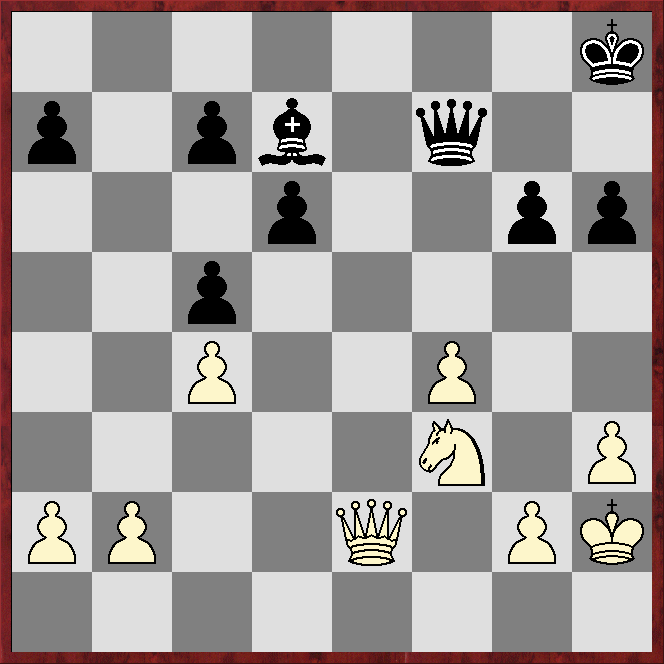
How would you assess this queen-and-minor-piece ending?
*****
*****
*****
*****
*****
White's bad bishop and exposed king, combined with Black's good knight, make this a very good ending for Black, provided a) perpetual check is prevented, and b) queens stay on the board (at least until any resulting minor-piece ending is a trivial black win).
29...Nf5 30.g3?
UF was presumably worried about ...Nh4, but the engines give 30.Bc3!? as 30...Nh4 can be met by 31.Kg3! However, 30...Nh6 is strong, eg 31.Bd4 Qe4 32.Qd2 Qb1 33.Bb2 Qa2 34.h3 Qb3 35.Qe2 Nf5, when White is still hanging on, but the practical difficulties of defending such a position are huge.
30...Qd3
Probably even stronger is 30...Qh1.
31.Qc3!?
This is best, according to the engines, but now b5 falls.
31...Qxb5 32.Qd2 Qc5+ 33.Kg2 Ne3+ 34.Kf3 Nd5 35.Qc1!? Qb5
35...Qxc1?! may win, but it is a lot less clear than keeping queens on.
36.Kg2?!
This speeds the losing process, but White was anyway the equivalent of almost a rook down, according to the engines.
36...Qe2+ 37.Kh3 Ne3 0-1
Entrance to Villa Diogenes at Hotel Alpenhof

Sunday, 1 December 2024

Benidorm Round Four

FACED an Indian junior (born 2014).

Safarullakhan Safin (1824) - Spanton (2009)
Spanish Cozio
1.e4 e5 2.Nf3 Nc6 3.Bb5 Nge7 5.d4
This is fourth-most popular in ChessBase's 2025 Mega database, the top choice being 5.0-0.
4...exd4 5.Nxd4 g6 6.c4!?
A rare continuation, setting up a sort of Maróczy Bind, but one in which Black has played ...e5 rather than ...c5.
How should Black respond?
*****
*****
*****
*****
*****
6...Bg7
There is no dramatic refutation.
7.Be3 0-0 8.0-0 f5!?
Possibly a novelty. Known moves are 8...a6 and 8...d6.
9.exf5 Nxf5 10.Nxf5 Rxf5
Now Black has broken the bind, how would you assess the position?
*****
*****
*****
*****
*****
The bind is broken, but the c4 pawn gives White a little more freedom in the centre, and White has the safer king. Dragon1 gives White a slight edge, but Stockfish17 calls the position equal.
11.Nc3 d6 12.Qd2 Ne5?!
Playing for threats against c4 and the white kingside, but probably prematurely. Sensible is getting on with development with 12...Be6.
13.Ne2?!
Passive. The engines reckon White has the upper hand after 13.f4!?, and if 13...Ng4 then 14.Bd4. They also like 13.c5.
13...Kh8?
Too slow. Black had two good moves, 13...Qh4 and 13...c6!?, eg 13...Qh4 14.Ng3 Ng4 15.h3 Nxe3 16.Qxe3 Re5 with pressure, or 13...c6!? 14.Ba4 Qh4!? 15.Bb3 a5 with multiple threats.
14.Ng3
Even stronger, according to the engines, is 14.f4.
14...Rf8?!
Almost certainly better is 14...Rf7, so 15.Bg5 can be met by moving the queen to f8 or g8, avoiding an exchange of dark-square bishops.
15.Bg5 Bf6 16.Bxf6
This is good, but even better, according to the engines, is 16.Bh6 Rf7 17.Ne4, eg 17...Bg7 18.Bxg7+ Rxg7 (18...Kxg7?! 19.f4 gives play against the black king), when Black's pieces are less well-coordinated than in the game.
16...Qxf6 17.f4 Ng4 18.h3 Nh6 19.Ne4 Qg7
Not 19...Qf5? 20.Qc3+!? Kg8 21.Rae1 with a strong attack.
20.Rae1 Nf5 21.Kh2 Nd4 22.Ba4
The engines like 22.Rd1!? Nxb5 23.cxb5, eg 23...Be6 24.Rf3 Rae8 25.Ng3!?, claiming a slight edge for White, apparently based on the vulnerability of Black's queenside pawns.
22...Bf5?!
It seems 22...Be6 equalises.
23.Ng5 h6 24.Nf3 Nc6!?
The engines prefer exchanging knights, albeit awarding White the upper hand.
25.Bxc6 bxc6 26.Re3
The engines like other lines, including 26.g4 Bd7 27.b4.
26...Rae8 27.Rfe1 Rxe3 28.Rxe3 c5!?
The engines agree this is best.
29.Qe2
After 29.Qa5 both 29...Qxb2 30.Qxc7 Qf6 31.Qxa7 Be6!? and 29...Qf7 are fine for Black, according to the engines.
29...Bd7 30.Re7 Rf7 31.Rxf7 Qxf7
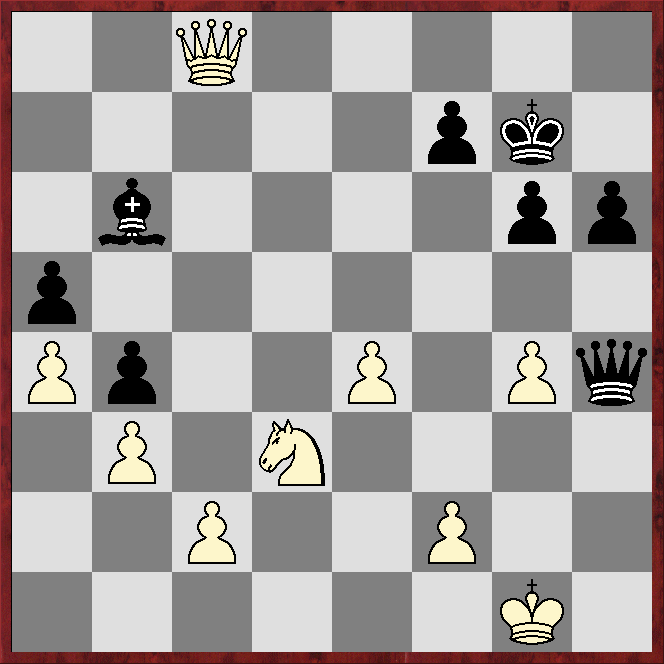
How would you assess this queen-and-minor-piece ending?
*****
*****
*****
*****
*****
Black has an extra pawn-island and the more-open king, while White has a knight, which is often said to be the better minor piece for cooperating with a queen. However, the bishop has good diagonals to work on, and the knight does not have a central or advanced outpost. The engines reckon the position is completely equal.
32.Qe4 Qf5?!
Several moves maintain the balance, including the simple 32...Kg7.
33.Qa8+ Kg7 34.Kg3!
The king is safe here, and now ...Qxf4+ is not threatened.
34...g5 35.fxg5 hxg5 36.Qxa7
Black to play and (probably) hold
*****
*****
*****
*****
*****
36...c6?
Self-pinning the bishop, and meaning it will fall with check if the black queen no longer protects it. Best is 36...g4 37.hxg4 Qxg4+ 38.Kf2 Qxc4, when after 39.Qxc2 Black seems to have enough counterplay, eg 39...Qc2+ 40.Kg3 Qg6+ 41.Kf4!? Qh6+ 42.Ke4 Qe6+! 43.Kd3 Kg6!? However, this is one of those positions where one slip by Black probably hands the win to White, while the worse  White can reasonably do is draw.
37.Qc7 g4
Too late.
38.hxg4 Qxg4+ 39.Kf2 Qe6 40.a4
The passed a pawn will decide matters.
40...Kf6 41.Qd8+ Qe7 42.Qh8+ Kf7 43.a5 Qf6 44.Qxf6+ Kxf6 45.a6 Bc8 46.a7 Bb7
With the bishop tied to preventing the a pawn queening, White is effectively a piece up
*****
*****
*****
*****
*****
47.Nd2 Ke5 48.Nb3 Ba8 49.Kg3 d5!? 50.Nxc5 d4 51.Kf2 Kd6 52.Na4 Kc7 53.c5 Kb7 54.Nb6 Kxa7 55.Nxa8 Kxa8 56.Ke2 1-0

Sunday, 10 November 2024

Cap Negret Round Four

FACED a fellow England-registered player after taking a half-point bye in round three.

Spanton (2009) - Raymond Wynarczyk (1843)
Philidor
1.e4 d6 2.d4 Nf6 3.Nc3 e5!?
This is the top choice of Stockfish17 and Dragon1.
4.Nf3!?
As is fairly well-known, White gets little from 4.dxe5 dxe5 5.Qxd8+. The text is more popular in ChessBase's 2024 Mega database, and is preferred by the engines.
4...Nbd7 5.Bc4 Be7 6.0-0 0-0
Now both sides have castled, how would you assess the position?
*****
*****
*****
*****
*****
The engines reckon White's extra space in the centre and freer development give a slight edge. 
7.h3 c6 8.Re1!?
Overwhelmingly more popular is 8.a4.
8...b5 9.Bb3 a5 10.a4 b4 11.Nb1 c5!?
This may be a novelty. Known moves are 11...h6!? and 11...Qc7.
How should White respond?
*****
*****
*****
*****
*****
12.dxe5!
This is the only move to give White any sort of advantage, according to the engines.
12...Nxe5 13.Bf4?!
Probably the wrong follow-up. The engines reckon White should fix the centre with 13.Nxe5, eg 13...dxe5 14.Nd2 Qc7 15.Qe2, when the c4 square makes a fine outpost for a white minor piece.
13...Bb7
The engines like 13...c4!?,  when 14.Ba2?! loses the exchange to 14...b3! 15.cxb3 Nd3 etc, while 14.Bxe5 cxb3 15.Bd4 bxc2 gives Black at least a pull, according to the engines, despite Black having an isolated d6 pawn on a half-open file.
14.Nbd2 Qc7 15.Bxe5!? dxe5
Black has the bishop-pair, but the dark-square bishop is bad and White has the c4 outpost
*****
*****
*****
*****
*****
16.Qe2 Ba6?!
This is easily countered. The engines prefer 16...g6!?, while Stockfish17's top choice is the positional pawn sacrifice 16...c4!? 17.Bxc4 Bc5, after which the dark-square bishop is active, and White's extra pawn on c2 is somewhat vulnerable.
17.Bc4 Bb7 18.Rac1!? Rac8 19.b3 Nd7?!
RW offered a draw.
20.Ba6
Even stronger seems to be 20.Bd5.
20...Bf6?
Better is 20...Bxa6 21.Qxa6 Nb8 and ...Nc6, but even so the engines give White at least a slight edge.
21.Bxb7 Qxb7 22.Nc4 Qc7 23.Rcd1 Nb6 24.Nxb6 Qxb6 25.Rd5 Rfe8 26.Qc4
Even stronger, according to the engines, is 26.Nd2, intending Nc4.
26...Re6 27.Red1 g6 28.g4!? h6 29.h4 Be7!?
How should White proceed?
*****
*****
*****
*****
*****
30.Rxe5?!
Missing the point of Black's play. White already has a winning position, according to the engines, and should ratchet up the pressure, eg 30.Kg2 Qb8 31.Rd7 Rd8 32.R1d5 Rxd7 33.Rxd7, although there is no immediate breakthrough.
30...Rxe5 31.Nxe5 Qf6 32.Rd5!
The only move to maintain an advantage - other moves leave Black with at least a slight edge, according to the engines.
32...Rd8
The engines give 32...Qf4!? 33.Qe2 Bd6!? 34.Rxd6 Qxe5 35.Rd5, although White remains a sound pawn up.
33.Rxd8+?
Other moves are better, including 33.Kf1, according to the engines, one point being 33...Qxh4?? loses to 34 Rxd8+ Bxd8 35.Qxf7+ Kh8 36.Nxg6#.
33...Bxd8 34.Qxc5
Better may be 34.Nd3 Qxh4 35.e5, but at best White has only a slight edge, according to the engines.
34...Bb6 35.Qc8+
Not 35.Nd7?? Qa1+ etc.
35...Kg7 36.Nd3 Qxh4
RW offered a draw.
Should the draw offer be accepted?
*****
*****
*****
*****
*****
The position is completely equal, according to the engines, as long as White plays 37.Kg2!? or 37.e5.
37.Qd7?!
How should Black proceed?
*****
*****
*****
*****
*****
37...h5
The engines reckon 37...Qh3!? gives at least a slight edge.
38.gxh5 gxh5?
Both 38...Qxh5 and 38...Qg5+ 39.Kf1 Qxh5 give complete equality, according to the engines.
39.Qf5 f6?!
The engines' 39...Bd4 is probably better.
40.Kg2?!
Almost certainly better is 40.Kf1.
40...Qg5+?!
The engines much prefer 40...Kh6!?
41.Qxg5+?!
It seems only 41.Kh3!? gives winning chances, eg 41...Qxf5+ 42.exf5 Kh6 43.f4, although this too may be drawn.
41...fxg5
Black is a pawn down, but the ending is completely equal, according to the engines
*****
*****
*****
*****
*****
42.Ne5 Bc7 43.Nc4 g4 44.Ne3 Be5 45.f3 gxf3+ 46.Kxf3 Kf6 47.Nc4 Bc7 48.Nb2!? Ke5 49.Nd3+ Kd4 50.Nf4?!
What should Black play?
*****
*****
*****
*****
*****
50...Bd6
Not 50...Kc3?? 51.Nd5+ etc, but Black has at least a slight edge, according to the engines, after 50...Bxf4!? 51.Bxf4 h4 52.e5 h3 53.e6 h2 54.e7 h1=Q 55.e8=Q Qh4+, eg 56.Kf3! (an only-move, as 56.Kf5?! Kc3 wins for Black, according to the engines, one line running 57.Qc6+ Kb2 58.Ke5 Qh2+ etc) Qh3+ 57.Kf4 Qh2+ 58.Kg4 Qxc2, when Black has the advantage, but it is probably not a winning one, although the position looks difficult for White to defend.
51.Ne2+ Ke5 52.Ke3!? h4!? 53.Nf4 Bc5+ 54.Kf3 h3!? 55.Nxh3 Kd4 56.Nf4 Kc3 57.Nd3 Be7 58.Ne5 Bd6 59.Nc4 Bc7 60.Nd3 Kd2 61.e5
Black to play and draw
*****
*****
*****
*****
*****
61...Bxe5!
The only move, but clear enough.
The game finished:
62.Nc4+ Kc2 63.Nxa5 Bc7 64.Nc6 Kxb3 65.a5 Bxa5 66.Nxb4 ½–½