Showing posts with label QGD Normal Position. Show all posts

Monday, 1 June 2026

Bad Neuenahr Round Six

Udo Schneider (1780) - Spanton (1911)
QGD Normal Variation
1.d4 d5 2.Nf3 e6 3.c4 Nf6 4.e3!?
There are 14,082 examples of this move in ChessBase's 2026 Mega database, which puts it massively ahead of 4.cxd5 in popularity, but behind 4.Bg5, 4.g3 and especially 4.Nc3.
4...c5 5.a3!?
Magnus Carlsen is among those who have played this move, which scores better percentagewise in Mega26 than the more popular 5.cxd5 and 5.Nc3. The move is not defensive, or. at least, not purely defensive, as will soon become clear.
5...Nc6
The top choice of Stockfish18 and Dragon1 is 5...dxc4!?, which seems strange when White has not spent a tempo on moving the king's bishop. However, after 6.Bxc4 a6 7.0-0 b5 the engines reckon the game is equal.
6.dxc5!?
Also strange, but it is the engines' top choice, and again has been played by Carlsen, although Dragon1 for quite some time marginally prefers 6.Nc3.
6...Bxc5 7.b4 Be6 8.Bb2 0-0 9.Be2!?
The engines prefer 9.Nbd2 or 9.cxd5.
9...dxc4 10.Qxd8+ Rxd8 11.Bxc4 Bd7
Possibly a novelty. Known moves are 11...a6 and Murray Chandler's 11...Nd5.
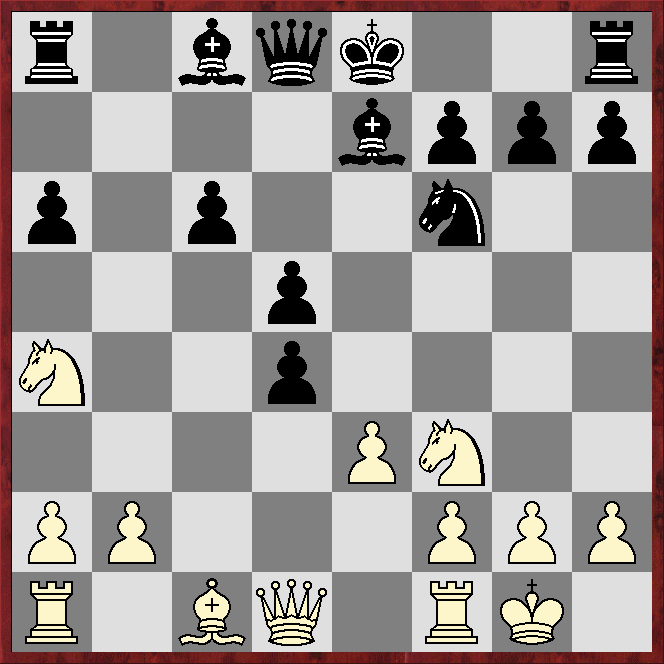
12.0-0
Now both sides have castled, how would you assess the position?
*****
*****
*****
*****
*****
Black is ahead on development, quantitively, in having developed five pieces against White's three (and it is Black to move). But White's quality of development is better, in that White's bishops are much more active than their black counterparts. The engines reckon the position is equal, but if White can catch up in the number of pieces developed, then White may well have a decent advantage, unless Black in the meantime can catch up on quality of development.
12...Rac8 13.Bb3
The engines suggest 13.Nbd2.
13...Ne4!?
This sets a little trap.
How should White proceed?
*****
*****
*****
*****
*****
14.Nc3?
The engines suggest 14.Nbd2, but reckon Black has at least the better part of equality after both 14...Nxd2 and 14...Nd6.
Black to play and get what the engines reckon is a winning advantage
*****
*****
*****
*****
*****
14...Nxc3 15.Bxc3
US offered a draw, shortly after pressing the clock.
15...Na5! 16.bxa5
There is nothing better.
16...Rxc3 17.Rfb1
Black's activity, bishop-pair and superior pawn-structure add up to an advantage worth almost a minor piece, according to the engines
*****
*****
*****
*****
*****
17...Bf6 18.Ra2 Bc6
What should White play?
*****
*****
*****
*****
*****
19.h3?
The engines suggest 19.Rd2 Be4 20.Rbd1! Rdd3 21.Rxd3 Bxd3 22.Nd2!?, but agree Black is winning. Their alternative is 19.Nd2, but they reckon Black is again winning after, for example, 19...a6 20.h3 Kf8 21.a4 h5, although, in both cases, White has not fallen behind on material. Note that 19.Kf1?, which, like the text, tries to solve White's back-rank-mate problems, runs into 19...Bb5+ (19...Be4 is also good) 20.Ke1 Bd3.
19...Be4 20.Rbb2 Rc1+ 21.Kh2 Bxb2 22.Rxb2 Bxf3!? 23.gxf3 Rc5 0-1

Saturday, 25 April 2026

World Team 65+ Round Six

Bo.18
  Albania
Rtg-46
  England - 5
Rtg0 : 0
12.1IM
Seitaj, Ilir
2303-
Freeman, Richard C P
1897
12.2FM
Cela, Shkelqim
2179-CM
Stokes, Michael
1861
12.3
Stavri, Gligor
1979-
Spanton, Tim R
1908
12.4
Pasku, Sotir
2031-
Marshall, Michael
1859

Gligor Stavri (1979) - Spanton (1908)
QGD Normal Variation
1.d4 d5 2.Nf3 c5 3.e3 e6 4.c4 Nc6 5.Nc3 Nf6
The starting point of the Normal Variation
*****
***** 
*****
*****
*****
One advantage for White in playing this way is that often it is White who decides whether to play with or against an IQP. It is not that either way is theoretically advantageous, but playing what you like can be important.
6.cxd5 exd5
Black can avoid an isolated queen's pawn with 6...Nxd5, when the main line in ChessBase's 2026 Mega database runs 7.Bd3 Be7 8.0-0 0-0 9.a3!? cxd4 10.exd4 Bf6, with Stockfish17.1 and Dragon1 giving White at least the better part of equality.
7.Be2 Bg4
The engines suggest 7...cxd4!? 8.Nxd4 and 8...Bb4, 8...Bd6 or 8...Bc5.
8.0-0 Be7!?
This is the commonest move in Mega26, but Black scores just 26%, although it is a small sample size (19 games). The engines like 8...c4!? or 8...Rc8.
9.dxc5
So White gets to inflict an IQP on Black after the black dark-square bishop has moved.
9...Bxc5 10.a3 0-0
Now both sides have castled, how would you assess the position?
*****
*****
*****
*****
*****
This position is usually reached with Black to move, when the engines reckon the game is equal. With White to move, they give the latter a slight edge.
11.Qa4!?
This may be a novelty. Known moves are 11.b4 and 11.h3.
11...Qe7?
The engines give 11...d4!?, and if 12.Rd1, then 12...Bxf3!? 13.Bxf3 Qb6, claiming at least equal chances for Black.
12.Nxd5 Nxd5 13.Qxg4
White has won a sound pawn, and has the bishop-pair
*****
*****
*****
*****
*****
13...Rad8 14.Qc4!?
The engines like this.
14...Rfe8 15.Re1!? Bb6 16.Qc2 Ne5 17.Nxe5 Qxe5 18.Bf3 Nf4!?
How should White respond?
*****
*****
*****
*****
*****
19.Rf1!
The engines reckon this is easily the best move, whereas 19.Bxb7, although probably objectively fine for White, can lead to tricky play, eg 19...Re7 20.Bf3 Nd3 21.Rd1 Rc7 22.Qb3 Rcd7 23.Rf1!? h5, when White is two pawns up, but faces a difficult defensive task.
19...Nd5 20.Bd2 Re6 21.Bxd5!? Qxd5
The bishop-pair has gone, but White is a pawn up and has no weaknesses, and so can count on a substantial advantage if development is successfully completed
*****
*****
*****
*****
*****
22.Bc3 Red6 23.Qe2 Rg6!? 24.g3 Rgd6 25.Bb4 R6d7 26.Qg4
The engines give 26.Rfd1!, the point being they reckon 26...Qxd1+ 27.Rxd1 Rxd1+ 28.Kg2 is much better for White.
26...h5!? 27.Qh3 Qf3 28.Qg2 Qe2 29.Bc3 Re8 30.Rfe1 Qg4 31.h3 Qe6 32.Rad1
It has taken some time, but White has finally contested the open d file.
32...Red8 33.Rxd7 Rxd7
However, Black retains control of the file.
34.g4!?
The engines like this.
34...h4
But in reply they prefer 34...hxg4 or 34...Bc7.
35.Qf3 Qd6
How should White proceed?
*****
*****
*****
*****
*****
36.e4?
The engines suggest 36.Rc1, 36.Kg2 or 36.Qe4, but can you see what is wrong with the text.?
*****
*****
*****
*****
*****
36...Qd3
Black has 36...Qg3+! 37.Qxg3 (forced) hxg3 and 38...gxf2(+), with at least a slight edge.
37.Qxd3 Rxd3 38.Kg2 Bd4 39.Bxd4 Rxd4
How would you assess this rook-and-pawn ending?
*****
*****
*****
*****
*****
White's extra pawn gives a slight edge, according to Stockfish17.1; is winning, according to Dragon1.
40.Kf3 g5
Possibly the less-committal 40...f6!? is better.
41.Ke3 Rd6 42.f4?!
The engines agree White has at least the upper hand after 42.Rc1!?
42...f6?
This turns a completely equal position into a completely lost one, according to the engines. They give 42...Rb6, eg 43.b4 Ra6 44.Ra1 Rc6 45.Kd4!? gxf4 46.Rf1 Rd6+ 47.Kc4 (47.Ke5 Rd3 may even favour Black) Rc6+ 48.Kd4 Rd6+ etc, or 43.fxg5 Rxb2 44.e5 Rb3+ 45.Ke4 Rxh3 46.g6!? Rxa3!? 47.gxf7+ Kxf7 48.Rf1+ Ke6 49.Rf6+ Ke7 50.Rh6 h3, with what they agree is complete equality.
43.fxg5 fxg5 44.e5 Rb6 45.b4 Ra6 46.Ra1!?
This looks horribly passive, but is one of several winning moves.
46...Kf7 47.Ke4 Ke6 48.a4 b5!? 49.a5 Rc6 50.Rd1
The rook is in time to defend b4.
50...Rc3
Or 50...Ra6 51.Rd6!? (not the only winning move) Rxd6 52.exd6 Kxd6 53.Kf5 etc.
51.Rd6+ Ke7 52.Kf5 Rxh3 53.Kxg5 Rh1 54.Ra6 h3 55.Rxa7+ Ke6 56.Rh7 h2 57.a6 Kxe5 58.a7 Ra1 59.Rxh2 Rxa7
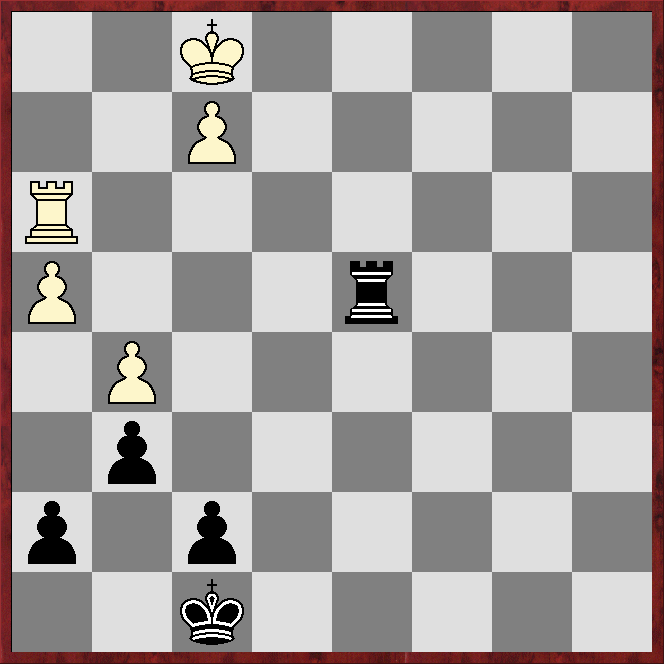
White has a tablebase win
*****
*****
*****
*****
*****
60.Rc2 Rg7+ 61.Kh4 Kf4 62.Rf2+ Ke3 63.Rf5 Rc7 64.Rxb5 Rc4 65.Kh5 Kf3 66.Rf5+ Kg3 67.b5 Rb4 68.g5 Rh4+ 69.Kg6 Rb4 70.Kf6
Even 70.b6!? wins, according to the Syzygy endgame tablebase.
70...Kg4 71.g6 Rd4 72.Re5 Rd6+ 73.Re6 Rd5 74.b6 Rf5+ 75.Ke7 Rg5 76.Kf7 Rf5+ 77.Rf6 Rd5 78.g7 Rd7+ 79.Kg6 Rd8 80.Kh7 Rd7 81.Kh8 Kh5 82.g8=Q 1-0
Team Result
Seitaj = Freeman
Cela 0-1 Stokes
Stavri 1-0 Spanton
Pasku 1-0 Marshall
Albania 2.5-1.5 England 5

Wednesday, 31 December 2025

Cracovia 60+ Round Five

FACED an Israeli Fide master.

Ran Shabtai (1996) - Spanton (1913)
QGD Normal Position
1.c4 e6 2.Nc3 d5 3.d4 c5 4.e3 Nf6 5.Nf3 Nc6
The game started as an English, became a Tarrasch Defence to the Queen's Gambit, and has now reached the Normal Position of the Queen's Gambit Declined, albeit the variation has not been the normal continuation in the QGD for well over a century
*****
*****
*****
*****
*****
6.cxd5
This is second in popularity to 6.a3.
6...exd5 7.Be2 Bf5!?
A rare continuation. Most popular in ChessBase's 2026 Mega database is 7...Be7, while Stockfish17.1 and Dragon1 recommend 7...cxd4 8.Nxd4, and either 8...Bb4 or 8...Bd6, although Dragon1 comes to prefer 7...c4!?
8.0-0 Rc8 9.dxc5 Bxc5 10.Nb5!? 0-0
Now both sides have castled, how would you assess the position?
*****
*****
*****
*****
*****
The game has produced a fairly typical IQP position, with equal chances, according to the engines.
11.b3 Qe7 12.Bb2 Rfd8 13.Rc1 Bb6
RS criticised this after the game, but the engines are fine with it.
14.Ba3 Qd7?
This is the real mistake. Instead 14...Nb4!? is good, the point being the knight can always be supported by ...a5, since an exchange on b4 would leave a2 weak.
15.Nd6 Rc7 16.Nxf5
Even stronger is 16.Nxb7! Rxb7 17.Bb5 with Ne5 to come.
16...Qxf5 17.Bc5
The engines prefer 17.Bd3 or 17.Bb2.
17...Bxc5 18.Rxc5 Rdc8 19.Bd3 Qd7 20.Qb1 g6 21.Rfc1
How should Black proceed?
*****
*****
*****
*****
*****
21...d4?
Black is fine after, for example, 21..Nb4.
22.Nxd4
Not 22.exd4? Nxd4 23.Rxc7 Nxf3+ etc.
22...Nxd4 23.exd4 b6
The engines suggest 23...Ne8!?
24.Rxc7 Rxc7 25.Rxc7 Qxc7 26.Qe1!
The engines agree this is better than the obvious 26.Bb2.
26...Ng4 27.g3 Qd7 28.Qe4 Nf6 29.Qf4 Nd5 30.Qe5 Nb4 31.Bb5 Qd8 32.a3!? Nc2?
Better is 32...Nd5, but Black has no compensation for being down a passed pawn.
33.d5 Nxa3 34.Bc6
The knight is out of play, and there is nothing to stop the d pawn queening
*****
*****
*****
*****
*****
34...Nc2
Marginally better may be 34...Qc8.
35.Qc3 Na3 36.b4 Qe7 37.Qxa3 a5 38.Qd3 Qd6
Either capture on b4 is met by 39.d6.
39.bxa5 bxa5 40.Qb5 Qa3 41.Kg2 h5 42.Qb8+ Kh7 43.Qc7 Kg7 44.d6 h4 45.d7 h3+ 46.Kxh3 Qd3 47.Kg1 1-0

Wednesday, 2 April 2025

Lessons From Bad Wörishofen III

IN rounds three and eight I faced the same somewhat-unusual variation of the Queen's Gambit Declined.
Both games began 1.d4 d5 2.Nf3 e6 3.c4 Nf6 4.e3!?, reaching what is probably best described as a line from the Normal Position,  or System, of the QGD.
I wrote somewhat-unusual because this position occurs 19.728 times in ChessBase's 2025 Mega database, which means it is far from a rarity
*****
*****
*****
*****
*****
Black, not surprisingly in view of White's slow fourth move, has quite a free hand as how to continue, but in all 11 games in my praxis I have played 4...c5.
More popular in Mega25 are 4...c6 and 4...Be7, but all three score a respectable 48%, and, as Black in many lines of  the QGD goes to some pains to get in the move ...c5, it seems sensible to play it when the chance is offered.
I was discussing the position with Geoffrey Stern of Luxembourg, and he said that on first facing it he played the most popular move, 4...Be7, but got into a passive position and lost.
Naturally 4...Be7 cannot be blamed for the loss, but all-in-all I feel 4...c5 is perfectly reasonable, and may even be best at club level, where most players are far better at attacking than defending.
What made my BW games truly unusual is that both continued 5.cxd5 exd5 6.Bb5+, reaching a position occurring 667 times in Mega25.
What is Black's best response?
*****
*****
*****
*****
*****
In round three, against a 1719, I played 6...Bd7, which is the commonest continuation in Mega25.
After 7.Bxd7+ I recaptured with the queen's knight, at which point Stockfish17 and Dragon1 reckon White can get an edge with both 7...b3!? and 7....dxc5!?
Instead my opponent met 7...Nbxd7 with 8.0-0, after which the engines agree 8...c4!? is better than the more popular 8...Bd6 and 8...Be7, although the game was drawn.
Three years ago in Brno, the only previous time I have faced 6.Bb5+, Stefan Arndt (2176) - Spanton (1771), went 6...Bd7 7.Bxd7+ Qxd7, which seems at first glance to be asking to be punished by 8.Ne5, but the engines reckon that is well-met by Jonathan Speelman's 8...Qc7, or their suggested novelty of 8...Qe6!?
Instead the Brno game went 8.0-0 Nc6 9.b3 cxd4!? 10.Nxd4 Be7 11.Bb2 0-0, with an isolated queen's pawn position that the engines reckon slightly favours White (but ½–½, 24 moves).
In round eight at Bad Wörishofen I switched to 6...Nc6, meeting 7.0-0 with 7...a6!?, which the engines do not like.
However they are unsure as to what Black should play, fluctuating between 7...Be7, 7...Be6, 7...Bd7, 7...Bd6 and 7...cxd4!?, in each case giving White a slight edge.
So which move is better: 6...Bd7 or 6...Nc6?
*****
*****
*****
*****
*****
Actually, the question should be, which move is best?, for there is a third option, the rarely played 6...Nbd7!? (43 appearances in Mega25, against 275 for 6...Nc6 and 349 for 6...Bd7).
It scores much better percentagewise, and it is the top choice of the engines.
The main reply is 7.dxc5!?, when the engines like 7...a6!?
After 8.Bxd7+ Bxd7 White can try to hold on to the pawn with 8.b4 a5 9.Qd4, but Black has enough compensation, eg 9...axb4 10.Qxb4 Ra4!? 11.Qxb7 Bxc5, with the bishop-pair and more development.
Second-most popular in Mega25 is 7.0-0, when 7...c4!? is the engines' top suggestion, one line running 8.b3 a6 9.Bxd7+ Bxd7 10.bxc4 dxc4 11.e4 Bb4!?, with the engines preferring Black's queenside majority over White's centre.
A third choice is 7.Nc3, when Black has what seems a pleasant choice between 7...c4!? and 7...a6.
LESSON: there is a lot to think about in the position in the second diagram above, but it seems the slightly counterintuitive 6...Nbd7!? is worth a try. It could easily catch White unprepared, and comes with engine endorsement.

Friday, 28 March 2025

Bad Wörishofen Round Eight

FACED a Swiss.

Paul Remensberger (2038) - Spanton (1911)
QGD Normal
1.d4 d5 2.Nf3 e6 3.c4 Nf6 4.e3!?
How should Black respond to White's slow fourth move?
*****
*****
*****
*****
*****
4...c5
Stockfish17 and Dragon1 like the most popular continuation, 4...Be7, and also 4...b6. The text can hardly be bad, but it may be what White hopes to provoke as the text makes it is easy for the first player to create an imbalance.
5.cxd5 exd5 6.Bb5+ Nc6
In round three I played the more popular 6...Bd7 against a 1719, gaining an equal position out of the opening (but failing to gain the full point). The engines suggest the rare 6...Nbd7!?
7.0-0 a6!?
The engines are not keen on this, presumably on the ground that capturing on c6 is part of White's plan anyway.
8.Bxc6+!? bxc6 9.Nc3 Be7 10.Na4!?
10.Na4!? seems to be a novelty, and is the top choice of Stockfish17, although Dragon1 fluctuates between it and one of the eight known moves, 10.Qc2
*****
*****
*****
*****
*****
10...cxd4
How should White recapture?
*****
*****
*****
*****
*****
11.exd4!?
The engines very much agree this is best. Indeed their second-choice move is 11.h3!?, claiming White has full compensation for a pawn after 11...dxe3 12.Bxe3.
11...Bg4 12.Qd3
The engines reckon White has the upper hand after 12.Qc2!?, eg 12...0-0!? 13.Ne5 (13.Qxc6?! Bxf3 14.gxf3 Rc8!? 15.Qxa6 Nh5 gives Black dangerous play) Bd6!? 14.Bg5!? Be6!? 15.Qxc6, although it is a series of moves unlikely to be seen at club level.
12...Bxf3!?
Giving up the bishop-pair is the engines' top choice.
13.Qxf3 Ne4 14.Nc3 Nd6 15.Be3 0-0
Now both sides have castled. how would you assess the middlegame?
*****
*****
*****
*****
*****
Black has the better bishop, but two pawn weaknesses (a6 and c6) against White's one (d4), although White's weakness is arguably the easiest to get at. The engines call the position equal.
16.Rac1 Nc4 17.Rc2 Re8 18.b3 Nxe3 19.fxe3!?
The engines prefer the other recapture.
19...Bf6 20.Rfc1
The engines suggest 20.Ne2 or 20.Na4.
20...Re6 21.Na4 Qe8 22.Rc3 Bg5 23.Re1 h6?!
The engines reckon 23...Bf6 24.Rd3 Be7!? is good for Black, one line continuing 25.Qe2 a5 26.Rf1 Bb4 27.Rf3 Ra7!? 28.h3 h5 29.Kf2!? Rae7 30.Nc3 h4, when they give Black a positionally won game.
24.Nc5 Re7 25.g3 Bf6 26.Rd3 Re4!? 27.Qf2
The engines give 27.Rdd1 Re7 28.e4!? dxe4 29.Nxe4 Re6 30.Nxf6+ gxf6, after which Black has five isolated pawns, two of them doubled, but White has no more than the better part of equality, according to the engines.
27...Re7 28.Qf3 Re4!? 29.Qf2 Re7 ½–½

Sunday, 23 March 2025

Bad Wörishofen Round Three

Karola Hörhold (1719) - Spanton (1911)
QGD Normal
1.d4 d5 2.Nf3 e6 3.c4 Nf6 4.e3!? c5 5.cxd5 exd5 6.Bb5+ Bd7 7.Bxd7+ Nbxd7 8.0-0 c4!?
More popular in ChessBase's 2025 Mega database are 8...Bd6 and 8...Be7, but Stockfish17 and Dragon1 prefer the text.
9.Nc3 Bd6
Pavel Tregubov (2642) - Varuzhan Akobian (2624), Fide World Cup (Khanty-Mansiysk, Russia) 2009, went 9...Bb4 10.Ne2!? 0-0 11.a3 Bd6 12.Nc3 a6, with a slight edge for Black, according to the engines (but 1-0, 60 moves).
10.Re1 0-0
Now both sides have castled, how would you assess the position?
*****
*****
*****
*****
*****
Black has the better bishop and a farside pawn-majority, but White cannot be be stopped from either breaking in the centre or attacking the lead pawn with b3. The engines reckon equal chances.
11.Qc2
The immediate 11.e4 is possible, with the idea of 11...dxe4 12.Nd2!?
11...Rfe8 12.e4 dxe4 13.Nxe4 Bb4?
Black is marginally for choice after 13...Nxe4 14.Rxe4 Qa5!?, according to the engines.
14.Bd2?
Missing the win of a pawn by 14.Nxf6+, 15.Rxe8+ and 16.Qxc4.
14...Bxd2 15.Nexd2 b5 16.Rxe8+ Qxe8 17.Re1 Qb8!?
The engines prefer 17...Qc8 or 17...Qd8.
18.Qf5 Qb6 19.g4!? g6!? 20.Qg5 Qd6?!
Unguarding b5, whereas after 20...Rc8 the engines give Black the upper hand.
21.Ne4?!
White can probably take the pawn and emerge with the better game, eg 21.Qxb5 Rb8 22.Qg5 Rc8!? (not 22.Rxb2?? 23.Nxc4 etc) 23.Rc1, but the lines are not completely clear.
21...Qe6?!
The engines give 21...Nxe4 22.Rxe4 b4 with at least the upper hand for Black.
22.Nxf6+ Qxf6 23.Qxf6?!
The rook-and-knight ending is good for Black. Instead 23.Qxb5 Qxf3 24.Qxd7 wins a pawn, albeit the engines reckon Black has enough play for it.
23...Nxf6 24.g5 Nd5 25.Re5 Rd8 26.Kf1 Kf8 27.h4 a6
This consolidating move is the engines' top choice.
28.a3?!
Now White's queenside pawns are fixed. The engines suggest 28.c3, although they give Black at least a slight edge.
28...Nf4 29.Re4 Nd3 30.Re2 a5 31.Rd2 b4 32.axb4 axb4 33.Rc2?!
The engines prefer 33.Ke2, but agree Black is winning.
Black to play and win
*****
*****
*****
*****
*****
33...Rc8
Black has an edge after this, but winning is 33...c3! as 34.bxc3 runs into 34...b3!?
34.Nd2
White has good drawing chances after 34.b3! c3 35.Ke2, according to the engines.
34...Nxb2?
White has an easy draw after this. Almost certainly winning is 34...c3 35.bxc3 Rxc3 36.Ra2 Ra3 37.Rc2 Nf4! (threatening a quick back-rank mate) 38. f3 Rd3 39.Kf2 Nd5 with ...Rxd4 to come.
35.Rxb2 b3
No better is 35...c3 as 36.Rc2 pins the c pawn, although White is not winning as Black has 36...Ra8. Also drawing is 36...Rxb4, and White is even for choice after 37.c2?! Nb3.
36.Nxc4
Also sufficient is 36.Nxb3.
36...Rxc4 37.Rxb3 Rxd4 38.Rh3
White's rook is passive, but there is no way for Black to exploit this
*****
*****
*****
*****
*****
The position is completely equal, according to the engines. I played on for another 30 moves, hoping to induce an error, but eventually had to accept half a point.

Wednesday, 29 January 2025

League Chess

PLAYED on board one (of eight) for Battersea 2 against Charlton 2 in London League Division Four last night,

Daniel Douglas (1766) - Spanton (1958)
Queen's Gambit Declined Normal Variation
1.c4 e6 2.Nc3 d5 3.e3!? Nf6 4.Nf3 c5 5.d4 Nc6
Aron Nimzowitsch recommended playing the Normal Variation of the QGD as White
*****
*****
*****
*****
*****
His idea was to sometimes leave Black with an isolated queen's pawn, sometimes to accept an IQP oneself (the latter requiring assistance from Black, although Nimzowitsch did not mention this in My System, if memory serves me correctly). Nimzowitsch argued that exploring the fine details of such a position would awaken positional understanding.
6.cxd5 exd5 7.dxc5!? Bxc5
I suspect Nimzowitsch did not seriously entertain my opponent's next move
*****
*****
*****
*****
*****
8.e4?
Probably a novelty; definitely not a good one.
How should Black respond?
*****
*****
*****
*****
*****
8...dxe4
Stockfish17 and Dragon1 prefer not capturing. Their top choice is 8...0-0!?, one line running 9.exd5 Ng4! 10.Be2!? (10.dxc6?? allows mate, starting with 10...Bxf2+ 11.Ke2 Re8+) Nxf2 11.Qa4 Nd4!? 12.Nxd4 Nxh1, with a sharp position that the engines reckon is winning for Black.
Stockfish17's second choice, 8...Qb6!?, also leads to sharp play, as does Dragon1's second choice, 8...Ng4!?
The text may not objectively be as strong, but has the merit of being straightforward, and so less likely to lead to accidents.
9.Qxd8+ Nxd8
The engines prefer 9...Kxd8!?, meeting 10.Ng5 with 10...Nb4 (Stockfish17) or 10...Re8 (Dragon1).
10.Bb5+ Bd7
Not 10...Nc6? 11.Ne5.
11.Bxd7+ Kxd7 12.Ng5 h6!
Judging by body language, DD had missed this.
13.Nh3
Not 13.Nxe4?? Nxe4 14.Nxe4 Re8 15.f3 f5.
13...Ne6 14.Bf4!? Rhd8!?
This is Stockfish17's top choice. Dragon1 prefers 14...Nxf4, but I felt that helped White by bringing the h3 knight back into play.
15.0-0-0+ Ke8
Now both sides have effectively castled - either normally or 'by hand' - how would you assess the position?
*****
*****
*****
*****
*****
Black's extra pawn is reasonably secure for the moment, but may be vulnerable in the long run. The other main feature of the position, in my opinion, is the offside white knight at h3. The engines reckon Black's advantage is worth about 2.5 pawns.
16.Be5?!
The engines like moving the bishop, but not here, preferring Bg3 or Bd2.
16...Ng4 17.Bg3 f5 18.Rd5 Rxd5 19.Nxd5 Rc8 20.Kb1 Kf7 21.Rc1
DD offered a draw.
21...Rd8 22.Nc7 Bd6!? 23.Nxe6 Kxe6 24.Bxd6 Rxd6 25.f3 Nf6 26.Re1 g5 27.fxe4 fxe4
How big is Black's advantage in this rook-and-knight ending?
*****
*****
*****
*****
*****
White has no serious opportunity of counterplay. The engines reckon Black is roughly the equivalent of a minor piece and a pawn ahead, Dragon1 being the more fulsome in its assessment.
28.Nf2 Ke5 29.Kc2 h5 30.a3!? g4 31.Nd1 Rc6+ 32.Kd2 Nd5 33.Ne3 Nf4 34.g3 Nd5 35.Nxd5 Kxd5 36.Re3 Kd4 37.Re1 e3+!? 38.Rxe3 0-1 (Time)
White's flag fell as he made his 38th move, but he is lost anyway as after 38...Rc2+ 39.Kxc2 Kxe3 Black queens a kingside pawn.
Battersea 2 won the match 5-3.

MY BATTERSEA SEASON 2024-5
DATE.....EVENT...........................COL..RATING..OPP'S RATING..SCORE..SEASON PERF
12/9/24..Central London League....W......1933..........1886................1............2286
26/9/24..Central London League....B.......1933..........2112................1............2399
15/10/24.Club Championship.........W......1968..........1578................1............2259*
31/10/24.Central London League...B.......1968..........1867.................0...........2061*
19/11/24.London League...............W......1957..........1991................1............2127*
21/11/24.Central London League....B.......1957..........2035................=...........2112*
27/11/24.London League...............W......1957..........1723................=...........2056*
12/12/24.Central London League....B.......1965..........2153................0...........2018*
7/1/25.....Club Championship.........B.......1958..........1785................1...........2037*
9/1/25.....Central London League....B.......1958..........1851................0...........1978
14/1/25....Eastman Cup.................B.......1958..........2052................1............2021*
28/1/25....London League..............B.......1958..........1766................1............2033*
*My season's performance is slightly better than this, the point being my win against a 1578 counts as a 1978 performance, which lowers my average despite me winning the game.

Tuesday, 9 July 2024

Bad Herrenalb Round Five

FACED a Swiss.

Hansuli Remensberger (2068) - Spanton (1928)
QGD Normal Position
1.c4 e6 2.Nf3 d5 3.e3!?
There are 4,489 examples of this move in ChessBase's 2024 Mega database.
3...Nf6 4.Nc3 c5 5.cxd5
How should Black recapture?
*****
*****
*****
*****
*****
5...exd5
This is over three times more popular than 5...Nxd5 in Mega24, but Magnus Carlsen has preferred the latter, and the moves are of roughly equal value, according to Stockfish16.1 and Dragon1.
6.d4 Nc6
This position can arise from many move-orders, the commonest probably being 1.d4 d5 2.c4 e6 3.Nc3 Nf6 4.Nf3 c5 5.e3 Nc6 6.cxd5 exd5
*****
*****
*****
*****
*****
7.Bb5 Be7 8.0-0 0-0 9.dxc5 Bxc5 10.b3 Bg4 11.Be2!? a6!?
The engines like this, along with 11...Re8.
12.Bb2 Qd6 13.Nd4
How should Black proceed?
*****
*****
*****
*****
*****
13...Bxe2
This may be a novelty. The engines suggest 13...Bxd4!? 14.Bxg4 Be5 15.f4 Nxg4 16.Qxg4 Bf6, claiming equality.
14.Ncxe2 Rfd8?
Capturing on d4 is much better.
White to play and get a winning advantage
*****
*****
*****
*****
*****
15.Rc1?
White has an edge after this, but decisive is 15.Nf5, eg 15...Qe6 16.Nxg7! Kxg7 17.Nf4 Qf5 18.g4 and 19.Nh5+ etc.
15...Ba7?
Again, capturing on d4 is better, either immediately or after 15...Ng4 16.Ng3.
16.Nf4?
Nf5 still wins.
16...Rac8? 17.Nf5
At last!
17...Qd7
How should White proceed?
*****
*****
*****
*****
*****
18.Nxg7
Even stronger is the simple 18.Bxf6 Qxf5 (18...gxf6?? 19.Qg4+ mates) 19.Bxd8, and the engines' 18.Nh6+ with Bxf6 to follow.
18...d4!
This keeps the game going, whereas 18...Kxg7? is hopeless in view of 19.Nh5+.
19.Ngh5 Qf5 20.Nxf6+ Qxf6 21.Qg4+ Qg7 22.Qxg7+ Kxg7 23.Ne2 Kg8 24.exd4 Nxd4 25.Ng3
How big is White's advantage?
*****
*****
*****
*****
*****
Black is not just a pawn down, but also has two isolanis. Black's only compensation is a slight lead in development. The engines reckon White is the equivalent of 1.5 pawns ahead.
25...Ne6?!
Black has better, eg 25...Rxc1!? 26.Rxc1 Nc6, but then the engines reckon 27.Bc3 is winning.
26.Bf6 Re8 27.Nf5 Bc5 28.Rc3 Nf4
28...Bxf2+?? 29.Rxf2 Rxc3 fails because White has the backward-bishop move 30.Bxc3.
29.Rg3+ Ng6 30.Ne3!? Bxe3 31.Rxe3 Rxe3 32.fxe3
How would you assess this rook-and-minor-piece ending?
*****
*****
*****
*****
*****
White has the better minor piece for cooperating with a rook, and has the better pawn-structure. The engines reckon White's advantage has grown to the equivalent of two pawns.
32...Re8 33.Rd1!?
Can Black safely capture the e pawn?
*****
*****
*****
*****
*****
After 33...Rxe3? 34.Rd8+ Nf8 35.Kf2 the knight eventually falls, eg 35...Re4 36.Bb2 b5 37.Bd4 etc.
33...Ne5 34.Rd5 Nc6 35.Kf2 Re6 36.Bc3 Kf8 37.Rd7 b5 38.a3 Ke8 39.Rd5 Rh6 40.h3 Ke7 41.e4 Ke6 42.Kf3 f6?!
Putting a pawn on the same colour complex as the enemy bishop in this type of ending is rarely a good idea, and this is probably not an exception.
43.Rc5 Kd6 44.b4 Ne5+ 45.Bxe5+ fxe5
How would you assess this rook-and-pawn ending?
*****
*****
*****
*****
*****
White is a sound pawn up in an otherwise largely symmetrical position. The engines reckon White's advantage is worth at least a minor piece.
46.a4?!
The engines do not like this, preferring a slower approach, eg 46.Rc8 Rf6+ 47.Ke2 Rg6 48.g4 Rh6 49.Rc3, followed by slowing advancing White's kingside majority.
46...Rf6+ 47.Ke3 Rg6?!
Probably better is 47...bxa4 48.Ra5 Kd7.
48.axb5 axb5
What should White play?
*****
*****
*****
*****
*****
49.Rxb5!?
This is Stockfish16.1's top choice, but Dragon1 much prefers 49.Kf3 or 49.Kf2.
49...Rxg2 50.Rb6+ Kc7
Dragon1 at first reckons 50...Kd7 is close to equalising, but comes to agree with Stockfish16.1 that all king moves lose.
51.Rh6 Rb2 52.Rxh7+ Kb6 53.Rh5 Rxb4 54.Rxe5 Rb3+ 55.Kf4 Rxh3
White to play and win by finding an only-move
*****
*****
*****
*****
*****
56.Rd5!
The Syzygy endgame tablebase shows this is the only winning move, eg 56.Kf5 Kc6! leaves White unable to make progress, one simple line running 57.Re6+ Kc7 58.e5 Rf3+ 59.Ke4 Kxe6 etc.
56...Kc6 57.Rd1 Rh4+ 58.Kf5 Rh5+ 59.Kg4 Rh2 60.e5 Re2 61.Kf5 Rf2+ 62.Ke6 Kc7 63.Ke7 Re2 64.Rc1+ Kb6 65.e6 Re3 66.Kd7 Rd3+ 67.Ke8 Re3 68.e7 Re2 69.Rc4 Re1 70.Kf7 Rf1+ 71.Ke6 Re1+ 72.Kf6 Kb5 73.Rc8 Rf1+ 74.Kg5 1-0

Saturday, 15 June 2024

Davos Round Two

FACED a Ukrainian.

Kyrilo Zaitsev (2225) - Spanton (1942)
QGD Normal Position
1.d4 d5 2.Nf3 e6 3.c4 Nf6 4.e3 c5 5.Nc3 Nc6 6.a3 a6 7.dxc5 Bxc5 8.b4 Ba7 9.Bb2 0-0 10.cxd5
More popular in ChessBase's 2024 Mega database are 10.Be2 and especially 10.Qc2.
10...Nxd5!?
All 70 games in Mega24 featured 10...exd5.
How should White respond?
*****
*****
*****
*****
*****
*****
11.Ne4
Stockfish16 and Komodo14.1 reckon 11.Bd3 and 11.Qc2 give a slight edge.
11...Qe7 12.Qc2 Bd7 13.Rd1 Rfc8?!
Probably the wrong rook.
14.Qb1
The engines give 14.Neg5 f5 (if 14...g6 then 15.Qe4 looks strong) 15.Qb3, after which Stockfish16 awards White the upper hand, but Komodo14.1 calls the game completely equal.
14...f5!? 15.Ng3 f4!? 16.exf4 Nxf4 17.Qe4 e5?
The game is equal after 17...Rf8, according to the engines.
18.Bc4+
Even stronger, according to the engines, is 18.Rxd7!? Qxd7 19.Bc4+ Kh8 20.Ng5.
18...Be6 19.Nf5 Qf7?
Better is 19...Qf6, although the engines reckon 20.Rd7 is winning.
20.Ng5! Qg6
Not 20...Qxf5? 21.Qxf5.
21.Nxe6 Nxe6 22.Rd7 Kh8
There is nothing better.
23.Bxe6 Qxe6 24.Rxg7 Rf8 25.g4 Rxf5!?
Desperation - Black is completely lost.
26.gxf5 Qh6 27.Rxb7 Bd4
How should White proceed?
*****
*****
*****
*****
*****
28.Bxd4?
Several moves win, including 28.Rc7 and 28.f6.
28...Qc1+ 29.Ke2 Nxd4+ 30.Qxd4 Qc2+ 31.Qd2 Qe4+ 32.Qe3 Qg4+?
Drawing is 32...Qc2+ as White cannot escape the checks.
33.f3 Qg2+ 34.Qf2 Qxh1 35.Qg3 1-0

Sunday, 28 January 2024

County Chess

PLAYED on board eight (of 16) for Kent at Middlesex in the Southern Counties U2050 championship yesterday.

Xavier Cowan (1931) - Spanton (1884)
QGD Normal Position
1.d4 d5 2.c4 e6 3.Nc3 Nf6 4.Nf3 c5 5.e3!?
Today the commonest continuation is 5.cxd5, but the text, which goes back to at least 1843, used to be the mainline and is more sophisticated than its reputation might imply.
5...Nc6 6.a3 a6 7.dxc5 Bxc5 8.b4 Ba7 9.Bb2
This position occurs 617 times in ChessBase's 2024 Mega database
*****
*****
*****
*****
*****
9...d4?!
This has been played by international masters and at least one grandmaster, but is almost certainly premature. The mainline in Mega24 runs 9...0-0 10.Qc2 Qe7 11.Rd1 Rd8 12.Be2 dxc4 (12...d4 is also quite popular) 13.Rxd8+ Nxd8!? 14.Bxc4 b5, with an equal position, according to Stockfish16 and Komodo14.1.
10.exd4 Nxd4 11.Nxd4
The engines reckon 11.c5!? gives White a positionally won game.
11...Qxd4!?
This seems to be a novelty. The engines prefer the known move 11...Bxd4.
12.c5!? Qg4?
The engines reckon this is a serious mistake, much preferring 12...Qxd1+.
13.Qxg4 Nxg4 14.Ne4 0-0 15.h3 Nh6 16.Nd6
The white knight has a commanding outpost, and meanwhile Black has problems coordinating pieces
*****
*****
*****
*****
*****
16...Nf5!? 17.Nxc8!?
Grabbing the bishop-pair on such an open board is almost certainly better than damaging Black's pawn-majority.
17...Raxc8 18.Bd3 Rfd8 19.Rd1 Ne7 20.0-0 Re8?
I picked up the rook intending to play 20...Rd7?, remembering in time White has Bxh7+! Having touched the rook, there is no better square than e8, but Black is losing. After the superior 20...Nd5 White 'only' has the upper hand, according to the engines.
21.Be4 Nc6?
Immediately giving up a pawn with 21...Nd5! is better.
22.Rd7 Bb8 23.Rxb7 Red8 24.Rb6 Nd4 25.Bxd4 Rxd4 26.Bb7 Rcd8 27.Rxa6 Rd1!?
Black's only hope is for a blunder - even an opposite-coloured bishop ending would almost certainly be lost.
28.g3 Be5 29.Rxd1 Rxd1+ 30.Kg2 Kf8 31.Ra8+ Ke7 32.Bc6 Rd2 33.Ra7+ Kf6 34.Be8 Bd4 35.Rxf7+ Ke5 36.Bc6 Rd3? 37.f4#
Middlesex won the match 9-7.

Friday, 3 November 2023

Bavarian International Round Six

Michael Schulz (2083) - Spanton (1858)
QGD Normal Variation
1.d4 d5 2.c4 e6 3.Nf3 Nf6 4.e3!? c5 5.Nc3 Nc6
Aron Nimzowitsch recommended playing the Normal Variation of the Queen's Gambit Declined with white
*****
*****
*****
*****
*****
Nimzowitsch's idea was that sometimes White should give Black an isolated queen's pawn, and sometimes White should accept an IQP. He believed playing thus was a good way to increase positional understanding.
6.cxd5 exd5 7.Be2 Be6 8.0-0 a6 9.b3 Be7 10.Bb2 0-0
Now both sides have castled, who do you think stands better?
*****
*****
*****
*****
*****
Stockfish16 and Komodo14.1 give White a slight edge.
11.Rc1
White threatens to gain a large advantage with 12.dxc5.
11...cxd4 12.Nxd4 Rc8 13.Na4 Nxd4!? 14.Qxd4 b5!?
The engines prefer 14...Qa5 or 14...Qd6, in both cases preventing 15.Nc5.
15.Nc5 Qa5?
This encourages White to play a move that is useful anyway. Victor Manuel Garcia Cuenca (2369) - Luis E Valle (2268), Chess.com Blitz 2022, went 16...Qd6 (the position was reached by a different move-order) 17.b4 Qb6?! 18.g4!? with White enjoying the upper hand, according to the engines (1-0, 31 moves).
16.b4 Bxc5 17.Rxc5
The engines agree this is slightly better than capturing with the pawn.
17...Qd8
Not 17... Qxa2?? 18.Ra1 Qb3 18.Ra3.
18.Rfc1 Qd7 19.a4 Rxc5
19...bxa4 20.Bxa6 Rxc5 is less worse, according to the engines, but still deeply unpleasant.
20.bxc5!?
The engines again slightly prefer capturing with the pawn.
20...Rc8 21.axb5 axb5 22.Qb4 Qb7 23.Bd4
This is better than allowing opposite-coloured bishops by 23.Qxb5? qxb5 24.Bxb5 Rb8 25.Bxf6 Rxb5.
23...Bd7 24.h3 Ne4 25.Rb1 Bc6?!
There was no need for this tidying-up move, so perhaps counterplay with 25...Qc7 was better, but the engines reckon White has a positionally won game.
26.Ra1 Ra8 27.Ra5!? Rxa5?!
Probably better is 27...Ng5.
28.Qxa5 h6??
The back rank had to be protected.
29.Qd8+ Kh7 30.f3 b4!?
This is Komodo14.1's top choice, at least for a while, but the position is hopeless.
31.fxe4 fxe4 32.Qb6 1-0

Sunday, 27 November 2022

Brno: Typical Mistakes & How To Avoid Them (Part Six)

MY opponent in round six of the Brno Open had 66 games with white in ChessBase's 2022 Mega database.
In 61 of those games he started 1.e4, in two he played 1.d4, two also for 1.Nf3 and one for 1.c4.

Stefan Arndt (2176) - Spanton (1771)
So it was something of a surprise when our game began 1.d4 d5 2.Nf3 e6 3.c4 Nf6 4.e3!?
The oldest game in ChessBase's 2022 Mega database to reach the position after 3...Nf6 also saw 4.e3!? That game was played in 1877 and featured Johannes Zukertort with white.
The set-up with the white dark-square bishop inside the white pawn-chain is known as the Normal Position of the Queen's Gambit Declined, or at least it used to be so known when such play was popular.
I replied 4...c5, at which point Aron Nimzowitsch in chapter 12 of My System recommends continuing 5.Nc3 Nc6.
His idea was White should practise playing two continuations: A) 6.Bd3 cxd4 7.exd4 dxc4 8.Bxc4, and B) 6.cxd5 exd5 7.dxc5 Bxc5.
Nimzowitsch wrote (Lou Hays' 1991 translation for the "21st Century Edition): "It will do [White] good to realise how dangerous an enemy isolani may be, and how difficult it is to save his own from an untimely end."
Nimzowitsch also stated: "The problem of the isolated d pawn is in my opinion one of the fundamental problems in the whole theory of positional play."
My opponent accelerated, as it were, the second continuation by choosing 5.cxd5, but after 5...exd5 he omitted 6.dxc5 in favour of the much more popular 6.Bb5+!?
He told me after the game his plan was to give me an isolated queen's pawn and play against its weakness.
It is well known White should try to avoid playing dxc5 until Black has spent a tempo on developing the dark-square bishop, the hope being dxc5 will then oblige Black to move the dark-square bishop for a second time.
The move 6.Bb5+!? has been played by Magnus Carlsen, and Vladimir Kramnik, and is a favourite of English grandmaster Mark Hebden. It is also the choice of Stockfish15 and Komodo13.02.
However, after 6...Bd7 7.Bxd7+ Qxd7 White has speeded Black's development. True, a possible defender of the isolani has been exchanged, but so has a potential attacker.
The later is arguably the more significant in that it is generally accepted the best role for the white light-square bishop in this type of position is to be fianchettoed by g3 and Bg2.
For example the mainline of the Tarrasch Defence to the Queen's Gambit starts 1.d4 d5 2.c4 e6 3.Nc3 c5 4.cxd5 exd5 5.Nf3 Nc6, and now 6.g3, as seems to have been first played by Carl Schlechter at Prague 1908.
Position in the Tarrasch Defence to the Queen's Gambit after 6.g3
The move 6.g3 was avidly taken up by Akiba Rubinstein, Frank Marshall and many other strong players.
Returning to my game in Brno, it continued 8.0-0 Nc6 9.b3, White's plan being to fianchetto the dark-square bishop so it covers d4, the square the black d pawn will "lust to expand" into, using Nimzowitsch's memorable phrase.
I now played 9...cxd4!?, voluntarily isolating my queen's pawn. The point is that if, instead, 9...Be7, then 10.dxc5 Bxc5 11.Bb2 Be7 causes Black problems.
Position after 11...Be7
*****
*****
*****
*****
*****
The engines reckon both 12.Qd3 and 12.Nc3 give White at least a slight edge, thanks to pressure against d5.
After 9...cxd4!? my game continued 10.Nxd4, when the white knight is ideally placed as a blockader but also neutralises some of the white pressure against d5.
The game Magnus Carlsen (2863) - Fabiano Caruana (2835), Chessable Masters Internet Rapid 2020, continued 10...Nxd4!? 11.Qxd4, when the masking of potential pressure along the a1-h8 diagonal from the white dark-square bishop allowed Caruana to play the active 11...Bd6, although after 12.Bb2 0-0 the engines agree White has a slight edge (1-0, 45 moves).
I preferred 10...Be7 11.Bb2 0-0, reaching a position occurring six times in Mega22. Three of those games saw 12.Nc3, which pressurises d5 but obstructs the white dark-square bishop, while the other three continued 12.Nd2.
After 12...Rac8 13.N2f3 Rfd8 the following position was reached.
Black is fully developed, whereas the white rooks are passive and the white queen has not moved - nevertheless White may be able to get a slight edge
*****
*****
*****
*****
*****
14.a3
But this is probably too slow. The engines suggest the natural-looking 14.Rc1 and the interesting 14.Ne2!?
The text allowed me to equalise with 14...Ne4 15.Rc1 Nxd4!? 16.Nxd4 Rxc1 17.Qxc1 Rc8.
Following 19.Qd1 Bf6 20.f3?! Nc3 21.Qd2 Bxd4 22.exd4 Nb5 Black was probably slightly better, thanks to having an active knight against a bishop hampered by its own central pawn, and the game was quickly agreed drawn.

SA was more than 400 points stronger and had white, and so was heavily favoured to win.
His 'mistake' was a psychological one in using a system with which he was (apparently) not familiar.
Effectively he probably lowered his rating in this game by 200 points or more, but was perhaps also unlucky in that I knew some of the key ideas and was able to find reasonable moves.