Showing posts with label Reversed Grünfeld. Show all posts

Friday, 11 October 2024

Lessons From Crete: Passivity

WHITE scores about 55% across large databases, a score that reflects the advantage of having the first move.
Moving first is an advantage, no matter how many people you come across who claim they score better as Black.
(When I ask such players what they actually score as White and what they score as Black, they can never give numbers - they just have a gut feeling).
One way of throwing away the advantage of the first move is to play passively, typically by trying to play 'solidly' in the face of a perceived Black threat.
My round-one game at the Amateur Chess Organization's 50+ 'world championships' in Crete neatly illustrates this.
Pay particular attention to White's fifth and seventh moves.
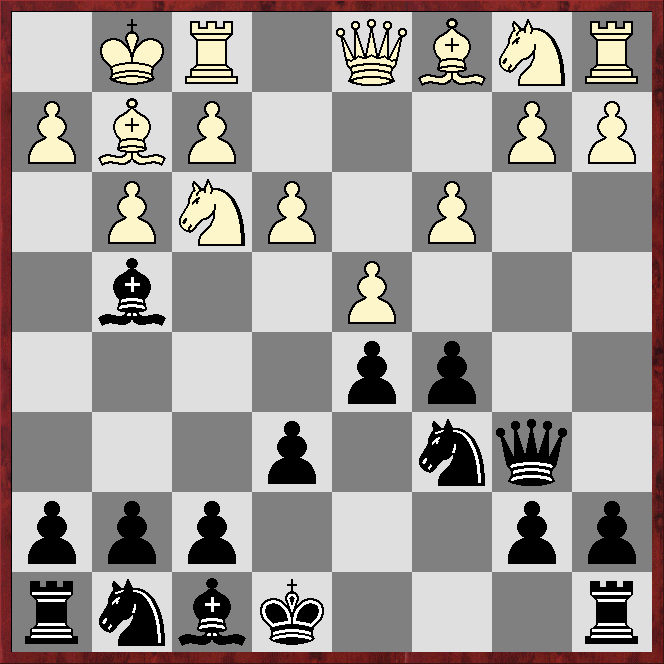
1.Nf3 d5 2.g3 c5 3.Bg2 Nc6 4.d4 Bg4 5.c3 e6 6.0-0 Qb6 7.e3
Position after White's seventh move
Spyridon Skembris, one of the ACO's resident grandmasters at its events, pointed out, after my next move, 7...Nf6, that the position looked as if Black were playing with the white pieces.
Stockfish17 and Dragon1 more-or-less confirm this by giving Black a slight edge - roughly the same edge they give White at the start of a game before a move has been played.
The fault lies with White's passive fifth and seventh moves, which, among other things, make the white queen's bishop a problem piece shut in by its own pawns (Black often has such a problem bishop in d-pawn openings).
Skembris said that, instead of 5.c3, White should play 5.Ne5.
I intended replying 5...Nxe5, which is the most popular continuation in ChessBase's 2024 Mega database, but after 6.dxe5 the engines reckon White has a positionally won game.
That may seem a bit OTT, but following 6...e6 7.c4 it is obvious Black's centre is under a lot of pressure.
White's passive 7.e3 may be a novelty.
The engines prefer 7.a4, meeting 7...Bxf3 with 8.dxc5 Qxc5 9.Bxf3.
They also like Skembris's suggested 7.dxc5 Bxc5 8.b4, an idea seen in lines of the Advance Variation of the French Defence.
LESSON: White, having the advantage of the first move, can get away with more than Black in the opening, but there is a limit, and passive pawn moves are liable to hand the initiative to Black and so give away the very advantage of having the first move.

Thursday, 3 October 2024

Crete Round Two

FACED a Scot, with my second black in a row.

Michael Ridge (1885) - Spanton (2013)
Amateur Chess Organization 50+ World Championship Group C
Réti/Reversed Grünfeld/Catalan/QGD Tarrasch
1.Nf3 d5 2.g3 c5 3.Bg2 Nc6 4.d4 Nf6
Varying from round one, when I played 4...Bg4!?
5.0-0 e6 6.c4
There are 7,833 games with this position in ChessBase's 2024 Mega database
*****
*****
*****
*****
*****
6...dxc4
This is the main move in Mega24, and leads ChessBase to classify the opening as "E04: Open Catalan: 5 Nf3," but other classifications are possible.
7.Qa4 Bd7 8.Qxc4 b5! 9.Qd3
Probably not 9.Qxb5?! Nxd4.
9...Nb4!?
The main moves are 9...Rc8 and, a tad more popular in Mega24, 9...c4.
10.Qd1 Bc6!?
A superficial glance at the position might lead one to suppose Black is doing well - the white queen has been chased back to its starting square, and the white king's knight cannot move without allowing a swop of light-square bishops
*****
*****
*****
*****
*****
However after ...
11.a3
... the impetuous black knight does not have a good retreat square, eg 11...Nbd5?! 12.e4 is positionally winning for White, according to Stockfish17 and Dragon1.
That leaves ...
11...Na6
... but the knight is sidelined for the foreseeable future.
12.Bg5!?
This may be a novelty. The engines prefer the known 12.Nc3.
12...cxd4 13.b4!?
Fixing the b5 weakness and preventing ...Nc5.
13...h6?!
Probably better is 13...Be7.
14.Bxf6 Qxf6
The engines prefer 14..gxf6!?
15.Qxd4
Even stronger is 15.Qd3!?, according to the engines.
15...Be7 16.Nbd2 Qxd4
Both 17.Ne4 and 17.Rac1 were unpleasant threats.
17.Nxd4 Bxg2 18.Kxg2 Bf6
Perhaps better is 18...Nc7, but Black's position is very difficult.
19.N2b3 0-0 20.Rac1
Can you find a decent continuation for Black?
*****
*****
*****
*****
*****
No, unless your abilities surpass those of Stockfish17 and Dragon1. They reckon best-play goes 20...Bxd4!? 21.Nxd4 Nb8 22.Nxb5 a5, but White is winning.
20...Rfd8 21.Nxb5 Rd7 22.Rfd1 Rad8?!
Perhaps better is the engines' 22...Rb7 23.Nd6 Re7!?, but it is all rather hopeless.
23.Rxd7 Rxd7 24.Rc6 Rb7
There is nothing better, eg 24...Nb8 25.Rc8+ Rd8 26.Nxa7.
25.Rxa6 Rxb5 26.Rxa7 Bb2 27.Nc5 Bd4 28.Rb7!? (1-0, 41 moves)

Wednesday, 2 October 2024

Crete Round One

FACED a German.

Daniel Schröder (1975) - Spanton (2013)
Amateur Chess Organization 50+ World Championship Group C
Réti/Reversed Grünfeld
1.Nf3 d5 2.g3 c5 3.Bg2 Nc6 4.d4
How should Black proceed?
*****
*****
*****
*****
*****
4...Bg4!?
This has been tried by many grandmasters, but Greek GM Spyridon Skembris, who is one of the ACO's resident GMs and kindly offered to go over my game, said Black should play 4...e6 or 4...Nf6. Stockfish17 and Dragon1 basically agree, while also being happy with 4...cxd4. All three moves are more popular than the text in ChessBase's 2024 Mega database.
How should White respond to the bishop's development?
*****
*****
*****
*****
*****
5.c3!?
This is somewhat passive, but is second in popularity behind Skembris's suggested 5.Ne5, and if then 5...Nxe5, White has 6.dxe5, with c4 to come, enhancing the influence of the white light-square bishop.
5...e6 6.0-0 Qb6!?
Normal is 6...Nf6.
7.e3!? Nf6
As Skembris pointed out, Black has a type of position more usually associated with White, and vice versa
*****
*****
*****
*****
*****
8.Nbd2 Be7 9.Qb3 c4 10.Qxb6
The engines prefer 10.Qa4!?
10...a6 11.Re1 Bf5!?
The engines agree that stopping an immediate e4 is Black's best plan.
12.h3!?
The engines strongly dislike this, suggesting 13.Ng5!? with 14.e4 to come.
12...0-0 13.Nh2 b5 14.g4!?
The engines like 14.e4, eg 14...Nxe4 15.Nxe4 Bxe4 16.Bxe4 dxe4 17.Rxe4, reaching the same position as is reached in the game, but with the white g pawn on g3 instead of g4.
14...Bd3 15.e4
What should Black play?
*****
*****
*****
*****
*****
15...dxe4
Skembris wanted Black to undertake immediate queenside play, first suggesting 15...b4!? and later 15...Na5? The latter is a mistake, however, as White has 16.exd5, when Black cannot recapture as the bishop at e7 will hang. The engines like 15...b4!? and 15...h6!?
16.Nxe4 Nxe4 17.Bxe4 Bxe4 18.Rxe4 b4
White has opened the position to the benefit of White's bishop and king's rook, but Black has a queenside initiative
*****
*****
*****
*****
*****
19.Re2
Perhaps it was better to start bringing the white knight back into play with 19.Nf1!?
19...Ra4 20.Bf4?!
The engines' 20.Nf3 is probably better.
20...Rfa8 21.Rae1!? bxc3
As Chelmsford's Edgar Wilson, who was watching the analysis, pointed out, 21...Rxa2!? may be stronger, the engines showing that if 22.d5 then 22...exd5!? 23.Rxe7 Nxe7 24.Rxe7 Rxb2 leaves Black winning thanks to the preponderance of black queenside pawns.
22.bxc3 Rxa2 23.Rxa2 Rxa2 24.Rb1
Now that White suddenly has strong counterplay, how should Black continue?
*****
*****
*****
*****
*****
24...g5!
The engines agree this is best, but Skembris's 24...Na5 also seems reasonable.
25.Bc7!?
This may give the best practical chances as, after 25.Be3, Black has 25...Nd8, with the black rook remaining active and the b pawn not falling.
How should Black reply?
*****
*****
*****
*****
*****
25...Rc2
Even stronger seems to be the engines' 25...Nxd4!?, eg 26.cxd4 c3 and 27...c2, or 26.Rxb7 Ne2+ and 27...f6.
26.Rxb7 Rxc3 27.Rb6
Black to play and maintain a winning advantage
*****
*****
*****
*****
*****
27...Nb4!
This proved very difficult to find, as was illustrated by the number of people who could not find it during the post-game analysis.
While playing I thought Black has a draw with 27...Nxd4!? 28.Bxe5 Rb3?? 29.Bxd4 Rxb6 30.Bxb6 c3 31.Be3? Ba3 32.Nf3 c2 33.Nxg5 c1=Q+ 34.Bxc1 Bxc1, but the engines point out that winning for White is the simple 31.Bd4 c2 32.Bb2 as White retains an extra piece. However 27...Nxd4!? does win as 28.Be5 can be met by the engines' 28...Bd8!, eg 29.Rb8 Rc1+ 30.Kg2 Nc6.
28.Rb8+
Or 28.Be5 f6 29.Bxf6 (29.Rxe6? Kf7) Bxf6 30.Rxb4 Bxd4, when, as Skembris pointed out, White's kingside is horribly weak.
28...Kg7 29.Ba5
This pin is easily dealt with, but White is lost anyway.
29...Rc1+ 30.Kg2 Nc6 31.Rb5?!
Objectively better is 31.Bd2.
31...Nxd4
This is plenty good enough, but, as Skembris noted, even stronger is 31...c3!?
32.Rb7 Bf6 33.Nf3 Ne2 34.Rc7?
Better, but still losing, is 34.Bd2.
34...c3 35.Rc5 h6 36.h4!? gxh4 37.Kh3 c2 38.Bd2 Rh1+ 39.Kg2 c1=Q 40.Bxc1 Rxc1 0-1
Sunday, 10 September 2023

Lessons From Torquay 2

REVERSED openings are a fascinating subset of opening theory.
Perhaps the best-known is the King's Indian Attack, which frequently sees the moves Nf3, g3, Bg2, 0-0, d3, Nbd2 and e4, although not necessarily in that order.
Naturally the opening is named because of its strong resemblance to the King's Indian Defence, in which Black often plays ...Nf6, ...g6, ...Bg7, ...0-0, ...d6 and, eventually, ...e5.
That is all fairly straightforward, but it can be argued that after the popular sequence 1.c4 e5 White is playing not just an English, but also a Reversed Sicilian with an extra tempo.
Similarly, grandmaster Nigel Davies, on his ChessBase DVD The Closed Sicilian, points out that after 1.c4 e5 2.Nc3 Nc6 Black is effectively playing the white side of a Closed Sicilian, but with a tempo less.
He argues that while a tempo in such positions affects the specifics of what each side can play, it is not hugely important, and so the same general principles apply as in the Closed Sicilian proper.
However there are other reversed openings in which a tempo makes a significant difference.
In my round-two game at the Riviera afternoon opening, the full score of which can be seen here, I played a Reversed Grünfeld.
After 1.Nf3 d5 2.g3 Nf6 3.Bg2 c5 4.0-0 Nc6 5.d4 cxd4 6.Nxd4 e5!? 7.Nxc6 bxc6 8.c4 Be6 9.Nc3, the following position was reached.
Black has what, at first glance, might seem a strong centre, but it is under intense pressure
This position is reached 236 times in ChessBase's 2023 Mega database, with White scoring a very impressive 67%.
Black's most-popular continuation in Mega23 is 9...Qd7, after which White's success rate rises to 75%.
The latest theory, as I understand it, is that Black is doing OK, if not completely equal, after both 9...Qd7 and 9...Rc8, the idea in both cases being to sacrifice the d pawn for activity.
Indeed after 9...Rc8 White's score falls to 51%, which is a little hard to explain as the two lines can easily transpose.
I played 9...h6, and after 10.Qa4 found myself on the back foot for more-or-less the whole game.
LESSON: taking on a known opening-setup a tempo down can be fraught with danger, especially when the setup involves the second player grabbing the lion's share of the centre.

Monday, 4 September 2023

Riviera Round Two

Sean  Gordon (2091) - Spanton (1852)
Réti/Reversed Grünfeld
1.Nf3 d5 2.g3 Nf6 3.Bg2 c5 4.0-0 Nc6 5.d4 cxd4 6.Nxd4 e5!? 7.Nxc6 bxc6 8.c4 Be6
The opening is effectively a Reversed Grünfeld with White taking on the mantle of Black, but with an extra tempo
*****
*****
*****
*****
*****
9.Nc3 h6
Stockfish16 and Komodo14.1 like 9...Qd7!? and 9...Rc8!? After the former the mainline in ChessBase's 2023 Mega database runs 10.Qa4 Rc8 11.cxd5 cxd5 12.Qxd7+ Kxd7!? 13.Rd1 Bc5!? 14.Nxd5 Nxd5 15.Bxd5 Bxd5 16.Rxd5 Ke6, when Stockfish16 reckons Black's activity gives full compensation for a pawn, but Komodo14.1 is less sure. After 9...Rc8!? the mainline in Mega23 runs 10.cxd5 cxd5 11.Qa4+ Qd7, which is a direct transposition.
10.Qa4 Bd7
The main move in Mega23 is 10...Qd7, but clearly that is an inferior version of the line given in the previous note as ...Rc8 is a lot more useful than ...h6.
11.cxd5 cxd5 12.Qa6!
The move that gives White an advantage.
12...Bc8
Black has tried sacrificing the exchange with 12...d4?!, but 13.Bxa8 (13.Nb5!? may be even better) Qxa8 14.Nb5 was convincing enough in both games in Mega23.
13.Qd3 Be6?!
Better, according to the engines, is 13...e4, when they reckon 14.Qc2 and 14.Qd4 leave White slightly better.
14.Rd1 e4 15.Qd4?!
Stronger seems to be the engines' 15.Qb5+, meeting 15...Bd7 with 16.Qb7.
15...Qb6?!
White is at best only slightly better after 15...Qd7 or 15...Qa5, according to the engines.
16.Be3 Rb8?
Grabbing the b pawn is even worse, eg 16...Qxb2? 17.Rab1 Qa3 18.Nb5 Qa5 19.Rdc1 with a huge attack for White. But the engines' 16...Qa5 and 16...Bb4!? give better chances.
17.Qa4+ Bd7 18.Bxb6 Bxa4 19.Bxa7 Rb7 20.Nxa4 Rxa7
Materially White is 'only' a pawn up, and opposite-coloured bishops give Black a little hope, but the connected queenside passers are very strong 
*****
*****
*****
*****
*****
21.b3?!
Probably better is immediately putting pressure on d5 with 21.Nc3 or 21.Nb6.
21...Rd7?!
Probably better is 21...Ba3, although the engines give White the upper hand.
22.Rac1 Rd8
More-or-less forced as otherwise 22...Rc8+ is very strong.
23.Nc3 Ba3 24.Rb1 0-0 25.Nb5 Ra8 26.Nc7 Ra5 27.b4 Ra4 28.b5 Rd8 29.b6 Rb4 30.Na6 Rxb1 31.Rxb1 Nd7 32.Bh3 Nb8 33.Nxb8 Rxb8 34.b7 Kf8 35.Rb3 Bc5 36.a4 Ke7 37.a5 Kd6 38.a6 Ba7
White's advantage is worth about a rook, according to the engines
*****
*****
*****
*****
*****
39.Rc3 g6 40.e3 f5 41.Bf1 d4 42.exd4 Bxd4 43.Rc8 Ba7 44.Bb5 Kd5 45.Kf1 g5 46.Rc6 f4 47.gxf4 gxf4 48.Ke2 f3+ 49.Kf1 Ke5 50.Rc8 Kf4 51.Ke1 h5 52.Bd7 h4. 53.h3 Ke5 54.Bg4 Kf4 55.Rc6
White has made a meal of converting his advantage, but now I miscalculate and speed the process
*****
*****
*****
*****
*****
55...Rd8!?
However, if 55...Ke5 then 56.Bc8 in effect wins the exchange as the black rook is tied down by the white bishop.
56.Rc8 Bxf2+!? 57.Kxf2 e3+ 58.Ke1
Not 58.Kf1?? Rd1#.
58...f2+ 59.Kf1 1-0