Showing posts with label Spanish Schliemann. Show all posts

Saturday, 10 January 2026

Miniatures 19

IN this occasional series I am going through my decisive games of 20 moves or fewer.

Spanton (151 BCF) - Geoffrey Stearn (158 BCF)
Highbury (London) Rapid 1990
Spanish Schliemann
1.e4 e5 2.Nf3 Nc6 3.Bb5 f5 4.Qe2!?
This is only sixth-most popular in ChessBase's 2026 Mega database, but has been played by grandmasters.
4...fxe4 5.Qxe4 Nf6 6.Qe2
How should Black proceed?
*****
*****
*****
*****
*****
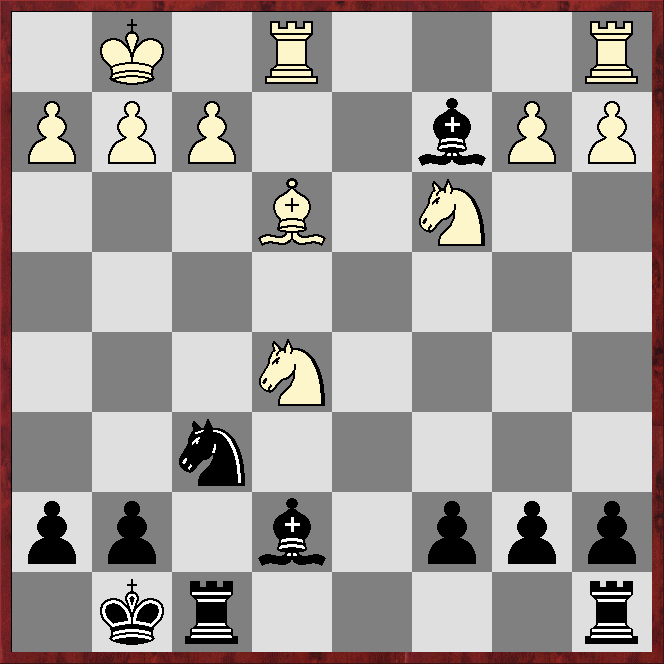
6...Be7
Stockfish17.1 and Dragon1 suggest 6...Bd6!?, which is second in popularity to 6...e4?! (after the latter, White gets the upper hand with 7.d3, according to the engines).
7.Nxe5?
Better is 7.Bxc6 dxc6 8.Nxe5, although after 8...0-0 Black has some compensation for a pawn.
7...Nxe5 8.Qxe5 0-0
Black is a pawn down, but has more than enough compensation, according to the engines
*****
*****
*****
*****
*****
9.0-0 c6
The engines prefer 9...d5.
10.Ba4?
White needed to play 10.Be2, with equality, according to the engines.
10...d5 11.d4 Bd6 12.Qg5!?
The engines agree this is best, but the white queen remains a target, and White is short of pieces on the kingside.
12...Qc7 13.h3?
This natural-looking move is a mistake. Better is 13.Qh4 or 13.f4!?, but Black is winning, according to the engines.
13...Ne4 14.Qe3 Be6?!
Much stronger is 14...Bh2+ 15.Kh1 Bf4 16.Qe1 Bxc1 17.Qxc1 Nxf2+.
15.Nd2?
Better is 15.Nc3.
15...Bf4 16.Qe2 Bh2+ 17.Kh1 Rxf2 18.Qd3 Rxf1+ 0-1
LESSON: early development of the queen is fraught with danger - it often becomes a target for tempi-gaining moves by the opponent's minor pieces.

Saturday, 25 January 2025

Mariánské Lázně Round Nine

Spanton (1946) - František Bublik (1896)
Spanish Schliemann
1.e4 e5 2.Nf3 Nc6 3.Bb5 f5 4.d4!?
This trails 4.Nc3 and 4.d3 in popularity. The main line in ChessBase's 2025 Mega database runs 4.d3 fxe4 5.dxe4 Nf6 6.0-0 Bc5, and now the equally popular 6.Bxc6 and 6.Nc3 give White a slight edge, according to Stockfish17 and Dragon1, although 6.Bxc6 scores 16 percentage points higher in Mega25.
4...fxe4 5.Bxc6!? dxc6 6.Nxe5 Nf6 7.0-0 Bd6 8.Bg5 0-0
Now both sides have castled, how would you assess the position?
*****
*****
*****
*****
*****
Black has the bishop-pair, but White has a well-placed knight at e5. Much may depend on whether the e pawn turns out to be a strength or a weakness. The engines start by calling the position equal, but given more time they come to give White a slight edge (Dragon1) or at least the better part of equality (Stockfish17).
9.Nd2 Qe8 10.Qe2 Bxe5 11.dxe5 Qxe5 12.Bxf6 Qxf6 13.c3!?
Protecting the queenside before levelling material.
13...Bf5 14.Nxe4 Qg6
If 14...Qe6, then 15.Ng3.
15.Rfe1 Rae8 16.Qc4+ Be6 17.Qd4 Bd5
Also equal is 17...Rf4 18.f3.
18.f3?
But here f3 is a mistake. White had to play 18.Ng3, with complete equality, according to the engines.
18...Rxf3! 19.Ng3 Rff8 20.c4
Not 20.Qxa7?? Qc2, when Black mates in five.
20...Be6 21.Re2 b6 22.Rae1 c5 23.Qc3 Bd7 24.Rxe8 Rxe8 25.Rxe8+ Qxe8 26.b3 Qe6 27.h3 Qd6 28.Qe3 Qd4 29.Kf2 Kf7 30.Ne2 Qxe3+ 31.Kxe3 Kf6
How would you judge this bishop-v-knight ending?
*****
*****
*****
*****
*****
Black is a pawn up, albeit the extra pawn is doubled, and has the better minor piece for action on both wings. All the White pawns being on light squares makes them possible targets for the bishop. The engines agree Black is winning.
32.Nc3 Bc6 33.g3 a6 34.a4
The engines prefer 34.h4!?
34...g5 35.Ne4+?
I knew Black's queenside pawns could not by themselves create a passer, but I did not properly take into account that they gave Black reserve tempi easily exploited in a pawn-ending. Black is lost anyway, but the text simplifies White's task.
35...Bxe4 36.Kxe4 c6 37.h4 h6 38.h5 Ke6 39.g4 Kf6 40.a5 bxa5 41,Kd3 Ke5 42.Ke3 a4!? 0-1

Saturday, 9 September 2023

Lessons From Torquay

IN round one of the Riviera afternoon open my opponent played the the sharp Schliemann Variation of the Spanish, which starts 1.e4 e5 2.Nf3 Nc6 3.Bb5 f5.
The game continued 4.d4!? fxe4 5.Bxc6 dxc6 6.Nxe5, bringing about a position in which the players have very different assets.
Position after 6.Nxe5
Black has the bishop-pair on a relatively open board, and an advanced e pawn, which gives more space but is isolated and could prove vulnerable.
White has a knight on a central outpost that cannot be challenged by a black pawn. The knight is the only developed piece and, according to Siegbert Tarrasch's teachings, it should be counted as two development tempi since it has reached the fifth rank.
So the opening has determined that the game will be a battle of the bishop-pair, which, according to Larry Kaufman's Evaluation Of Material Imbalances, is on average worth a half-pawn, against White's lead in development.
The bishop-pair is usually thought of as a long-term asset, while a lead in development is usually short-term.
Theses are general considerations, and everything depends on specific moves, with, in this case, a major complication in the status of the e pawn.
The full game can be seen here, but in this post I want to present a series of snapshots of how play developed, with the focus being on bishops versus development.
Position after my apparent novelty, 11.Bg5-e3 - both players have castled, and White has developed a rook and three minor pieces, one of which is a knight on the fifth rank; Black has also developed a rook and three minors, and so has almost caught up in development (Komodo14.1 gives Black a slight edge, while Stockfish16 gives Black the better side of equality)
Black has played a mini-combination, exchanging the advanced but isolated e pawn for the white c pawn, gaining a farside pawn-majority into the bargain - the price is that White will develop the queen's rook with tempo by playing 15.Rac1 (the engines reckon the game is completely equal)
Position after 18.Be3-g5 - Black has retreated the light-square bishop to the back rank to preserve the bishop-pair, giving White a large lead in development but with no obvious targets for exploiting the lead (the engines reckon the position remains balanced)
Position after 26.Rd1-d2 - a flurry of exchanges has brought about an ending in which Black has the bishop-pair and a farside pawn-majority, and he would be slightly better after completing development with 26...Re8 (the a7 pawn is poisoned)
Position after 33.Be3-f4 - Black still has not developed the queen's rook, and the bishop-pair has been forced to the back rank, but bishops are long-range pieces and are not especially inconvenienced by this 
The engines reckon Black would gain a slight edge, or at least have the better side of equality, by developing the rook via a7 and d7.
Instead the game saw 33...Bb7?, after which 34.Nxb6! Bab6 35.Rd7+ won a pawn and got rid of the bishop-pair (1-0, 58 moves).
LESSON: the bishop-pair is a powerful weapon, quite possibly worth a pawn on an open board with rival pawn-majorities. But a lead in development is also a powerful weapon, especially in the unusual circumstances of this game, where the lead was maintained into an ending, meaning the possibility of a tactical coup was ever-present.

Sunday, 3 September 2023

Riviera Round One

Spanton (1852) - David L Roberts (2031)
Spanish Schliemann
1.e4 e5 2.Nf3 Nc6 3.Bb5 f5 4.d4!?
The main continuations are 4.d3 and especially 4.Nc3.
4...fxe4 5.Bxc6
Giving up the bishop-pair, but not without compensation. The mainline in ChessBase's 2023 Mega database runs 5.Nxe5!? Nxe5 6.dxe5 c6, after which Stockfish16 and Komodo14.1 do not rate the most-popular move, 7.Bc4, as it loses a pawn to 7...Qa5+. Instead White should perhaps try 7.Nc3!? cxb5 8.Nxe4, when 8...d5!? 9.exd6 Nf6 scores 55% for Black in Mega23. Komodo14.1 reckons White has full compensation for the material sacrificed, but Stockfish16 gives Black a slight edge.
5...dxc6 6.Nxe5
How would you assess the position?
*****
*****
*****
*****
*****
Black has the bishop-pair but White has a knight on a central outpost. Much may depend on whether the e pawn is a strength, thanks to the space it gives Black, or, thanks to being isolated, a weakness. The engines reckon the position is equal.
6...Nf6 7.0-0 Be7 8.Nc3 0-0 9.Bg5 Bf5 10.Re1 c5!?
How should White respond?
*****
*****
*****
*****
*****
11.Be3
Reinhard Jaenig (2168) - Manfred Hermann (2341), Bad Wörishofen 2003, saw 11.Bxf6 Bxf6 12.Nxe4 cxd4 13.Nxf6+ Rxf6 14.Qe2 Qd5 with what the engines reckon is an equal game (but 0-1, 63 moves).
The engines give 11.d5, again with what they reckon is equality.
11...cxd4 12.Qxd4 Qxd4 13.Bxd4 e3!? 14.Bxe3 Bxc2 15.Rac1 Bf5
Now the e pawn has gone, who stands better?
*****
*****
*****
*****
*****
Black still has the bishop-pair, and has a farside pawn-majority, but the engines reckon this is balanced by White's lead in development.
16.Nb5 c6 17.Nd4 Bc8 18.Bg5 Bb4 19.Re2 Re8 20.a3 Ba5
I now picked up my queen's rook, intending 21.Rce1?? but seeing in time that loses the exchange.
21.Rd1 Nd5 22.Nc4 Rxe2 23.Nxe2 Bc7 24.Ne3 Nxe3 25.Bxe3 Bf5 26.Rd2 Kf7
Black would have a slight edge, according to the engines, after 26...Re8, the a7 pawn being poisoned.
27.h3 a6 28.g4!? Be6 29.Nf4 Bc8 30.Nd3 b6 31.Nb4 c5 32.Nd5 Bd8 33.Bf4
The engines reckon 33.Nc3 is equal.
33...Bb7?
Better is 33...Ra7.
34.Nxb6!
Best, although 34.Nc7!? is also good.
34...Bxb6 35.Rd7+ Kg6 36.Rxb7 Bd8 37.Rb8!?
The engines are not keen on this, presumably because the white rook is much more active than its black counterpart.
37...Rxb8 38.Bxb8 c4!?
Probably hoping to follow up with ...Bf6, but the pawn is vulnerable on c4.
39.Be5 Kf7 40.Kg2 g6 41.Kf3 Bb6 42.Ke4!
A queenside majority will be easier to convert than the kingside one.
42...Bxf2
If 42...Ke6, then 43.f4.
43.Kd5 h5 44.Kxc4 hxg4 45.hxg4 Ke6 46.Bd4 Bg3 47.b4 Kd6 48.a4 Kc6 49.Bc5 Bf4 50.b5+ axb5+ 51.axb5+ Kc7 52.Kd5 g5!? 53.Ke6 Bd2 54.Kf5 Bc1 55.Ke4 Bb2 56.Bd4 Ba3 57.Be3 Be7 58.Kf5 1-0
I was slightly surprised at resignation coming here, especially considering the rating difference, but the Syzygy endgame tablebase has had White winning throughout once the game got down to seven 'pieces'.

Tuesday, 14 December 2021

Benidorm U2000 Games: Round Eight

PLAYED on Saturday.

Spanton (1829) - Arturo López Heras (1698)
Spanish Schliemann
1.e4 e5 2.Nf3 Nc6 3.Bb5 f5 4.d4!?
A sharp reply. The analysis engines Stockfish14.1 and Komodo12.1.1. prefer 4.Nc3 or 4.d3.
4...fxe4 5.Bxc6
5.Nxe5!? leads to wild play after 5...Nxe5 6.dxe5 c6 7.Nc3!?
5...exf3?
Black should recapture on c6 with either the d or b pawn.
6.Bxf3 exd4 7.Qxd4 Nf6 8.Nc3 Be7 9.Bf4?!
My originally intended 9.Nd5 is almost certainly stronger.
9...0-0?
Black is fine after 9...c6, with ...d5 to come.
10.Qc4+ Kh8 11.Bxc7 Qe8 12.0-0 Qg6 13.Rfe1 d5!?
Desperation - but Black's game is horrible in any case.
14.Nxd5 Nxd5 15.Bxd5 Bh4?? 16.Bg3??
A ridiculous case of chess blindness by both players (16.Qxh4 wins a piece).
16...Bxg3 17.hxg3 Bf5 18.Re2 Rac8 19.Qb4 Bxc2 20.Bxb7 Rb8 21.Rae1 Bd3 22.Re6?
Better is 22.Re7, but White still has a large advantage after the text.
22...Qf7
What should White play?
*****
*****
*****
*****
*****
23.Qd4?
White still has a large advantage after 23.Re7 Qxf2+ 24.Kh2.
23...Rxb7 24.Qxd3 Qxf2+ 25.Kh2 Rxb2 26.R1e2 Rxe2 27.Rxe2 Qf6 28.Qe3 a6 29.Qe6 Qxe6 30.Rxe6 Ra8 31.Kg1
ALH offered a draw.
31...Kh8 32.Re7 Kf8 33.Rd7 Rc8 34.Rd6 a5 35.Rd5 a4 36.Rd4 a3 37.Rd3 Ra8 38.Kf2 Ke7 39.Ke3 h5 40.Rb3 Kd6 41.Rb7 g5 42.Rh7 Rb8 43.Ra7 Rb2 44.Rxa3 Rxg2
Two pawns have left the board, but the position remains as it has been for many moves - dead-equal.
45.Kf3 Rc2 46.Rd3+ Ke5 47.Ra3 g4+ 48.Ke3 Rg2 49.Ra5+ Kf6 50.Rxh5 Rxg3+ 51.Kf4 Ra3 52.Rh6+ Kg7 53.Rh2 Ra4+ 54.Kg5 g3 55.Rg2 Ra3 56.Kf4 Kf6
White to play and lose
*****
*****
*****
*****
*****
57.Ke4?? Kg5 58.Rb2 Kg4 59.Rb8 g2 60.Rg8+ Kh3 61.Kf4 Kh2 62.Rh8+ Kg1 63.Kg4 Kf1 64.Rf8+ Ke2 0-1