Showing posts with label Tarrasch. Show all posts

Saturday, 9 September 2023

Lessons From Torquay

IN round one of the Riviera afternoon open my opponent played the the sharp Schliemann Variation of the Spanish, which starts 1.e4 e5 2.Nf3 Nc6 3.Bb5 f5.
The game continued 4.d4!? fxe4 5.Bxc6 dxc6 6.Nxe5, bringing about a position in which the players have very different assets.
Position after 6.Nxe5
Black has the bishop-pair on a relatively open board, and an advanced e pawn, which gives more space but is isolated and could prove vulnerable.
White has a knight on a central outpost that cannot be challenged by a black pawn. The knight is the only developed piece and, according to Siegbert Tarrasch's teachings, it should be counted as two development tempi since it has reached the fifth rank.
So the opening has determined that the game will be a battle of the bishop-pair, which, according to Larry Kaufman's Evaluation Of Material Imbalances, is on average worth a half-pawn, against White's lead in development.
The bishop-pair is usually thought of as a long-term asset, while a lead in development is usually short-term.
Theses are general considerations, and everything depends on specific moves, with, in this case, a major complication in the status of the e pawn.
The full game can be seen here, but in this post I want to present a series of snapshots of how play developed, with the focus being on bishops versus development.
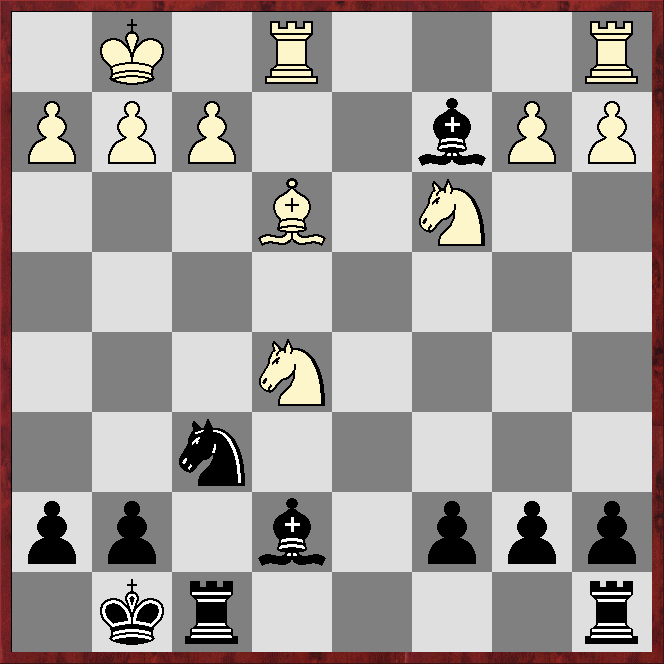
Position after my apparent novelty, 11.Bg5-e3 - both players have castled, and White has developed a rook and three minor pieces, one of which is a knight on the fifth rank; Black has also developed a rook and three minors, and so has almost caught up in development (Komodo14.1 gives Black a slight edge, while Stockfish16 gives Black the better side of equality)
Black has played a mini-combination, exchanging the advanced but isolated e pawn for the white c pawn, gaining a farside pawn-majority into the bargain - the price is that White will develop the queen's rook with tempo by playing 15.Rac1 (the engines reckon the game is completely equal)
Position after 18.Be3-g5 - Black has retreated the light-square bishop to the back rank to preserve the bishop-pair, giving White a large lead in development but with no obvious targets for exploiting the lead (the engines reckon the position remains balanced)
Position after 26.Rd1-d2 - a flurry of exchanges has brought about an ending in which Black has the bishop-pair and a farside pawn-majority, and he would be slightly better after completing development with 26...Re8 (the a7 pawn is poisoned)
Position after 33.Be3-f4 - Black still has not developed the queen's rook, and the bishop-pair has been forced to the back rank, but bishops are long-range pieces and are not especially inconvenienced by this 
The engines reckon Black would gain a slight edge, or at least have the better side of equality, by developing the rook via a7 and d7.
Instead the game saw 33...Bb7?, after which 34.Nxb6! Bab6 35.Rd7+ won a pawn and got rid of the bishop-pair (1-0, 58 moves).
LESSON: the bishop-pair is a powerful weapon, quite possibly worth a pawn on an open board with rival pawn-majorities. But a lead in development is also a powerful weapon, especially in the unusual circumstances of this game, where the lead was maintained into an ending, meaning the possibility of a tactical coup was ever-present.

Saturday, 26 September 2020

Chess Evolution: The French Defence (part 10)

TARRASCH'S 3.Nd2 quickly became a popular weapon against the French, but another move, 3.e5, first mentioned by Greco in 1620 (see part one of this series) was revived by Nimzowitsch in the run-up to World War One.
The move 3.e5 had never fallen completely from favour, being extensively used by the Paulsen brothers, Wilfried and Louis, in the 1870s and 1880s, and by Steinitz in the 1890s.
Nimzowitsch played 3.e5 three times at Karlsbad 1911, drawing with Rubinstein but beating Salwe and Levenfish.
The move really took off the following year when at San Sebastian he used it to beat Tarrasch, Speilmann, Duras and Leonhardt.
Aron Nimzowitsch - Siegbert Tarrasch
San Sebastian 1912
French Advance
1.e4 e6 2.d4 d5 3.e5
This move divided opinion in the early 1900s and still does today. Is White punishing Black for failing to take his full share of the centre, or is White spending time on over-extending?
3...c5 4.c3 Nc6 5.Nf3 Qb6 6.Bd3!?
More common today are 6.Be2 and especially 6.a3.
6...cxd4 7.cxd4 Bd7
There are 71 examples in ChessBase's 2020 Mega database of Black falling for the well-known trap 7...Nxd4??, which loses because of 8.Nxd4 Qxd4?? 9.Bb5+ etc.
8.Be2!?
More popular today, but not necessarily better, is the Milner-Barry Gambit, starting with 8.0-0!?
The position after 8.Be2!? can also be reached if White plays 6.Be2 instead of 6.Bd3, in which case White gains a tempo as it would be his turn to move. But after 6.Be2 Black is not obliged to play an early ...Bd7, so 6.Bd3 followed by 8.Be2!? only loses a tempo if Black plays inaccurately.
8...Nge7 9.b3?!
This is probably too slow - 12 rounds later, against Duras, Nimzowitsch switched to 9.Na3.
9...Nf5 10.Bb2 Bb4+ 11.Kf1
The only way to save the d4 pawn.
11...Be7!?
The point of this move, which Tarrasch had played against Louis Paulsen 24 years earlier, is so 12.g4?! can be met by 12...Nh4. Rubinstein at Karlsbad prevented g4 by playing 11...h5. But according to Nimzowitsch, Black can play 11...0-0! (Nimzowitsch's punctuation) as 12.g4 Nh6 (12...Nfe7? 13.a3) is nothing to be feared.
12.g3 a5 13.a4
The text was also played against Tarrasch by Louis Paulsen at the Bavarian Congress (Nürnberg) 1888. Note that trying to stop ...a4 with 13.Nc3 does not work as 13...a4 14.Nxa4?! runs into 14...Rxa4 15.bxa4 Qxb2.
13...Rc8 14.Bb5 Nb4?!
Connecting rooks by 14...0-0, as suggested by the analysis engines Stockfish11 and Komodo11.01, seems better.
15.Nc3!?
Paulsen played 15.Bxd7+ against Tarrasch. After 15...Kxd7 16.Nc3 Black could have kept an edge, according to the engines, with 16...h5, when White's king seems the more vulnerable. The game saw 16...Nc6 17.Nb5 Na7 18.Nxa7 Qxa7 with a roughly level game (but 0-1, 62 moves).
15...Na6 16.Kg2 Nc7 17.Be2 Bb4
Tarrasch presumably had in mind keeping his king in the centre, as he did against Paulsen.
18.Na2 Na6 19.Bd3 Ne7 20.Rc1 Nc6 21.Nxb4 Naxb4
White has the bishop-pair, but the position remains fairly closed. The one major warning sign for Black, perhaps, is that his kingside is somewhat denuded of pieces.
22.Bb1 h6 23.Bb1 Ne7 24.Rxc8+ Bxc8 25.Ne1 Rf8 26.Nd3 f6 27.Nxb4 Qxb4 28.exf6 Rxf6 29.Bc1?
Nimzowitsch gave this an exclamation mark, but missed a tactical point of the position. Better is 29.Re1.
How can Black take advantage of White's last move?
*****
*****
*****
*****
*****
29...Nc6?
Black has a very good game after 29...e5 as 30.dxe5? runs into 30...Bxg4.
30.g5 hxg5 31.Bxg5 Rf8 32.Be3 Qe7?!
The engines reckon ...e5 is still Black's best shot, although the position is no longer favourable to him.
33.Qg4
Preventing 33...e5 by pinning the e pawn.
33...Qf6 34.Rg1 Rh8 35.Rh1 Rh4?
The engines reckon 35...Bd7 is decidedly better.
36.Qg3
There is no good answer to this, which leaves White threatening Bg5 and Qxg7.
36...Rxd4
Tarrasch hopes his central pawn-duo, along with depriving White of the bishop-pair, will compensate for the exchange.
37.Bxd4 Nxd4 38.Qxg7 Qf3+
Or 38...Qxg7 39.Rxg7 Nxb3 40.Rg8+ Kd7 41.h4 etc.
39.Qg2 Qxg2+ 40.Rxg2 Nxb3 41.h4 1-0

Friday, 25 September 2020

Chess Evolution: The French Defence (part nine)

AFTER 1.e4 e6 2.d4 d5, the moves 3.exd5, 3.e5 and the relatively new-fangled 3.Nc3 all had their plus and minus points.
From a historical basis, using ChessBase's 2020 Mega database as the source, the next move to be tried, in 1859, was 3.Bd3.
It never really caught on, not least because after 3...dxe4 4.Bxe4 Nf6, White had to either cede the bishop-pair or spend a tempo moving the light-square bishop for a third time.
The move 3.Nc3 continued to grow in importance, even though it blocks the white c pawn from supporting d4 and allows Black to increase pressure on e4 by playing the Winawer: 3...Bb4 or the McCutcheon: 3...Nf6 4.Bg5 Bb4.
Then in 1890, at the British Chess Association Congress in Manchester, Tarrasch unveiled a way of side-stepping both those variations without committing to moving the e pawn, namely 3.Nd2 (he had played the move previously in casual games, but Manchester seems to have been its competitive debut).
Steinitz was an early convert, and soon the Tarrasch Variation appeared in the repertoires of many of the leading masters of the late-19th century including Pillsbury, Schlechter and Albin.
Ironically Tarrasch gave up his variation in 1894, largely due to games like the following.
Siegbert Tarrasch - Karl Eckart
Nürnberg (Friendly) 1891
French Defence
1.e4 e6 2.d4 d5 3.Nd2 c5
The most-popular move in Mega20 is 3...Nf6, but the text is a logical way of taking advantage of the fact that a knight on d2 does not pressurise Black's centre in the way a knight on c3 does. For Tarrasch, 3...c5 was a virtual refutation of his system as Black is almost assured of obtaining an isolated queen's pawn - something Tarrasch believed greatly benefits Black.
4.exd5 exd5 5.dxc5!?
This move is still occasionally played by grandmasters, although it has been overtaken in popularity by 5.Ngf3 and 5.Bb5+.
5...Bxc5 6.Nb3
White regains the tempo that was arguably lost in capturing on c5 before Black had moved his dark-square bishop.
6...Bb6 7.Nf3 Nf6 8.Be2 Nc6 9.c3 0-0 10.0-0 Ne4!?
An interesting and aggressive choice. Instead of developing another piece (for example ...Bf5, ...Bg4 or ...Re8), Eckart occupies a central outpost in his opponent's half of the board, probably hoping for a kingside attack.
11.Bf4 Re8 12.Nfd4!?
Wrong knight?
12...Qf6 13.Be3 Qg6 14.Re1 Bh3 15.Bf1 Ne5
Black's pieces are gathering ominously in the region of White's king. The position is roughly equal, according to the analysis engines Stockfish11 and Komodo11.01, but such positions are usually easier for the attacker to play.
16.f3 Nd6 17.Kh1?!
Seeking to drive away the Black light-square bishop, but White's position turns out to be looser than it may seem. White needs to play a consolidating move such as 17.Bf2.
17...Nec4
Even stronger is the engines' 17...Bxg2+! 18.Bxg2 Nd3, the point being that 19.Re2? loses to 19...Rxe3! since 20.Rxe3? runs into 20...Nf2+.
18.Bf2 Rxe1 19.Qxe1 Re8 20.Qc1 Bd7 21.Nd2 Bc7?!
Black keeps a pleasant edge with 21...Ne3, according to the engines.
22.b3?
More-or-less forcing Black to make the knight entry he missed last time. The engines reckon White equalises with 22.Nxc4.
22...Ne3 23.Bxe3 Rxe3 24.Be2 Nf5 25.Nf1 bf4 26.Nxf5?!
White is holding on after 26.Qb2.
How should Black proceed?
*****
*****
*****
*****
*****
26...Qxg2+! 27.Kxg2 Rxe2+ 28.Kg1 Bxc1 29.Rxc1 Bxf5
Black has won a pawn, got his rook to the seventh rank and has the more-active minor piece.
30.Ng3 Rc2 31.Rd1!?
Objectively better may be 31.Rxc2, but White should eventually be ground down.
The game finished:
31...Be6 32.c4 Rxa2 33.cxd5 Bd7 34.Ne4 Rc2 35.b4 b6 36.Ra1 Rc7 37.Kf2 f5 38.Ng5 h6 39.Nh3 g5 40.f4 g4 41.Ng1 Bb5 0-1
The knight cannot move (42.Ne2? Rc2 43.Re1 Rxe2+ 44.Rxe2 Bxe2 45.Kxe2 Kf7) and meanwhile White has too many weak pawns.

Tuesday, 22 September 2020

Chess Evolution: The French Defence (part six)

WORLD champions have a strong influence on opening trends, so Lasker's use of 4.Bg5 against the Classical: 1.e4 e6 2.d4 d5 3.Nc3 Nf6 made a big impression on contemporaries.
He played the move three times in his 1908 world championship match against Tarrasch, scoring two wins and a draw.
Here is their third encounter:
Emanuel Lasker - Siegbert Tarrasch
World Championship 1908 Game 11
French McCutcheon
1.e4 e6 2.d4 d5 3.Nc3 Nf6 4.Bg5
Lasker in his career also played 4.e5, 4.Bd3 and (once) 4.exd5, but the text was overwhelmingly his most-common response to the Classical.
4...Bb4
Tarrasch replied with the McCutcheon in all three games.
5.exd5
Lasker played the somewhat obscure 5.Bd3 in games seven and nine, winning the first but being held to a draw in the second. The main move - then and today - is 5.e5.
5...Qxd5
This active queen recapture is very much in Tarrasch's style of liking piece-play, eg after 1.e4 e6 2.d4 d5 3.Nc3 Nf6 4.e5 Nfd7 in the Steinitz Variation of the French Classical he advocated 5.Nf3 rather than shoring up the centre with 5.f4.
6.Nf3!?
Lasker three times played 6.Bxf6 in his 1907 world championship massacre of Marshall, but 'only' scored a win and two draws (the match finished in Lasker's favour +8=7-0).
6...c5 7.Bxf6 gxf6 8.Qd2
White has given up the bishop-pair but weakened Black's kingside.
8...Bxc3
8...Qd6 was tried in Leonid Totsky (2550) - Sergey Koutsin (2415), Rýmařov (Czechia) 1999, but after 9.a3 Black felt obliged to return the bishop-pair anyway with 9...Bxc3. The further moves 10.Qxc3 Nd7 11.0-0-0 gave White a strong attacking position, according to the analysis engines Stockfish11 and Komodo11.01 (1-0, 26 moves).
9.Qxc3 Nd7?!
The engines much prefer 9...Qe4+, as played by Vidmar in a draw against Leonhardt at the 1906 German chess championship in Nürnberg.
10.Rd1
The engines reckon even stronger is the messy-looking 10.0-0-0!? Qxa2 11.dxc5!? Qa1+ 12.Kd2.
10...Rg8 11.dxc5 Qxc5 12.Qd2
Lasker believes his king will be safer than Black's, and anyway 12.Qxc5?! Nxc5 frees the black position.
12...Qb6 13.c3 a6 14.Qc2 f5!?
Indirectly protecting h7 and creating a possible central outpost square at e4, but weakening the kingside dark squares.
15.g3 Nc5 16.Bg2 Qc7
Planning to fianchetto his remaining bishop.
17.Qe2 b5 18.0-0 Bb7
How should White proceed?
*****
*****
*****
*****
*****
19.c4!
The white king looks pretty safe, so Lasker seeks to open lines to get at the uncastled black king.
19...b4 20.Qd2 Rb8
Indirectly defending b4 (21.Qxb4?? loses to 21...Bxf3), but now Lasker invades on the kingside.
21.Qh6 Bxf3 22.Bxf3 Qe5
Indirectly defending h7 (23.Qxh7?? loses to 23...Rh8) and attacking b2, but the key to this position is White's better piece-coordination and Black's unsafe king.
23.Rfe1 Qxb2 24.Qf4 Rc8 25.Qd6 f6
This does not help, but there is no way to save Black's position.
26.Bh5+ Rg6 27.Bxg6+ hxg6 28.Rxe6+ 1-0

Sunday, 19 January 2020

Lasker's Spanish Inquisition (part six)

THIS was the first game of the 1908 world championship match.
Emanuel Lasker - Siegbert Tarrasch
1.e4 e5 2.Nf3 Nc6 3.Bb5 a6 4.Bxc6 dxc6 5.d4
Lasker had played 5.Nc3 in a win against Tarrasch 12 years before.
5...exd4 6.Qxd4 Qxd4 7.Nxd4 c5!?
Fred Reinfeld & Reuben Fine condemned this in a 1935 book, reprinted by Dover in 1965 as Lasker's Greatest Chess Games 1889-1914, for weakening Black's queenside, but it has been the choice of many strong players.
8.Ne2 Bd7 9.b3!?
Reinfeld & Fine criticise this rare move as "an indifferent idea," preferring 9.Bf4 followed by Nd2 "with pressure on Black's queenside pawns."
Andrew Soltis in Why Lasker Matters (Batsford, 2005) says "the natural response to ...c5" is Nbc3, intending Nd5.
9...Bc6
Reinfeld & Fine recommend castling, with ...f6 to follow to blunt White's bishop.
Soltis says Alekhine was impressed by Schlechter's recommendation of 9...c4. The future world champion used it in a 1909 game, meeting 10.bxc4 with 10...Ba4?!, when 11.c3 0-0-0 was unpleasant for White. But Stockfish10 and Komodo10 come up with a major improvement, 11.Nbc3, the point being that Black's light-square bishop is trapped after 11...Bxc2?? 12.Kd2, so instead has to retreat with loss of tempo.
10.f3 Be7 11.Bb2 Bf6?!
Reinfeld & Fine are surely right in calling this "illogical, since Black's only compensation for his weakened queenside is his two bishops." Soltis calls it "a curious decision."
12.Bxf6 Nxf6 13.Nd2 0-0-0 14.0-0-0 Rd7 15.Nf4 Re8
As Soltis points out, 15...Rhd8? loses a pawn to 16.Nd3 as 16...b6?? allows 17.Ne5.
16.Nc4 b6 17.a4
Soltis gives this an exclamation mark, but does not explain why.
17...a5
This is Komodo10's choice, but Reinfeld & Fine call it "purposeless," saying Black should have played ...Kb7 followed by ...b5 to create counterplay.
18.Rxd7 Nxd7 19.Rd1 Ne5 20.Nxe5 Rxe5
Reinfeld  & Fine say the ending favours White "because of the relative immobility of Black's bishop."
21.c4
This gets an exclamation mark in both books, but the move is almost compulsory as otherwise Black undoubles his pawns with ...c4.
21...Re8 22.Nh5 Rg8?!
A horrible-looking move. The engines point out the better 22...Re6, which effectively prevents 23.Nxg7 as White does not want to allow 23...Rg6 followed by ...Rxg2.
23.Rd3 f6 24.Kd2 Be8 25.Ng3 Bd7
Soltis: "In principle, Black should be reluctant to trade rooks (...Bg6 and ...Rd8) because there is a danger that White will simply create a passed kingside pawn. Here ...c6 followed by ...Kc7 and ...b5 looks right."
26.Ke3 Re8 27.Nh5 Re7 28.g4
Another move that Soltis rewards with an exclamation mark, but does not explain what is so good about it. However, note that 28.f4? loses the e pawn, eg 28...Bc6 29.Ng3 h5 30.h4 Bxe4 31.Nxe4 f5 etc.
28...c6
Soltis praises this move, saying it is necessary to keep the knight out of d5.
29.h4 Kc7
How should White proceed?
*****
*****
*****
*****
*****
30.g5?!
This move passes without comment in both books, but it seems to be an example of how Lasker occasionally became impatient to finish a game.
The engines suggest 30.Rd1, but do not really come up with a plan for further activating White's kingside.
Perhaps 30.Kf4!? was best. The idea is to be able to play g5 without allowing the reply ...f5.
30...f5 31.Ng3 fxe4 32.Nxe4
Soltis says "the thematic" 32.fxe4 is better, but that Black is fine with ...b5. The engines reckon ...Rf7 is also satisfactory.
32...Bf5 33.h5 Rd7! 34.Rc3!?
The players have seen, and the commentators agree, that White cannot make progress after 34.Rxd7+ Kxd7 35.Kf4 Ke6. The text, hardly surprisingly, does not improve White's position, but avoids simplification - a sign, surely, that Lasker regarded himself as the superior player.
34...Rd1 35.Kf4 Bd7?
Tarrasch goes wrong almost immediately. He had a simple draw with 35...Bxe4 36.Kxe4 Rh1, which wins the h5 pawn, although White is in no trouble either as Black cannot create a passer on the queenside.
36.Re3 Rh1 37.Ng3 Rh4+ 38.Ke5 Rh3  39.f4 Kd8 40.f5 Rh4 41.f6 gxf6+ 42.Kxf6 Be8 43.Nf5!
Not the only way to win but, as Reinfeld & Fine say, "pretty and decisive."
43...Rf4
Or 43...Rxh5? 44.Rxe8+ Kxe8 45.Ng7+.
44.g6 hxg6 45.hxg6 Rg4 46.Rxe8+!? Kxe8 47.g7 Kd7 48.Nh4 Rxg7!?
A desperate last try, but White has it all covered.
49.Kxg7 Ke6 50.Nf3 Kf5 51.Kf7 Ke4 52.Ke6 Kd3 53.Kd6 kc3 54.Kxc6 Kb3 55.Kb5 1-0

Friday, 9 August 2019

Attack v Defence

ASSESS this middlegame.
White has just played 15.Qd1-g4 in Tarrasch - Janowski, Ostend 1907
*****
*****
*****
*****
*****
*****
*****
*****
"Although the black king's defences appear to be adequate, the frontal attack, initiated by (15.Qg4), wins all along the line," writes Tartakower in 500 Master Games Of Chess. "What follows is a masterpiece of clarity and conciseness in chess."
Nevertheless, the engines Stockfish10 and Komodo9 reckon the position is dead equal.
15...Qe8?
"Or 15...Kf7 16.fxe5 dxe5 17.Rf3, and the black king's position remains precarious. After the text move, White's f pawn becomes a battering-ram."
The engines reckon the line given by Tartakower favours Black, if anyone, with Stockfish10 being particularly gung-ho at first after 17...Be7. Eventually both engines come to give Black a slight edge after 17...Be7, with Stockfish10 equally liking 17...Rh8. I presume their assessments are based on Black's king being safe behind its wall of pawns, especially now White has no kingside pawn breaks (h4-h5 is not feasible). Meanwhile, Black has the half-open h file to work down, and the better minor piece. After the text, White is able to use the pin on the g file to further his attack.
It should be noted that on general principles, 17...Kf7 was the more natural move in that a) it breaks a pin, and b) kings are usually safer when in touch with their defensive pawn-wall.
I think it also illustrates what is fairly well-known, ie that attack is easier than defence. One mistake by a defender can be fatal, while a mistake by the attacker often only leads to equality or at worse a slightly inferior position.
16.f5 exf5 17.exf5 Bxc3?
The bishop was hanging, and at first glance it seems a good idea to give it up for a knight that could help White's attack. But the engines much prefer 17...Bc5+ 18.Kh1 d5, denying the knight the e4 square while keeping the bishop for defence. However, they still like White's position, and it does look easier to play.
18.bxc3 Kg7 19.Rf3 Rh8
"If 19...g5, 20.h4, which the move in the text is to prevent."
20.fxg6 Qe7
"As 20...Qxg6 is not feasible, on account of 21.Qd7+, Black's position, with a powerful wedge driven into his game, gradually becomes hopeless."
21.h4 d5 22.Raf1 Raf8 23.h5 Rh6 24.R1f2 Rhh8 25.Qf5
"Vacating the g file for the triumphant entrance of the "third Musketeer."
25...Qd6 26.g4 Qe7
"Hoping to control the critical square g5."
27.g5!
"A decisive advance."
27...fxg5 28.Qxf8+ Rxf8 29.Rxf8 Qxf8
"There is nothing left. If 29...Qc5, 30.d4 exd4 31.R2f7+ Kh6 32.Rh7(or Rh8)#"
30.h6+
According to ChessBase's 2019 Mega database, the game ended here, but 500 Games continues:
30...Kxh6 31.Rxf8 Kxg6 32.Kg2 e4 33.dxe4 dxe4 34.Kg3 1-0

Wednesday, 17 July 2019

Morphy v The French

PAUL Morphy was hailed in his lifetime as being clearly the best player in the world, and is often listed as an unofficial world champion before the generally-recognised first titleholder, Wilhelm Steinitz.
ChessBase's 2019 Mega database lists 408 games by Morphy (along with a handful of games in which he played consulting with a partner).
Just 59 of the 408, according to Wikipedia, were "serious," ie played in tournaments or matches.
But it should be remembered that in Morphy's heyday, the late 1850s, so-called serious chess was very rare - the first international tournament had only been held in London in 1851.
Morphy's many "casual" games were anything but. However, it is striking that of the 408 games, Morphy had the white pieces, or at least moved first (the rule that White always moves first came after his time), in 284.
In other words he had white 69.6% of the time, which presumably reflects that in a lot of the games he was giving odds or giving a simultaneous display. In both cases the master often moves first.
In any event, Morphy's record in games when he had the white pieces was +221=24-39, which is an 80% score.
Just six of the games began 1.e4 e6 2.d4 d5, with Morphy scoring +5=1-0. That is 91.7%, and the only draw he conceded was in a blindfold simul in which he had what may have been a disappointing score, for him, of +2=6-0 (62.5%).
His experience against the French constitutes a small sample size, but his record is impressive enough to suggest that a modern 1.e4 player could do a lot worse than adopt Morphy's anti-French repertoire.
As is commonly known, Morphy played the Exchange Variation (3.exd5) against the French, which is often, quite reasonably, put down to being due to his fondness for open positions in which piece-play dominates.
All six games featured Morphy following up 3.exd5 with 4.Nf3, 5.Bd3 and 6.0-0, with 7.Nc3 coming in all but one game.
These moves can be taken as something of a Morphy mantra as he played them even though his opponents varied their moves, at least in a small way.
The first of the six was played in Paris in 1858 against a consulting team, according to Johann Löwenthal in his famous 1860 work Morphy's Games Of Chess (I have the 1985 Batsford facsimile reprint).
Morphy - Jacques Chamouillet* & Allies
1.e4 e6 2.d4 d5 3.exd5 exd5 4.Nf3 Nf6 5.Bd3 Bd6 6.0-0 0-0 7.Nc3 c5?!
Black could not keep the symmetry for ever, but this is a radical way of breaking it, and is not liked by Stockfish10 or Komodo9.
8.dxc5
Komodo9's choice, although Stockfish10 prefers 8.Bg5. The position after Black's seventh move features in four modern games, none featuring strong players, in Mega19 - no one played Morphy's move. Presumably Morphy's idea was to give Black a weakness (an isolated queen's pawn) without it costing a tempo as Black has to recapture with a piece that has already moved.
8...Bxc5 9.Bg5
We have transposed to a position that occurs 23 times in Mega19, with the Swedish grandmaster Stahlberg among those to have played the same Black reply as in this game, although his game quickly varied.
9...Be6 10.Qd2 Nc6 11.Rad1 Be7 12.Rfe1
Barely 12 moves into the game, and White has seven pieces developed to Black's four
White's numerical advantage in development is striking, and the quality of his development is better in that both white bishops are more active than their black counterparts. How did Morphy achieve this?
One of White's three extra development tempi is a natural consequence of having first move.
Another is down to Black playing the non-developing 7...c5?! Morphy met this with a non-developing move of his own, 8.dxc5, but he did not lose developing time as Black was obliged to reply 8...Bxc5.
The capture 8.dxc5 isolated Black's d pawn, which left Black feeling obliged to play the somewhat passive 9...Be6 and to later lose a third developing tempo with the retreat 11...Be7.
12...a6!?
Having written the above, you may not be surprised to find I prefer getting on with development with, say, 12...Re8. However, the text wavers between being Komodo9's first and second choice (behind ...Re8).
13.Qf4 Nh5?
Black cracks under the pressure. Best still seems to be ...Re8.
14.Qh4 g6 15.g4?
A rare tactical error by the great American. Simple and good is 15.Bxe7 Qxe7 16.Qxe7 Nxe7, when any hopes Black had of attacking with the help of the IQP are gone, and he is left with the pawn's weakness, a bad bishop and a continuing lag in development.
15...Nf6?
Löwenthal's suggested 15...Ng7? is, if anything, even worse, eg 16.Bxe7 Qxe7 17.Ng5 h5 18.gxh5 Nxh5 19.Bxg6! etc,
However, the engines point out 15...Nd4! 16.Nxd4 Bxg5 17.Qh3 Nf4, when White's king looks the shakier.
16.h3 Rc8
The engines suggest 16...Re8, but with a large advantage to White after 17.Bc4 (Stockfish10) or 17.Bf5!? (Komodo9).
17.a3?!
This seems rather slow. The engines like 17.Bf5!? or 17.Ne2, the point of the former being that 17...gxf5 18.gxf5 Bxf5 loses to 19.Rxe7! Nxe7 20.Bxf6, when White gets a huge attack for the exchange.
17...Re8 18.Ne2 h5?
Black is still in the game after 18...Nd7 19.Bxe7 Qxe7, although Morphy, as in the note to White's move 15, would have had a pleasant positional edge.
19.Nf4 Nh7
Black now collapses, but 19...Bd7 also lost material, eg 20.Rxe7.
20.Nxe6 fxe6 21.Rxe6 Bxg5 22.Rxg6+ Kf8 23.Qxh5 Rc7 (1-0, 26 moves)
*His first name is rather improbably spelt as Jackcues in ChessBase, and there is no mention of it being a consultation game. Chamouillet is given an estimated best-rating of 2405 by Chess-DB.com.
To be continued

Saturday, 29 June 2019

Tarrasch Triumph

ANYONE with even a passing interest in the history of chess and its great players will know something of the rivalry between Nimzowitsch and Tarrasch.
Thanks to the power of the former's writings, this is often thought of as a clash between the old school, represented by Tarrasch, and the hypermoderns, represented by Nimzowtisch, and there is a lot of truth in this.
Their lifetime score favoured Nimzowitsch by the fairly convincing margin of +5=5-2, although it should be noted Tarrasch had white in just four of the 12 games.
Interestingly, both Tarrasch's wins came with the black pieces, including this excellent endgame performance at San Sebastian 1911.
Notes in italics are algebraicised from 500 Master Games Of Chess by Tartakower and du Mont.
Aron Nimzowitsch - Siegbert Tarrasch
Scotch Game
The following game, which very soon enters upon the endgame phase, skipping, so to speak, the middlegame, is impressive in its almost geometric character, reserving to the very end, in a king-and-pawn ending, a most thrilling surprise.
1.e4 e5 2.Nf3 Nc6 3.d4 exd4 4.Nxd4 Nf6
The modern defence, which tends to avoid fluctuation and thereby the pitfalls of the opening.
I am not sure what to make of this comment (the book was originally published in 1952 by G Bell & Sons - I have the 1975 Dover reprint), but I do not believe that people today play 4...Nf6 to avoid opening complications.
5.Nxc6
An impatient continuation, instead of 5.Nc3 with greater expectations. An amusing draw occurs after 5.e5 Nxe5 6. Qe2 Qe7 7.Ne5 Qe6 (or 7...Qb4+) 8.Nd4 Qe7 etc.
The text is today the main continuation, while the pawn-sac line given by Tartakower is considered dubious (because of 7...Qb4+).
5...bxc6 6.Bd3
Logical play. If 6.Nd2, 6...Bc5 seeking to assume the initiative.
Today's mainline runs 6.e5 Qe7 7.Qe2 Nd5 8.c4 Ba6 9.b3 g6, with  a position that occurs more than 1,000 times in ChessBase's 2019 Mega database.
6...d5
More straightforward than 6...d6.
7.exd5
If 7.Nd2, 7...Bc5, and if 7.e5, 7...Ng4.
7...cxd5 8.0-0
The tension would be relieved after 8.Bb5+ Bd7 9.Bxd7+ Qxd7 10.0-0 Be7 etc.
8...Be7 9.c4
White tries, in too dogmatic a fashion, to reduce the number of pawns. 9.Nc3 0-0 10.Bg5 c6 etc would lead to equality.
Armand Blackmar, of Blackmar-Diemer Gambit-fame, twice played 9.Bf4 at an 1891 New York state tournament.
9...0-0
Of doubtful value would be 9...d4 10.b4. In spite of its energetic appearance, White's last move only enable(s) all the hostile minor pieces to get into action.
10.cxd5 Nxd5 11.Be4 Be6 12.Nc3
Trying to speed up his backward development, but his pawns lose contact with each other.
12...Nxc3 13.bxc3 Qxd1 14.Rxd1 Rad8
Now it is Black who, with good reasons, seeks exchanges.
15.Be3
Hrvoje Stevic (2512) - Alexander Beliavsky (2650), 2002 Slovakian Championship, saw 15.Bf4, with a draw in 24 moves.
15...c5 16.Bf3
More to the point would be 16.h3, but he tries to make things complicated for his opponent.
16...Rxd1+ 17.Rxd1 Rb8
Occupying a more favourable file than that occupied by White's rook. If 17...Bxa2, 18.Rd7, easily recovering his pawn (not 18.Ra1 Rb8 19.Be4 Rb2 etc).
18.h3 Rb2 19.Bd5
The first attempt to save the loss of a pawn.
19...Bxd5 20.Rxd5 Rxa2 21.c4
The first disillusionment. If 21.Bxc5, 21...Ra5 and wins.
21...Ra1+ 22.Kh2 Ra5
Clearly not 22...Ra2, as White could play 23.Bxc5.
23.f4
With one pawn less, White cannot afford to remain inactive.
The analysis engines Komodo9 and Stockfish10 reckon White should start centralising his king with 23.Kg3.
23...f6 24.Kg3 Kf7 25.Kf3 a6 26.h4 Ra4
Having secured his weak points (the bishop by the king's proximity and the a pawn by moving it), Black can go on simplifying.
27.Bxc5 Rxc4 28.Bxe7 Kxe7
A rook-ending is now reached, which at first sight promises a drawn result, but some rare finessing is yet to enliven the game.
29.Rh5 h6 30.Ra5 Rc6 31.Kg4 Rb6
Now if 32.Kf5, 32...Rb5+ wins - a far more convincing way to prevent the white king getting into the game than 31...g6, which allows liquidation by 32.h5.
32.f5 Kf7 33.Kh5
Barring a miracle, White thinks himself safe, but the miracle occurs.
33...g6+
Accurately thought out. The result hangs by a thread.
The engines prefer 33...Rb5 34.Rxa6 Rxf5+ 35.Kg4 Kg6, but, with pawns on only one flank, White must have good drawing chances.
34.Kxh6
Or 34.fxg6+ Kg7 35.Ra2 Rb5+ 36.Kg4 h5+ 37.Kf3 a5, followed by ...Kxg6, and Black's advantage is definite.
The engines reckon Black only has a slight edge after the continuation 38.g4 hxg4+ 39.Kxg4 Kxg6. Earlier in this line, they assess 35.Kg4 Kxg6 36.Kf4 as dead equal, and it is indeed hard to see how Black makes progress. But it seems Nimzowitsch's choice should also draw.
34...gxf5 35.Rxf5 Rb8
The point being to force the exchange of rooks after 36.Kh5, as in the (game), or also after 36.Kh7.
Despite Tartakower's comment, White is not lost.
White to play and draw
*****
*****
*****
*****
*****
36.Kh5?
This loses, although it takes beautiful play by Tarrasch to prove it. The engines show White draws with 36.Kh7, as it turns out in this case the exchange of rooks is not decisive, viz 36...Rb5 37.Rxb5 axb5 38.g4 (the point is that White will queen as well as Black) b4 39.g5 fxg5 40.hxg5 b3 41.g6+ Kf6 42.g7 b2 43.g8=Q b1=Q+ 44.Kh8 (the only move, but it draws).
36...Rb5 37.Kg4
Trying to get into the "square."
37...Rxf5 38.Kxf5 a5 39.Ke4
Black to play and win
*****
*****
*****
*****
*****
39...f5+! 0-1
A beautiful final point.
This must have been what Nimzowitsch missed at move 36. White cannot capture the f pawn as his king would no longer be able to stop Black's a pawn, and after 40.Kd3, Black plays 40...f4!, preventing White's g pawn from protecting the h pawn. Black's king then has enough time to capture both of White's pawns before White's king can capture the a pawn and get back to the kingside. A "miracle" indeed.

Wednesday, 5 June 2019

How Nimzowitsch Won

I MENTIONED yesterday how Tarrasch suffered the embarrassment of losing a drawish-looking opposite-coloured bishops ending to Nimzowitsch at Bad Kissingen, 1928.
The ending arose with Tarrasch to make his 38th move as Black (notes in italics translated from the German of those of an anonymous annotator in ChessBase's 2019 Mega database):
Black is a pawn down but has more space
The ending, which gives the impression of being clearly drawn, is won thanks to a hard-to-see subtlety of White's position.
38...Kb7 39.Kh2 c4?!
This may be a mistake. Tarrasch takes a pawn off the same-coloured square as White's bishop, but the pawn was not immediately vulnerable and now White's bishop gets more freedom-of-movement.
Stockfish10 likes 39...f4?!, which leaves Black two pawns down after 40.Bg5 e3 41.fxe3 fxe3 42.Bxe3. This looks very dubious as White will be able to create threats on two distant parts of the board - the classic formula for winning an opposite-coloured bishops ending.
Komodo9 prefers a waiting move such as 39...Bb5 or 39...Bf7.
It would seem natural to centralise the king with 39...Kc6, but Tarrasch must have seen something he did not like about it (or he just thought ...c4 was better). After 39...Kc6, the engines give 40.Kg3, and if 40...Kd7, then 41.Bg5, when Black can play 41...Ke6 with what seem to me to be reasonable drawing chances (a major problem with analysing endings like this is that engines tend to over-emphasise a material advantage as they have trouble seeing that opposite-coloured bishops will often in the long term neutralise such an advantage).
40.Kg3 Kc8?!
I am at a loss to understand why this would be preferred over 40...Kc6, although after Nimzowitsch's continuation in the game it does not matter whether Black chose ...Kc8 or ...Kc6.
41.Kf4
The engines reckon 41.Bg5 is slightly better (but that Bg5 would not have been after 40...Kc6).
41...Kd7 42.Bb4 Ke6 43.Bc3 Bd7 44.g3 b5
Tarrasch has moved all his pawns to light squares, where they are invulnerable to White's bishop, but his problems are not over.
45.Kg5
Black to make his 45th move
*****
*****
*****
*****
*****
45...Kf7
The engines suggest the incredible-looking defence 45...e3!?, the point being that after 46.fxe3 Bc6 47.Kh6! (this seems better than the engines' 47.Bd4), Black has 47...Be4, when 48.Kxh7? lands White in trouble after 48...f4+. However, given enough time, the engines come up with 48.Be1 Bxc2 49.Kxh7. This now looks strong as 49...f4+ is met by 50.Kh6 fxg3 51.Bxg3, when White has two passed pawns separated by more than one file, which usually gives good winning chances. Note that in each case ...fxe3, instead of ...fxg3, seems inferior. But also note that this whole line is complicated, so it is possible 45...e3!? really does give drawing chances.
46.h4 Bc8 47.Kh6 Kg8 48.b3 cxb3 49.cxb3 f4
49...Bd7 50.Bb2 A waiting move Be8 (50...Bc8 51.a4 bxa4 52.bxa4 Bd7 53.a5 Bc8 54.Ba1 A waiting move, and Black is in zugzwang) 51.Kg5 Bd7 52.Kf6 Kf8 53.Ba3+ White wins.
50.gxf4 Bd7 51.Kg5 Kf7 52.f5 Bc6 53.Kf4 Ke7 54.Ke5 Be8
Also hopeless is 54...Bb7 55.f6+ Kf7 56.Kd6 etc.
55.Kxe4 (1-0, 66 moves)

Tuesday, 4 June 2019

Food For Thought

MY one loss at Newmarket came in round two as White in a Veresov that began 1.Nc3 d5 2.d4 Nf6 3.Bg5 Nbd7 4.e3 - somewhat insipid stuff, at least by White.
Quite a few players are reluctant to play 1...d5 in this sequence because they are uncomfortable against what is by far White's most popular second move here, ie 2.e4!?
The mainline after 2...d4 runs 3.Nce2 e5 4.Ng3. The first person to have apparently reached this position as White was Lasker, albeit in a simul. One idea in the position is that Black's set-up is ripe for the pawn-lever f4, which Lasker did indeed play in the game (Lasker - Ewers, 1909).
Black's main alternative to pushing on with 2...d4 is to exchange with 2...dxe4. After 3.Nxe4, White can claim he has gained a tempo (it is Black to move, but only White has tempi on the board - N-c3-e4).
In a handful of games, including a win by 2300 over a 2370, Black has tried to punish White with the extravagant  3...f5!?, intending to meet 4.Nc3 or 4.Ng5 with 4...e5!? A word of warning - my main analysis engines, Stockfish10 and Komodo9, are not impressed with Black's play. On the other hand, engines are not very reliable in many early-opening positions.
Supposing, however, White is not happy with the lines after 2.e4!? (and wants to avoid the familiar lines starting with 2.d4)?
One possibility is 2.e3. After 2...e5, White can try 3.d4, when he is playing a French Defence with colours reversed and an extra tempo.
His extra tempo (the move Nc3) is not bad - after all, in the French proper, after 1.e4 e6 2.d4 d5 3.Nc3, one option for Black is 3...Nc6!? Carlsen is among strong players who have tried it, albeit, in his case, as far as I know, only in a rapid game.
One "problem" with this is that after 1.Nc3 d5 2.e3 e5 3.d4 (3.Qh5!? is worth investigating), Black can reply 3...exd4, when 4.exd4 transposes to a French Exchange that is more usually reached via 1.e4 e6 2.d4 d5 3.exd5 exd5 4.Nc3. In this sequence the moves 4.Bd3 and 4.Nf3 are much more popular (and arguably more flexible).
However, instead of 4.exd4, White can get on with development with 4.Qxd4!?, threatening Black's d pawn.
The most natural defence is 4...Nf6, after which 5.Nf3 Nc6 6.Bb5 Bd7 7.Bxc6 Bxc6 looks absolutely fine for Black, although Stockfish10 likes 8.b3 for White.
This last line is not very forcing. Indeed, White can vary right at the start with 5.e4!? My idea is that if Black wins a pawn, and holds on to it, with 5...dxe4 6.Qxd8+ Kxd8 7.Bg5 Bf5, White gets good compensation with 8.0-0-0+ (the engines reckon 8.Bc4 is even better).
You might think this is getting a bit far-fetched - I know I did when I was musing on it earlier this evening. So imagine my surprise when I checked the lines with ChessBase's 2019 Mega database and found 5.e4!? was played in Nimzowitsch - Tarrasch, Bad Kissingen 1928.
Tarrasch did not try to win a pawn, preferring 5...Nc6.
The game continued: 6.Bb5 Bd7 7.Bxc6 Bxc6 8.e5 Ne4 9.Nxe4 dxe4 10.Ne2 Be7 11.Be3 Qxd4 12.Nxd4 Bd7.
Position after Black preserved the bishop-pair with 12...Bc6-d7
Black has the bishop-pair but Nimzowitsch went on to positionally outplay his great rival, with Tarrasch suffering the embarrassment of losing an opposite-coloured bishops ending that I suspect many people would instinctively regard, at first sight, as being rather drawish (whether it really should have been drawn is another matter).

Monday, 13 May 2019

Did Black Miss A Draw?

HAD a 64-move rook-and-pawn ending in round three of the Bad Wiessee Senioren-Cup today … and it seems my opponent missed instructive draws on consecutive moves.
The rook-and-pawn ending began with White to make his 28th move in Spanton (1880) - Elof Cordts (1701)
White is about to go a pawn up, leaving Black with four isolated pawns, including two that are doubled.
I certainly thought I was winning, and the analysis engine Stockfish10 agrees. But another very strong engine, Komodo9, 'merely' gives White plus-over-equals - after all, it is a rook-and-pawn ending!
The critical position came 50 moves later:
White has just played 78.Kf4-f5
*****
*****
*****
*****
*****
78...Ra6
I thought Black had to play 78...Kg7. After 79.Rd7+ Kh6, the first point is that White cannot play 80.Kxf6 as Black draws with 80...Ra4 81.Kf5 Rf4+! (81...Rxg4! also draws). If instead of 81.Kf5, White tries 81.g5+, then 81...Kxh5 is a tablebase draw.
Since 80.Kxf6 does not work, White is more-or-less obliged to try 80.Rf7. Then comes 80...Ra5+ 81.Kf4 (81.Kxf6 is met by 81...Ra4 with a draw as before) Ra4+ 82.Kg3 Ra3+ 83.Kh4 Rf3 84.Rb7 (84.Rxf6+? Rxf6 85.g5+ Kg7 is a trivial draw) Rf1, and there does not seem to be any way for White to make progress.
One line given by the engines after 84...Rf1 goes 85.Rb4 Rh1+ 86.Kg3 f5! 87.Kg2 (87.gxf5 is the notorious drawn ending of f+h pawns) Ra1, and the best White can get is again the drawn f+h pawn-ending.
Where possible I have confirmed the engines' conclusions with the Nalimov endgame tablebase, so it does seem Black missed a draw. It is perhaps needless to say that neither player was aware of virtually any of this during the game.
Going back to the second diagram and the game continuation of 78...Ra6, there followed …
79.Re4 Kg7?
It seems Black still had a draw with 79...Ra1! (or 79...Ra2! or 79...Ra3!). Here the point is that, after 79...Ra1!, White has nothing better than 80.Kxf6, but then Black has a tablebase draw with 80...Rf1+ as the White king has to let its counterpart into g5, after which the draw is relatively simple. No wonder Tartakower (or was it Tarrasch?) quipped that all rook endings are drawn.
After Black's second missed drawing chance, the game finished:
80.Re7 Kf8 81.Re6 Ra4 82.Rxf6+ Kg7 83.h6+ Kh7 84.Rf7+ Kh8
Black meets a swifter end after 84...Kxh6? 85.g5+ Kh5 86.Rh7#
85.g5 Ra8 86.Re7 Kg8 87.g6 Ra5+ 88.Kf6 Ra6+ 89.Re6 Ra8 90.Rd6 Rb8 91.Ke7 1-0

Wednesday, 8 May 2019

Battle Of Giants

PREPARING for a league match tonight, I saw that one of my possible opponents plays the Schliemann (1.e4 e5 2.Nf3 Nc6 3.Bb5 f5!?) and seems to know the theory.
I then turned to the book I am going through for light reading, 500 Master Games Of Chess by Tartakower and du Mont, and found I had reached the following game (notes in italics from 500 Master Games Of Chess).
Harry Pillsbury - Siegbert Tarrasch
Monte Carlo 1903
Ruy Lopez, Schliemann Defence
A memorable game, aptly named "a battle of giants," between the two leaders in the tournament.
1.e4 e5 2.Nf3 Nc6 3.Bb5 f5!? 4.Nc3
The most logical reply, calm and energetic at the same time.
4.Nc3 is White's most successful try in ChessBase's 2019 Mega database, although 4.d3 is increasingly popular, having been recommended in several repertoire books.
4...Nf6
Contesting the centre, whereas after 4...fxe4 5.Nxe4 he would lose his hold there, with a hostile piece established in the middle of the board.
Today 4...fxe4 is overwhelmingly more popular, with the key decision being whether Black meets 5.Nxe4 with 5...d5 or 5...Nf6.
5.exd5
Less good is 5.Qe2, because of 5...Nd4 with complications.
Michael Adams is among strong players who have tried both 5.exd5 and 5.Qe2.
5...e4
A close struggle ensues around this pawn. Less consistent would be 5...Bc5 6.0-0 0-0  (Black's sixth move is missing in my Dover edition, but I feel sure 6...0-0 was intended) 7.Nxe5 Nxe5 8.d4, and White has a dominating position.
6.Qe2
He could besiege, or even undermine, Black's e pawn by 6.Ng5 d5 7.d3 Bxf5 8.dxe4 dxe4 9.Qe2.
Tarrasch faced this line three years later against Dawid Prezepiorka in the German chess federation's annual congress. Tarrasch played 9...Bd6, a move that has not found favour since, and was in trouble after the simple 10.Bxc6+ bxc6 11.Qc4, but won in 37 moves.
6...Qe7
He immediately occupies the critical e file, whereas after 6...d5 7.d3 White could proceed there with his work of dissolution.
7.Bxc6
Necessary, for if at once 7.Ng5 (or 7.Nh4), there follows 7...Nd4.
7...bxc6 8.Nh4 d5 9.d4 a5
Preparing for the intensified action of his queen's rook, which is to make up for his lost pawn.
9...exd3 would have transposed to Schapiro - Tartakower, Barmen 1905 (0-1, 22 moves).
10.Bg5 Ba6
A necessary measure.
11.Bxf6 Qxf6 12.Qh5+ Kd7
Instead of the pusillanimous 12...Qf7, Black has to play 'va-banque'  (all-in).
13.Ng6
But White also has to take the doubtful course of material gain at the cost of his development. There would, indeed, be little attraction in 13.0-0-0 Be7 14.g3 Qg5+ 15.Qxg5 Bxg5+ 16.Kb1 Raf8 17.Rdg1 Rhg8 etc, and Black prepares to recover his pawn.
13...Qxd4
Forced. If 13...Rg8, 14.Ne5+.
14.Nxh8
For the time being, White is a whole rook ahead, but his king is in difficulties.
14...Bc5 15.Qh4 Rxh8 16.Rd1 Qb4
More effective than either 16...Qc4 or 16...Qe5.
Stockfish10 and Komodo9 much prefer 16...Qe5, but the position is unclear. Stockfish10 for quite some time reckons 16...Qe5 is winning for Black, eventually settling on Black 'just' having the upper hand, whereas Komodo9 has Black only slightly better.
17.Qg4
A very promising counteraction. He cannot play 17.Qxe4 because of 17...Re8.
17...Kd8
White to make his 18th move
*****
*****
*****
*****
*****
18.Qxg7?
This looks to be the losing move. The engines, rather unusually, agree on a long best-play line: 18.a3 Qxb2 19.Qxg7 Re8 20.Rb1 Qxc2 21.Rb8+ Bc8 22.0-0 e3 23.fxe3 Qd3 23.Rf3 Rxe3 24.Rf3 Rxe3 25.Qg8+ Ke7 26.Qg7+ with perpetual check.
18...Re8 19.Qf6+ Kd7 20.a3 Qb6
Avoiding the trap 20...Qxb2 21.Nxd5.
21.Rd2
If 21.Kd2, Bd4.
21...e3 22.fxe3 Bxe3 23.Nxd5
If 23.Kd1, Qxb2. In his precarious position, White decides not only to give back the exchange but to give up a piece as well.
23.Bxd2+ 24.Kxd2 Qf2+ 25.Kd1
Clearly not 25.Kc1 Re1+ 26.Rxe1 Qxe1#.
25...Qe2+
A necessary interim check; he protects his own bishop and then proceeds to win the piece.
26.Kc1 cxd5 (0-1, 83 moves)

Thursday, 7 March 2019

Win Or Draw?

HERE is an interesting rook-and-pawn ending from a super-tournament played in 2001 in the Kazakh capital Astana.
Black to make his 55th move in Shirov - Morozevich
"All rook endings are drawn" is a well-known aphorism by Tartakower, or was it Tarrasch? It certainly sounds more like the former to me.
Anyway, more to the point, is this endgame a win for White or a draw?
*****
*****
*****
*****
*****
*****
55...Kb4?
This looks natural, but Black lost a second pawn after 56.Rb6+ Kc5 57.Rxh6, and eventually the game.
Later, according to IM Vladimir Barsky and GM Alexander Baburin, writing in the October 2001 edition of Chess Life, Morozevich was told by Ablai Mirzahmetov, president of the Kazakhstan Chess Federation, that children in the audience nearly screamed out the saving move 55...Rxh5! (this draws because 56.Ra5+ Kb4 57.Rxh5 is stalemate).
Morozevich apparently replied: "Next time they should scream louder."
Would I have done better than grandmaster Morozevich? Well, immodest as it may seem, I might well have done as a very similar idea occurred in my game against the Turkish player Burak Akguc (unrated at the time, but now 2120) at the 1997-8 Hastings Challengers'.
White has just played 49.Ke3xf4? in Akguc - Spanton (2065)
BA should have played 49.gxf4! as 49...Rxb4 50.Rxa7 Kxh4 wins for White after the only-move 51.Rh7+, according to the Nalimov endgame tablebase.
After the move played, 49.Kxf4?, the game finished:
49...Rxb4+ 50.Kf5 Rb5+ 51.Kf4
Or 51.Kf6 Rf5+! etc.
51...Rb4+ 52.Ke3 Rb3+ 53.Kf2 Rxf3+! ½–½