Wednesday, 31 December 2025

That Was The Year That Was 2025

BEST PERFORMANCE
Bad Bertrich 60+ (July): I scored +5=1-3, gaining 40.6 Fide elo and 160 euros

WORST PERFORMANCE
My score in September's Northumberland Open of +1=0-3 (I also received a compulsory full-point bye) lost 26.8 ECF elo and 40.2 Fide elo.

MOST ENJOYABLE NEW TOURNAMENT
Bad Bertrich 60+ (July): very good playing conditions, and there was even better walking in the Eifel mountains of Rhineland-Palatinate

FAVOURITE PREVIOUSLY-PLAYED TOURNAMENT
So many to choose from, but the lovely weather on the Costa Blanca in November helped the Cap Negret 65+ edge it

BEST WIN
Not so many to choose from, but I enjoyed the following game in March, and it was brief.
Bad Wörishofen Round Seven
Spanton (1911) - Holger Hinz (2006)
Pirc
1.e4 d6 2.d4 Nf6 3.Nc3 g6 4.f4 Bg7 5.Nf3 a6!?
This is seventh-most popular in ChessBase's 2025 Mega database, the main moves being 5...c5 and especially 5...0-0.
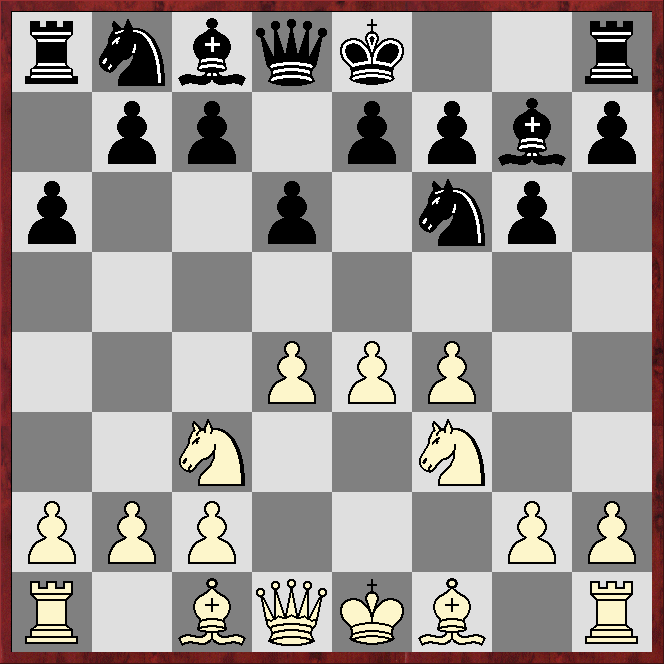
How should White respond?
*****
*****
*****
*****
*****
6.a4!?
The main line in Mega25 runs 6.Bd3 0-0 7.0-0 b5 8.e5 Ne8, with a positionally won game for White, according to Stockfish17 and Dragon1.
6...0-0 7.Bd3 Nc6 8.0-0 e5!?
Stockfish17 prefers the main move in Mega25, 8...Bg4, while Dragon1 likes 8...Nb4. After the latter, Jiří Nun (2365) - Andrzej Adamski (2350), Wrocław (Poland) 1980, continued 9.e5!? dxe5 10.fxe5 Ng4?! 11.Ne4 Nxd3 12.Qxd3, with White enjoying the upper hand, according to the engines (but ½–½, 35 moves).
9.fxe5 dxe5 10.d5 Ne7!?
This may be a novelty. Known moves are 10...Nd4 and 10...Nb4.
11.Nxe5!? Nxe4?!
A better capture seems to be 11...Nfxd5, when 12.Nxd5 Nxd5 13.Nxf7 Rxf7 14.Rxf7 Kxf7 15.Bc4! gives White at least the upper hand, according to the engines. However, their top suggestion is 11...c6!?, when 12.dxc6?? loses to 12...Qd4+ etc. White's best may be 12.Bg5!?, when the long, but largely forcing, line 12...cxd5! 13.Bxf6 Qb6+ 14.Kh1 Bxf6 15.Nxd5 Nxd5 16.Nc4 Qd4 17.exd5 Bf5!? leaves White with a slight edge, according to the engines.
12.Nxe4 Bxe5
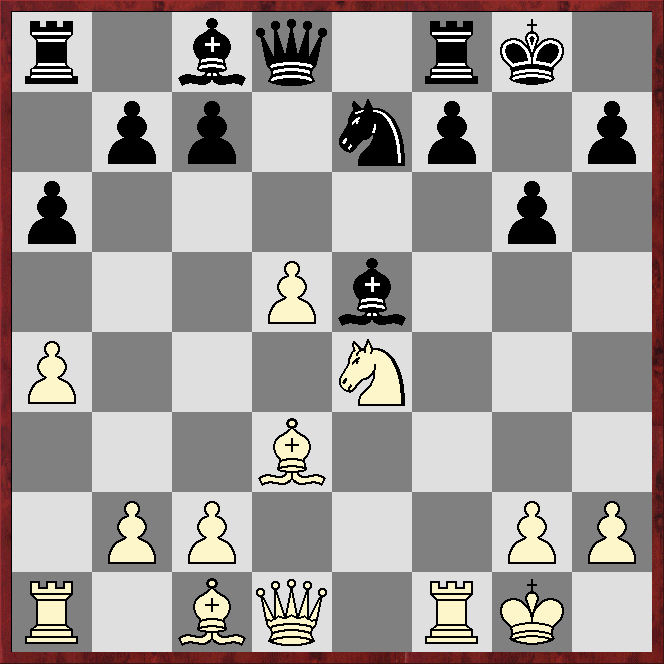
White to play and gain what the engines reckon is a winning advantage
*****
*****
*****
*****
*****
13.Bh6?!
The engines give 13.Bg5!? Bf5 14.Nf6+ Bxf6 (14...Kg7? 15.Bxf5 gxf5? 16.Qh5 leads to mate, while 14...Kh8? 15.Qe1 is not much better) 15.Bxf6 Bxd3 16.Qxd3 Qd7 17.c4, one line continuing 17...Nf5 18.Rf3 Rae8 19.c5!? Ng7 20.Rg3 Qg4 21.d6 cxd6 22.cxd6 Qd7 23.Be7 etc.
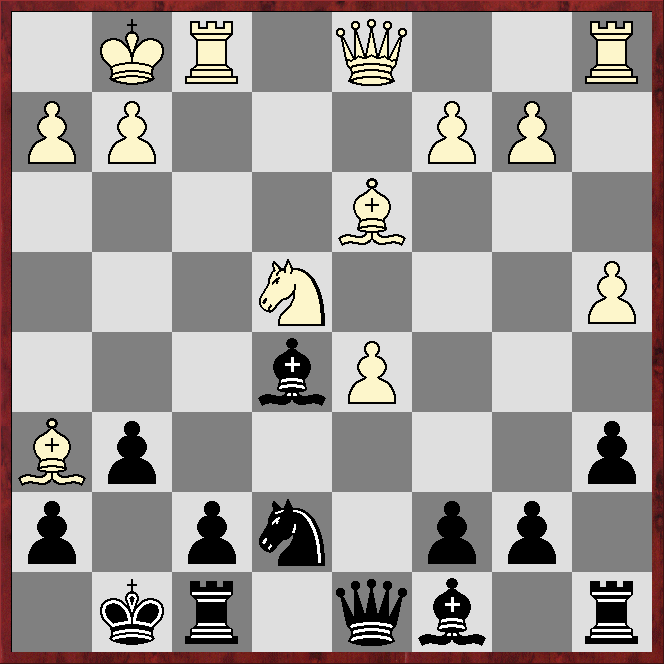
How should Black proceed?
*****
*****
*****
*****
*****
13...Bg7?!
Probably best is 13,,,Nxd5!?, when after 14.Bxf8 Ne3 15.Qf3 Nxf1 16.Rxf1 Qxf8 White's lead in development partially compensates for being a pawn down and for facing the bishop-pair. However the engines' 14.h3 may give White equality, although after 14...Re8 the engines disagree as to whether 15.Qf3 or 15.Bg5 is correct.
14.Bxg7 Kxg7 15.Bc4
Now Qd4+ is a huge threat.
15...Nf5 16.g4!?
The engines suggest 16.Re1!? or 16.a5, claiming a slight edge for White.
What should Black play?
*****
*****
*****
*****
*****
16...Qe7?
After 16...Nd6? Black loses in a similar way to the game, but 16...Qh4 holds the balance, according to the engines, as long as Black meets 17.Rf4 with 17...h5.
17.Qd3 Nd6 18.Qd4+ f6 19.Nxf6! Rxf6
After 19...Nxc4? White has several winning lines, the simplest perhaps starting with 20.Nd7+.
20.g5 Bf5 21.Rae1!
This is even better than immediately capturing on f6.
21...Qd8 22.gxf6+ 1-0
A likely continuation was 22...Qxf6 23.Re7+ Nf7 24.Qxf6+ Kxf6 25.Rxc7, when White is the exchange and a pawn up, and enjoys a continuing attack.

Cracovia 60+ Round Five

FACED an Israeli Fide master.

Ran Shabtai (1996) - Spanton (1913)
QGD Normal Position
1.c4 e6 2.Nc3 d5 3.d4 c5 4.e3 Nf6 5.Nf3 Nc6
The game started as an English, became a Tarrasch Defence to the Queen's Gambit, and has now reached the Normal Position of the Queen's Gambit Declined, albeit the variation has not been the normal continuation in the QGD for well over a century
*****
*****
*****
*****
*****
6.cxd5
This is second in popularity to 6.a3.
6...exd5 7.Be2 Bf5!?
A rare continuation. Most popular in ChessBase's 2026 Mega database is 7...Be7, while Stockfish17.1 and Dragon1 recommend 7...cxd4 8.Nxd4, and either 8...Bb4 or 8...Bd6, although Dragon1 comes to prefer 7...c4!?
8.0-0 Rc8 9.dxc5 Bxc5 10.Nb5!? 0-0
Now both sides have castled, how would you assess the position?
*****
*****
*****
*****
*****
The game has produced a fairly typical IQP position, with equal chances, according to the engines.
11.b3 Qe7 12.Bb2 Rfd8 13.Rc1 Bb6
RS criticised this after the game, but the engines are fine with it.
14.Ba3 Qd7?
This is the real mistake. Instead 14...Nb4!? is good, the point being the knight can always be supported by ...a5, since an exchange on b4 would leave a2 weak.
15.Nd6 Rc7 16.Nxf5
Even stronger is 16.Nxb7! Rxb7 17.Bb5 with Ne5 to come.
16...Qxf5 17.Bc5
The engines prefer 17.Bd3 or 17.Bb2.
17...Bxc5 18.Rxc5 Rdc8 19.Bd3 Qd7 20.Qb1 g6 21.Rfc1
How should Black proceed?
*****
*****
*****
*****
*****
21...d4?
Black is fine after, for example, 21..Nb4.
22.Nxd4
Not 22.exd4? Nxd4 23.Rxc7 Nxf3+ etc.
22...Nxd4 23.exd4 b6
The engines suggest 23...Ne8!?
24.Rxc7 Rxc7 25.Rxc7 Qxc7 26.Qe1!
The engines agree this is better than the obvious 26.Bb2.
26...Ng4 27.g3 Qd7 28.Qe4 Nf6 29.Qf4 Nd5 30.Qe5 Nb4 31.Bb5 Qd8 32.a3!? Nc2?
Better is 32...Nd5, but Black has no compensation for being down a passed pawn.
33.d5 Nxa3 34.Bc6
The knight is out of play, and there is nothing to stop the d pawn queening
*****
*****
*****
*****
*****
34...Nc2
Marginally better may be 34...Qc8.
35.Qc3 Na3 36.b4 Qe7 37.Qxa3 a5 38.Qd3 Qd6
Either capture on b4 is met by 39.d6.
39.bxa5 bxa5 40.Qb5 Qa3 41.Kg2 h5 42.Qb8+ Kh7 43.Qc7 Kg7 44.d6 h4 45.d7 h3+ 46.Kxh3 Qd3 47.Kg1 1-0

Trophy

Yesterday's gift to players at the Cracovia chess festival

Tuesday, 30 December 2025

Cracovia 60+ Round Four

FACED a Fide master.

Spanton (1913) - Henryk Samborski (2085)
Sicilian Bb5(+)
1.e4 c5 2.Nf3 d6 3.Bb5 Nd7
This trails 3...Bd7 in popularity in ChessBase's 2026 Mega database, but scores six percentage points better.
4.c3
Of moves occurring at least 1,000 times in Mega26, 4.d4 and especially 4.0-0 are more popular, while most successful percentagewise is 4.Ba4!?
4...Nf6 5.Qe2 e6 6.d4 Be7
Stockfish17.1 and Dragon1 prefer 7...a6 or 7...cxd4.
How should White proceed?
*****
*****
*****
*****
****
7.0-0
The engines suggest 7.e5 or 7.dxc5!? After the latter, which is not in Mega26, they reckon 7...dxc5 should be met with 8.a4!? a6 9.Bd3, claiming White has the upper hand.
7...Qc7 8.Rd1 0-0
Now both sides have castled, how would you assess the position?
*****
*****
*****
*****
*****
White's classical centre gives a slight edge, according to the engines.
9.e5 Nd5 10.Qe4?!
The queen may look menacing on e4, but threats against the black kingside are illusory, and meanwhile the queen becomes a target. The engines like 10.c4.
10...cxd4 11.cxd4 g6?
Unnecessarily weakening. The engines give 11...dxe5 12.dxe5, followed by the cool 12...Rd8!?, claiming a slight edge for Black. They reckon 12...Nc5 also gives at least equality.
12.Bh6 Rd8 13.Na3
13.Nbd2 gives White the upper hand, according to the engines.
13...dxe5 14.dxe5 Nc5 15.Qe2 a6 16.Bc4 b5
The engines agree with HS's postgame suggestion that 16...Nb6 is better.
17.Bxd5 Rxd5
The engines prefer this over capturing with the pawn.
18.Rxd5 exd5 19.Rd1 Be6
The engines like 19...Bg4!?, and if 20.Rxd5, then 20...Be6, reckoning Black's bishop-pair and better coordination give full compensation for a pawn.
20.Nc2 Rd8
What should White play?
*****
*****
*****
*****
*****
21.Bg5?!
Getting rid of Black's bishop-pair, but ceding all of White's advantage, according to the engines, which reckon 21.Nfd4 gives at least a slight edge.
21...Bg4!? 22.Bxe7 Qxe7 23.Ncd4 Qd7 24.h3 Bxf3 25.Qxf3 Ne6
After exchanges have left each side with identical material, how would you assess the position?
*****
*****
*****
*****
*****
Black's isolated but passed pawn is firmly blockaded, but at the same time is not vulnerable. The engines reckon the game is completely equal.
26.Qe3 Rc8 27.f4!? Qa7 28.f5!? Nxd4 29.Qxd4 Qxd4+ 30.Rxd4
How would you assess this rook-and-pawn ending?
*****
*****
*****
*****
*****
There are nearly always drawing chances in rook-and-pawn endings, and in this case the position is completely equal, according to the engines.
30...Rc1+ 31.Kh2 gxf5 32.Rxd5 Rc2 33.Rd6
Not the only drawing move.
33...a5 34.Ra6 a4 35.b3 Rxa2 36.bxa4 bxa4
Black has won a pawn, but the white king, unlike its back counterpart, can activate
*****
*****
*****
*****
*****
37.Kg3 a3 38.Kf4 Rf2+ 39.Kg3 Ra2 40.Kf4 Ra1 41.Kxf5 a2 42.Kg5 Kg7 43.Ra7 Re1 ½–½

Magnetic Attraction

Players yesterday were given a fridge magnet featuring a stylised version of Kraków's legendary Wawel dragon

Monday, 29 December 2025

Cracovia 60+ Round Three

Józef Twardy (1585) - Spanton (1913)
Sicilian Hyper-Accelerated Dragon
1.e4 c5 2.Nf3 g6 3.Bb5!?
This position occurs 46 times in ChessBase's 2026 Mega database, and includes White wins by grandmasters Zaven Andriasian and Zhamsaran Tsydypov
*****
*****
*****
*****
*****
I guess the opening could be called a Sicilian Bb5(+), although I do not recall the line being covered in any books I own.
3...Bg7
Five games saw Black play 3...Nc6!?, transposing to a main line of the Bb5(+) Variation of the Sicilian.
4.0-0 a6
Seven of the 12 games to reach the position after 4.0-0 saw Black choose 4...Nc6!?, again transposing to a well-known main line.
5.Bc4
Apparently a novelty. Stockfish17.1 and Dragon1 reckon it is an improvement on the known 5.Ba4?? (obviously) and 5.Be2 (marginally).
5...Nc6
If 5...b5!?, then 6.Bd5.
6.a3 Nf6 7.d3 b5 8.Ba2 0-0
Now both sides have castled, how would you assess the position?
*****
*****
*****
*****
*****
White's play has been on the eccentric side, with Black able to expand on the queenside 'for free', but there are no weaknesses in the white position, and White has the only pawn on the two central files to reach the fourth rank. The engines reckon the game is equal.
9.h3!? d5 10.exd5 Nxd5 11.Re1 Bb7
How should White proceed?
*****
*****
*****
*****
*****
12.c4?!
The engines suggest 12.Nbd2.
12...Nb6 13.Nc3
This is best, according to the engines, one point being 13.Qb3? runs into 13...bxc4 14.dxc4 Na5.
13...b4 14.axb4!?
The engines are OK with this. Indeed, it comes to be Stockfish17.1's top choice, although Dragon1, after initially top-rating it, comes to prefer the move I expected, 14.Ne4, when both engines reckon 14...Nd7 gives Black at least a slight edge. Also quite good for Black is 14...bxa3 15.Nxc5 axb2.
14...Nxb4 15.Bb1 Qc7 16.Na2 a5 17.Nxb4?!
The black knight looked menacing, but swoping it improves Black's pawn-structure and gives up control of the a file.
17...axb4 18.Ra2!?
Even worse is 18.Ba2? Bxf3 19.gxf3 (19.Qxf3 b3) Ra6, when Black has huge pressure against White's queenside. However, possibly better than the text is 18.Rxa8.
18...Rxa2 19.Bxa2 Ra8 20.Bb3 Ra1!?
What should White play?
*****
*****
*****
*****
*****
21.Qe2
This is Stockfish17.1's choice; Dragon1 comes to prefer 21.d4.
On 21.Bf4!? I intended sacrificing the exchange, with 21...Qxf4! 22.Rxa1 Bxf3, which gives Black more than enough compensation, eg 23.gxf3 Bd4. The engines reckon 23.Qc1!? is an improvement, but 23...Qxc1 24.Rxc1 Bc6 leaves Black well on top.
21...e6 22.Qc2?
The engines suggest 22.Rd1, but agree Black has a positionally won game.
22...Bxf3 23.gxf3 Bd4 24.Bd2? Qg3+! 25.Kh1 Qxf3+ 26.Kh2 Qxf2+ 27.Kh1 Rxe1+ 28.Bxe1 Qxe1+
Missing 28...Qg1#.
29.Kg2 Qg1+ 30.Kf3 Qf1+ 31.Kg3 Be5+ 0-1

Presents

YESTERDAY turned out to be a day of gifts.
Booty
First up, from the tournament organisers, were a jar of Polish honey and a keyring/bottle-opener.
Then my Lithuanian opponent handed me a brochure from what is presumably his hometown of Plungė, together with a pen for my ever-expanding collection of chess writing-implements (Lietuva is the country's name in Lithuanian).

Sunday, 28 December 2025

Cracovia 60+ Round Two

FACED a Lithuanian.

Spanton (1913) - Rimandas Šakinis (1757)
Old Indian
1.d4 Nf6 2.c4 d6 3.Nc3 c6!?
This is fifth-most popular in ChessBase's 2026 Mega database, behind ...Bf5, ...e5, and especially ...g6 and ...Nbd7.
4.e4 Qa5!?
More popular are ...Qc7 (marginally), ...g6, ...Nbd7 and ...e5.
5.Bd3 e5 6.Ne2 Nbd7 7.0-0 Be7 8.a3!? Qc7 9.b4 exd4 10.Nxd4 Ne5 11.Be2!?
Stockfish17.1 and Dragon1 agree it is worth spending a tempo to save White's bad bishop.
11...0-0
Now both sides have castled, how would you assess the position?
*****
*****
*****
*****
*****
Whites' extra space gives the upper hand, according to the engines.
12.Bb2 Be6!?
This is Stockfish17.1's second choice, but both engines prefer 12...a5.
13.Nxe6
Stockfish17.1 suggests 13.Qb3!?, but Dragon1 likes the text.
13...fxe6
White has gained the bishop-pair, but has strengthened Black's centre and given Black a half-open f file
*****
*****
*****
*****
*****
14.Rc1 Nfd7!?
The engines suggest 14...a5 or 14...Kh8!?
15.Qd2 Nb6 16.Nd1 Nbd7!?
The engines agree this is best, albeit reckoning White is still better.
17.f4 Nf7
This is almost certainly better than 17...Ng6?! 18.Bg4 e5 19.Be6+ Kh8, and either 20.f5 or 20.Bxd7 Qxd7 21.f5.
18.Bg4 e5 19.Bxd7!?
This comes to be Stockfish17.1's top choice, but Dragon1 marginally prefers 19.g3!?
19...Qxd7
How should White proceed?
*****
*****
*****
*****
*****
20.fxe5?
This throws away White's advantage. White is still better after 20.Ne3 or 20.Qc3.
20...Qg4
Also equal is 20...Bg5 21.Ne3.
21.Nf2 Qg5 22.Qxg5 Bxg5 23.Rcd1 Nxe5 24.Bxe5!?
Otherwise Black is better, according to the engines.
24...dxe5 25.Ng4 Rf4!? 26.Rxf4 exf4
How would you assess this rook-and-minor-piece ending?
*****
*****
*****
*****
*****
White has the open file, and a passed pawn, but Black has fewer pawn islands, and the better piece for cooperating with a rook. Equal chances, according to the engines.
27.Kf2
27.Rd7 Rd8?! 28.Rxb7 is good for White, but the engines reckon Black is fine after 27...a5!?, eg 28.Rxb7 axb4 29.axb4 Bh4!? 30.Kf1 Re8, and if 31.e5, then 31...Ra8!?
27...Rd8?!
The engines suggest 27...a5, or 27...h5!? 28.Ne5 and then 28...a5.
28.Rxd8+ Bxd8
How would you assess this bishop-v-knight ending?
*****
*****
*****
*****
*****
White's more-active king and the vulnerability of f4 give White at least a slight edge, according to the engines, despite the bishop being better than the knight when there is play on both wings.
29.Kf3 h5?!
Probably the wrong idea. Black should be activating the king, either immediately with 29...Kf7!?, or after first protecting f4 with 29...Bc7. The point, after 29...Kf7!?, is that 30.Kxf4 Bc7+ 31.Kf3 can be met by 31...h5 and 32...Bxh2. However, the engines give 30.Ne5+!? Ke6 31.Nd3 b5! (White threatened 32.Nc5+ as well as 32.Nxf4+), eg 32.Nxf4+ Ke5 33.cxb5 cxb5, after which Black's king is very active.
30.Ne5 g5 31.h3?!
The engines reckon White is winning after 31.Nd7 or 31.Nd3.
31...Bf6?
Again Black should be activating the king, this time with 31...Kg7.
32.Nd7 Bd4 33.h4! Bb2 34.a4 Kf7 35.hxg5 Bc1 36.Ne5+ Kg7 37.b5!?
This may be marginally better than 37.Nd3 Bd2.
37...cxb5 38.axb5!?
This is fine, but White has to take care against Black creating a passed a pawn.
38...Bd2 39.Nd3 Kg6 40.Nxf4+ Kxg5 41.Ne6+ Kf6 42.Nd8 a5!?
How should White respond?
*****
*****
*****
*****
*****
43.Nxb7?
Black also gets drawing chances after 43.bxa6? bxa6. Correct is gaining a tempo with 43.Ke2, bringing White's king within the queening box of the a pawn (the a pawn is four squares from a1, so the queening box runs from a5-a1-e1-e5-a5).
43...Bb4?
Black had to play 43...a4.
44.c5?
Again White wins by bringing the king within the queening box.
44...a4
White to play and draw
*****
*****
*****
*****
*****
45.e5+!
The engines reckon 45.b6 also draws, but only if, after 45...a3, White finds the same idea and plays 46.e5+! However, 45.c6? loses trivially to 45...Ke7 etc. Probably also losing is 45.Nd6?! a3 46.b6 a2 47.b7 a1=Q 48.b8=Q, although this may be one of those positions where the engines have one side winning (Black is almost +5.00, according to Stockfish17.1; almost +6.00, according to Dragon1), but they cannot finish it off, eg 48...Qd1+ 49.Kg3 Qg4+ 50.Kf2 Bxc5+ 51.Ke1 Qh4+ 52.Kd2 Qf4+ 53.Kc2 Bxd6 (Black now has queen, bishop and pawn versus queen and two pawns) 54.Qd8+ Kg6 55.Qg8+ Kh6 56.Qd5!? Be5 57.Kb3 Kg5 58.Kc4 Kh4 59.Qd3 Qg4 60.Qd5 Bf4 61.Qd3 Qxg2, finally reaching a position that the Syzygy endgame tablebase can give a definitive verdict on: Black is winning. Naturally, there were lots of plausible alternatives along the way, so 45.Nd6?! may draw, with best play, but it would in practice be very hard for White to do so.
45...Ke7
Or 45...Kxe5 46.c6 Ke6 47.Nd8+ Ke7 48.c7 Kd7 49.b6 Ba5 (not 49...a3? 50.Nc6! a2 51.b7 Kxc7 52.b8=Q+ Kxc6 53.Qa8+ and 54.Qxa2) 50.c8=Q+! Kxc8 51.b7+ Kc7 52.Nc6! Kxb7 53.Nxa5+ Kb6, with a tablebase draw.
46.Nd6 a3 47.Nf5+ Kd8!?
47...Ke6 also draws.
48.Nd4 Bxc5??
48...a2 draws.
49.Nb3??
Winning is 49.Ne6+ followed by 50.Nxc5(+).
49...a2 50.Ke4 Kc7 51.Kd5 Kb6 52.Kc4 h4 53.e6 Be7 54.Na1 Bf6 55.Nc2 Kc7 56.Kd5 Be7 57.Kc4 Kd6 58.Kb3 Kxd6 59.Kxa2 Bc5 60.Ne1 Kf5 61.Kb3 Kg4 62.Kc4 Bf2 63.Nd3 Bb6 64.Ne5+ Kg3 65.Ng6 Bf2 66.Kd5 Kxg2 67.Nxh4 ½–½

Playing Conditions (Kraków)

Before the start of round one in the room where the main tournament and the seniors are being held - conditions are similar in the hall where other groups are playing

Saturday, 27 December 2025

Cracovia 60+ Round One

Jan Plesiuk (1674) - Spanton (1913)
Sicilian 2.Bc4
1.e4 c5 2.Bc4!?
There are 15,123 examples of this move in ChessBase's 2026 Mega database. It goes back to at least 1783, when Thomas Bowdler - famous for bringing out a 'family' version of Shakespeare's plays - used it to gain a draw in a blindfold simul given by André Philidor.
2...e6 3.Nc3 Ne7!?
Trying to insist on a quick ...d5.
4.e5?!
Stockfish17.1 and Dragon1 very much dislike this.
4...d5
Insisting on ...d5, but the engines prefer 4...Ng6.
5.exd6 Nf5!? 6.Nf3 Bxf6 7.d3
The engines give 7.d4, assessing the game as equal.
7...0-0 8.Nb5 Nc6!?
Allowing White to win the bishop-pair, but at a cost in time.
9.Nxd6 Qxd6 10.0-0
Now both sides have castled, how would you assess the position?
*****
*****
*****
*****
*****
Black has more space, and a lead in development, factors that outweigh the bishop-pair, according to the engines, which reckon Black has the upper hand.
10...e5
The engines prefer an immediate ...b6.
11.Re1 b6 12.Ng5!? Qg6!?
12...h6 13.Ne4 Qg6 may be a little better.
13.Bd5
The engines suggest 13.f4!? or 13.Nf3!?
13...Bb7?!
Probably better is 13...Nfe7, hitting White's light-square bishop while protecting c6, or 13...Bd7, covering both black knights.
14.Be4 h6?
Hitting the white knight is right, but with the other pawn.
How should White proceed?
*****
*****
*****
*****
*****
15.Qg4?
White has a large advantage after 15.g4!? hxg5 16.gxf5, eg 16...Qd6 (16...Qf6?! 17.h4!? gxh4 18.Qg4 is good for White) 17.h4!? gives a strong attack.
What should Black play?
*****
*****
*****
*****
*****
15...hxg5?
Missing the strength of 15...Bc8!, eg 16.Bxc6 Qxc6 (16...Nd4 is also good) 17.Ne4 Nd4 18.Qd1 f5, with excellent kingside play.
16.Bxf5 Qd6 17.Bxg5
Now White has won a pawn, how would you assess the position?
*****
*****
*****
*****
*****
White is up a pawn, and still has the bishop-pair, while also having caught up in development. Black has more space, and a little initiative, but that is not enough compensation, according to the engines.
17...Nd4 18.Re3!?
This is Stockfish17.1's top choice, but Dragon1 prefers 18.Be3. In neither case can Black afford to reply by forking the white rooks.
18...g6?!
Not 18...Nxc2? 19.Rh3, but perhaps best is 18...Nxf5 19.Qxf5 Qc6, relying on opposite-coloured bishops to give counterplay.
19.Be4 Bxe4
Not 19...f5 20.Qh4 fxe4 21.Rh3, when White has a wining attack.
How should White recapture?
*****
*****
*****
*****
20.dxe4?!
Almost certainly wrong, although not as bad as 20.Rxe4?, when 20...f5 21.Rxd4 gives White a pawn for the exchange, but that is not enough. Instead 20.Qxe4 leaves White on top, eg 20...Nxc2? 21.Rh3, when there is no good answer to Qh4, or 20...Nf5!? 21.Rh3. when White has an attack, as well as being up a pawn.
20...Nxc2!?
This is at last possible, and indeed is Black's only good move.
21.Rd1?!
The problem with 21.Rh3? is that 21...Nxa1 threatens back-rank mate as well as winning a rook, so there is no time for Qh4. However, the engines' 21.Rf1! gives what are perhaps somewhat unexpected chances. After 21...Nxe3 22.fxe3, Black should probably continue with 22...Rfe8, when best-play seems to run 23.Qh4 Re6 24.h3!?, after which Black is up the exchange, and has the better pawn-structure, but White is very active, and possibly only slightly worse (the engines find the position hard to assess - Black's immediate material and structural advantages, against White's long-term compensation).
21...Nxe3 22.fxe3
Not 22.Rxd6? Nxg4 23.h3 f6 24.Bd2 Rad8 25.Rd5 Rxd5 26.exd5 Nxf2 27.Kxf2 Rd8, when Black will have an easily won rook-v-bishop ending.
22...Qe6 23.Qg3?!
Objectively best is swopping queens, but Black should have little trouble converting the exchange-up endgame.
23...Kg7 24.Qf3 f6 25.Bh4 Rad8 26.Rf1!? Rd2 27.g4 Rxb2
Not 27...g5? 28.Bxg5!
28.g5 f5 29.exf5 Rxf5 30.Qb7+ Rf7 31.Rxf7+ Qxf7 32.Qb8!?
Presumably hoping to somehow get a perpetual.
32...Rb1+ 33.Kg2 Qf1+ 34.Kg3 Qg1+ 35.Kf3 Rf1+ 36.Ke2 Qg2+ 37.Kd3 Qd5+ 38.Kc3 Rc1+ 39.Kb2 Qd2+ 0-1

Weather (Kraków)

THE high on Christmas Day was -5C, but it was warmer when I arrived yesterday, and is expected to reach 1C this evening, before turning colder next week.
A sprinkling of snow fell overnight

Friday, 26 December 2025

Getting There (Kraków)

CAUGHT Ryanair's 10:25 from Stansted, followed by a train from Kraków airport to the city's main station, a five-minute walk from my hotel, where I arrived shortly after 15:00 local time.
Approaching the Old Town

Correspondence Chess

I PLAY correspondence chess at the Fide-approved International Correspondence Chess Federation.
Most games are drawn, thanks to the strength of modern engines, but occasionally a game escapes that fate, or is interesting for some other reason.

Héctor Pupo Pérez (2317) - Spanton (2330)
Philippine 5th Year Anniversary Invitational Section 3
Spanish Berlin
1.e4 e5 2.Nf3 Nc6 3.Bb5 Nf6 4.d3 Bc5 5.Bxc6!?
This modern-looking continuation dates back to at least 1851, but has been taken up by Carlsen, Caruana, Ding, Nakamura and other of today's greats.
5...dxc6 6.0-0 Qe7 7.Nbd2 Bg4 8.h3 Bh5 9.a3 Nd7 10.b4 Bd6 11.Nc4 f6!? 12.Na5 0-0-0!?
This seems to be a novelty. The known move 12...Rb8 may be more prudent, but I like to play adventurously at correspondence, within reason, as a learning exercise.
Now both sides have castled, how would you assess the position?
*****
*****
*****
*****
*****
The consequences of opposite-side castling are often hard to judge because there are so many variables. However, Stockfish17.1 and Dragon1 give White a slight edge.
13.Rb1 g5!?
Stockfish17.1 dislikes this, but I felt Black has to try something on the kingside, and Dragon1 is less unfavourable.
14.c4 Qe8 15.c5 Be7 16.Be3 g4 17.Nh4 gxh3 18.Qa4!? Nb8
18...gxh2? gives the white king shelter.
19.b5!? cxb5 20.Rxb5 Be2 21.Rc1 Bxd3 22.c6 b6 23.Rb2
Black is two pawns up, but White has at least sufficient compensation, according to the engines
*****
*****
*****
*****
*****
23...Ba6 24.Nf5 Bf8!?
Stockfish17.1 dislikes this, but Dragon1 is fine with it.
25.g3 h5 26.Nc4 Rd4!
A necessary exchange sacrifice to prevent White blasting through to Black's king by sacrificing on b6.
27.Bxd4 exd4 28.f3
Black has two bishops and two pawns for rook and knight
*****
*****
*****
*****
*****
The engines give White the upper hand, but the position is imbalanced and unclear.
28...h4!? 29.gxh4 Bc5 30.Na5!?
This is Stockfish17.1's top choice, but Drgaon1 much prefers 20.Kh1!?
30...Qe5 31.Qb3
Black is lost, according to Stockfish17.1, but Dragon1 for quite some time reckons the game is completely equal, although eventually comes to give White a slight edge
*****
*****
*****
*****
*****
31...d3+ 32.Kh1 Re8 33.h5!?
Suddenly the game is not about mutual attacks on the enemy's king, but a matter of a passed pawn rushing to queen.
33...Bf8 34.Nc4!?
This is best, according to Dragon1, but Stockfish17.1 much prefers 34.Qf7!?
34...Bxc4 35.Rxc4 Bc5
The game has, to a certain extent, stabilised to a more-easily understandable one of Black having a pawn for the exchange
*****
*****
*****
*****
*****
36.Rb1 d2!? 37.Rc2 Nxc6 38.Rxd2 Qf4 39.Rbd1 Kb7 40.h6
After a brief flurry of intermediate moves, it's back to White's dangerous passer
*****
*****
*****
*****
*****
40...Ne5 41.Re2 Qxf3+ 42.Qxf3 Nxf3 43.a4!?
The engines agree this pawn needs to be saved, but reckon it is better to push the a pawn after 43.Rd3 Ng5.
43...Ne5 44.Rf1 Rh8 45.Rf4 Ka6 46.Ra2 Nf7
Bizarrely, Stockfish17.1 now gives White only a slight edge, while Dragon1 reckons White is winning.
47.Rh4 Bf8 48.Rxh3 c5 49.Rg2
Dragon1 has lost some of its enthusiasm for White's position, but for quite a while prefers 49.Rah2, before settling on the text, albeit while at first not believing White is winning. Given time, however, it again comes to rate White's position as winning.
49...c4!?
This dampens Dragon1's enthusiasm.
50.Rg6
Dragon1 suggests 50.h7, but the distracting 50...c3!? seems to hold, eg 51.Rh5 (51.Rxc3 Rxh7+ 52.Rh2 Rxh2 53.Kxh2 Bc5 may even marginally favour Black) Bh6 52.Nd4 Rxh7 53.Nb5 Ne5 54.Rc2 Ng4 55.Nxc3 Rg7 56.Nd5 Be3, after which Black does not appear to be in trouble.
50...Ne5 51.Rg2
If 51.Rxf6, then 51...Ng4 forces 52.Rxf8 Rxf8, with equality.
51...Nf7 52.Rg6 Ne5 ½–½
Dragon1 reckons White has an edge in the final position, but Stockfish17.1 calls the position completely equal.
The game is an interesting example of how strong engines can radically differ in their assessments of imbalanced middlegames.

Thursday, 25 December 2025

Cracking On

AM making final preparations for flying tomorrow to Kraków, the former Polish capital, where the 36th Cracovia chess festival starts on Saturday.
I am playing in the seniors (60+), which has 49 entries, including international masters from Romania, France and Ukraine.
The time control is 40 moves in 90 minutes, with 30 minutes to finish, and a 30-second increment throughout.
The tournament has nine rounds over nine days, with no game on New Year's Day, but two on January 2. Six of the rounds start at 16:00, and three at 09:00.
This is my third time playing in the seniors at Cracovia.
In 2023-4 I scored +4=2-3, performing 37 elo below my rating of 1743.
In 2024-5 I scored +4=1-4, performing 190 elo below my rating of 2011.
Clearly, it is time for a seriously improved performance, or perhaps to look for pastures new.

All About That Bass - Conclusion

THE lessons from my first five defeats against John Bass have a somewhat repetitive message: "decided by tactics," "JB showed better tactical control," "calculation issues ... still glaring," "a series of tactical errors," "blunders."
In our sixth game, I escaped with a lucky draw, but even so "I was first outplayed positionally, and then tactically."
Finally, I lost again, mainly due to " sub-optimal tactics."
LESSON: positional errors can sometimes be overcome by better tactical control, but tactical errors, especially when they come in bunches, are rarely cancelled out by positional niceties.

Wednesday, 24 December 2025

All About That Bass VII

MOST of us have an opponent against whom nothing seems to work.
When the opponent is considerably stronger, this is not surprising, but when ratings are not so different, the results are harder to explain.
My biggest bogeyman is probably John Bass, whose record against me is +6=1-0.
Seven games is not a huge sample, but such a poor performance on my part must signify something.
So in this mini-series I am looking at my games against JB to try to discover what is going on.
Here is our latest encounter.

Spanton (1980) - Bass (1932)
Central London League 1925
English Four Knights
1.c4 e5 2.Nc3 Nf6 3.Nf3 Nc6 4.e4!?
This was a Nimzowitsch favourite.
4...Bb4 5.d3 0-0 6.Be2 d6 7.0-0
Now both sides have castled, how would you assess the position?
*****
*****
*****
*****
*****
White has more queenside space, and the hole at d4 is probably not a serious weakness, but White has a passive and bad light-square bishop, while Black's bad bishop is outside the pawn-chain, and therefore active. Stockfish17.1 and Dragon1 rate the game as equal.
7...h6 8.h3 Bxc3!? 9.bxc3 Re8 10.Rb1 Ne7 11.c5!? Ng6 12.cxd6 Qxd6!? 13.Qc2 b6 14.Rd1 Bb7 15.Be3 Rad8 16.Nh2 c5 17.Ng4 Nxg4 18.Bxg4 Qc7 19.Bh5 Nf4!? 20.Bxf4 exf4 21.Bf3
There has been much manoeuvring, and quite a few exchanges, but the position remains equal, according to the engines
*****
*****
*****
*****
*****
21...Re7 22.Qa4 Bc6 23.Qc4 Bb7 24.a4 Qc8 25.Bg4 Qc7 26.Ra1 Bc8 27.Bxc8 Qxc8 28.a5
More prudent is 28.f3.
28...f3! 29.axb6?
White is only slightly worse after 29.Re1, according to the engines.
29...axb6
This is enough for an edge, but stronger is 29...fxg2! 30.Kxg2 (30.bxa7? Qxh3) axb6.
30.Kh2?
The engines suggest 30.Re1 or 30.Qa6.
30...fxg2 31.Rg1?!
If 31.Kxg2?!, then 31...Qc6. Best may be 31.Re1.
31...Qc7+ 32.Kxg2 Qf4 33.Rad1 Re6 34.Qa2 Rg6+ 35.Kf1 Rxg1+ 36.Kxg1 Qf3 37.Rd2 Rxd3 38.Rxd3 Qxd3 39.Qa8+ Kh7 40.Qd5!?
This is Dragon1's top choice, but the ending is lost anyway.
40...Qxd5 41.exd5 Kg6 42.c4 Kf6 43.f4 g5 44.Kf2!? gxf4 45.Kf3 Ke5 46.h4 b5 47.cxb5 Kxd5 48.Kxf4 c4 49.Ke3 Kc5 0-1
LESSON: carelessness about king safety was followed by sub-optimal tactics that left me with a losing position.

Tuesday, 23 December 2025

All About That Bass VI

MOST of us have an opponent against whom nothing seems to work.
When the opponent is considerably stronger, this is not surprising, but when ratings are not so different, the results are harder to explain.
My biggest bogeyman is probably John Bass, whose record against me is +6=1-0.
Seven games is not a huge sample, but such a poor performance on my part must signify something.
So in this mini-series I am looking at my games against JB to try to discover what is going on.
The following game came 35 years after our first two encounters, in both of which he opened with 1.e4.

Bass (1951) - Spanton (1916)
Central London League Division Two 2024
QGD Semi-Tarrasch
1.d4 d5 2.c4 e6 3.Nc3 Nf6 4.Nf3 c5 5.cxd5 cxd4!?
5...cxd4!? is a sharp line, marginally preferred over the mainline 5...Nxd5 by Stockfish17.1 and Dragon1
*****
*****
*****
*****
*****
6.Qa4+!?
More popular is the straightforward 6.Qxd4.
6...Bd7 7.Qxd4
The point of White's manoeuvre is to oblige Black's light-square bishop to interfere with Black's coverage of the d5 square, but this does not prove important.
7...exd5 8.Bg5 Nc6 9.Qd2 Be6 10.e3
White cannot win the d pawn, for example 10.Bxf6 Bxf6 11.Nxd5?? Bxd5 12.Qxd5 Bb4+ 13.Nd2 Qxb2 14.Rd1 Rd8 etc.
10...Be7 11.Bb5 0-0 12.0-0
Now both sides have castled, how would you assess the position?
*****
*****
*****
*****
*****
It looks like a typical IQP position - imbalanced, but with equal chances, according to the engines.
12...Ne4!? 13.Nxe4 dxe4 14.Bxe7!?
The engines reckon this apparent-novelty is a marginal improvement on the known 14.Qxd8.
14...Nxe7 15.Nd4 Nf5 16.Rfd1 Nxd4 17.Qxd4 Qxg5!?
The engines suggest 17...Qxd4 18.Rxd4 Rac8!?
18.Be2 f5?!
Probably better is 18...Rfe8 or 18...Qf6!?
19.g3 Rfd8 20.Qa4 a6?!
The engines much prefer 20...Qf6 or 20...h6.
21.Qb4 Rab8 22.a3
White has a positionally won game after 22.h4 Qf6 23.Rxd8+ Qxd8 24.Rd1, according to the engines.
22...Qf6
The engines reckon 22...Kf7!? is best.
23.Rxd8+ Qxd8 24.Rd1 Qc7 25.Rd6 a5!? 26.Qd4 Kf7!?
How should White proceed?
*****
*****
*****
*****
*****
27.Kg2
Even stronger is 27.Rxe6! Kxe6 28.Bc4+ Ke7 29.Qxg7+, eg 29...Kd6 (29...Kd8 30.Qf8+ Kd7 31.Qxf5+) 30.Qf6+ Kc5 31.Qd4+ Kc6 32.Bd5+ etc.
27...b6?
Better is 27...Rc8 or 27...Re8.
28.Qe5
This is winning, but again Rxe6 is even stronger.
28...Re8 29.Qd4?!
Stronger is 29.Bb5 or 29.b4, but not 29.Rxe6?? Qxe5.
29...Rb8?
29...Qc5 was a chance to get out of the worst of Black's troubles.
30.Qe5 Re8 31.Qd4?! ½–½
LESSON: my lucky let-off does not conceal the fact that, first, I was first outplayed positionally, and then tactically.