Showing posts with label French Irregular. Show all posts

Friday, 18 September 2026

Lessons From Bad Bertrich II

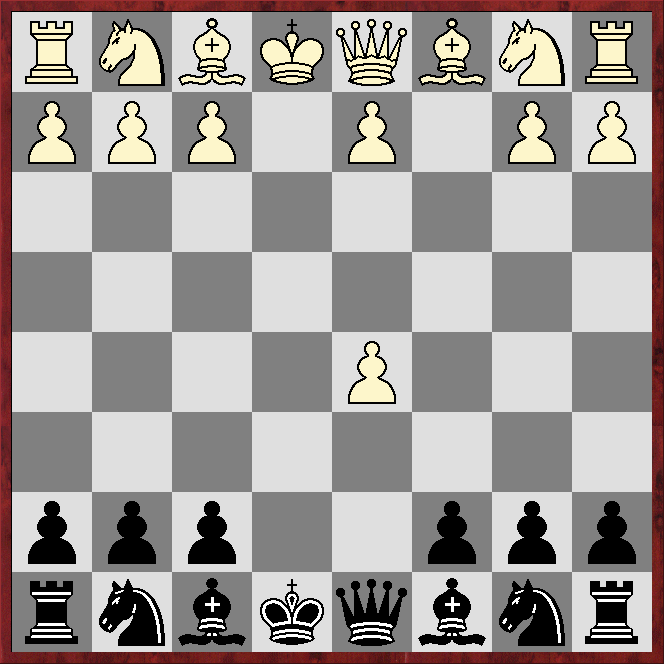
MY round-two game, in which I was White against Wolf Ebert (1725), was a French Defence that began 1.e4 e6 2.d4 d5 3.Nc3.
A position familiar to every tournament player, even if it has not appeared in one of their games
*****
*****
*****
*****
*****
*****
*****
The position occurs 239,392 times in ChessBase's 2026 Mega database, with the most popular continuations being 3...dxe4 (27,031 games), 3...Nf6 (94,362) and 3...Bb4 (106,481).
Geoffrey Stern (1931, Luxembourg) told me later that, although he had played the French for many years, my opponent's continuation was one that GS had never even considered playing.
The move my opponent played was 3...Ne7!?, which frankly looks rather silly at first, but appears 251 times in Mega26.
One of my first thoughts was to reply 4.Be3, to make it difficult for Black to get in ...c5. But then one of the points of my opponent's move becomes apparent, as he can play 4...dxe4 5.Nxe4 Nf5, with ...Nxe3 to come, when Black at least has the bishop-pair for his trouble.
I finally settled on 4.Bd3, which is reasonable enough, but the commonest continuation in Mega26, and the top choice of Stockfish18 and Dragon1, is 4.Nf3.
(Note that a move such as 3...Ne7!?, no matter how awful it may look, cannot be refuted out of hand - there is no tactical blow to punish Black.)
After 4.Nf3, the engines for quite some time completely disagree as to how Black should continue, but eventually agree that best is 4...Nbc6!?
This may look odd, but a knight on c6 is well-placed to harass a white bishop on d3 (by continuing ...Nb4) and may support a later ...e5.
After 4...Nbc6!?, the continuation 5.Bd3 scores a disappointing 47% in Mega26, but 5.e5, ensuring Black cannot play ...e5 in the foreseeable future, rings up a much more satisfactory 61%.
Black can attack the head of the pawn chain with 5...f6 - Nimzowitsch might have disapproved - when the relatively high-level game, Yunguo Wan (2471) - Ngoc Truong Son Nguyen (2579), PGMA Cup (Manilia, Philippines) 2008, continued 6.exf6 gxf6 7.Nh4!? Ng6?! (the engines reckon 7...Bg7 improves) 8.Qh5 Ne7 9.Nxg6 Nxg6 10.Bd3 f5 11.Bg5 Be7 12.h4 Qd6 13.0-0-0 Bd714.Bxe7 Kxe7! (14...Qxe7 15.Nxd5!) 15.g3 Rag8, when the engines agree White has at least the upper hand, but the game was drawn after 41 moves.
A later game, but also at quite a high level, Axel Delorme (2495) - Aleks Sahakyan (2243), Chess.com Blitz 2023, varied with 7.Bd3. There followed 7...a6!? 8.Bf4 Ng6 9.Bg3 Bd6 10.Qe2 Nb4!? 11.0-0-0 Nxd3 12.Rxd3 Nf4!? 13.Bxf4 Bxf4+14.Kb1, with a slight edge for White, according to the engines (but 0-1, 49 moves).
LESSON: following established theory is often be safe and reliable, if a little predictable, but striking out on one's own, even with a move that may cause 'superior' players to smile or wince, can be invigorating, and may bring surprising success if the move is played with specific worked-out ideas in mind.

Tuesday, 8 September 2026

Bad Bertrich 50+ Game Two

The tower looks impressive when first seen looming above you, but it was built as recently as 1895, albeit on a site that had been repeatedly fortified since pre-Roman times 
Spanton (1997) - Wolf Ebert (1725)
French Irregular
1.e4 e6 2.d4 d5 3.Nc3 Ne7!?
There are just 251 examples of this move in ChessBase's 2026 Mega database, but it has been tried by strong players.
How should White respond?
*****
*****
*****
*****
*****
4.Bd3
It is hardly surprising there is no out-and-out refutation, but the commonest continuation is 4.Nf3, which is also the top choice of Stockfish18 and Dragon1.
4...a6!?
The engines do not mind this.
5.Nf3 Nbc6!? 6.e5 Ng6?!
This seems to be a novelty - known moves are 6...Nb4 and 6...g6!? - and is strongly disliked by the engines.
7.h4 Bb4 8.h5 Nf8!?
The engines prefer this over 8...Nge7.
9.h6 g6 10.Rh4!? Be7!?
This may be best, but Black has lost time.
11.Rg4!? Qd7 12.Ng5
The engines prefer 12.a3 or 12.Kf1!?
12...f5 13.exf6 Bxf6 14.Qf3?!
This wastes much of White's advantage, whereas 14.Be3 leaves White with a positionally won game, according to the engines.
14...Qe7 15.Be3
How should Black proceed?
*****
*****
*****
*****
*****
15...Bd7?
Better is 15...Nxd4! 16.Rxd4! Bxg5, although 17.0-0-0 gives White more than enough for a pawn, according to the engines.
16.0-0-0
The engines point out the strength of 16.Nge4!. when 16...dxe4 can be met by 17.Nxe4, and if 17...Bxd4?!, then 18.Bxd4 Nxd4 19.Nf6+.
16...0-0-0
Both sides have castled long, but who stands better, and by how much?
*****
*****
*****
*****
*****
White's activity and pressure is worth a little more than 1.5 pawns, according to the engines, but only if White finds a sharp continuation.
17.a3?!
17.Kb1 keeps an advantage, but the engines give as best 17.Nf7! Qxf7 18.Rf4, one line running 18...Nxd4 19.Rxf6! Nxf3 20.Rxf7 Ne5 21.Rg7!?, when they reckon White has much more than enough for a pawn.
17...Re8?!
The engines reckon Black is fine after 17...Kb8!?, but note that 17...Nxd4?! 18.Bxd4 Bxd4 can be met by 19.Bxa6!? or 19.Nf7!?, in both cases with advantage to White.
18.Nh3
Best seems to be 18.Nge4!? dxe4 19.Nxe4 Nxd4 20.Qxf6, when the engines reckon White has a winning advantage.
18...Rg8 19.Rf4 Bh8 20.Rf7 Qd6
White to play and gain at least the upper hand
*****
*****
*****
*****
*****
21.Ng5?
Promising is 21.Bf4 e5 22.dxe5 Nxe5 23.Bxe5 Qxe5 24.Nf4 c6 25.Na4!?, when White's better development is probably the most important factor, but the engines also point out 21.Bb5!?, when 21...axb5? 22.Nxb5 traps the black queen, so best may be 21...g5!? 22.Nxg5 axb5 23.Nxb5 Qh2!? 24.g3 Bxd4!? 25.Nxd4 Ne5 26.Qf6!, when 26...Ng4!? 27.Ndf3!? Qxh6 28.Qd4 e5! (in order that Qa7 can be answered by ...Qa6) 29.Qxd5 Qc6 (29...Bc6? 30.Qa5) 30.Qa5 leaves White up a pawn and with a continuing attack.
21...Bxd4?
The wrong capture. After 21...Nxd4 22.Bxd4 Bxd4 23.Bxa6!? Qe5! 24.Rxd4! Qxd4 25.Be2 White has good compensation for the exchange, but, at best, a slight edge, according to the engines.
22.Bxd4 Nxd4 23.Qe3
Even stronger seems to be 23.Qf6!?, eg 23...Nf5 24.Bxf5 gxf5 25.Rg7!, when 25...Ng6 can be met by 26.Rxh7, and 25...Rxg7 26.hxg7 Ng6 by 27.Nxh7, in each case with a large advantage for White, according to the engines.
23...Nf5?
Better is 23...e5, but White has several promising replies, perhaps headed by 24.f4. Note that 23...Nc6?, which prevents White's game continuation, allows 24.Rg7 Ne7 25.Nce4! dxe4 26.Nxe4, when White has all the chances, eg 26...Qb6 27.Qxb6 cxb6 28.Nf6 Rxg7 29.hxg7 Rd8 30.Be4!
24.Qa7
After fiendish complications, at least in the notes, White has a winning queen sortie
*****
*****
*****
*****
*****
24...c6
If 24...c5, then 25.Bxf5 gxf5 26.Nxe6! Rxe6 27.Nxd5 wins, eg 27...b6 28.Rg7!? Rh8 29.Ne7+ Qxe7 30.Rxe7 Rxe7 31.Qxa6+ Kd8 32.Qa8+! Kc7 33.Qa7+ Kc6 34.b4! cxb4 35.axb4, when Black has rook, bishop and knight for queen and two pawns, but the hopelessly weak black king and scattered black pieces decide matters, one engine-line running 35...Re4 36.Qb8 Re6 37.Qg3, after which Black cannot reasonably save the king's rook.
How should White proceed?
*****
*****
*****
*****
*****
25.Bxa6?
Best is 25.Na4! I rejected it because of 25...Qf4+ 26.Kb1 Qxa4, missing that after 27.Qa8+ Kc7 White has 28.Qxe8! Also strong is 25.Bxf5 gxf5 26.Rg7, with ideas similar to those already covered.
25...Qb8 26.Qc5
The engines give 26.Bxb7+!? Qxb7 27.Qc5, when 27...Nxh6? runs into 28.Rd4!, so perhaps best is 27...Qc7, but 28.g4! Nxh6 29.Rd4! Nxf7 30.Nxf7 seems to give White a winning attack, despite being a rook down, eg 30...Rg7 31.Ra4! Rxf7 32.Nb5! Qb8!? 33.Nd6+ Kc7 34.Nxf7 Qb5 35.Qa7+ Qb7 36.Qe3!? c5!? (otherwise 37.Ra7) 37.Qxc5+ Qc6 38.Qa5+ Qb6 39.Qc3+ Qc6 40.Qe5+ Kb7 41.Nd6+ Qxd6 42.Qxd6 Bxa4 43.Qb4+ - another fiendishly complicated engine-line with many alternatives along the way.
26...Qd6
Dragon1 reckons 26...bxa6!? saves the game, but Stockfish18 continues 27.g4 Nxh6 28.Rf3, which Dragon1 comes to agree is winning for White, eg 28...Qc7 29.Na4 Qe5 30.Nb6+ Kc7 31.Qa5! Qxg5+ 32.Kb1 Kd6 33.Nc4+! Ke7 34.Qb4+ Kd8 35.Qb8+ Bc8 36.Na5 Re7 37.Nxc6+ Kd7 38.Rc3 Re7 39.Ne5+ Ke7 40.Qb4+! Kf6 41.f4!? The engines also point out that if, right at the start, Black tries to save a tempo with 28...Qe5!?, White has 29.Nce4!
[I doubt if either of us saw even a small faction of most of these lines.]
27.Qb6 Qc7 ½–½

Thursday, 8 May 2025

Summer Club: Round Two

AM playing in a summer daytime tournament organised by Surrey's Coulsdon Chess Fellowship.
It takes place on 10 Wednesday afternoons, the time control being 90 minutes with a 30-second increment.


Spanton (1960 ECF/1937 Fide) - Qaiyum Khan (1362 ECF/1543 Fide)
Irregular
1.d4 e6 2.e4 c6!?
There are 1,050 examples of this position in ChessBase's 2025 Mega database
*****
*****
*****
*****
*****
3.Nf3 Nf6 4.e5 Nd5 5.c4.Ne7!? 6.Nc3 h6!? 7.Bd3 d5 8.exd6 Qxd6 9.Ne4 Qc7 10.0-0 Nd7 11.g3!? Ng8!? 12.Bf4 Qd8 13.Nd6+ Bxd6 14.Bxd6 Ngf6
With Black unlikely to castle anytime soon, how would you assess the position?
*****
*****
*****
*****
*****
White is ahead on development and has more space, while Black will struggle to get his king to safety. Stockfish17 and Dragon1 reckon White has a positionally won game.
15.Re1
Threatening 16.Rxe6+! fxe6 17,Bg6#.
15...Nb6 16.c5 Nbd5 17.Rxe6+??
Missing that e6 is now protected by the black light-square bishop as well as the f pawn.
17...Bxe6 18.Ne5 Nd7 19.Nxf7?? Kxf7 20.Qh5+ Kg8 (0-1, 41 moves)

Saturday, 25 May 2024

English 65+ Round Two

Nigel Collins (1525 ECF/1602 Fide) - Spanton (1913 ECF/1902 Fide)
English
1.c4 e6 2.e4!? d5 3.cxd5 exd5 4.exd5
There are 2,128 examples of this position in ChessBase's 2024 Mega database, which often arises via a French Defence move-order, ie 1.e4 e6 2.c4!?
*****
*****
*****
*****
*****
4...Nf6 5.Nc3
Slightly more popular in Mega24 is 5.Bb5+, after which the mainline runs 5...Nbd7!? 6.Nc3 Be7 7.Nf3 0-0 8.0-0 Nb6, with complete equality, according to Stockfish16 and Komodo14.1.
5...Nxd5 6.Bc4 Nb6 7.Bb3 Nc6 8.Nf3
The engines prefer 8.Nge2.
How can Black exploit White's last move?
*****
*****
*****
*****
*****
8...Bg4
This is the commonest move in Mega24, albeit from a small sample, but the engines prefer 8...Qe7+ 9.Qe2, and now 9...Bg4, claiming Black has at least a slight edge.
9.d4!?
Contrary to first impressions, this is possible, but the engines prefer castling. Note 9.Bxf7+?? fails because after 9...Kxf7 the white king's knight cannot go to g5 or e5 (without being captured).
9...Bxf3?
Probably a novelty, and not a good one. The engines suggest another probable novelty, 9...Qf6!?, claiming a slight edge.
10.Qxf3 Qe7+ 11.Be3 0-0-0
11...Nxd4?! 12.Qxb7 looks good for White.
12.Qxf7?!
In the postmortem, long castling seemed strong, but the engines reckon even stronger is short castling.
12...Nxd4 13.Qxe7!?
Castling - either way - may be a tad better, but the engines are happy enough with the text.
13...Bxe7 14.Bxd4
White can keep the bishop-pair with 14.Bd1!? Nc4 15.Bc1, but it is hard to believe White can get any advantage that way.
14...Rxd4 15.0-0 Rd2 16.Rab1 Rf8 17.Ne4 Rd4 18.Nc3
Other moves also maintain equality, including 18.Rfe1 and 18.f3.
18...Rdf4 19.Rbe1 Bc5?!
How can White exploit Black's last move?
*****
*****
*****
*****
*****
20.Re2
The black bishop seems to have no good square after 20.Ne4!?. eg 20...Be7? runs into 21.g3, and if 21...Rf3 then 22.Nd2. Black could try 20...Bd4?!, but 21.g3 Rf3 22.Re2 sets up 23.Ng5, and if 22...h6 then 23.Rd2, eg 23...Be5 24.Re1 a5 25.Ng5!? Best may be 20...Bb4, but 21.Re2 gives White the upper hand, according to the engines.
20...a6?
This lets Ne4 come with even stronger effect.
21.Nd5?
Missing 21.Ne4, with similar lines to the note at White's 20th move, except that the white queen's rook is on the superior e2 square.
21...Nxd5 22.Bxd5 c6 23.Bf3 Bd4 24.b3 g5 25.Re4 Rxe4 26.Bxe4 h5 27.g3 h4 28.Kg2 Kc7 29.f3 Re8 30.g4?
This greatly devalues White's pawn-majority, and leaves an exploitable hole at f4.
30...Kd6
Black has a large advantage after 30...Be5!, according to the engines, eg 31.Rf2 Rd8 32.Re2 Bf4 33.Bf5 Kb6 with what they reckon is a positionally won game, although there is a lot of play left.
31.Rc1 Ke5?
How can White exploit Black's last move?
*****
*****
*****
*****
*****
32.Kf1?!
White wins a pawn with 32.Bxc6! as 32...bxc6?? loses to 33.Re1+ etc, and 32...Rc8 can be countered by 33.Re1+. Other moves also seem better than the text.
32...Rd8 33.Rd1 Rd6 34.Kg2 b6
This is enough for an advantage, but much stronger, according to the engines, is 34...b5!?
35.Rc1?!
The engines want White to start restraining, or at least slowing, Black's queenside pawns with 35.a4.
35...c5
Even better, according to the engines, is 35...Be3!, the point being 36.Rxc6? runs into 36...Rd2+ 37.Kh3 Rxa2.
36.Rc2?
White may hold with 36.Re1.
36...Be3 37.Re2 Kf4 38.Rc2 Rd1 39.h3 b5 40.Bb7 0-1 (Time)
The engines reckon Black is winning, eg 40...Rd6 41.Be4 a5 42.Bb7 a4! 43.bxa4 bxa4 44.Rb4+ Bd4 45.Rxa4 Rb6 46.Bd5 Rb2+ 47.Kf1 (47.Kh1? Kg3 and mates) Rf2+ 48.Ke1 Rh2 49.Kf1 Rh1+ (49...Rxh3?? 50.Kg2) 50.Ke2 Rxh3 etc, although we have come a long way from the point where White's flag fell (the time control was 90 minutes with a 30-second increment).

Wednesday, 1 September 2021

Lessons From Northumbria

IN round one, in which I had the white pieces, the game began 1.e4 e6 2.d4 a6!?
I won the game, which can be seen at https://beauchess.blogspot.com/2021/08/northumbria-round-one.html, but I was lost out of the opening, which I take to be over once one side has connected rooks.
So the question I want to try to answer here is, how should White meet Black's provocative second move?
I played 3.c4, which is second-most popular in ChessBase's 2021 Mega database with 154 games, but scores a disappointing 50%.
Most popular is 3.Nf3, with 519 games that score a very respectable 57%, but the analysis engines Stockfish14 and Komodo12.1.1 prefer 3.Bd3, which has 152 games and scores a very good 61%.
Position after 3.Bd3 - Black has three main replies
A) 3...b5
The engines reckon this is dubious, ie they flash yellow, but disagree as to White's best continuation.
Sensible seems to be Stockfish14's choice of 4.Nf3, which has also been the commonest choice of grandmasters, at which point the line splits.
A1 4...Bb7
5.0-0, and now 5...c5 has been played by Magnus Carlsen, Nigel Short and many others.
At this point Komodo12.1.1 likes 6.dxc5, which gives the game a Sicilian feel, but much more popular is Stockfish14's choice 6.c3, which has been played by Garry Kasparov.
After 6...Nf6 7.Re1 Be7, White gets the upper hand, according to the engines, with the little-played 8.e5!?, after which their main line runs 8...Nd5 9.dxc5 Bxc5 10.Nbd2 f5 11.exf6 Nxf6, when both Stockfish14's 12.Ne4 and Komodo12.1.1's 12.Nb3 seem to give White an initiative.
A2 4...c5
This was 2...a6!? pioneer Michael Basman's choice in all 11 games in which he reached this position in Mega21.
Again the engines differ in their response, with Komodo12.1.1 liking 5.dxc5 while Stockfish14 prefers the much-more popular 5.c3.
Then the overwhelming choice of blacks is 5...Bb7, when 6.0-0 transposes to A1.

B) 3...d5
This is less-popular than 3...b5 but is preferred by the engines, who like the little-known reply 4.Nc3!?
One point is that if Black continues with 4...b5, the response 5.exd5 exd5 gives White a positionally won game, according to Stockfish14, after 6.Qe2+ Be6 7.a4 bxa4 (7...b4?! 8.Nxd5!) 8.Nh3!? And if Black tries to interject 5...b4?! then White has 6.dxe6! as 6...bxc3 7.exf7+ Kxf7 8.Qf3+ Nf6 9.Qxa8 leaves White the exchange and two pawns up.
The position after 4.Nc3!? has actually transposed to a fashionable modern line of the French that is normally reached by the move-order 1.e4 e6 2.d4 d5 3.Nc3 a6!? 4.Bd3. There are three main continuations:
B1 4...Nc6 5.Nf3 Nb4 6.Be2 Nf6 7.e5 Ne4, when the engines reckon White is better after both 8.0-0 and 8.a3.
B2 4...Nf6, when the engines like 5.e5 Nfd7 6.Nce2 c5 7.c3, again claiming White is better.
B3 4...c5!? 5.dxc5 Bxc5 6.exd5 exd5 7.Nxd5!, after which White is a pawn up. Black can get it back with 7...Bxf2+ 8.Kxf2 Qxd5, but White's bishop-pair on an open board is the key factor in the position.

C) 3...c5
The engines like what would appear to be a novelty, 4.d5!?, with two main continuations:
C1 4...b5 5.c4!? Nf6, when both Stockfish14's 6.Nd2 and Komodo12.1.1's 6.Nc3 seem to leave White well-placed.
C2 4...Nf6 5.c4 b5, which is a transposition to C1.

CONCLUSION: 2...a6!? is positionally tricky in that anyone playing it is likely to have a better feel for the resulting positions than their opponents. But the move temporarily neglects the centre, and my response in the tournament of 3.c4 sought to solidify White's advantage there. But I suspect 3.c4 is exactly the type of move blacks are hoping for, and the engines' more modest, but also centrally focussed, 3.Bd3 is a better practical choice for club players.

Thursday, 26 August 2021

Northumbria Round One

The main playing area before the start of this evening's first round
Spanton (1808 Fide/1998 ECF) - Anuurai Sainbayar (1561 Fide/1547 ECF)
Challengers (U2000)
French Irregular
1.e4 e6 2.d4 a6!?
An anti-theoretical continuation that was a favourite of Michael Basman, but has also been tried by other strong players, including Veselin Topalov ... and Northumbria congress organiser Tim Wall.
3.c4 d5 4.Nc3 Bb4
This is not in ChessBase's 2021 Mega database but is a typical move in positions like this.
5.Bd3 dxc4 6.Bxc4
We have reached a known position - there are seven games in Mega21, but in each it is White to move. So Black has gained a tempo on those games, but the engines Stockfish14 and Komodo12.1.1 still slightly prefer White.
6...b5 7.Bb3
Also playable is 7.Bd3 as 7...Qxd4?? loses to 8.Bxb5+ etc.
7...Bb7 8.f3 Qh4+!?
This is easily countered, but it does slightly inconvenience White.
9.g3
The engines prefer 9.Kf1!?
9...Qh5
And they reckon the black queen should stay on the h4-d8 diagonal with 9...Qe7 or 9...Qf6.
10.Bf4 c5
Stockfish14 wants to offer the c pawn with 10...Nc6!?
11.a3 Ba5 12.g4 Qh4+ 13.Bg3 Qg5 14.Ne2 cxd4
14...Qe3?! is met by 15.Rf1, after which the black queen is in danger of getting trapped.
15.Qxd4 Nc6 16.Qd2?!
The engines prefer 16.Qf2 Rd8 17.0-0.
16...Qxd2+ 17.Kxd2 Rd8+
Queens have come off, but the white king is still in danger.
Where should the white king go?
*****
*****
*****
*****
*****
18.Ke1?
I thought the queenside was dangerous for the king, but the engines like 18.Kc2, when 18...Bxc3 can be met by 19.Kxc3 or 19.bxc3 (but not 19.Nxc3?? Nd4+), and 18...b4 19.axb4 Nxb4+ 20.Kb1 also seems fine for White.
18...Nge7 19.Kf2?
White had to challenge on the d file with 19.Rd1, when Black is better but the white position is probably defendable.
19...Bb6+
This is good but the immediate 19...Rd2!? is stronger, according to the engines.
20.Kg2
The engines slightly prefer 10.Ke1!?, but White still has a horrible game. Their main line continues 10...Ng6 11.f4!? h5 12.gxh5 Rxh5 13.Rd1 Rxd1+ 14.Kxd1 Nh4, when Black has continuing pressure against a loose white position. If in this line White tries 11.Rd1, the engines give 11...Rxd1+ 12.Kxd1 Nge5 13.Rf1 Ke7, again with pressure.
20...Rd2 21.Rab1 Nd4 22.Bd1 Ng6
Even better, according to the engines, is to start opening the kingside with 22...f5!?
23.Be1 Nf4+ 24.Kf1
How should Black convert her advantage?
*****
*****
*****
*****
*****
24...Rd3??
Black has an edge, according to the engines, after 24...Nxf3 25.Nxf4 (not 25.Bxd2?? Nxd2+ 26.Ke1 Nxb1 27.Nxf4 Nxc3 28.bxc3 Bxe4) Nxh2+ 26.Rxh2 Rxh2, when Black has a rook and two pawns for a pair of knights, and White's pieces remain uncoordinated.
By no means so clear is 24...Rxd1 25.Rxd1 Nfxe2 26.Nxe2 Nxf3, although Black does have a pawn and the bishop-pair for an exchange.
25.Nxf4 1-0

Friday, 23 July 2021

Opening Lessons From Basel II

IN round two I had white against Anuar Tureshbayev from France, who is nine or 10 and does not have a Fide rating.

French Irregular
1.Nc3!?
This can have independent meaning but can also be used as a transpositional device.
1...d5 2.d4
The independent 2.e4 is the most-popular move by far, at least in ChessBase's 2021 Mega database, reaching a position that can arise, but rarely does, from a Scandinavian: 1.e4 d5 2.Nc3!?
2...e6 3.e4 c6!?
I have called this an irregular variation of the French Defence, but the position more often comes about from a Caro-Kann move-order: 1.e4 c6 2.d4 d5 3.Nc3 c6!?
4.Bd3
More popular are 4.Nf3 and 4.e5, but the text has been chosen by strong players, as has Stockfish13's pick, 4.a3!?
4...dxe4 5.Nxe4!?
Offering a promising gambit. Blackburne in 1880 preferred 5.Bxe4 Nf6 6.Bg5 Be7 7.Bxf6 in a simul win.
5...Qxd4
Stockfish13 and Komodo12.1.1 approve of this principled decision, but they agree White has an edge.
6.Nf3 Qd8
All nine games in Mega21 feature this retreat, but 6...Qb6!? is worth investigating. The engines come to view the moves as of approximately equal value.
7.Qe2!?
Holding back on where to develop the dark-square bishop and on whether to castle short or long.
7...Nf6 8.Nxf6+
Known moves are 8.Bg5 and 8.Bf4, but the engines prefer the text.
8...Qxf6
The engines prefer 8...gxf6!?, one line given by them running 9.0-0 Qd5!? 10.Nh4!? Nd7 11.Be3 Ne5, when they reckon White has a slight edge.
9.Bg5?!
Reckless. The engines give White the upper hand after 9.c3.
9...Qxb2 10.0-0
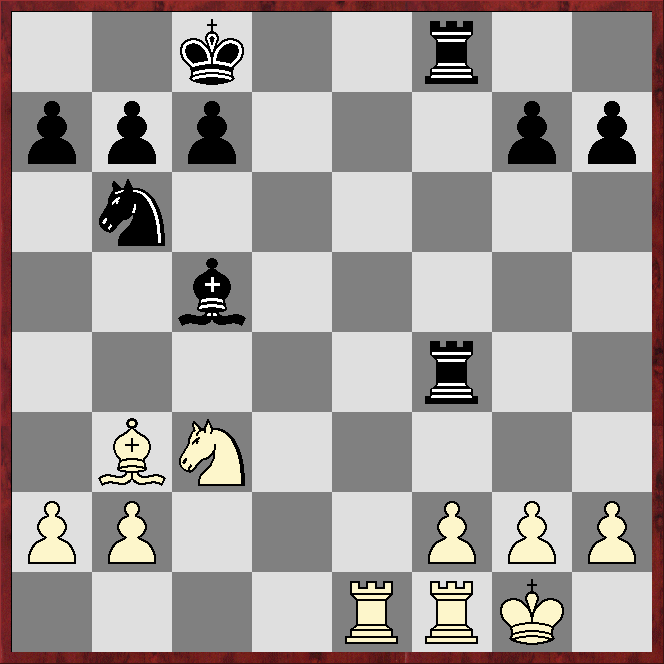
Position after White castles
With one side having connected rooks, the middlegame can be thought of as starting. Stockfish13 gives Black a slight edge after 10...Nd7, but Komodo12.1.1 reckons White has full compensation for the sacrificed pawns.

Sunday, 18 July 2021

Basel Round Two

FACED another junior this morning, and could discover little about him except he is French, aged nine or 10, does not have a Fide rating, and drew with a 1939 in round one.
Spanton (1814) - Anuar Tureshbayev (-)
French Irregular
1.Nc3 d5 2.d4 e6 3.e4 c6!?
Irregular, to say the least, but it has been played by grandmasters, and there are 525 examples of 3...c6!? in ChessBase's 2021 Mega database.
4.Bd3 dxe4 5.Nxe4!?
Speculative, but playable.
5...Qxd4 6.Nf3 Qd8 7.Qe2
Freeing d1 for a rook, and holding back on the dark-square bishop until Black has shown more of his hand.
7...Nf6 8.Nxf6+ Qxf6 9.Bg5?!
Throwing a second pawn on the fire, but Stockfish13 and Komodo12.1.1 reckon White has the upper hand after 9.c3.
9...Qxb2 10.0-0 Qb6 11.Rab1
The engines prefer 11.Ne5.
11...Qc7 12.Rfd1 Be7 13.Qe4?!
The engines like 13.Qe3 and 13.Bxe7.
13...Bxg5 14.Nxg5 h6 15.Nf3 Nd7 16.Rd2 Nf6 17.Qh4 0-0 18.Rbd1 Bd7 19.g4!?
Black has connected his rooks and remains two pawns up, so I felt I had to do something or else I would be without compensation for the material minus.
19...Qf4 20.Be2 Rad8 21.Rd4 Qc7 22.g5 hxg5 23.Nxg5 e5
How should White proceed?
*****
*****
*****
*****
*****
24.Rd6?
The engines give 24.Bd3! Rfe8 25.Bc4 with an unclear position.
Another better try than the text is 24.Ne4!? as 24...exd4? 25.Nxf6+ gxf6 26.Bd3 Rfe8 27.Qh6 is a draw. However, after 24.Ne4!? Black has 24...Nxe4 25.Rxe4 Be6 with what the engines reckon is a clearly winning position.
24...Bf5 25.Rxd8
The desperate 25.Nxf7? fails to 25...Kxf7.
25...Rxd8 26.Rxd8+ Qxd8 27.Bc4
27.Qh8+!? Kxh8 28.Nxf7+ Kg8 29.Nxd8 wins back a pawn, but the engines continue 29...Bc8, when the white knight is surely doomed.
27...Bg6?
Much better is 27...Qd1+ 28.Kg2 Nd5.
28.Nf3?
Retreating the knight is always likely to be hopeless, but here it misses 28.Bxf7+! Bxf7 29.Qh8+ Kxh8 30.Nxf7+ and 31.Nxd8, when White has equalised.
28...Qd1+ 29.Kg2 Be4 30.Qh3 Qxc2?
Greedy. Black can simply swop off into an ending two pawns up, but even better is 30...g5 etc.
31.Qc8+ Kh7 32.Qh3+ Kg6 33.Qg3+ Kh6 34.Qh4+ Kg6
Disastrous for Black would be 34...Nh5?? 35.Qg5+ Kh7 36.Qxh5+ Kg8 37.Qxf7+ and 38.Qh5#.
35.Qg3+ Kh7 36.Qh3+ Kg6 37.Qg3+ Kh6 38.Qh4+ Kg6 39.Qg3+ Kh6 40.Qh4+ ½–½

Thursday, 21 March 2019

Boring Chess?

MY opponent at the conclusion of our game in round six of Bad Wörishofen U2000, accused me of playing boring chess and not being interested in winning.
Jochen Eilers (1974) - Spanton (1890)
French Defence, Irregular Variation
1.e4 e6
As well as calling my play in general boring, JE dismissed 1...e6 as "boring," saying he had prepared for 1...e5 and 1...c5.
2.Nc3 d5 3.g3!?
There are more than 500 examples of this move in ChessBase's 2019 Mega database, and it was not a surprise to me as I knew JE was fond of fianchettoing his king's bishop when playing 1.e4.
3...d5xe4 4.Nxe4 e5!?
A suggestion of the analysis engine Stockfish10. The justification for moving the e pawn a second time is, presumably, that White has spent time opening two diagonals for his king's bishop, so Black has time to grab space in the centre.
5.d3 Nc6 6.Bg2 Nf6 7.Bg5 Be7 8.Nxf6+ Bxf6 9.Bxf6
I thought White's idea was 9.Bxc6+!?, doubling Black's c pawns, followed by 10.Bxf6 to remove Black's resulting bishop-pair, but JE said he did not think it was good to give up his king's bishop in this way.
9...Qxf6 10.Ne2?!
My main analysis engines do not like this, preferring 10.Qd2 (Stockfish10) or 10.Qf3 (Komodo9).
10...Bg4 11.h3 Bxe2?
Missing  the strength of 11...Bf3, eg Stockfish10 gives 12.Bxf3 Qxf3 13.0-0 0-0-0 with a strong attack. If 12.0-0, then Stockfish10 gives 12...Nd4 13.Re1 0-0-0 with what it reckons is a winning attack.
12.Qxe2 Nd4 13.Qd2
13.Qd1!? looks retrograde, but unbalances the game somewhat by preserving the bishop, and it eventually becomes the engines' choice.
13...Nf3+ 14.Bxf3 Qxf3 15.0-0 0-0-0?!
I probably should have played the safely centralising 15...Qd5, rather than offer a pawn, or pawns, for speedy development.
How should White continue?
*****
*****
*****
*****
*****
16.Rae1
Critical is 16.Qa5 Kb8 17.Qxe5, when Black does not seem to get enough for the pawn(s), eg 17...Rde8 18.Qxg7 Reg8 19.Qh6 Rg6 (19...Rxg3+?? 20.fxg3 Qxg3+ 21.Kh1 Rg8 22.Qd2 Qxh3+ 23.Qh2 wins for White) 20.Qd2 Rhg8 21.Kh2 Qh5 (what else?) 22.Qe3 Rh6 23.h4 (or 23.g4 - Black's back rank is weak). Another possibility is 17...Rhe8 18.Qxg7 Re2 19.c4!
The engines give Black's best as 17...f6, when after, say, 18.Qc5 Rhe8 19.Rae1 Re2 20.Rxe2 Qxe2, Black has some pressure for the pawn.
16...f6 17.Qe3 Qxe3 18.Rxe3 Rd6
The engines come to like 18...g5 to discourage the 19th move played by White in the game.
19.f4 exf4 20.Rxf4 Rhd8
JE now played ...
21.Rfe4
...and offered a draw, which I immediately accepted. The engines reckon White is slightly better after a move such as 21.Kf2, 21.Rh4 or 21.Ra4.