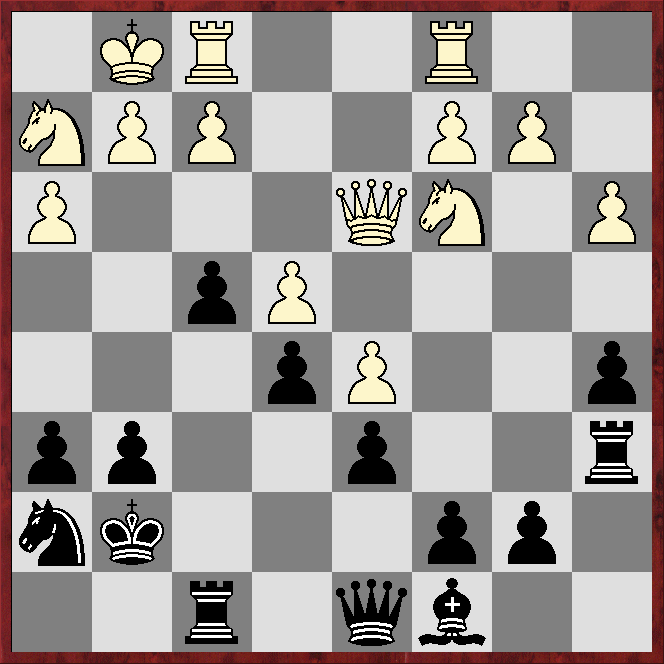
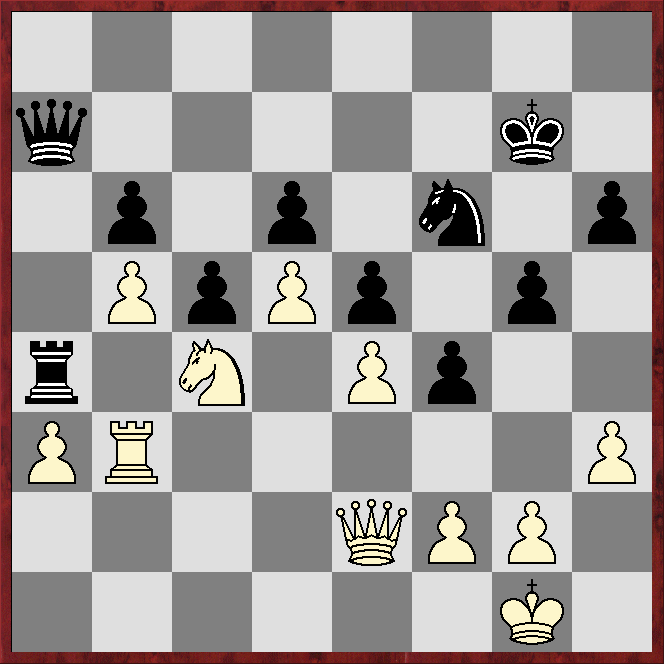
Showing posts with label Nimzowitsch Defence. Show all posts

Wednesday, 15 April 2026

Miniatures 33

IN this occasional series I am going through my decisive games of 20 moves or fewer.

Spanton (147 BCF) - N Foster (200 BCF)
Barbican (London) Rapid1990
Nimzowitsch Defence
1.e4 Nc6 2.d4 d5 3.e5 Bf5 4.Nf3 e6 5.g3!?
The main continuations in ChessBase's 2026 Mega database are 5.c3 and especially 5.Bd3.
5...f6!?
This immediate attack on the white centre is a rare continuation but is liked by Stockfish17.1 and Dragon1.
6.exf6 Qxf6!?
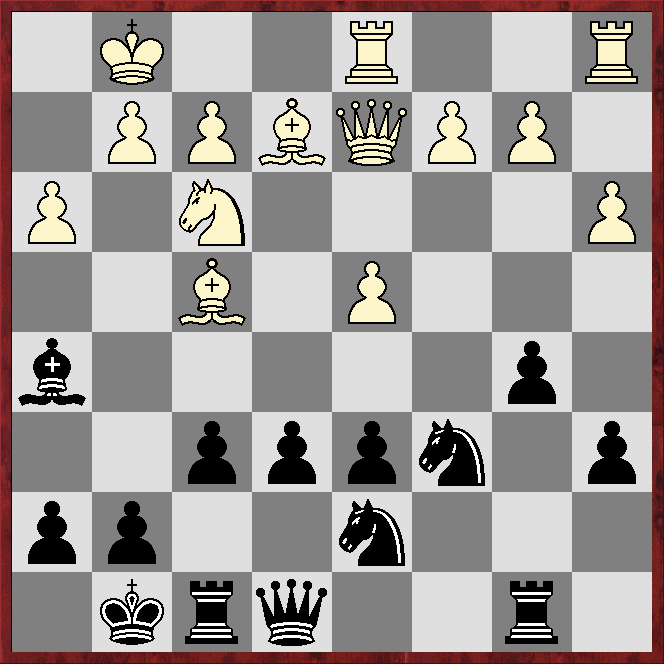
How should White proceed?
*****
*****
*****
*****
*****
7.Bg5?
The engines suggest 7.c3 or 7.Bg2, with what they reckon is equality.
7...Bxc2! 8.Qe2
Or 8.Bxf6 Bxd1 9.Kxd1 (forced) gxf6, when Black is a sound pawn up.
8...Qf5 9.Nc3?
Better is 9,Nbd2, developing and protecting the king's knight.
9...Bb4?
Missing the strength of 9...Be4.
10.h4?
The bishop should be moved, probably to e3.
10...Be4 11.Bg2 Bxf3 12.Qxf3 Qxf3 13.Bxf3 Nxd4
Winning a second healthy pawn.
14.Bd1 Nf6 15.0-0 0-0 16.Rc1 c6 17.a3 Bd6 18.Be3 Nf5 19.Re1?! 0-1
LESSON: success against a much higher-rated opponent is made infinitely harder if basic tactical mistakes are committed while still in the opening.

Monday, 9 March 2026

Miniatures 28

IN this occasional series I am going through my decisive games of 20 moves or fewer.

Spanton (147 BCF) - William Upton (?)
Highbury (London) Rapid 1990
Nimzowitsch Defence
1.e4 Nc6 2.d4 Nf6?!
There are 200 examples of this position in ChessBase's 2026 Mega database, but Black already has a lost game, according to Stockfish17.1 and Dragon1
*****
*****
*****
*****
*****
3.Nc3!?
There seems no good reason not to play 3.d5.
3...d5 4.e5
This is a relatively mainstream position, reached 897 times in Mega26
*****
*****
*****
*****
*****
4...Bg4??
Normal is 4...Nd7, as played by Magnus Carlsen, although Edgar Colle back in 1925 preferred 4...Ng8.
5.f3 Bh5 6.exf6 gxf6 7.Bd3 Bh6?? 8.Bxh6 Nxd4 9.Bb5+ Qd7?? 10.Bxd7+ Kxd7 11.Qxd4 Rag8!? 12.Qxd5+ Ke8 13.0-0-0 e6 14.Qd8#
LESSON: for once I am lost for words.

Tuesday, 30 September 2025

Miniatures 12

IN this occasional series I am going through my decisive games of 20 moves or fewer.

Spanton (151 BCF) - Chris Briscoe (155 BCF)
Barbican (London) Rapid 1989
Nimzowitsch
1.e4 Nc6 2.Nf3 d5!?
Magnus Carlsen has played the text, which keeps the game in independent Nimzowitsch Defence lines, and has a strong affinity with the Scandinavian.
3.exd5 Qxd5 4.Nc3 Qa5 5.d4 Bg4 6.Be2
Stockfish17 and Dragon1 like 6.Bb5!?
6...e6
The engines reckon 6...0-0-0 equalises.
7.h3 Qh5?
The engines give 7...Bxf3 8.Bxf3 Rd8!? 9.Bxc6+ bxc6 10.0-0, with what they reckon is a slight edge for White.
8.Bf4
Even stronger is the simple 8.0-0, forcing 8...Bxf3 9.Bxf3, when White has more space, the bishop-pair and a lead in development.
8...0-0-0 9.Qd2
White is still better after this, but the engines give 9.Bh2 as best, whereas 9.0-0 allows 9...Qf5 10.Be3 Bh5, when 11.g4? Bxg4! 12.hxg4 Qxg4+ 13.Kh1 Qh3+ is a perpetual as 13.Nh2? loses to 13...Bd6 14.f4 (forced) Qxe3.
9...Bb4?!
Probably better is the engines' 9...Bxf3!? 10.Bxf3 Qa5, albeit they give White at least a slight edge.
10.0-0-0?
The wrong side.
After 10.0-0 Bxf3 11.Bxf3 Qa5 White would be well on top
*****
*****
*****
*****
*****
10...Bxf3 11.Bxf3 Qa5
The same position as in the previous diagram, except here White has effectively castled into Black's attack instead of away from it
*****
*****
*****
*****
*****
12.Bxc6 bxc6 13.Kb1?
This somewhat natural-looking move is a mistake. White should unpin the knight, for example with 13.a3!? or 13.Qe3, or get on with development with 13.Rhe1.
13...Nf6 14.Bg5??
Correct is 14.Qd3, albeit Black is better after 14...Bxc3 15.bxc3 (15.Qxc3? Qxc3 16.bxc3 Ne4) and 15...c5 or 15...Nd5.
14...Ne4 15.Qc1?
White can more-or-less struggle on, at least at rapidplay time controls, after either 15.Qe3 Nxc3+ 16.bxc3 Bxc3 17.Rd3 Qb4+ 18.Kc1 or 15.Nxe4!? Bxd2 16.Bxd8 Rxd8 17.Rxd2.
15...Nxg5?!
Good enough for a winning advantage, but immediately decisive is 15...Nxc3+ 16.bxc3 (16.Ka1 Qxa2#) Bxc3, when White has nothing better than giving up the queen with 17.Qb2!?
16.Qxg5?? Qxg5 0-1
LESSON: I cannot recall what I was thinking during this game, but my moves have all the hallmarks of playing too quickly, and I am convinced more games are lost through playing too quickly than through playing too slowly.

Tuesday, 9 September 2025

Miniatures 7

IN this occasional series I am going through my decisive games of 20 moves or fewer.

Spanton (ungraded) - J Kaye (168)
North London Spring Congress 1989
Nimzowitsch Defence
1.e4 Nc6 2.Nf3 d6 3.d4 Nf6 4.Nc3 Bg4
There are 3,152 examples of this position in ChessBase's 2025 Mega database
*****
*****
*****
*****
*****
5.Bc4 e6
Probably not 5...Nxe4?! 6.Nxe4 d5 7.Bb3 dxe4 8.Bxf7+!
6.Bb3 d5 7.exd5 exd5 8.Be3
Stockfish17 and Dragon1 reckon White is slightly better after 8.Bg5.
8...Bb4 9.0-0 Na5 10.Ba4+?!
The engines strongly dislike this, preferring 10.Bg5 or 10.h3.
10...c6 11.Bg5 0-0 12.Qd3 Nc4 13.Nd1 h6 14.Be3?!
It was probably better to maintain the pin with 14.Bh4.
14...Re8
Black has three minor pieces past the halfway line, supported by a rook
*****
*****
*****
*****
*****
15.Nd2?
Perhaps 15.c3 is best, but Black is well on top after 15...Bd6.
15...Rxe3?!
The simpler 15...Bxd2 16.Bxd2 Be3 is much stronger, but the text also wins.
16.Nxe3 Nxd2 17.Nxg4 Nxg4 18.c3?
Better is 18.h3 Nxf1 19.hxg4, but Black remains a knight up after 19...Qa5 or 19...Nd2.
18...Nxf1 19.cxb4 Qh4 0-1
LESSON: combinations are almost certainly in the offing when enemy pieces cross the middle of the board in strength.

Sunday, 29 June 2025

Bischofsgrün Round Three

FACED a Fide Master.

Spanton (1954) - Dieter Seyb (2137)
Nimzowitsch Defence/Alekhine Defence
1.e4 Nc6 2.Nf3 Nf6!?
There are 1,463 examples of this move in ChessBase's 2025 Mega database.
3.e5 Nd5 4.d4
The game began as a Nimzowitsch Defence, but has transposed to a sideline of Alekhine's Defence (333 games reach this position in Mega25), although it is not, as ChessBase calls it, a Four Pawns Attack.
4...d6
Now we have reached a popular main line of the Alekhine, with 1,980 examples in Mega25
*****
*****
*****
*****
*****
5.c4 Nb6 6.exd6 exd6 7.Nc3 Be7 8.Be3 Bg4
This is the commonest continuation in Mega25, but Stockfish17 and Dragon1 are not keen, preferring 8...0-0 or 8...Bf6!?
9.h3 Bh5 10. b3 Bf6!?
The engines strongly dislike this, preferring 10...0-0 or 10...a5.
How should White try to take advantage of Black's last move?
*****
*****
*****
*****
*****
11.Be2
The engines give 11.g4!? Bg6 12.g5!? Be7 13.h4, claiming White has at least the upper hand (Dragon1)  or a positionally won game (Stockfish17).
11...d5?!
Trying to grab a fair share of the centre, but the result is Black is left on the back foot.
12.c5 Nc8
Not 12...Nd7? 13.Nxd5.
13.0-0 0-0
Now both sides have castled, how would you assess the position?
*****
*****
*****
*****
*****
White has a lead in development and more space on the queenside, giving White the upper hand, according to the engines.
14.Rc1 h6 15.Re1 N8e7 16.g4!? Bg6 17.h4!?
How should Black respond to the threat to trap the f6 bishop?
*****
*****
*****
*****
*****
17...Qd7!?
The engines reckon this is much better than 17...Nc8 18.g5 Be7 19.Bf4!?, when they give White a winning advantage.
18.g5 Qg4+ 19.Kh2 Bf5?
A better way to give up a piece, according to the engines, is 19...hxg5 20.hxg5 Qh5+ 21.Kg2 Qg4+ 22.Kh1 Qh3+ 23.Nh2 Bxd4, although they agree White is well on top.
20.gxf6 Qh3+ 21.Kg1 gxf6 22.Nh2
Best, according to the engines, is 22.Bf4 or 22.Bf1, but not 22.Bxh6? Kh8 23.Bxf8? (better is 23.Bf1 Rg8+ 24.Bg5, albeit Black has at least an edge after 24...Qg4+ 25.Bg2 fxg5) Rxf8, when Black has a winning attack.
22...Kh7 23.Kh1 Rg8 24.Bf3
This seems better than 24.Rg1 Rxg1+ 25.Qxg1 Rg8.
24...Qxh4
Now that Black has a second pawn for his missing dark-square bishop, how would you assess the position?
*****
*****
*****
*****
*****
The position remains sharp, and the white king is somewhat less safe than its black counterpart, but White is winning, according to the engines.
25.Qd2
The engines also like 25.Nxd5!?, continuing 25...Nxd5 26.Bxd5 Rad8 27.Bxc6!? bxc6 28.f3!?, but it looks very risky.
25...Nb4 26.Rg1 Ng6!?
The engines do not like this.
27.Bg4 Bxg4 28.Rxg4 Qh5 29.Rcg1 Qf5 30.R1g3!?
This is Stockfish17's second choice, behind 30.Ne2. Dragon1 also likes 30.Ne2, and 30.Bxh6!?
30...h5 31.Rh3 Rge8 32.Rgg3 h4 33.Rf3 Qe6 34.a3 Nc6 35.Qd3 Kg7 36.Qf5 Nce7 37.Qxe6!? fxe6
Black's pawn-formation has been improved, but with queens off the board there is less likelihood of a fatal accident in the vicinity of the white king (or the black king for that matter)
*****
*****
*****
*****
*****
38.Ng4 Nf5? 39.Ne2?
Missing the simple win of a pawn by 39.Nxd5.
39...b6 40.b4
The engines suggest keeping lines closed with 40.c6!?, and if 40...Nge7, then 41.Nf4 Kf7 (41...Nxc6 42.Nxe6+!) 42.Nh5.
40...bxc5 41.bxc5
Here they prefer 41.dxc5!?
41...Rab8 42.Nf4 Nxf4 43.Rxf4?!
Probably better is 43.Bxf4!?, and if 43...Nxd4?!, then 44.Bh6+ and 45.Rxf6(+).
43...Kg6 44.Bd2 Rb1+ 45.Kg2 Rd1 46.Bc3 Kg5
What should White play?
*****
*****
*****
*****
*****
47.Rhf3?
The engines give 47.Rxf5+!? exf5 (47...Kxf5?? 48.Ne3+ and 49.Nxd1) 48.Ne3 Rd3 49.Nxd5 Rxh3 50.Kxh3, when they reckon White's bishop and knight are worth much more than Black's rook and (doubled) pawn. Also better than the text is 47.Ne3 Kxf4 (47...Rd3?? 48.Rg4+ Kh5 49.Nxf5 Kxg4 50.Nh6+ and 51.Rxd3) 48.Nxd1.
47...h3+! 48.Kh2
Forced, as 48.Kxh3?? loses to 48...Rh8+ 49.Kg2 Nh4+ etc.
48...Nh4 49.Nxf6 Nxf3+ 50.Rxf3
How should Black proceed?
*****
*****
*****
*****
*****
50...Re7?
Even worse is 50...Rf8?? 51.Nh7+, but the engines give 50...Rb8, claiming complete equality.
How should White proceed?
*****
*****
*****
*****
*****
51.Ng8
Best according to the engines, is 51.Ba5!? (they also like 51.c6!?), the idea being 51...Rf7, which they reckon is Black's best reply, can be met by 52.Ne4+!, and if 51...Rxd4, then 52.Bc3! followed by 54.Nxd5!
51...Rh7
Black loses the rook after 51...Rg7?? 52.Rg3+.
52.Rg3+
Possibly better is the engines' 52.Nf6! Rf7 53.Ne4+! Kg6 54.Nd2.
52...Kf5 53.Rf3+ Kg6 54.Rf6+??
Better is 54.c6, intending Bb4 to rescue the knight (Black cannot attack the knight with 54...Kg7?? as it simply escapes with 55.Nf6 or 55.Ne7.
54...Kg7 55.Rxe6 Kxg8
White has no compensation for the exchange, and in an ending with lots of open lines for the rooks, and weak pawns for the rooks to target
*****
*****
*****
*****
*****
56.Rg6+ Kf7 57.Rg4 Rd3 58.Rg3?!
Hastening the finish.
58...Rxg3 59.fxg3 Kg6 60.Bd2 Kf5 61.Bf4 c6 62.a4 Kg4 63.a5 a6 64.Bd6 Rb7 0-1
This ended my seven-game unbeaten streak.

Saturday, 9 December 2023

Benidorm U2000 Round Six

FACED a Spain-registered player.

Spanton (1743) - Benjamin Bote Kobolo (1935)
Nimzowitsch Defence
1.e4 Nc6 2.Nf3 d6 3.d4 Nf6 4.Nc3 Bg4 5.Be2 e5 6.Be3 Be7 7.h3 Bd7 8.d5!?
When to play this thrust, if to play it all, is often a key decision in this type of position; here it seems well-timed.
8...Nb8 9.Qd2 0-0 10.0-0
Castling long is an obvious alternative, while Stockfish16 and Komodo14.1 like 10.g4!?
10...h6 11.Rad1 Nxe4?!
The engines strongly dislike this.
12.Nxe4 f5
How should White proceed?
*****
*****
*****
*****
*****
13.Nc3
Even stronger, according to the engines, is 13.Nxe5!? dxe5 14.d6!? cxd6 15.Qd5+ Kh7 16.Nxd6.
13...f4 14.Bd4 exd4 15.Nxd4 f3?!
Another sacrifice, and this time not a temporary one.
16.Bxf3 Bg5 17.Qd3 Qf6 18.Ne6!?
How should Black respond to a white knight landing on e6?
*****
*****
*****
*****
*****
18...Rf7
The engines prefer 18...Bxe6 19.dxe6 Nc6, but reckon White is positionally winning.
19.Ne4 Qxb2 20.N6xg5
The simple 20.Nxc7 may be even more powerful.
20...hxg5 21.Nxg5 Rf5 22.Ne6 Bxe6?!
Almost certainly better is the engines' idea of giving up the exchange with 22...Rxf3 23.Qxf3 Na6.
23.dxe6 Re5 24.Rb1 Qxa2 25.Bxb7 Qxe6 26.Bxa8 Nd7
Black is a rook down, but carries on.
27.f4 Rc5 28.Rfe1 Qf7 29.Qe4 Nb6 30.Bc6 d5 31.Qe8+ Qxe8 32.Bxe8 Kh7 33.Re2 Rc4 34.f5 Kh6 35.Ra1 Kg5 36.Bg6 Na4 37.g4 a5 38.Be8 Nc3 39.Re7 Kh4 40.Bd7 Ne4 41.Rxg7 Rxc2 42.Re1 Kg3 43.Re3+ Kf4 44.Rxe4+!?
Giving up the exchange to simplify matters.
44...dxe4
White is now up a bishop rather than a rook
*****
*****
*****
*****
*****
45.f6 Kg3 46.Bb5 c6!? 47.f7 Rg2+ 48.Kh1 Rh2+ 49.Kg1 Rf2
If 49...Rg2+ White wins after 50.Kf1 Rf2+ 51.Ke1 cxb5 52.g5, eg 52...Rf5 53.g6 a4 54.Rg8.
50.Bxc6 e3 51.f8=Q?
Winning is 51.Bb5.
51...Rxf8 52.Re7 Kxh3 53.Rxe3+ Kxg4 54.Re5 Rf6 55.Bd7+ Kf4 56.Rxa5 Ke3
BBK offered a draw in my time.
57.Ra4 Rd6 58.Bg4?
Extinguishing any hopes of winning.
58...Rd4 ½–½

Thursday, 9 March 2023

Bad Wörishofen Game Six

Spanton (1835) - Gunnar Ahrens (1650)
Nimzowitsch Defence
1.e4 Nc6 2.Nf3 d5!?
Normal are 2...d6 and 2...e5, but ChessBase's 2023 Mega database has 2,310 examples of the text, which is strongly reminiscent of the Scandinavian.
3.exd5 Qxd5 4.Nc3 Qd6!?
Most popular is 4...Qa5, but Stockfish15 and Komodo13.02 prefer the text.
5.Nb5!?
The mainline in Mega23 runs 5.d4 Bg4?! (5...Nf6 is popular with strong players), after which the engines reckon 6.d5 and 6.Nb5 leave White better.
5...Qd8 6.d4 a6 7.Nc3 Bg4!?
The engines prefer 7...Nf6 or 7...Bf5.
8.Be2
Best, according to the engines, is 8.d5!?, eg 8...Nd5 9.Qe2!? Nxf3+ 10.gxf3 Bf5 12.Bf4 with what they reckon is the upper hand for White.
8...e6 9.0-0 Nf6 10.Be3 Be7 11.Re1 0-0 12.h3 Bh5 13.a3!?
The engines like this prevention of ...Bb4 and ...Nb4.
13...Rb8!? 14.Qd2 b5 15.Red1!?
Keeping the queen's rook on a1 to be ready for play down the a file in the event of ...b4. The engines prefer 15.Ne5 or 15.Rad1.
15...Qe8!?
This is Stockfish15's top choice; Komodo13.02 likes the text and 15...Nd5.
16.Bf4 Bd6 17.Bg5!? Nd7!? 18.Ne4 f6 19.Nxd6 cxd6 20.Bf4
The game has been quiet tactically but complicated positionally - how should Black proceed?
*****
*****
*****
*****
*****
20...Qe7?!
Probably best is 20...e5, and if 21.dxe5 then 21...Nde5!?, when the engines reckon 22.Qxd6 Nxf3+ 23.Bxf3 Bxf3 24.gxf3 Rc8 gives Black quite good compensation for a pawn.
21.d5 Bxf3?!
The engines give 21...Nce5 22.dxe5 dxe5 23.Bxh5 exf4 and either 24.dxe6 or 24.d6, in each case with a winning advantage for White.
22.Bxf3?!
This is enough for a large edge, but almost certainly better is 22.dxc6, unveiling the threat of 23.Bxd6.
22...Nce5 23.Be2 Ng6 24.dxe6 Nxf4 25.Qxf4 Ne5
White has emerged from the flurry of tactics a pawn up, at least temporarily, and with pressure against d6, but Black has a strong knight
*****
*****
*****
*****
*****
26.Qd4 Rfd8 27.Qd5 Rbc8 28.c3 Rc5 29.Qe4 d5
Not 29...Qxe6?? 30.f4.
30.Qe3?!
White keeps a large advantage with 30.Qd4, according to the engines.
30...Rc6 31.f4
Possibly best is attacking the black queenside with 31.a4!?
Black to play and more-or-less equalise
*****
*****
*****
*****
*****
31...Rxe6! 32.Qf2
Black has a large advantage after 32.fxe5? Rxe5.
32...Nc4 33.Bxc4
White maintains a slight edge with 33.Bf3 or 33.Ng4, according to the engines.
33...dxc4 34.Rxd8+ Qxd8 35.Re1 Rd6
In this completely equal position, GA offered a draw
*****
*****
*****
*****
*****
36.Kh2 Qd7 37.Qc5 Kf7?
Sensible is 37...h6 to give the black king more breathing room.
38.Qh5+ Kf8
Forced, but it loses a pawn, although Black has reasonable prospects of holding either a queen ending or a rook ending.
39.Qxh7 Re6 40.Qf5 Kf7??
This lets White swop off into an easily won pawn-ending. Correct is 40...Rd6, meeting 41.Qc5 with, say, 41...Kf7.
41.Qxe6+ Qxe6 42.Rxe6 Kxe6 43.Kg3 (1-0, 51 moves)

Friday, 13 January 2023

Central London League

PLAYED in division one for Battersea against Athenaeum on board four (of five) last night.

Spanton (1974) - Alvin Kissoon (1951)
Nimzowitsch Defence
1.e4 Nc6 2.Nf3!?
This is much more popular in ChessBase's 2023 Mega database than the 'obvious' 2.d4.
2...d6 3.d4 Nf6 4.Nc3 g6 5.d5 Nb8
Magnus Carlsen has played the text. Komodo13.02, but not Stockfish15, prefers 5...Ne5 6.Nxe5 dxe5, although reckoning both 7.f3 and 7.Be3!? (the latter is not in Mega23) give White the upper hand.
6.h3!?
This somewhat slow play seems OK in this position which, if not closed, is not open either. The idea is to restrict the black light-square bishop. Garry Kasaprov in a 2015 blitz game preferred 6.Be2.
6...Bg7 7.Be3 a5!?
I hesitate to call this a novelty as it would be surprising if it had not been played before, but the move is not in Mega23. Pushing the a pawn two squares allows the queen's knight to be redeveloped via a6, and prepares a queenside attack in case White castles long. However the move is not liked by the engines, which prefer 7...c6 or 7...0-0.
8.Qd2 Na6 9.Bh6 0-0 10.Bxg7 Kxg7 11.Qd4!? e5
How should White respond?
*****
*****
*****
*****
*****
12.Qe3?
This throws away most of the advantage White has built up thanks to Black's somewhat unorthodox opening play. Better is 12.dxe6, when AK in the postmortem said he intended 12...Nb4 followed by hitting the queen with 13...Nc6. After the text Black has a good King's Indian formation in which the bad black dark-square bishop has been exchanged and White's queenside counterplay is yet to develop. The engines reckon the position is equal.
12...h6 13.Be2 Nb4
The engines prefer attacking White's centre with 13...c6.
14.Rc1
And here they reckon White should take the plunge with 14.0-0-0.
14...Nh7
Perhaps 14...Nh5 is more in keeping with the King's Indian theme.
15.a3 Na6 16.0-0 f5 17.Bxa6!?
Uncramping the white kingside, but the engines prefer 17.exf5.
17...f4 18.Qd3 Rxa6 19.Nh2
How would you assess the position?
*****
*****
*****
*****
*****
Unclear was my verdict during the game. Stockfish15 reckons Black has a positionally won game, while Komodo13.02 for quite some time rates the position as completely equal, before switching to giving Black a slight edge. 
19...g5 20.Qe2
This implies 18.Qd3 may have been a waste of a tempo, but it is not clear 20.Qe2 is necessary, eg White could initiate queenside play with 18.Nb5.
20...Qe8?!
The engines much prefer getting the knight back into play with 20...Nf6.
21.Nb5 Qf7 22.Qc4?
Much better is 22.c4.
22...c5
This snuffs out White's queenside play as 23.dxc6?? drops the queen, but even stronger, according to the engines, are 22...Bd7 and 22...Nf6, one point being 22...Nf6 23.Nxc7?! can be met by 23...Rc6!
23.Qe2 Bd7 24.c4 Bxb5?!
A rule-of-thumb in King's Indian-type positions is Black's kingside attack cannot succeed without the light-square bishop, so the bishop should probably have been left on c8, at least in the short term, and almost certainly not swopped for a knight that looks to have nuisance value but can hardly help its king.
25.cxb5 Raa8 26.Rc3 b6 27.Rfc1 Nf6 28.Nf1
The knight heads for c4.
28...a4 29.b3!?
This may be premature. The engines suggest 29.Nd2, and if 29...Qd7 then possible is 30.b3!? axb3 31.Rxb3, allowing 31...Ra4 to be met by 32.Nc4.
29..axb3 30.Rxb3 Ra4 31.Rc4 Rfa8 32.Rxa4 Rxa4 33.Nd2 Qa7?!
This is probably a waste of time as the queen cannot stay on the a file in the long term. Instead 33...Rd4 is hard to meet, eg 34.f3?! Qa7 wins for Black, according to the engines, one line running 35.Rd3 Qa4 36.Rxd4 Qxd4+ 37.Qf2 Qc3 38.Nb1 Qb3. White seems to need to find 34.Rd3!? - equal, according to Stockfish15, but Komodo13.02 gives Black the upper hand.
34.Nc4
The white knight protects a3 and, indirectly, e4, while attacking b6 and d6, giving White an advantage
*****
*****
*****
*****
*****
34...Ne8 35.Rc3 Qc7 36.Qg4 Nf6 37.Qf5 Ra8 38.f3 Rf8 39.Qe6 Ne8 40.a4 Qd8 41.Ra3?
Too slow. White has a large advantage after 41.a5.
41...h5
How should Black's threat to trap the white queen be met?
*****
*****
*****
*****
*****
42.h4?
Both engines give 42.Nxb6! Qxb6 43.Qd7+ as equal, eg 43...Kh8 44.a5 Qc7 45.Qxc7 Nxc7 46.Rb3 Rc8 47.b6 Na6, after which neither side can apparently make progress. Stockfish15 also gives 42.a5!? Rf6 43.axb6 Rxe6 44.dxe6 as equal, an assessment which Komodo13.02 comes to agree with after being shown the line.
42...gxh4??
Losing, whereas 42...g4 43.fxg4? Rf6 traps the queen, forcing White to instead sacrifice the knight on e5, d6 or b6 for inadequate compensation.
43.a5 bxa5
Or 43...Rf6 44.Qh3, when Black again has to deal with the double attack on b6.
44.Rxa5 Rf6 45.Ra7+ Kh6 46.Qg8 Rg6 47.Rh7+ Kg5 48.Qh8 1-0
*Battersea won the match 3-2.

Friday, 24 June 2022

Opening Lessons From Mallorca IX

IN round nine of the Colonia de Sant Jordi U2400 I had white against a German rated 2031.
The full game can be seen at M9 but here I want to concentrate on the opening.

Nimzowitsch Defence
After 1.e4 Nc6 I continued 2.Nf3!?, which occurs 16,488 times in ChessBase's 2022 Mega database, compared with 12,196 for 2.d4, and has been preferred by Magnus Carlsen and Garry Kasparov.
I was slightly surprised to find 2...e5 is the second-most popular reply as in my, admittedly limited, experience blacks usually avoid transposing to a double-e pawn opening. But 2...e6!? is certainly not popular, although it was played by Aron Nimzowitsch and has been tried by modern grandmasters.
After 3.d4 d5 4.e5 White must be better, but Aleksandr Inđić (2607) has been happy to defend Black's position at least six times, albeit at blitz.
How should Black proceed?
*****
*****
*****
*****
*****
Challenging the base of White's French-style centre with ...c5 will take time, so hitting the head with 4...f6 is logical.
The most popular continuation in Mega22 is 5.Bb5!?, while Stockfish15 and Komodo13.02 suggest 5.Bd3. I preferred 5.Be2, and after 5...fxe5 6.dxe5 Bc5 I got my king to safety and prepared Re1 with 7.0-0.
Black also made ready to castle and to add pressure to e5 by playing 7...Nge7, at which I played 8.Bf4, which is not much liked by the engines. Indeed after 8...0-0 9.Bg3 Nf5 Stockfish15 gives Black an edge, although Komodo13.02 reckons the position is even.
Instead of developing the dark-square bishop they suggest attacking the Black centre with 8.c4. Then 8...Ng6 9.cxd5 is good for White after both 9...Qxd5 10.Bd2!? Ncxe5 11.Nc3 Nxf3+ 12.Bxf3 and 9...exd5 10.Nc3, according to the engines.
So Stockfish15 suggests 8...dxc4, eg 9.Qxd8+ Nxd8 10.Nc3 Bd7 11.Bxc4 Bc6 with approximate equality, while Komodo13.02 gives 8...0-0 9.Nc3 a6!? 10.Bg5 h6 11.Bxe7!? Nxe7, slightly preferring White.
Conclusion: few players would argue that White is not better in the diagram, but it may well be experience of how to play such positions is more important than a theoretical edge.

Monday, 13 June 2022

Colonia De Sant Jordi Round Nine

FACED a German in the last round yesterday.
It is hard to believe this public display would last long unvandalised in many parts of the world

Spanton (1861) - Manfred Herbold (2031)
Nimzowitsch Defence
1.e4 Nc6 2.Nf3 e6 3.d4 d5 4.e5 f6
In this French-style pawn structure Black is almost obliged to attack the white centre at its head rather than at its base with...c5.
5.Be2!?
The mainline in ChessBase's 2022 Mega database runs 5.Bb5!? Bd7 6.Bxc6!? Bxc6 7.0-0, which Stockfish15 and Komodo13.02 reckon is slightly better for White.
5...fxe5 6.dxe5 Bc5 7.0-0 Nge7 8.Bf4
The engines prefer putting immediate pressure on the black centre with 8.c4!?, meeting 8...Ne7 with 9.cxd5 Qxd5 (best, according to the engines) 10.Bd2!?, and if 10...Ncxe5 then 11.Nc3 Nxf3+ 12.Bxf3, when they reckon White has more than enough compensation for a pawn.
8...0-0 9.Bg3 Nf5 10.Nc3 a6
This lets the black dark-square bishop stay on the a7-g1 diagonal in the event of Na4.
11.Bd3 Be7!?
Black's last two moves do not look well together, but Black could not play 11...Bd7? as White has 12.Bxf5 followed by 13.Nxd5.
12.Qe2!?
The engines prefer 12.Ne2 or, if the queen has to be developed at this point, 12.Qd2.
12...Bd7 13.Bxf5?!
Giving up White's better bishop, albeit for a well-placed knight, is unlikely to be best. The engines suggest 13.Qd2!?
13...Rxf5 14.Rad1 Qf8 15.Qd2!?
This is Komodo13.02's choice for quite a while, but it comes to agree with Stockfish15 that 15.Qd3 is better.
How should Black proceed?
*****
*****
*****
*****
*****
15...Be8
The engines reckon 15...Rxf3!? 16.gxf3 Qxf3 is strong.
16.Nd4
The engines prefer 16.Ne2 Bh5 17.Nfd4, albeit reckoning Black is better.
16...Nxd4 17.Qxd4 c5 18.Qd2 Bc6 19.Ne2 b5!?
Black is still better after this, but kingside play with 19...h5 is almost certainly stronger.
20.Nc1 a5 21.Nd3 Qf7 22.c3 h5 23.h4!?
The engines agree this is the best defence.
23...Rd8 24.Qe3 d4 25.cxd4 cxd4
Not 25...Rxd4? 26.Nxc5.
26.Qd2 b4?
This gives White time for queenside counterplay. The engines reckon Black is well on top after 26...g5 or 26...Bd5, and if after 26...Bd5 White plays 27.Qxa5 then 27...g5 or 27...Qg6.
27.Rc1 Qe8 28.Nc5?
Missing a tactic. The game is equal after 28.Nf4, according to the engines.
28...Bf8
28...Bxg2!
29.Nb3 Bb5 30.Rfd1 d3 31.Nc5
White has an edge after 31.Nxa5!?, according to the engines, as 31...Ra8 can be met by 32.Nb7 Rxa2 33.Nd6. Instead Black should play something like 31...g5!? (Stockfish15) or 31...Rd4 (Komodo13.02), with more-or-less enough compensation.
31...Rf7 32.Ne4
Not 32.Nxd3?? Rfd7.
32...Rfd7?!
Probably better is the engines' 32...Rd5.
33.Qg5 Kh8?!
Black had to play 33...Be7, according to the engines, but 34.Nf6+ gives White a large advantage.
34.Nd6 Be7
34...Bxd6?! 35.exd6 is even worse for Black, according to the engines.
How should White proceed?
*****
*****
*****
*****
*****
35.Qf4?
White has a positionally won game after 35.Qe3 or 35.Qd2, according to the engines.
35...Bxd6 36.exd6 Rxd6 37.Qxd6?
Winning two rooks for a queen, but the powerful d pawn and the vulnerability of many of the white pawns make this a bad exchange. The engines reckon White is equal (Stockfish15) or only slightly worse (Komodo13.02) after 37.Qe3.
37...Rxd6 38.Bxd6 Qd7 39.Bf4 Qd5 40.b3 Bc6 41.f3 Qd4+ 42.Kf1 Bb5 43.Bd2 Qxh4 44.Re1 Qe7?!
44...Qd4 is almost certainly stronger.
45.Re5 Be8 46.Rxa5 Kh7 47.Rd1 Qc7?
Better is 47...Bg6.
48.Bxb4 Bg6 49.Rc5?!
Probably better is consolidating with 49.Bd2 or 49.rd2.
49...Qh2 50.Be1
Forced, but now Black gets an initiative.
50...h4 51.Rc4 Qh1+ 52.Kf2 Bf5 53.Rdc1 Qh2 54.Ke3
There is no defence.
54...Qe5+ 55.Kf2 Qe2+ 56.Kg1 h3!? 57.gxh3 d2 (0-1, 67 moves).

Tuesday, 8 June 2021

Beat The ... Nimzowitsch

IN this series I am looking at the statistically best way to play against popular opening lines.
The numbers are drawn from the 2021 edition of ChessBase's Mega database, ignoring, where possible, those results that include very few games and so are statistically insignificant.

The Nimzowitsch Defence: 1.e4 Nc6 is very much an opening more popular at club level than among the elite.
White's commonest reply is not, as might be expected, 2.d4, but 2.Nf3.
The latter is also more successful, statistically, scoring 54% against the 51% of 2.d4.
Position after 2.Nf3
Black has seven replies that appear at least 500 times in Mega21.

A) 2...d6 (5,912 games)
After 3.d4 the line splits.
A1 3...Nf6 4.c3!?, after which the line splits again.
A1.1 4...g6 5.Bd3 Bg7 6.0-0 0-0 7.d5!?, when A1.1a 7...Nb8 8.h3 scores 57% for White and A1.1b 7...Ne5 8.Nxe5 dxe5 9.c4 scores 67% for White.
A1.2 4...Bg4 5.Nbd2, when A1.2a 5...e6 6.Bb5!? scores 93% for White, albeit from a small sample, and A1.2b 5...e5 6.Bb5!? scores 75% for White.
A2 3...Bg4 4.d5!?, after which the line splits again.
A2.1 4...Nb8 5.Nc3 scores 80% for White, albeit from a small sample.
A2.2 4...Ne5 5.Nxe5!? Bxd1 6.Bb5+ c6 7.dxc6, when A2.2a 7...Qa5+ 8.Nc3 0-0-0 9.Nc4 Qc7 10.Nd5 scores 94% for White, albeit from a small sample and A2.2b 7...a6 8.c7+ axb5 9.cxd8=Q+ Rxd8 reaches a position in Mega21 where White scores 100% with both 10.Nxf7 and 10.Kxd1, albeit from very small samples.
A3 3...g6 4.d5, after which the line splits again.
A3.1 4...Nb8 5.c4 Bg7 6.Be2, when A3.1a 6...Nf6 7.Nc3 0-0 8.Be3!? scores 79% for White and A3.1b 6...e5 reaches a position in Mega21 where White scores 100% with both 10.0-0 and 10.h3, albeit from very small samples.
A3.2 4...Ne5 5.Nxe5 dxe5 6.c4 scores 81% for White, albeit from a small sample.
A4 3...e5 4.dxe5, after which the line splits again.
A4.1 4...dxe5 5.Qxd8+, when A4.1a 5...Kxd8 6.Ng5!? scores 94% for White and A4.1b 5...Nxd8!? 6.Nxe5 Nf6 7.f3 scores 98% for White.
A4.2 4...Nxe5 5.Nxe5 dxe5 6.Qxd8+ Kxd8 7.Bc4 f6 8.Nc3, when A4.2a 8...c6 9.Be3 Kc7 10.0-0-0 scores 64% for White, albeit from a small sample, and A4.2b 8...Bb4 9.Bd2 scores 85% for White, albeit from a small sample.
A4.3 4...Bg4?! 5.exd6 Bxd6 6.Be2, when A4.3a 6...Nf6 7.Bg5!? scores 100% for White, albeit from a small sample, and A4.3b 6...Qe7 7.0-0!? scores 75% for White, albeit from a small sample.

B) 2...e5 (4,607 games) is a transposition to mainline double-e pawn openings and will not be covered here.

C) 2...d5!? (1,801 games)
After 3.exd5 Qxd5 4.d4!? the line splits.
C1 4...Bg4 5.Be2, after which the line splits again.
C1.1 5...0-0-0 6.Be3, when C1.1a 6...e5 7.c4 Qa5+ 8.Bd2 Bb4 9.d5 Bxf3 10.Bxf3 Nd4 11.Nc3 Qa6 12.b3!? scores 64% for White and C1.1b 6...Nf6 7.Nbd2!? scores 69% for White.
C1.2 5...e6 6.h3 Bh5 7.Be3 scores 71% for White, albeit from a small sample.
C2 4...e5 5.Nc3 Bb4 6.Bd2 Bxc3 7.Bxc3 e4 8.Ne5 Nxe5 9.dxe5 Ne7 10.Qe2, after which the line splits again.
C2.1 10...Bf5 11.Rd1 scores 70% for White, albeit from a small sample.
C2.2 10...Be6 11.Rd1 Qc6 12.Qb5 scores 64% for White, albeit from a small sample.

D) 2...Nf6!? (1,186 games)
After 3.e5 the line splits.
D1 3...Ng4?! 4.d4 d6 5.h3 Nh6 6.Nc3, after which the line splits again.
D1.1 6...a6 7.g4 scores 100% for White, albeit from a small sample.
D1.2 6...g6 reaches a position in Mega21 where White scores 100% with both 7.Bf4 and 7.g4, albeit from very small samples.
D1.3 6...dxe5?! 7.d5 scores 100% for White, albeit from a small sample.
D2 3...Nd5 4.c4 Nb6 5.d4 (5.c5 scores equally well in Mega21, but Stockfish13 and Komodo12.1.1 much prefer d4) d6 reaches D) in Beat The ... Alekhine: https://beauchess.blogspot.com/2021/05/beat-alekhine.html

E) 2...f5!? (993 games)
3.exf5 d5 4.Bb5!? Bxf5 5.0-0!? scores 74% for White.

F) 2...e6 (831 games)
After 3.d4 the line splits.
F1 3...d5 4.Nbd2!? Nf6 5.e5, after which the line splits again.
F1.1 5...Nd7 6.c4!? dxc4 7.Bxc4!? scores 67% for White.
F1.2 5...Ne4!? 6.c3, when F1.2a 6...Nxd2 7.Bxd2 scores 74% for White and F1.2b 6...f5 7.exf6 Nxf6 8.Ne5 scores 88% for White, albeit from a small sample.
F2 3...Nf6 4.Nc3, after which the line splits again.
F2.1 4...Bb4 5.Bd3, when F2.1a 5...d5 6.0-0!? Bxc3 7.exd5 Nxd4 8.bxc3 Nxf3+ 9.Qxf3 Qxd5 10.Qg3 scores 63% for White and F2.1b 5...0-0 6.0-0!? scores 86% for White, albeit from a small sample.
F2.2 4...d5 5.Bd3!?, when F2.2a 5...Bb4 is a transposition to F2.1a, and F2.2b 5...Nb4 6.Bg5 Be7 7.e5 Nd7 8.Bxe7 Qxe7 9.Be2!? scores 75% for White, albeit from a small sample.
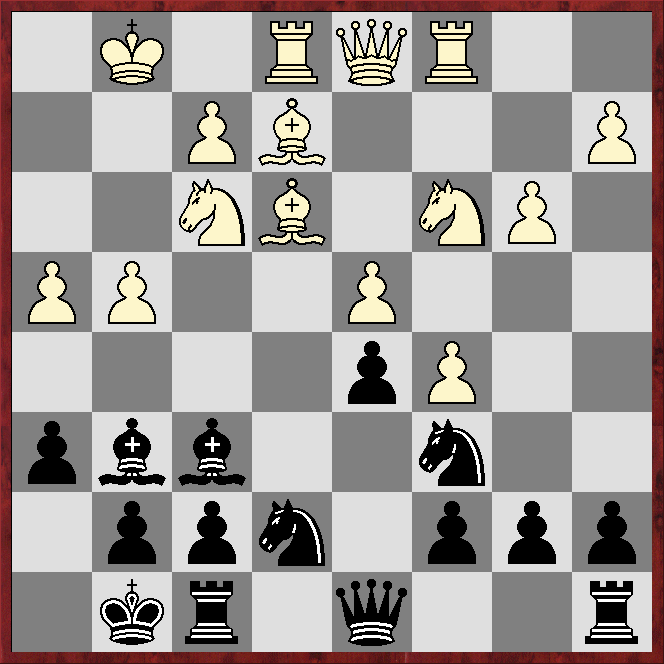
F3 3...d6 4.c4 Nf6 5.Nc3, after which the line splits again.
F3.1 5...Be7 6.Bd3, when F3.1a 6...0-0 7.0-0 e5 8.d5 Nb4 9.Be2 scores 72% for White, albeit from a small sample, and F3.1b 6...e5 7.d5 scores 62% for White, albeit from a small sample.
F3.2 5...g6 6.Bg5 scores 75% for White, albeit from a small sample.

G) 2...g6 (501 games)
After 3.d4 Bg7 4.Be2!? d6 5.d5 Ne5 6.Nxe5 the line splits.
G1 6...dxe5 6.0-0 scores 67% for White, albeit from a small sample.
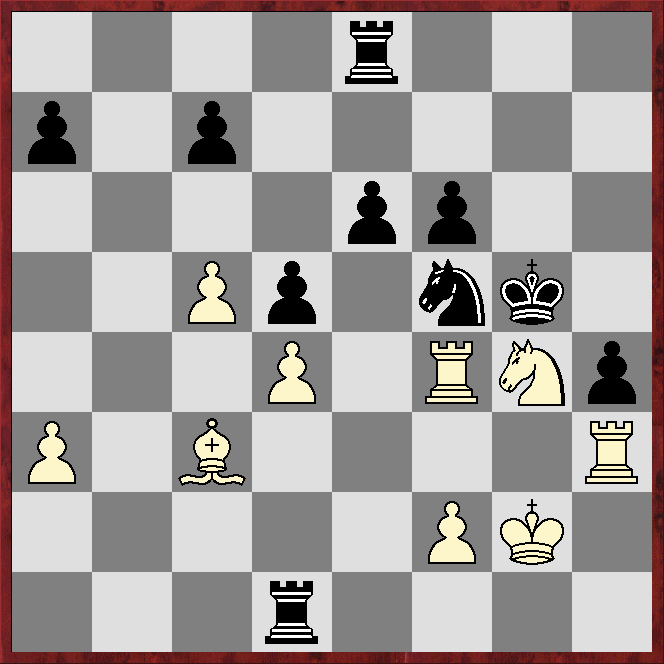
G2 6...Bxe5 7.0-0 scores 73% for White, albeit from a small sample.