Showing posts with label Nimzowitsch-Larsen. Show all posts

Saturday, 1 March 2025

Winning Chess

BOARD one for England 3 - the team I played for at the world senior 65+ championship in Prague - was Brian Hewson, who scored +3=3-3, gaining 26.8 Fide elo.
Here is his game from round one against Norwegian grandmaster Leif Øgaard.

Hewson (2039) - Øgaard (2358)
Réti/Nimzowitsch-Larsen
1.Nf3 Nf6 2.g3 d5 3.b3 c5 4.Bb2 Nc6 5.d4!?
The main move in ChessBase's 2025 Mega database is 5.Bg2.
5...Bg4 6.Nbd2 Qa5!? 7.Bg2!?
This may be a novelty. Borislav Kostić - János Balogh, Bardejov (Czechoslovakia) 1926, went 7.dxc5 Qxc5 8.Bg2, with an equal game, according to Stockfish17 and Dragon1 (1-0, 35 moves).
7...Bxf3!? 8.exf3!?
The engines prefer this to recapturing with the bishop, presumably because the bishop could become a target for black expansion after, for example, 8.Bxf3 cxd4 9.0-0 e5.
8...cxd4 9.0-0 e5
Black has won a pawn, but White has the bishop-pair and can hope to undermine the black centre
*****
*****
*****
*****
*****
10.a3 Bd6 11.f4!? exf4!?
After 11...0-0 12.fxe5 Bxe5 13.Nf3 the engines reckon White has at least full compensation for a pawn.
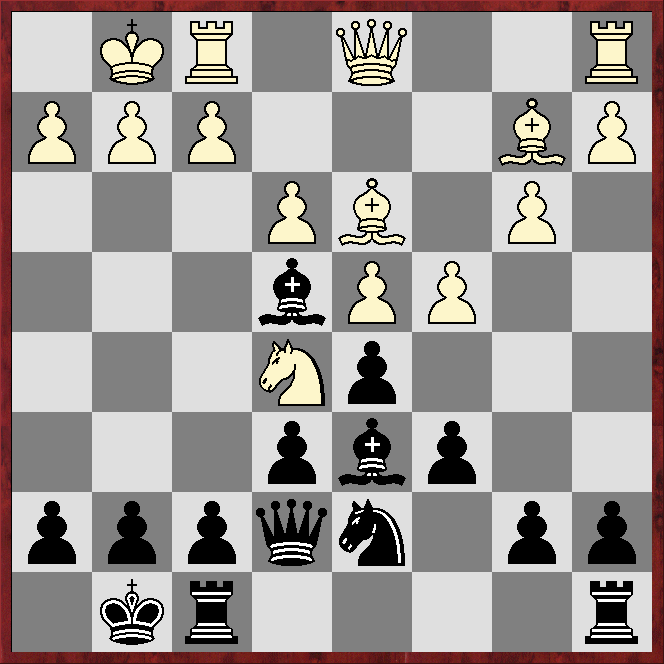
12.Re1+ Kf8 13.Nf3 fxg3 14.hxg3 h5 15.Nxd4 h4
Black is still up a pawn, but the position is opening for the bishops
*****
*****
*****
*****
*****
16.Nxc6?!
The engines prefer 16.g4 or 16.gxh4!?
16...bxc6 17.Qf3?
Again the engines prefer g4, but give Black the upper hand.
17...Ne4?!
Winning, according to the engines, is 17...hxg3, eg 18.Bxf6 gxf2+ 19.Qxf2 gxf6 20.Qxf6 Qc5+, but neither king is safe.
18.Qg4 Nf6
If 18...Rh7? then the simple 19.Bxe4 dxe4 20.Qxe4 is good for White.
19.Bxf6 gxf6 20.gxh4
Now White has regained the pawn, but given up the bishop-pair, how would you assess the position?
*****
*****
*****
*****
*****
Clearly it is messy, especially with opposite-coloured bishops, but the engines reckon equal chances.
20...Be5 21.Rad1 Qxa3 22.h5?!
The engines agree White maintains the balance with 22.c4!?
22...Qc5 23.Re2?!
The engines still prefer c4.
23...Rd8 24.Qf5?!
The engines suggest 24.Qh4 or 24.Kf1!?
24...Qd6?!
Black has at least a slight edge after 24...Rg8, according to the engines.
25.Rd3 Rb8 26.Rh3 Qa3 27.Rhe3!? Qd6 28.Rh3!?
An implicit draw offer?
28...a5
Black is right to play on, according to the engines.
29.Rh4 Qe6 30.Qxe6 fxe6 31.f4?
The engines reckon 31.Bh3 leaves Black at best slightly better.
31...Rb4?
Correct is 31...Bd4+, eg 32.Kf1 Kf7.
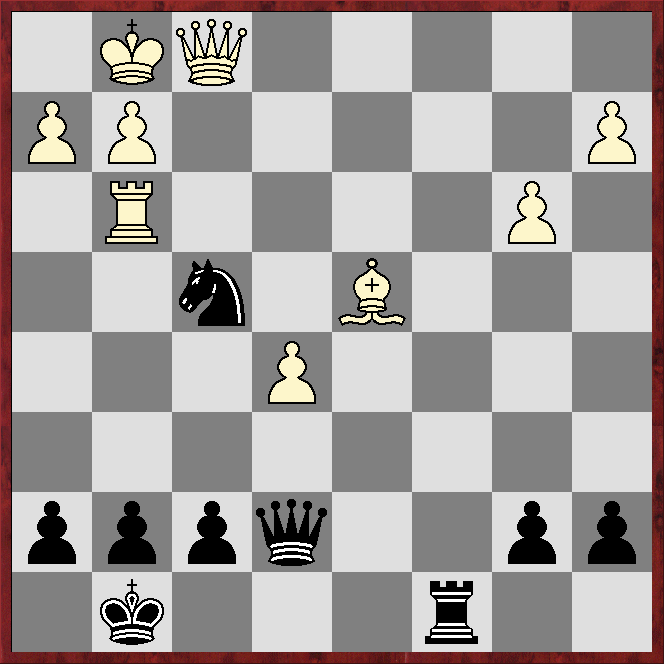
32.c3 Bxc3 33.Rxe6 Rxb3 34.Rxc6
Black to play and lose
*****
*****
*****
*****
*****
34...d4??
Saving the d pawn, but losing the game. Perhaps I should have titled this post Losing Chess.
35.Rc8+ Kg7 36.Rg4+ 1-0

Friday, 27 January 2023

Central London League

PLAYED for Battersea against Pimlico Knights on board three (of five) in division one last night.

Federico Bastianello (2002) - Spanton (1974)
Nimzowitsch-Larsen
1.b3
Pushing the b pawn one square on move one is rarer than one might imagine from its reputation as a 'nuisance' opening. I have faced it 19 times (ignoring casual games), and that number would be a lot lower if I had not had black against Ian Calvert on six occasions. My score of +5=6-8 is a not-very-good 42%. When a sample size is small, I think it is often more relevant to use a merit-points system I devised for comparing opening performance over many years when ratings fluctuate. You score a merit point if you beat someone higher rated, or draw with someone at least 160 elo higher, and a demerit if you lose to someone lower rated, or draw with someone at least 160 elo lower. On those rare occasions when my opponent has the same rating as me, both a merit and a demerit are possible. By this system my score against 1.b3 is 3-4, which again is nothing to shout about.
Black has a wide choice of replies to 1.b3, but I have come to believe there are three main plans:
A) Blockade. Black plays 1...e5 - the most popular move in ChessBase's 2023 Mega database - and sets out to blunt the white dark-square bishop, which can be expected to go to b2. This is similar to a common plan against White's kingside fianchetto, ie to play ...d5 and ...c6. A major difference is that ...f6 compromises Black's kingside, and indeed ...f6 is rarely part of Black's plan. The mainline in Mega23 runs 1...e5 2.Bb2 Nc6 3.e3 Nf6 4.Bb5 (fighting for the e5 square) Bd6!? 5.Na3 Na5!? 6.Be2!? a6 7.0-0 with an unclear and strategically complicated position.
B) Counterplay. White's first move is about dominating the central dark squares, ie d4 and e5. Black can, as it were, ignore this and play to dominate the central light squares, ie d5 and e4. This is the plan I adopted in the game.
C) Symmetry. Black copies White's moves until the opportunity arises to vary favourably. This is based on the idea that moving second can be advantageous in chess since the opponent has to commit first. It is not very practical to try this against 1.e4 or 1.d4, but it is reasonably popular against the English, and can also be used against the Nimzowitsch-Larsen. The mainline of this system in Mega23 goes 1...b6 2.Bb2 Bb7 3.e3 e6 4.Nf3 Nf6 5.Be2 Be7 6.0-0 0-0 7.c4 c5 8.d4, and now Black usually varies with 8...cxd4, meeting the main recapture 9.Nxd4 with 9...a6!?, although Stockfish15 and Komodo13.02 reckon White has a slight edge. Note that Black can maintain the symmetry for at least one more move with 8...d5!?
1...d5 2.Bb2 Nf6 3.e3 Bf5 4.Nf3 Nbd7 5.Nh4!?
The main move in Mega23 is 5.Be2, but the engines prefer the text, with Stockfish15 claiming it gives White a slight edge (Komodo13.02 disagrees).
How should Black reply?
*****
*****
*****
*****
*****
5...Bg6
All four games to reach the diagram in Mega23 saw the text played, but there is something to be said for 5...Bg4!?, as will soon become clear.
6.f4!?
Two of the four players in Mega23 played this. The engines prefer winning the bishop-pair with 6.Nxg6, meeting 6...hxg6 with 7.g3!?, while the strongest of the four players, a 2440, effectively ignored what was happening on the kingside by continuing 6.c4!?
6...Bh5!?
By no means forced, especially as after ...
7.Be2 Bxe2 8.Qxe2
... White has gained a tempo (6.f4!?) on the line 5...Bg4!? 6.Be2 Bxe2 7.Qxe2. However it is by no means certain the tempo is a useful one, although playing f4, to help control e5 and possibly half-open the f file, is thematic in the Nimzowitsch-Larsen.
8...e6
There are 15 games with this position in Mega23, and in all but one of them it is Black to play
*****
*****
*****
*****
*****
9.d3 Bd6 10.Nf3!?
This stops a quick ...e5, but that is probably not a big threat, eg 10.0-0 e5?! 11.Nf5 justifies White's flanking manoeuvre with the king's knight.
10...Qe7 11.Ne5 Bb4+!?
How should White meet the check?
*****
*****
*****
*****
*****
12.Nd2
Stockfish15 marginally prefers 12.c3, although Komodo13.02 reckons the text gives White a slight edge.
12...Ba3 13.Bxa3 Qxa3 14.Ndf3 Qb4+ 15.Qd2 Qxd2+ 16.Kxd2 Nxe5 17.Nxe5 Nd7 18.Nxd7 Kxd7
After an interesting opening, the game has quickly liquidated to an unusual ending with all the rooks and pawns still on the board, but nothing else (apart from kings)
*****
*****
*****
*****
*****
There are 3,221 examples of this ending in Mega23, meaning it occurs 0.03% of the time. Usually, as far as I can tell from looking at sample examples, the ending arises with at least one half-open file. The absence of such a file makes a draw more likely.
The game finished:
19.g4 h5 20.g5 g6 21.h4 a5 22.a4 Kd6 23.c4 Ra6 24.Kc3 c5 25.e4 dxe4 26.dxe4 Rd8 27.Rad1+ Ke7 28.Rxd8+ Kxd8 29.Rd1+ Ke7 30.e5 Rc6 ½–½
Pimlico Knights won the match 3.5-1.5

Saturday, 14 January 2023

Mariánské Lázně Game One

Pavel Kirs (1585) - Spanton (1895)
Seniors 50+
1.b3/Nimzowitsch-Larsen/Colle-Zukertort/Réti?
1.b3 d5 2.Bb2 Nf6 3.e3 Bf5 4.Nf3 Nbd7 5.d4
The opening began as a Nimzowitsch-Larsen but is now much more of a Colle-Zukertort, although ChessBase from move four calls it a Réti. Indeed it is only after ...
5...e6
... that ChessBase categorises the opening as part of the Colle complex.
6.Be2 Bd6 7.0-0 Qe7!?
Hinting at both queenside castling and ...e5.
8.Nbd2 0-0 9.c4 c6 10.Ne5 Ne4 11.Nxe4 Bxe4 12.Bd3!?
This may be a novelty. Seyed Khalil Mousavi (2475) - Kevin Bordi (2288), Chess.com Blitz 2019, went 12.a4 f6 13.Nxd7 Qxd7 14.f3 Bg6 15.Bd3 Qc7 with equality, according to Stockfish15 and Komodo13.02 (but 1-0, 60 moves).
How should Black react to White's apparent attempt to hoover pieces off the board?
*****
*****
*****
*****
*****
12...Bxe5!?
Part of a plan to end with good-ish knight against a bad bishop. The engines suggest 12...Rad8.
13.dxe5
Not 13.Bxe4? Bxh2+! 14.Kxh2 Qh4+ etc.
13...Bxd3 14.Qxd3 dxc4
Securing a farside pawn-majority.
15.Qxc4 Rfd8 16.Rad1 Nb6 17.Qc1!?
This 'long retreat' prepares Ba3-d6.
17...Rd5 18.Rxd5 exd5!?
Rival pawn-majorities normally favour a bishop over a knight, and here the technically-bad bishop threatens to become active now the e5 pawn is not blockaded.
19.f4!?
Another white pawn on a dark square, but now the white rook can join in the promising-looking white kingside play.
Who stands better, and by how much?
*****
*****
*****
*****
*****
The position is completely equal, according to the engines. However it is also very imbalanced, making the position tricky to assess and to play - White has kingside attacking chances; Black has queenside counterplay.
19...Rac8 20.Rf3 c5 21.Rg3 d4?!
My originally intended 21...c4 is almost certainly better.
22.exd4 cxd4 23.Qa1?
White is on top after 23.Qd2 or 23.Qd1.
23...Nd5 24.Bxd4?!
The engines suggest 24.Qf1, but have Black well on top.
24...Nxf4 25.Qf1
The engines flick between this and 25.Qd1, but both meet with the same refutation.
Black to play and win
*****
*****
*****
*****
*****
25...Rc1! 0-1
White could play on with 26.Qxc1 Ne2+ 27.Kh1! Nxc1 28.Rc3, when the threat of back-rank mate means Black wins the knight but is still comfortably losing, according to the engines.

Thursday, 3 June 2021

Beat The ... Nimzowitsch-Larsen

IN this series I am looking at the statistically best way to play against popular opening lines.
The numbers are drawn from the 2021 edition of ChessBase's Mega database, ignoring, where possible, those results that include very few games and so are statistically insignificant.

The Nimzowitsch-Larsen: 1.b3 has never been very popular but has dedicated followers.
Black has four replies occurring more than 2,000 times each in Mega21.
Two of those replies, 1...e5 and 1...c5!?, equalise, at least statistically, in that they score 50%.
I have gone with the latter as it is much less popular, but has nevertheless been played by Magnus Carlsen.
Position after 1...c5!?
White overwhelmingly continues with 2.Bb2, but 2.c4, although it only occurs 117 times in Mega21, is well worth looking at as it discourages Black from immediately grabbing more of the centre with ...d5. 

A) 2.Bb2 (1,908 games)
After 2...d5 (this and 2...b6 score equally well, but ...d5 is much preferred by the analysis engines Stockfish13 and Komodo12.1.1) the line splits.
A1 3.e3 a6!?, after which the line splits again.
A1.1 4.Nf3 Nc6, when A1.1a 5.d4 Nf6 6.Be2 cxd4 7.Nxd4 Qa5+!? scores 67% for Black, albeit from a small sample, and A1.1b 5.Be2 d4!? scores 73% for Black.
A1.2 4.f4 Nc6 5.Nf3 Nf6 6.Be2 e6 7.0-0 Bd6, when A1.2a 8.Ne5 Qc7 9.Nxc6 Qxc6 scores 67% for Black, albeit from a small sample, and A1.2b 8.Qe1 reaches a position in Mega21 in which Black scores 50% with 8...Ne7 and 8...Nb4, albeit from very small samples.
A2 3.Nf3 f6!? 4.e3 e5, after which the line splits again.
A2.1 5.d4 cxd4 6.exd4 e4 7.Nfd2 f5 8.c4 Nf6 9.Nc3 Be6 10.cxd5 Nxd5, when A2.1a 11.Bc4 Bb4 scores 75% for Black, albeit from a small sample, and A2.1b 11.Bb5+ Nc6 12.0-0 Bd6!? scores 67% for Black, albeit from a very small sample.
A2.2 5.Bb5+ Nc6, when A2.2a 6.0-0 Bd6 scores 80% for Black, albeit from a small sample, and A2.2b 6.Bxc6+ bxc6 7.d3 Bd6 scores 75% for Black, albeit from a small sample.
A3 5.Nxe5?! fxe5 6.Qh5+ Ke7 7.Qxe5+ Be6 scores 71% for Black. 

B) 2.c4 (117 games)
After 2...Nc6 3.Bb2 d6 the line splits.
B1 4.g3 e5 5.Bg2 Nge7, after which the line splits again.
B1.1 6.Nc3 g6 scores 55% for Black, albeit from a small sample.
B1.2 6.e3 Bf5 scores 75% for Black, albeit from a very small sample.
B2 4.e3 Bf5 scores 62% for Black, albeit from a small sample.