Showing posts with label Caro-Kann. Show all posts

Saturday, 10 May 2025

Lesa Round One

Spanton (1937) - Diego Olivieri (1715)
Caro-Kann
1.e4 c6 2.d4 d5 3.Nc3 dxe4 4.Bc4!?
This is third-most popular in ChessBase's 2025 Mega database, behind 4.f3!? and especially 4.Nxe4.
4...Nf6 5.f3 Bf5!?
The main line in Mega25 runs 5...exf3 6.Nxf3, reaching a position perhaps more likely to arise from a Blackmar-Diemer Gambit, ie 1.d4 d5 2.e4!? dxe4 3.Nc3 Nf6 4.f3 exf3 5.Nxf3 c6? 6.Bc4, with Stockfish17 and Dragon1 reckoning 6...Bf5 gives Black the upper hand. However, in the BDG move-order Black usually prefers 5...Bg4, or some other alternative to 5...c6!?
With Black having defended the e4 pawn, how should White proceed?
*****
*****
*****
*****
*****
6.g4!? Bg6 7.g5!? Nd5 8.Nxe4 e6
How would you assess this position, which occurs 16 times in Mega25?
*****
*****
*****
*****
*****
Material is level and both players have developed two pieces. White has more space, but the most significant aspect of the position is White's hole-ridden kingside. Dragon1 reckons the game is completely equal, but Stockfish17 gives a slight edge to Black.
9.Ne2 Be7 10.N2g3!?
This may be a novelty, and is not liked by the engines, which suggest 10.0-0!?
10...Nd7 11.Bb3!? Qc7 12.h4 c5 13.dxc5?
Opening lines when your king is unlikely to find safety anytime soon is a recipe for disaster.
13...Nxc5 14.Bxd5 exd5 15.Qxd5 Nxe4 16.Nxe4 0-0!?
Black is a pawn down, but winning (Dragon1) or has at least the upper hand (Stockfish17)
*****
*****
*****
*****
*****
17.Be3?
Better is 17.Bd2.
17...Rad8 18.Qb3 Bxe4 19.fxe4 Qg3+
If White's light-square bishop were on d2, this check would not be possible, and White would have equalised. However, after 17.Bd2 Black has better lines, eg 17...Rac8 18.Qb3 Qxc2 19.Qxc2 Rxc2 20.Bc3 Re8 with a big lead in development and no longer a pawn down.
20.Bf2 Qg2 21.Rh3?!
Probably better, but still losing, is 21.Rg1 Qxe4+ 22.Kf1.
21...Qxe4+
Even stronger is the engines' 21...Bb4+!, winning the exchange as 22.Kd2? allows mate in two.
22.Kf1
Not 22.Re3?? Qh1+ 23.Ke2 Qxa1 24.Rxe7 Qd1+ 25.Ke3 Rd2 26.Qc4 (forced) Rxc2 27.Qd3 (forced) Qxd3+ 28.Kxd3 Rxf2.
22...Qg4?
Only 22...Bb4 keeps a winning advantage, according to the engines. Their chief continuation runs 23.a3 Ba5 24.Kg1 Rd2 25.Re1 Qc6 with multiple threats, eg 26.c3? loses to 26...Bb6 27.Rf1 (27.Bxb6? Qg2#) Re8 28.Rh2 Qf3 etc.
23.Re1 Rd1
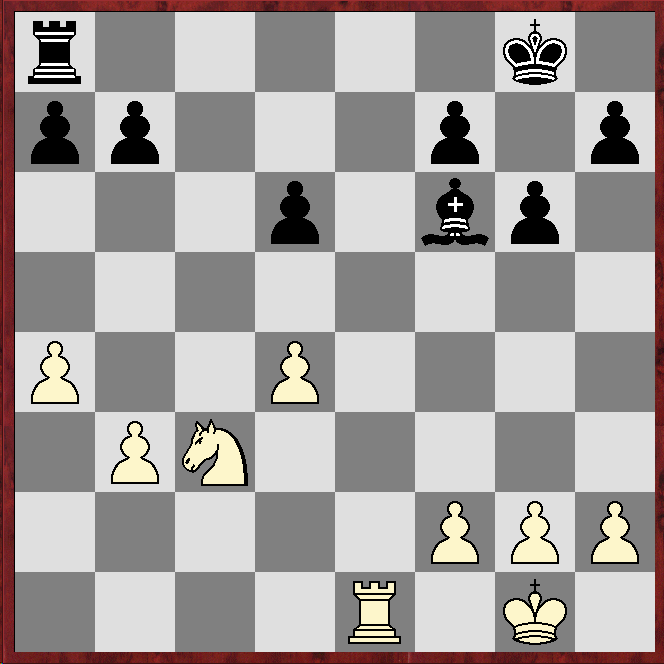
DO offered a draw in my time.
How would you assess this middlegame?
*****
*****
*****
*****
*****
Material is level, but with all the heavy pieces on the board, king safety is paramount. Dragon1 gives Black the upper hand, while Stockfish17 reckons Black only has a slight edge. In any event, Black's position is easier to play.
24.Qf3 Qc4+ 25.Qe2 Rxe1+ 26.Kxe1 Qc6!?
Indirectly defending e7.
27.Kd1 Bd8!?
This retreat is the engines' top choice.
28.Rd3 Qh1+ 29.Be1 f6!?
This is playable, but makes the position very sharp again.
30.Qe6+ Kh8 31.Qf7!?
How should Black proceed?
*****
*****
*****
*****
*****
31...Rg8
Clearly 31...Rxf7?? 32.Rxd8+ Rf8 33.Rxf8# is out of the question, but Black has two other ways to hold: a) 31...Qf3+ 32.Rxf3 Rxf7, although Dragon1 (but not Stockfish17) reckons White has a slight edge after both 33.Rd3 and 33.h5; b) 31...Qxe1+!? 32.Kxf1 Ba5+ 33.b4! Bxb4+ 34.c3 Rxf7 35.cxb4 g6.
32.g6?!
The game should probably have finished something like 32.Re3 Bb6 33.Re8 Qf4+ 34.Kd2 Qf4+, when the white king cannot escape perpetual check.
Black to play and gain at least a slight edge
*****
*****
*****
*****
*****
32...h6??
Also losing is 32...hxg6? 33.Qxg6 Rf8 (forced - White threatened 34.Qh5#) 34.Rd7. But the engines reckon 32...Bb6 keeps the position equal, while 32...Ba5! 33.c3 Qe4 gives Black the upper hand (Dragon1) or at least a slight edge (Stockfish17).
33.Qxg8+ 1-0

Monday, 16 December 2024

Coulsdon Round Four

DOWNFLOATED against a junior (born 2009).

Spanton (1965 ECF/2012 Fide) - Albert Eldrige (1851 ECF)
Blackmar-Diemer Gambit/Caro-Kann
1.e4 c6 2.d4 d5 3.Nc3 dxe4 4.Bc4!?
4.Bc4!? scores 52% in ChessBase's 2025 Mega database, the same as 4.Nxe4 but two percentage points higher than 4.f3!?
*****
*****
*****
*****
*****
Then again 4.Nge2 scores 67%, which presumably is largely down to its surprise value.
4...Nf6 5.f3!?
How should Black respond?
*****
*****
*****
*****
*****
5...c5!?
Probably a novelty. The mainline in Mega25 runs 5...exf3 6.Nxf3 Bf5 (6...e6!? is also very popular) 7.0-0 e6, with at least a slight edge for Black, according to Stockfish17 and Dragon1.
How should White proceed?
*****
*****
*****
*****
*****
6.d5!?
The engines agree this is best, although it, at least temporarily, blocks the light-square bishop. Stockfish17's second choice is 6.dxc5!?, continuing 6...Qxd1+ 7.Nxd1!? e6!?, awarding Black a slight edge. Dragon1's second choice, for a while, before switching to Stockfish17's preference, is 6.Bf4!?, when 6...cxd4 7.Nb5 Na6 8.fxe4!? Qa5+!? 9.Bd2 Qb6 10.e5 Bd7!? 11.a4 gives a sharp position that may be dynamically equal, but there are many plausible alternatives along the way.
6...Bf5?!
The bishop is vulnerable here. Stockfish17 suggests 6...Nbd7 or 6...a6!?, while Dragon1 advises acceptance with 6...exf3.
7.g4!? Bd7!?
After 7...Bg6 8.g5 Nfd7 9.fxe4 White is also doing well.
8.g5 Ng8?!
Probably better is 8...Nh5, meeting 9.fxe4 with 9...g6.
9.fxe4 a6 10.a4 h6?!
The engines suggest trying to block the centre with 10...e5, their point being 11.dxe6 Bxe6 12.Qxd8+ Kxd8 13.Bxe6 fxe6 leaves White on top - positionally winning, according to the engines - but with the black king in little danger of being mated. However they reckon White does better getting on with development, eg 11.Qf3.
11.Qf3 e6?
With the white queen off the d file, moving the e pawn is simply a mistake. The engines suggest the consistent 11...hxg5.
12.dxe6 Bxe6 13.Bxe6 fxe6 14.Qh5+ Kd7 15.Bf4 Kc8 16.Rd1 Qe7
Hardly much of an improvement, if at all, is 16...Nd7 17.Nf3 with Ne5 to come.
17.Bd6 Qxd6 18.Rxd6 Bxd6 19.Qe8+ Kc7 20.Qxe6
White has won queen and pawn for rook and bishop, giving a huge advantage, according to the engines (about +8.00), but with practical difficulties arising from the white king's lack of a safe haven 
*****
*****
*****
*****
*****
20...Nd7 21.Nd5+ Kc6 22.g6?!
Much better, according to the engines, is going after the black king with 22.b4 or developing with 22.Nf3.
22...Ngf6 23.Nxf6 Nxf6 24.e5 Rad8 25.Nf3 Rhe8 26.Qf5!?
The engines prefer 26.Qc4 or 26.Qb3.
26...Nd7 27.e6 Nf8 28.0-0 Rxe6
White's extra pawn has gone, but White is still winning, according to the engines
*****
*****
*****
*****
*****
29.Nh4 Be7 30.Qf3+ Kb6?!
Probably better is 30...Kc7 as the text allows White a simplifying continuation that removes danger from the white king.
31.Qb3+ Ka7 32.Rxf8! Re1+!?
This is best, according to the engines.
33.Rf1
Not 33.Kf2?? Bxh4+.
33...Rxf1+ 34.Kxf1 Bxh4
How would you assess this ending?
*****
*****
*****
*****
*****
White can win a pawn, which I assume means the ending is winning, although in queen-versus-rook-and-bishop endgames there is always the possibility of the weaker side setting up a fortress.
35.Qc3 Bf6 36.Qxc5+ Kb8 37.b3 Rc8 38.Qd6+ Ka8 39.c4 Rd8 40.Qe6 Rf8 41.Kg2 Rd8 42.c5 Kb8
One line illustrative of White's chances runs 42...Rd2+ 43.Kf3 Rxh2 44.Qxf6!? gxf6 45.g7 Rh3+ 46.Kg2 etc.
43.c6 Kc7 44.cxb7 Kxb7 45.a5 Ra8
The only way to defend the a6 pawn.
The game finished:
46.Qb6+ Kc8 47.Kf3 Bd8 48.Qc5+ Kb7 49.Qd5+ Ka7 50.Qd7+ 1-0

Thursday, 16 November 2023

Cap Negret Round Six

Looking from Altea Old Town towards Benidorm 
FACED a Spanish candidate master.

Spanton (1808) - Juan Bautista Sánchez (2094)
Caro-Kann Panov-Botvinnik
1.e4 c6 2.d4 d5 3.exd5 cxd5 4.c4 Nf6 5.Nc3 g6!?
This trails 5...Nc6 and especially 5...e6 in popularity, but scores an excellent 49% in ChessBase's 2023 Mega database, compared with 47% for 5...Nc6 and 45% for 5...e6.
How should White proceed?
*****
*****
*****
*****
*****
6.cxd5
Queen development with 6.Qb3 is more popular in Mega23, but the two moves usually transpose.
6...Bg7
In Mega23, 6...Nxd5 scores five percentage-points better.
7.Qb3 0-0
There are 2938 games with this position in Mega23
*****
*****
*****
*****
*****
Alexander Alekhine was first to reach the diagrammed position as White, at least in Mega23, and he played 8.Bc4!? against Max Euwe. The game was drawn, but when Alekhine had the same position a year later in a simul in Indonesia, he played what is today very-much the main move:
8.Be2
The idea is that the bishop will slide to f3, making it more difficult for Black to capture the d5 pawn.
8...Nbd7 9.Bf3 Nb6 10.Nge2 Bg4 11.Bxg4 Nxg4 12.a4
What should Black play?
*****
*****
*****
*****
*****
12...Qc8!?
Most popular in Mega23 is 12...a5, although Stockfish16 and Komodo14.1 reckon White has a slight edge.
13.0-0 Qc4!? 14.Qxc4 Nxc4 15.Bg5 Nf6 16.b3 Nb6!? 17.d6!?
This is a typical idea in this type of position. White recognises that the d5 pawn cannot be held in the long run, and so decides to give it back at a time when Black is obliged to capture with the e pawn.
17...exd6 18.Rfe1 Nbd5 19.Rac1 Rfe8 20.Bxf6!?
Initiating a forcing simplifying-sequence.
20...Nxc3 21.Nxc3 Rxe1+ 22.Rxe1 Bxf6
How would you assess this ending?
*****
*****
*****
*****
*****
Black has the better minor-piece for cooperating with a rook, but White has more space and a small lead in development. The engines reckon the position is completely equal.
23.Ne4 Bxd4 24.Nxd6 b6
This looks natural, but Black has a slight edge, according to the engines, after 24...Rd8. The point is 25.Nxb7? loses to 25...Rd7 26.Na5 Bc3.
25.Kf1 Bc5 26.Nf5 Kb8 27.Rd1 Ke7 28.f3 a6 29.Nc7 Ra7 30.Nd5+ Ke6 31.Nf4+ Kf6 32.Nd5+ Kf6 33.Nf4+ ½–½

Wednesday, 12 May 2021

Beat The ... Panov Attack

IN this series I am looking at the statistically best way to play against popular opening lines.
The numbers are drawn from the 2021 edition of ChessBase's Mega database, ignoring, where possible, those results that include very few games and so are statistically insignificant.

The Caro-Kann was once thought to be practically refuted by the Panov Attack: 1.e4 c6 2.d4 d5 3.exd5 cxd5 4.c4, and this system, aka the Panov-Botvinnik Attack, is still popular, especially at club level.
Easily the most-popular reply, 4...Nf6, is also the most successful statistically, scoring 46%, and after 5.Nc3 we reach a position with almost 35,000 games in Mega21.
Here Black's commonest continuations are 5...e6, which scores 44%, 5...Nc6, which scores 47%, and 5...g6, which scores 49%.
But all those moves are eclipsed, at least statistically by Evgeny Agrest's speciality 5...Be6!?, which scores 53%.
Position after 5...Be6!?
This move surprises many whites, which partly explains why no reply has become dominant. I will look at the six most-frequent continuations, although none is especially popular.

A) 6.c5 (100 games)
After 6...g6 the line splits.
A1 7.Nf3 Bg7, after which the line splits again.
A1.1 8.Bb5+ Bd7!? scores 70% for Black, albeit from a small sample.
A1.2 8.Bd3 0-0 9.0-0 scores 80% for Black, albeit from a small sample.
A2 7.Qb3 Qc8 scores 62% for Black, albeit from a small sample.

B) 6.Nge2 (54 games)
After 6...dxc4 7.Nf4 Bg4 8.f3 Bd7 9.Bxc4 e6 the line splits.
B1 10.d5 e5 11.Nd3 Bd6 scores 50% for Black.
B2 10.0-0 Bd6 scores 60% for Black.

C) 6.Nf3 (32 games)
After 6...dxc4 the line splits.
C1 7.Ne5 Nc6 8.Nxc6 bxc6 9.Qa4 Qd7 10.Bxc4 Bxc4 11.Qxc4 e6, after which the line splits again.
C1.1 12.0-0 Bd6 scores 70% for Black, albeit from a small sample.
C1.2 12.Bf4 Be7 13.0-0 0-0 14.Rac1 Rac8 scores 75% for Black, albeit from a very small sample.
C2 7.Bg5 Nd5 8.Qa4 Nc6 9.Ne5?! (played in eight of the 14 games to reach this position - Stockfish13 and Komodo12.1.1 give 9.Qxc4, but much prefer Black) Nxc3 10.bxc3 Qa5 11.Qxa5 Nxa5 scores 92% for Black, albeit from a small sample.
C3 7.Ng5 Bd5, after which the line splits again.
C3.1 8.Nxd5 Qxd5 9.Be2 e6 10.0-0 Nc6 scores 87% for Black, albeit from a small sample.
C3.2 8.Qa4 Nc6 scores 80% for Black, albeit from a small sample.
C4 7.Qa4+ Nc6 8.Bxc4 Bxc4 9.Qxc4 e6 10.0-0 Be7 scores 64% for Black, albeit from a small sample.
C5 7.Be2 Nc6 8.0-0 g6 scores 80% for Black, albeit from a small sample.
C6 7.Bxc4?? (there are six games with this blunder in Mega21) Bxc4 8.Qa4+ b5 scores 100% for Black, albeit from a small sample.

D) 6.cxd5 (29 games)
After 6...Bxd5!? the line splits.
D1 7.Nf3 Nc6, after which the line splits again.
D1.1 8.Be2 e6 9.0-0 Be7 10.Ne5 0-0 scores 62% for Black, albeit from a small sample.
D1.2 8.Nxd5, when Black scores 83% with both 8...Nxd5 and 8.Qxd5, albeit from small samples.
D1.3 8.Bb5 e6 scores 64% for Black, albeit from a small sample.
D1.4 8.Be3 e6 9.Be2 Be7 10.0-0 0-0 scores 90% for Black, albeit from a small sample.
D2 7.Nxd5 Nxd5 scores 75% for Black, albeit from a very small sample.

E) 6.Bg5 (27 games)
After 6...dxc4 7.Bxf6!? exf6 8.d5 Bf5 9.Bxc4 Bd6 Black scores 75%, albeit from a small sample.

F) 6.Qb3 (18 games)
After 6...Nc6 Black scores 61%, albeit from a small sample (note that 7.Qxb7?! Nxd4 is good for Black).

Sunday, 11 April 2021

Beat The ... Caro-Kann

IN this series I am looking at the statistically best way to play against popular opening lines.
The numbers are drawn from the 2021 edition of ChessBase's Mega database, ignoring, where possible, those results that include very few games and so are statistically insignificant.

The Caro-Kann: 1.e4 c6 2.d4 d5 is one of those openings whose popularity fluctuates at elite tournaments but tends to remain steady among club players.
White's best response statistically is 3.f3, which scores 58%.
Position after 3.f3
Since White's third move is clearly non-forcing, it is not surprising Black has seven reasonably popular replies.

A) 3...e6 (3,202 games)
White's most-successful try is 4.Nc3, to which Black has two main responses.
A1 4...Bb4, after which the position looks like a French Winawer, but with the extra moves f3 and c6. White's commonest continuation is 5.Bf4, which scores 57%, but White scores 59% with 5.a3, when the line splits.
A1.1 5...Bxc3+ 6.bxc3 dxe4 7.Nh3!? (not 7.fxe4? Qh4+), reaches a position that occurs just 10 times in Mega21. Four of those games saw 7...Qa5 8.Bb2, with White scoring 75%.
A1.2 5...Ba5 occurs just 24 times in Mega21. White scores 88% with 6.Bf4.
A2 4...Nf6 5.e5 Nfd7 6.f4 c5 is a transposition to the absolute main line of the Steinitz Variation of the French, which will normally not be what a Caro-Kann player is wanting. There are more than 21,500 games in which White continues 7.Nf3, scoring 57%, but fewer than 400 in which White plays 7.Nce2, scoring 58%.

B) 3...dxe4 (2,384 games)
Black has two main ways of meeting 4.fxe4.
B1 4...e5 5.Nf3, after which the line splits.
B1.1 5...exd4 6.Bc4, when the line splits again.
B1.1a 6...Be6 7.Bxe6 fxe6 8.0-0 scores 79% for White.
B1.1b 6...Be7 7.0-0 Nf6 8.Ng5 0-0 9.Nxf7!? Rxf7 10.Bxf7+ Kxf7 11.e5 scores 80% for White.
B1.1c 6...Nf6 7.0-0 Bc5 (7...Be7 is a transposition to B1.1b) 8.Ng5 0-0 has been reached 13 times in Mega21. White scores 88% with 9.Nxf7, but Stockfish13 and Komodo12.1.1 reckon 9...Qe7!? seriously muddies the water. They much prefer 9.Bxf7+!? Rxf7 11.Nxf7.
B2 4...Nf6 5.e5 Nd5 6.c4 resembles an Alekhine and scores 77% for White.

C) 3...g6 (1,068 games)
After 4.Nc3 Bg7 5.Be3 Black has four main replies.
C1 5...dxe4 6.fxe4 leads to another split.
C1.1 6...Nf6 7.Nf3 0-0 8.h3 scores 69% for White.
C1.2 6...e5 7.Nf3 exd4 8.Bxd4 Bxd4 9.Qxd4 scores 63% for White.
C2 5...Qb6 and now the most-popular move 6.Qd2 scores only 43% for White, but 6.a3!? scores 55%.
C3 5...Nf6 6.e5 scores 61% for White against both 6...Nfd7 and 6...Ng8!?
C4 5...e6 6.Qd2 scores 70% for White.

D) 3...Qb6 (439 games)
Black has two main ways of meeting 4.Nc3
D1 4...dxe4 5.dxe4 e5!? 6.Nf3 exd4 7.Nxd4, after which the line splits again.
D1.1 7...Bc5 8.Na4 Qa5 9.c3 Be7 10.b4 scores 69% for White, albeit from a small sample, while 9...Bd6 10.Nf3 scores 75% for White, but again from a small sample.
D1.2 7...Nf6 8.e5 Ng4 9.e6!? Bxe6 10.Bc4!? Bxc4 11.Qxg4 scores 60% for White, again from a small sample.
D2 4...e6 White has usually met this with 5.a3, but only scored 44%. Much better, statistically, is the 83% of 5.a4!?, but it is from a much-smaller sample.

E) 3...e5!? (266 games)
After 4.dxe5 Bc5 5.Nc3 Black has two main replies.
E1 5...Qb6 6.Na4, after which the line splits again.
E1.1 6...Qa5+ 7.c3 Bxg1 8.Rxg1 scores 60% for White.
E1.2 6...Bf2+ 7.Ke2 Qd4 8.Qxd4 Bxd4 reaches a position that occurs 19 times in Mega21. Most popular is 9.exd5, which scores 54%, but the engines much prefer 9.f4, which scores 67%, albeit in just three games.
E2 5...Ne7 6.Bd3 0-0 reaches a position that occurs just six times in Mega21, and again the engines like pushing the f pawn, 7.f4.

F) 3...Nf6 (257 games)
After 4.e5 Black has two replies.
F1 4...Nfd7 5.f4 e6 6.Nf3 c5 7.Nc3 is another transposition to a mainline French Steinitz, from which White scores 57%.
F2 4...Ng8!? 5.Bd3 e6 6.f4 scores 60% for White, rising to 75% after 6...c5 7.c3.

G) 3...Nd7 (141 games)
White scores 72% with 4.Nc3 (White scores 77% with 4.Bd3, but that only occurs 11 times in Mega21). Black has two main replies.
G1 4...e6 5.Be3 Bb4 6.Bd3 scores 75% for White.
G2 4...Nb6!? 5.Bf4 scores an amazing 93% for White, but only occurs seven times in Mega21. Slightly more frequent, with 11 appearances, is 5.Be3, which is preferred by the engines and scores 64%.

Friday, 30 October 2020

'Secret' Gambit Repertoire For White (part five)

BELOW is an article I posted in April that shows how to turn the Caro-Kann into a Blackmar-Diemer Gambit.

HERE is a way to spice up the Caro-Kann by effectively turning it into a Blackmar-Diemer Gambit: 1.e4 c6 2.d4 d5 3.Nc3 dxe4 4.f3!?
Spanton (2021)- Alan Ormsby (1995)
Isle Of Man 2003
4...e3?!
Accepting the gambit, which I will come to next, is overwhelmingly Black's most-popular choice in ChessBase's 2020 Mega database.
The text is Black's second-most common move, but if declining the gambit is what Black wants to do, it is almost certainly better to play 4...e5. This is sometimes cited as a refutation of White's fourth move, and is one of the reasons many whites prefer 4.Bc4!?, planning f3 on the next move.
After 4...e5, the main line runs 5.dxe5 (Milner-Barry preferred 5.Be3!?) Qxd1+ 6.Nxd1 exf3 7.Nxf3, with a position that may be better than is commonly supposed. Black's most-popular continuation in Mega20 is 7...Bc5, whereupon the analysis engines Stockfish10 and Komodo10 continue 8.Bc4 Ne7 9.Be3 Bb6 10.Ng5 0-0 11.0-0 with what they reckon is a slight edge for White, presumably based on White's lead in development.
5.Bxe3 Bf5
Marginally more popular in Mega20 is 5...Nf6, but then 6.Bd3 leaves Black struggling to find a good square for his light-square bishop. That is by no means the end of the world, but the engines give White a slight edge.
6.Nge2
This was the choice of German international master René Stern - now a GM - when he had this position in 2001, but the engines reckon even stronger is 6.g4!? Bg6 7.Nge2.
6...h6 7.Ng3 Bh7 8.Bd3 Bxd3 9.Qxd3
White is better thanks to having four pieces developed to Black's none, and Black is yet to open a diagonal for his king's bishop (1-0, 93 moves).
**********
Accepting the gambit is much more popular.
Nicolas Bertrand (1923) - Laurent Picart (2170)
Fouesnant (France) 2009
4...exf3 5.Nxf3 Nf6
This is Black's most-flexible response, leaving open the question of where to develop the light-square bishop. It is also a direct transposition to the Ziegler Defence in the Blackmar-Diemer Gambit.
Most popular in Mega20 is 5...Bg4, when the engines want White to sac a second pawn with 6.h3 Bxf3 7.Qxf3!? Qxd4 8.Be3.
Then the normal continuation of 8...Qf6 9.Qg3 gives White at least full compensation (bishop-pair, lead in development, exposed black queen) for the pawns, according to the engines. So they suggest 8...Qh4+ 9.g3 Qf6, when White does not have the sidestep Qg3. The only game to reach this position in Mega20, Helmut Küspert (1948) - Hubertus Schulze (2096), Landesliga North 2006, saw 10.Qg4 Nd7 11.0-0-0 e6, when Black is surely better, and did go on to win, but the position is tricky to play for Black.
Although Komodo10 likes 6.h3, Stockfish10 comes to reckon calmer play with 6.Be3 or 6.Bd3 is better. After the latter, Black can still win a second pawn by 6...Bxf3?! 7.Qxf3 Qxd4, but Bd3 is a much-more useful move for White than h3, and the engines reckon White gets an advantage with 8.Bf4.
6.Bc4
Gary Lane's recommendation in his 1995 Batsford book Blackmar-Diemer Gambit.
The engines prefer 6.Bd3 (the game reached the position with 6.Bc4 in a slightly different move-order, so 6.Bd3 was not an option), but since Black has not moved his e pawn, 6...g6 seems to be a good answer, as does the more-popular 6...Bg4, although in both cases White has some compensation for the pawn in the shape of a lead in development and useful half-open files.
6...e6
Black's most-popular reply in Mega20, but there is a lot to be said for first developing Black's light-square bishop. This is best done by 6...Bf5, which warrants consideration in a separate game.
Note, however, that 6...Bg4?, as played in 44 games in Mega20, is embarrassing if White finds 7.Bxf7+! etc.
7.0-0 Be7 8.Qe1
White is not being subtle about which part of the board he will attack on, but Black is more-or-less committed to castling short as his queenside is completely undeveloped.
8...0-0 9.Bg5
The engines suggest an interesting apparent-novelty, 9.Ne4!?, eg 9...Nbd7 10.Bd3 Nxe4?! 11.Qxe4 Nf6 12.Qh4 with advantage. Probably better in this line is Stockfish10's 10...c5 11.Nxf6+ Nxf6 12.Qh4, but with strong kingside pressure for White.
9...Nbd7 10.Qh4!?
Stockfish10 prefers 10.Bd3!?, although Lane calls that "a Teichmann Defence [1.d4 d5. 2.e4 dxe4 3.Nc3 Nf6 4.f3 exf3 5.Nxf3 Bg4] where White has lost time by moving the king's bishop twice."
10...Re8
This comes to be Stockfish10's choice, but Komodo10 prefers 10...h6, although then Stockfish10 gives 11.Bd3 Re8 12.Bxh6! gxh6 13.Ne5 Bf8 14.Rf3 Bg7 15.Rg3, when Black seems forced to give back his extra piece by 15...Ne4. After 16.Qxe4, Black keeps in the game with 16...f5, but White is better.

How should White proceed?

*****
*****
*****
*****
*****
11.Bd3?!
Probably better is the typical BDG move, 11.Ne5. White may have feared the exchanges that seem forced after 11...Nxe5 12.dxe5 Nd7, but Stockfish10 gives 13.Bd3 Nf8 14.Bf6!, which it reckons is winning, eg 14...gxf6 15.exf6 Ng6 16.Bxg6 hxg6 17.Ne4!. Komodo10 suggests 14...Bd7, and after 15.Ne4 it gives 15...b5, but 16.Qh5! wins, eg 16...Bxf6 17.Nxf6+! gxf6 18.exf6 etc. A fantastic line, but very typical of the Blackmar-Diemer Gambit.
11...Nf8
The engines suggest 11...h6, but then Stockfish10 finds 12.Bxh6! gxh6 13.Ne5 with similar play to the note at Black's 10th move.
12.Ne5 Ng6
This is best, according to the engines, but after …
13.Bxg6 hxg6?
… Black is lost. He had to play 13...fxg6, although White has a big initiative for his pawn after both 14.Rf3 and 14.Rad1.
14.Rf3 Nh7
There is no satisfactory defence.
15.Rh3 Bxg5 16.Qxh7+ Kf8 17.Qh8+ Ke7 18.Qxg7 1-0
After 18...Qxd4+ 19.Kh1 Rf8 comes 20.Nxg6+.
**********
Although 6...e6 is the most-popular move in Mega20, Lane treats 6...Bf5 as the main line, and that move is preferred by the engines.
Spanton (2004) - Richard Almond (2158)
Isle Of Man 2004
7.0-0 e6 8.Ne5
This threatens 9.Nxf7!

How should Black proceed?

*****
*****
*****
*****
*****
8...Bg6
The tempting 8...Bxc2?! is probably less good, as was shown by future IM Gerard Welling in a 1981 game, where he found 9.Nxf7! After 9...Kxf7 Welling played 10.Qg4?!, which was thought strong, but that verdict seems to have been reversed by the game Ian Webster (2116) - Michael Compston (1835), 4NCL (Telford) 2005, where Black's 10...Qd6! was instantly winning, according to the engines. The game continued 11.Bg5 Nbd7 12.Rae1 Re8, when it is hard to see what, if anything, White has for his sacrificed knight and pawn (0-1, 48 moves). However, Welling's concept still works, but with the follow-up 10.Qxc2!, which was played in Steven G Burke (2055) - Ian G Gallagher (2005), 4NCL (Sunningdale) 2007. The game continued 10...Qxd4+, upon which White unleashed 11.Be3!! The game saw 11...Qxc4 12.Rf4!, trapping the queen (if 12...Qa6, then 13.Ra4). Materially, Black is not badly off, but his lack of development and weak e pawn give White a large advantage, according to the engines (but 0-1, 57 moves).
Going back to the position after 9.Nxf7!, Black can try 9...Bxd1 10.Nxd8 Kxd8, but after 11.Rxd1, White's bishop-pair and Black's weak e pawn give White good compensation for his pawn-minus.
9.Be3
If you give the engines enough time, Stockfish10 settles on a novelty, or at least a move that is not in Mega20, viz 9.Nxg6!? The move also comes to be Komodo10's second choice - just 0.02 of a pawn behind 9.Bf4.
The idea, at least as I understand it, is that White will not go for a quick tactical knockout, as is often White's aim in the BDG. Instead White will rely on the bishop-pair and better pawn-structure to create long-term compensation. I am sympathetic to this, as will become clear, but there is no need to commit to it this early.
Instead I have gone for the developing 9.Be3, which for a long time is Komodo10's top choice, and is second in popularity in Mega20 to 9.Bg5.
9...Nbd7
As Black can capture on e5, now is the time to implement Stockfish10's idea:
10.Nxg6 hxg6
After the further moves ...
11.Qf3 Be7
… we have reached a position I wish to elaborate on. The game Spanton - Almond got here via a slightly different move-order, but I have used the move-order that arises from the Caro-Kann.
Lane says of the Ziegler Defence: "This line is a popular and important method of defence. It involves a pawn-formation similar to the Caro-Kann and has a sound reputation."
I would add that it is particularly effective when Black avoids the popular 6...e6 and instead develops his light-square bishop outside the pawn-chain. This is reflected in White scoring a healthy 54% after 6...e6, but just 33% after 6...Bf5.
The stats and the engines' assessments add up to the fact that Black has a good position that cannot realistically be blown away.
That is why I believe, if Black gets as far as the position after 9...Nbd7, and it requires some precise choices along the way, White should take the bishop-pair and settle in for the long-term.
I think this game is a reasonable example of how that can pan out in actual play.
12.Ne4
I see from my original notes that I realised, pretty soon after the game, that completing development with 12.Rae1 or 12.Rad1 is more logical, and the engines agree, although I also see Crafty19.01 preferred the text.
12...Nb6
It was too much to hope for 12...Nxe4?? 13.Qxf7# (but I did hope for it!).
13.Bb3
White loses the bishop-pair after 13.Bd3?! Nbd5 14.Bf2 Nb4.
13...Nbd5 14.Bf2
Komodo10, which I believe has a more positional feel than Stockfish10, which is usually better at finding deep combinations, likes the text. Stockfish10 prefers 14.Ng5?! Nxe3 15.Qxe3, when maybe the opposite-coloured bishops would give hope of drawing chances, but it would be a bleak position to play as White.
14...Nxe4!?
This is the engines' choice, but exchanging a pair of knights makes it less likely White will forfeit the bishop-pair.
15.Qxe4 Bd6 16.g3!?
I felt 16.h3 left White very weak on kingside dark squares, as well as setting up a possible sac on h3. The text also denies Black's pieces use of the f4 square.
16...Qg5 17.h4!?
I gave this an exclamation mark when I first wrote up the game, but today's engines are not overly impressed, preferring 17.Qf3 or 17.Rae1.
17...Qe7
Black could seek an exchange of queens with 17...Qf5, but such an exchange normally enhances the power of the bishops because they become the only pieces with long-range diagonal movement. There is also the point that in this specific position, White's king looks the more vulnerable, which is a reason to keep queens on the board.
18.c4 Nf6 19.Qf3 0-0
This is Komodo10's choice, but Stockfish10 prefers 19...0-0-0. From a practical view, long castling offers White more chances of counterplay.
20.g4?
I apparently played this to prevent ...Nh5, but getting on with development with 20.Rae1 is better.
20...Bc7
Preparing a bishop-queen battery on the b8-h2 diagonal.
21.Kg2 Qd6 22.Rh1 b5
The engines prefer a developing move such as 22...Rad8.
23.Rac1 Qf4?!
The engines reckon Black keeps a bigger edge with 23...bxc4 or 23...a5.
24.cxb5 cxb5 25.Rc5 a6 26.Qxf4 Bxf4 27.Kf3 Bd2
Or 27...Bd6 28.Rc6, when again Black's bishop is short of good squares.
28.Rd1
The engines reckon 28.g5 equalises, eg 28...Nd5 29.Bxd5 exd5 30.Rxd5 f6 31.gxf6 Rxf6+ 32.Ke2 Raf8 33.Bg3 Bh6, when White's better pawn-structure presumably cancels out Black's piece-activity and better coordination.
28...Bb4 29.Rc6 Rfd8
If 29...Rfc8, then 30.Rdc1, when 30...Rxc6 31.Rxc6 leaves Black with a horribly passive queen's rook. Therefore 30...Rd8 is better, in which case it is better to play it at move 29, as in the game.
30.Rdc1 Nd5 31.a3 Bf8 32.Ke4
White can equalise by giving up the bishop-pair, according to the engines, ie 32.Bxd5!? Rxd5 33.Rc8.
32...Ne7 33.R6c2 Rac8?!
Black contests the open file and is happy if the rooks come off as that gets him into an ending a pawn up, but it would also enhance the power of the bishops as, with rooks off, White will be 2-1 up on long-range pieces.
The engines reckon Black keeps an edge with 33...a5.
34.Bg3
Also good is 34.Rxc8.
34...Rxc2
This is fine, but after …
35.Rxc2
… Black should probably play 35...Nd5, when 36.Bxd5 Rxd5 37.Rc6 gives White full compensation for his missing pawn, according to the engines.
Instead the game saw …
35...Rc8?! 36.Rxc8 Nxc8 37.d5
… when more lines open for the bishops.
37...f5+?!
Better, according to the engines, is 37...exd5+ 38.Kxd5 Ne7!, when the white king cannot safely advance. My old Crafty19.01 thought the game would be equal, while whatever version of Fritz I had at the time gave Black a slight edge. But my modern engines prefer White, one line running 39.Ke4 Nc6 40.g5 Ne7 41.Bf4 Nf5 42.h5 Ne7 43.hxg6 Nxg6 44.Bd2, when Black's queenside looks vulnerable, but the position is unclear.
38.Kf3
After 38.gxf5? exf5+ 39.Kd4, Black has a protected passed pawn and activates his king with 39...Kf7, which the engines reckon makes Black slightly better.
38...Kf7?!
Black faced a tricky decision, but this is probably not the right answer.
The engines suggest 38...Be7 39.dxe6 Kf8, but then White has restored material equality while keeping the bishop-pair.
If 38...fxg4+ 39.Kxg4 exd5, the black king is sidelined by 40.Bxd5+ Kh7. But if instead 39...Kf7, then 40.dxe6+ again restores material equality while keeping the bishops.
39.dxe6+ Ke7
I thought 39...Kf6!? might be better as, although 40.g5+ drives the black king to e7 anyway, Black gets a protected passed pawn. But the engines prefer 40.Bc1, eg 40...g5 41.Bc3+ Kg6 42.h5+ with a large advantage. If Black meets 40.Bc1 with 40...Nd6, then the engines like 41.g5+ Ke7 42.Bd5 with massive coordination problems for Black.
40.Be5 Nb6
The engines suggest 40...Nd6 41.gxf5 Nxf5, but then comes 42.Kg4 with Kg5 to follow.
41.Bd4 Nc8
If 41...Nc4, then 42.Bxc4 bxc4 43.Bc5+ brings a winning pawn-ending.
42.gxf5 gxf5 43.Kf4 Kd6
Or 43...g6 44.Kg5.
44.Kxf5 Ne7+ 45.Ke4 Ng6
Enticing the h pawn forward does not help, but Black is lost anyway.
46.h5 Ne7 47.Bc3 Kc6
Or 47...Nc6 48.Bd5 Ne7 and 49.Bb4+ or 49.Be5+.
48.Ke5 Kc7 49.Bd5 Nc8 50.Ba5+ Kb8 51.Bb4 Ne7
Perhaps 51...Bxb4!? 52.axb4 Kc7 was worth a try, but then the quickest win, according to the engines, comes from 52.e7! Nxe7 53.Ke6 as 53...Nxd5 54.Kxd5 Kd7 loses to 55.Kc5 (but not 55.b3? Ke7) Kc7 56.b3 etc.
52.Bxe7!
Bringing about opposite-coloured bishops, but this is the clearest way to win.
52...Bxe7 53.Kf5 Kc7
Or 53...Bf6 54.h6 Bxb2 55.e7.
54.Kg6 Kd6 55.Ba2 a5 56.Kxg7 Bg5 57.Kf7 b4 58.axb4 axb4 59.h6 Bxh6 60.e7 1-0
This game illustrates how tricky it can be to play against a bishop-pair, even with a small material advantage (in this case an extra-but-doubled pawn).
**********
CONCLUSIONS
Ending up in a Blackmar-Diemer Gambit will come as an unpleasant surprise for many Caro-Kann players. Even more so if they in their games as Black against 1.d4, they usually reply with something other than 1...d5 (so ruling out a pure BDG).
And if they do happen to meet 1.d4 with 1...d5, and so by necessity have a line ready for the BDG, it may not be the Ziegler Defence with an early ...c6.
All in all, White has a good chance with 1.e4 c6 2.d4 d5 3.Nc3 dxe4 4.f3!? of getting the opponent on unfamiliar ground.