Sunday, 7 December 2025

Lessons From Benidorm

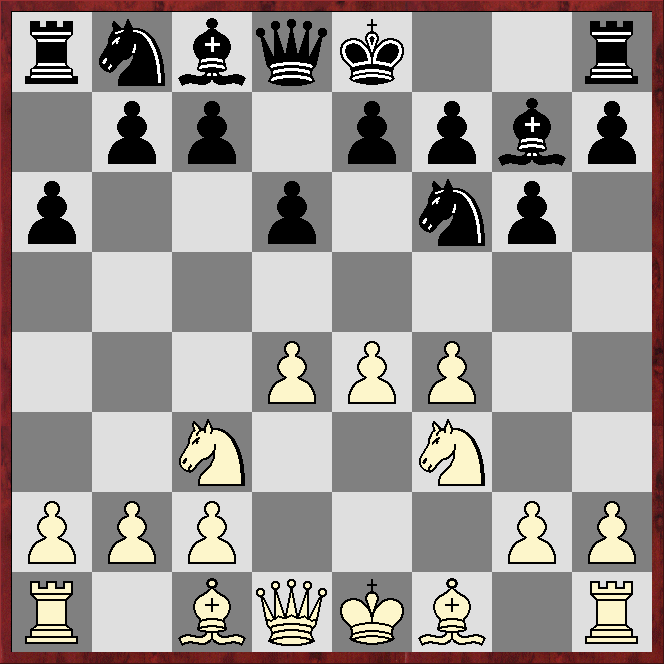
MY round-one game, where I had black against Samuel Salas Lerida (1669), reached a position after 10 moves that is not easy to judge.
I have just played 10...0-0
*****
*****
*****
*****
*****
*****
*****
The position is reminiscent of a Maróczy Bind for Black, except that the black d pawn has been swopped for White's e pawn, rather than for White's c pawn. Black has more space and is slightly more developed, while White has a slightly weakened king's position.
I cannot recall my exact thoughts, but I am fairly sure during the game I thought I had at least a slight edge.
However, Stockfish17.1 and Dragon1 reckon the game is equal (although Dragon1, if given plenty of time, comes to slightly favour Black), but with a big proviso - the 'equality' only applies if White quickly takes vigorous steps to break the bind.
Generally speaking, there are three ways to break a Maróczy Bind - by attacking it with the b pawn, the d pawn or the f pawn.
The first two options are not in play in the diagram, and are unlikely to be for quite some time, but White can instead play 11.g4!? Bg6 12.f4!, when Black has nothing better than 12...exf4, after which 13.Nxf4 gives a level game, according to Stockfish17.1, although Dragon1 slightly favours Black.
Note that 12...Nxg4!? runs into 13.f5 Bh5 14.Bxc6!? bxc6 15.Ng3, when the engines reckon White has the upper hand.
In the game White played a developing move, 11.Bg5, but after 11...h6 12.Bxf6 Bxf6 13.Ne4 Be7 the bind was intact, Black had the bishop-pair, and the knight at e4 invited Black to play the aggressive ...f5.
LESSON: I do not claim the engines' line with 11.g4!? and 12.f4! is obvious, at least not below master level, but it is an example of playing to the specifics of a position - "Black has a bind - I should be looking for a way to break it" - rather than just developing.

Saturday, 6 December 2025

Correspondence Chess

I PLAY correspondence chess at the Fide-recognised International Correspondence Chess Federation, where the strength of modern engines means most games are drawn, but occasionally one escapes that fate, or is interesting for other reasons.

David Hardingham (1895) - Spanton (2330)
British Correspondence Chess Championship Reserves
Ponziani
1.e4 e5 2.Nf3 Nc6 3.c3
The Ponziani scores a respectable 55% in ChessBase's 2026 Mega database
*****
*****
*****
*****
*****
3...Nf6
This is the commonest continuation, but 3...d5 scores seven percentage points more.
4.d4 Nxe4
Even more popular, but less successful percentagewise, is 4...exd4.
5.d5
How should Black proceed?
*****
*****
*****
*****
*****
5...Bc5!?
More popular are 5...Nb8 and especially 5...Ne7, the latter being Dragon1's choice; Stockfish17.1 likes the text.
6.dxc6
Accepting the sacrifice is more-or-less obligatory as 6.Be3?! Bxe3 7.fxe3 Ne7 8.Nxe5 0-0 is good for Black.
6...Bxf2+
Probably not 6...Nxf2?! Qd5.
7.Ke2 Bb6!
The engines agree this is best, although Dragon1 is less certain than Stockfish17.1
8.Qd5!
Capturing on b7 or d7 speeds Black's coming attack.
8...Nf2
What should White play?
*****
*****
*****
*****
*****
9.Rg1
The alternative is 9.cxb7 Bxb7 10.Qxb7 Nxh1, with an unclear position, but one which the engines reckon probably slightly favours Black.
9...0-0
Dragon1 suggests an apparent-novelty, 9...dxc6!?
10.cxb7
Dragon1 reckons this is winning, but after ...
10...Bxb7 11.Qxb7
... downgrades White's advantage to having the upper hand. Meanwhile, Stockfish17.1 has been giving Black a steady slight edge.
11...Qf6 12.Qa6?!
Peruvian 2500+ international master Renato Terry has won Titled Tuesday blitz games with 12.Nbd2 and 12.Qd5.
12...e4!
An improvement on the known 12...Qf5.
13.Nd4 c5 14.Nc2
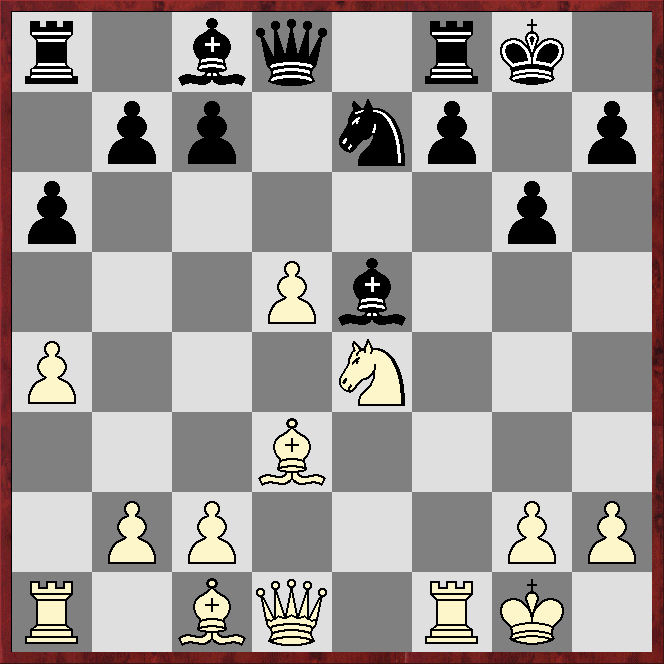
Black is down two pieces for two pawns, but has at least the upper hand, according to Stockfish17.1
*****
*****
*****
*****
*****
14...d5
Dragon1's evaluation has undergone a massive transformation - it now likes Black's position even more than Stockfish17.1 does.
15.Be3 Ng4 16.Nd2?
The engines suggest 16.Kd1 or 16.Bxc5.
16...d4
Black is recovering a major amount of material
*****
*****
*****
*****
*****
17.Nxe4
Or 17.cxd4 cxd4 18.Bxd4 Qf5 19.Kd1 Bxd4 20.Nxd4 Qf2 21.Qe2 (21.Rh1? Ne3+ 22.Kc1 Qe1#) Ne3+ 22.Kc1 Qxg1, with a continuing attack for Black.
17...Qg6 18.Re1 dxe3 19.Kd1 Rad8+ 20.Kc1 Qxe4
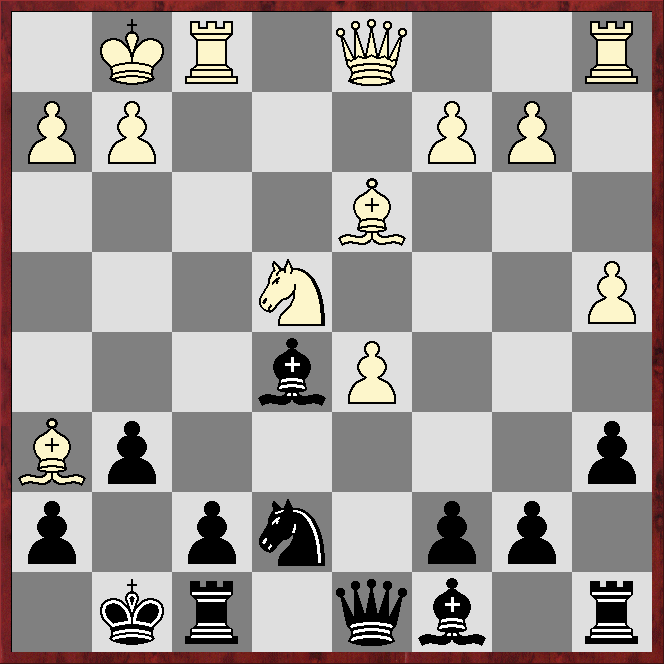
White's king has reached (relative) safety, but Black has emerged a pawn up, and the extra pawn is already on the sixth rank
*****
*****
*****
*****
*****
*****
21.Qc4 Qg6 22.h3 Ne5 23.Qb5 a6!? 24.Qa4
Probably not 24.Qxa6?! Rd2 25.Na3/e3 c4.
24...c4!? 25.Bxc4 Nxc4 26.Qxc4 Rd2 27.Nd4 Qe4
27...Bxd4 is met by 28.cxd4, although this is also good for Black.
28.Qc6 Rxd4! 29.Qxe4 Rxe4 30.Re2 Rf4 31.Rge1 Rf2 32.b4 f5 33.c4 Bd4 34.Rxe3!? Bxe3 35.Rxe3 f4 36.Rf3 Rxa2 37.c5 Rxg2 38.h4 Rg3 39.Rf2 f3 40.Kd2 Rg2 0-1

Summing Up Benidorm Bali

MY score in the U2000 of +3=5-0 (I also took a halfpoint bye) gained exactly two Fide elo.
I now have an 11-game over-the-board unbeaten streak, during which I have scored +5=6-0, performing roughly 68 elo above my average rating for those games.

Friday, 5 December 2025

Benidorm Bali Round Nine

FACED  a Romanian.

Emilian-Paul Ioniță (1972) - Spanton (1896)
Vienna Game
1.e4 e5 2.Nc3 Nf6 3.Bc4 Nxe4!?
This well-known combination, which relies on 4.Nxe4 being met by 4...d5, is not the top choice of Stockfish17.1 or Dragon1 - they prefer 3...Bc5 or 3...Nc6.
4.Qh5 Nd6 5.Bb3 Be7!?
This has taken over from 5...Nc6 as the most popular continuation. After 5...Nc6 the main line in ChessBase's 2026 Mega database runs 6.Nb5!? g6 7.Qf3 f5 8.Qd5 Qe7 9.Nxc7+ Kd8 10.Nxa8, which used to be regarded as a very promising sacrificial line for Black, but the engines are unimpressed, awarding White at least a slight edge.
6.Qxe5 0-0 7.Nf3!?
More prudent, and a little more popular in Mega26, is 7.Nge2, but the engines reckon the more-aggressive 7.Nf3!? is a tad better.
7...Bf6!?
Trying to exploit the fact that White's king is uncastled, but White scores 64% in Mega26 against this move, so the other way to hit the white queen, 7...Nc6. may be better.
Where should the white queen go?
*****
*****
*****
*****
*****
8.Qf4!
This is the only way to gain an advantage, according to the engines, which reckon every other move gives Black at least a marginal edge.
8...Re8+
How should White proceed?
*****
*****
*****
*****
*****
9.Kd1
Also possible is 9.Kf1, but not 9.Ne2? as that loses to 9...Re4!, eg 10.Qg3 Nf5! 11.Qh3 d5 12.d3 Rxe2+! 13.Kxe2 Nd4+ 14.Nxd4 Bxh3.
9...Nc6 10.d3
Dragon1 prefers 10.Nd5!?, but Stockfish17.1 fluctuates between the two moves.
10...Ne7!
Taking the sting out of Nd5, and making it possible to hit the white queen with ...Ng6.
11.g4?!
Probably a novelty, but Stockfish17.1 prefers the known 11.h4, and Dragon1 likes another known continuation, 11.Nd5 Nxd5 12.Bxd5.
11...Ng6 12.Qg3 Nh4?!
Black is at least slightly better after 12...Bxc3!? 13.bxc3 Qf6, according to the engines.
13.Bf4
The engines fluctuate between the text and 13.Nd5.
13...Nxf3 14.Qxf3 Be5
The engines suggest 14...Bxc3 15.bxc3 Qf6, or offering the exchange with 14...Re6!?, but anyway much prefer White.
15.Kd2?!
White is positionally winning after 15.Bxe5 Rxe5 16.h4, according to the engines.
15...Qf6 16.Nd5
An only-move.
16...Bxf4+ 17.Qxf4 Qxf4+ 18.Nxf4
Now queens are off the board, how would you assess the position?
*****
*****
*****
*****
*****
Black has difficulties completing queenside development, and so is slightly worse, according to Dragon1, but Stockfish17.1 reckons the game is equal, presumably because it does not believe White can exploit Black's difficulties.
18...c6 19.Nh3!?
Dragon1 suggests gaining space with 19.a4, while Stockfish17.1 has a similar idea, but on the kingside, with 19.h4.
19...Kf8 20.Rae1 h6 21.g5 Nf5 22.Rxe8+ Kxe8 23.Re1+ Kf8 24.g6?
24.gxh6 Nxh6 25.Ng5 d5 is equal.
24...d5?
24...Nh4 threatens both a fork at f3 and a simple capture on g6.
25.Nf4?
Correct is 25.gxf7 Kxf7, with what the engines agree is a slight edge for Black.
25...Nd4?
Threatening a fork at f3, but not simultaneously threatening to capture on g6, so again ...Nh4 is the right way to gain a large advantage.
26.Re3 Bf5 27.gxf7 Kxf7 28.c3!? Nxb3+ 29.axb3
How would you assess this rook-and-minor-piece ending?
*****
*****
*****
*****
*****
Usually rook and bishop work better together than rook and knight, and here there is the added factor of White having two isolanis. But the kingside pawns are not easy for Black to get at, White occupies the open file, and White has good chances of finding the knight a good outpost square. The engines agree the position is equal.
29...g5 30.Ne2 Re8 31.Rf3 Kg6 32.Nd4 Bd7 33.b4 b6 34.Rg3 Kf6 35.Rf3+ Kg6 36.Rg3 Kf6 37.Rf3+ Kg6 ½–½

Christmas Is Coming II

Nativity scene, Gran Hotel Bali

Thursday, 4 December 2025

Benidorm Bali Round Eight

Spanton (1896) - Miguel Ángel Fernández Alonso (1988)
Sicilian Bb5(+)
1.e4 c5 2.Nf3 Nc6 3.Bb5 e5!?
Carlsen, Caruana and Nakamura are among those who have played this, although it is only sixth-most popular in ChessBase's 2026 Mega database.
Nevertheless, the position occurs 2,558 times in Mega26
*****
*****
*****
*****
*****
4.0-0
There is no tactical refutation as, after 4.Bxc6 dxc6 5.Nxe5!? Qd4, Black is slightly better, according to Stockfish17.1 and Dragon1.
4...Bd6!?
This is the main continuation.
5.c3 a6 6.Ba4 b5 7.Bc2 c4?!
The engines strongly dislike this, preferring the mainline 7...Nge7.
8.Qe2!?
Apparently a novelty. The engines suggest 8.a4.
8...Nge7 9.Rd1 Bc5 10.b3 cxb3 11.axb3
Stockfish17.1 reckons 11.Bxb3!? is even stronger; Dragon1 fluctuates between the two moves.
11...Qc7?!
White gets a powerful initiative after this. Black should perhaps have taken the chance to castle.
12.d4 Bd6!?
This may be best.
13.Qd2?!
The engines reckon White has a positionally won game after 13.d5, eg 13...Nd8 14.Bd3!? Rb8 15.Be3 f6 16.c4 with strong play.
13...Ng6
This is the engines' second choice, but they much prefer 13...exd4.
14.dxe5
The engines still prefer pushing on with d5.
14...Bxe5
The engines prefer sacrificing the pawn with 14...Be7!? After 15.Nd4 White threatens Nxb5, so 15...Nxd4 16.cxd4 leaves White up a pawn, albeit the extra pawn is doubled. Black could avoid losing material with 15...Qxe5!? 16.f4 Qb8, but the engines reckon both 17.Nf5 and 17.Qf2 leave White on top.
15.Nxe5 Ncxe5 16.Ba3
Black has avoided losing a pawn, but White's bishops and pressure down the d file give a large advantage
*****
*****
*****
*****
*****
16...Bb7 17.Bd6 Qb6 18.Na3 f6!? 19.c4 Bc6 20.c5 Qb7 21.Re1 0-0-0?!
Much better, according to the engines, is 21...Nf7.
22.Qa5 Rde8 23.Rab1 Qa7
Again the engines suggest ...Nf7.
24.Ra1
Even stronger is 24.Nc4! as after 24...bxc4 25.bxc4 the threat of the b1 rook to invade along the b file cannot be parried.
24...Qb7 25.Nb1!? Nf7 26.Bg3!?
The engines agree the bishop is worth preserving.
26...f5?!
The engines suggest 26...h5 or 26...Ng5, but reckon White is winning.
How should White proceed?
*****
*****
*****
*****
*****
27.f3
Best is 27.exf5! True, after 27...Bxg2!? 28.fxg6?? Rxe1+ 29.Qxe1 Ng5 White is lost, but there are stronger alternatives at move 28, including 28.f3 and 28.Nd2! The engines reckon Black should instead play 27...Rxe1+ 28.Qxe1 Nge5!?, but agree White is winning after, for example, 29.Bxe5 Re8 30.f4 Bxg2 31.Nd2.
27...f4 28.Bf2 Ng5?!
The engines much prefer 28...Nge5.
29.Qxa6 Qxa6 30.Rxa6
Now Black has weathered the storm without getting mated, how would you assess the position?
*****
*****
*****
*****
*****
White is a pawn up, has the better pawn-structure, and still has the bishop-pair - winning, according to the engines.
30...Kb7 31.Rb6+ Kc7 32.Na3 Rb8
The engines suggest giving up a second pawn for activity, eg 32...Ra8!? 33.Nxb5+ Bxb5 34.Rxb5 Ne5, but agree White is still winning.
33.Rxb8 Rxb8 34.Bd3 Ne5 35.Be2 Ra8 36.Nc2
Possible is 36.Nxb5+!? Bxb5 37.Bxb5 N(either)xf3+ 38.gxf3 Nxf3+ 39.Kg2 Nxe1+ 40.Bxe1 as the two bishops should not have major problems overcoming the rook.
36...Ne6 37.Nd4!? Nxc5?
White to play and win
*****
*****
*****
*****
*****
38.Nxb5+??
White has at least two winning moves, the most convincing being 38.Nxc6 Kxc6 39.Rc1 etc.
38...Bxb5 39.Bxb5
Black to play and draw
*****
*****
*****
*****
*****
39...Ncd3?
After 39...Nxb3 Black is very solid, and with all the white pawns on one side of the board, the position is equal, according to the engines.
40.Rd1?
White is winning again after 40.Bxd3 Nxd3 41.Rb1, according to the engines, although it would not be an easy matter.
40...Nxf2 41.Kxf2 Ra2+ 42.Kf1 Rb2 43.Rc1+ Kb6 44.Bc4 Nxc4?!
The engines reckon the game is completely equal after moves such as 44...g5, 44...h6 and even 44...Kc4.
45.bxc4 Kc5?! ½–½
Correct, according to the engines, is 45...Rd2 or or 45...g6, when they reckon White has an edge, but is not winning.
After the text I accepted my opponent's draw offer, but the engines reckon White should play on, eg 46.Rd1 Kxc4 47.h4!? Rb7 48.Rd5, which they reckon wins - so much so that they give White's advantage as being worth a piece and a pawn.

Christmas Is Coming

The season's first balcony Santa

Wednesday, 3 December 2025

Benidorm Bali Round Seven

FACED a Malaysian junior (born 2010).

Spanton (1896) - Taj Prasshad Nambiyar Chanthiran (1518)
English Four Knights
1.c4 e5 2.Nc3 Nf6 3.Nf3 Nc6 4.e4!?
Nimzowitsch pioneered this move, and the associated pawn-formation with a grip over d5, but a hole at d4. Botvinnik is credited with refining the idea by playing e4 before developing the king's knight, which then went to e2, in conjunction with a kingside fianchetto.
How should Black respond?
*****
*****
*****
*****
*****
4...Bb4
This was a popular reply from the beginning, along with 4...Bc5, and has today established itself as the main continuation.
5.d3 h6!?
Nakamura and other grandmasters have played this, but more popular are 5...0-0 and especially 5...d6.
6.Be2 d6 7.Bd2 Bc5!?
A known idea, but apparently a novelty in this exact position. The move is liked by Stockfish17.1 and Dragon1, along with another apparent-novelty, 7...a5!?
8.0-0 0-0
Now both sides have castled, how would you assess the position?
*****
*****
*****
*****
*****
*****
White has more space on the queenside and has a grip over d5, but a hole at d4. Both white bishops are passive, while Black's dark-square bishop is technically bad, in that Black's centre pawns are on dark squares, but is outside the pawn-chain and is the most active piece on the board. The engines reckon the game is completely equal.
9.Na4 Qe7 10.a3 a5 11.Rb1 Ba7 12.b4 axb4 13.axb4 Nd4 14.Nc3 Nxe2+!?
Black wins the bishop-pair, but swops off White's bad bishop.
15.Qxe2 Bg4 16.h3 Bh5 17.Be3 c6
Maintaining the bishop-pair with 17...Bb8!? does not look appealing, and 17...b6? is simply bad after 18.Ra1 or 18.b5!?
18.b5 Bxe3
Black is slightly better after this, according to the engines, but they reckon 18...Bd4!? is stronger.
19.fxe3!?
It is hard to say which recapture is better - the engines are split on the matter - but I thought this was the less-drawish choice.
19...c5?!
Black is slightly better after 19...Nd7 or 19...Qd8, according to the engines, but they reckon the text leaves White slightly better.
20.g4 Bg6 21.Nh4!?
Black cannot exploit this tactically, because White threatens Nxg6, which in turn threatens Nxe7+, but they reckon White should be playing on the queenside with 21.Ra1 or 21.Qb2.
21...Bh7 22.Nf5 Bxf5 23.Rxf5 Nh7 24.Qf2 Ra3!?
Counterplay, but the engines reckon 24...g6!? gives complete equality, despite the hole at f6.
25.Nd5 Qd7 26.Rd1
Black to play and lose
*****
*****
*****
*****
*****
26...Rfa8??
Black is only slightly worse after 26...g6!? or 26...Qd8, according to Stockfish17.1, although Dragon1 awards White the upper hand.
27.Nb6 Qe7 28.Nxa8 Rxa8 29.Kh2 f6 30.Qf1 Nf8 31.Ra1 Rxa1!?
The engines are not overly critical of this, although swopping rooks when the exchange down is rarely a good idea.
32.Qxa1 Ne6 33.Qa8+ Kh7 34.Qc8
How should Black proceed?
*****
*****
*****
*****
*****
34...Nf4?!
This 'clever' combination wins back the exchange, but at the cost of allowing White to swop off into an easily won pawn ending. However, Stockfish17.1 reckons White's advantage is anyway worth almost a rook, and Dragon1 is even more effusive.
35.exf4 g6 36.fxe5 gxf5 37.Qxf5+ Kg8 38.Qg6+ Qg7 39.Qxg7+
The game finished:
39...Kxg7 40.exd6 Kf7 41.Kg3 Ke6 42.Kf4 Kxd6 43.Kf5 Ke7 44.Kg6 b6 45.h4 1-0

Black To Play And Win

A Dutch friend, Stef van Kesteren (1890), is currently playing in a seniors' tournament in Heringsdorf, a German resort on the Baltic.
In round five he reached the following position as Black against Reinhard Walther (1959).
Black to play and win
*****
*****
*****
*****
*****
Stef played 1...Rb7, and went on to lose the game.
He relates how he considered 1...Rb1+, but dismissed it as there seemed no decent follow-up after 2.Kh2.
However, engines show Black has a forced mate starting with 2...Nf6!, when 3...Ng4+ is a deadly threat.
White can postpone it with 3.Ne5, but then comes 3...Qxe5!!, eg 4.dxe5 Ng4+ 5.Kh3 Nxf2+ 6.Kh4 Rh1#.
Despite this setback, Stef is having a good tournament, having gained 16.4 elo after seven rounds.

Tuesday, 2 December 2025

Benidorm Bali Round Six

FACED a Singaporean junior (born 2007).

Rahul Lakshminarasimhan (1626) - Spanton (1896)
London System
1.d4 d5 2.Nf3 e6 3.Bf4 Bd6 4.Bg3 Nf6 5.e3 Ne4!?
Stockfish17.1 and Dragon1 prefer the mainline 5...0-0, or 5...c5.
How should White respond?
*****
*****
*****
*****
*****
6.Bxd6!?
White usually plays 6.Nbd2 or 6.Bd3, eg 6.Nbd2 Nxg3 7.hxg3, when the half-open h file and 'promotion' of the h pawn to a more-central g pawn are roughly balanced by Black having the bishop-pair and more flexible kingside pawn-structure. The engines give White the better part of equality.
White has also tried 6.Bh4, when Black has 6...g5!?, as well as the more conventional 6...Be7.
6...cxd6!? 7.c4 Qa5+ 8.Nbd2
The engines come to marginally prefer 8.Nfd2!?
8...dxc4 9.Bxc4 d5 10.Bd3!?
The engines agree this apparent-novelty is a slight improvement on the known 10.Be2.
10...Nc6 11.0-0 Nxd2 12.Nxd2 0-0
Now both sides have castled, how would you assess the position?
*****
*****
*****
*****
*****
White has much the better bishop, which the engines agree gives White a slight edge, although Stockfish17.1 is less sure than Dragon1.
13.f4
This looks dangerous, but the engines prefer immediate queenside play with 13.Nb3.
13...Bd7 14.Nb3!?
A move such as 14.Rf3, 14.Nf3, or even 14.Qh5!?, intending to meet 14...g6 with 15.Qe2, would seem more consistent, but the engines reckon White 's kingside play is not dangerous, and they prefer the text.
14...Qc7!?
This invites a pin, which is why the engines suggest 14...Qd8.
15.Rc1 Rac8
This is Dragon1's top choice; Stockfish17.1 prefers 15...Rfc8!?
16.Nc5 b6?!
This is Dragon1's top choice, at least for a while, but Stockfish17.1 much prefers 16...g6 or 16...Ne7, and Dragon1 comes to agree, presumably because the text is too loosening.
17.Nxd7 Qxd7 18.Qa4
How should Black proceed?
*****
*****
*****
*****
*****
18...Rc7?
Black had to play 18...Qd6 or 18...Nb8, although neither is pleasant, and it is unclear which is better, eg 18...Qd6 19.Ba6 Rc7 20.Qa3! Qd8! (20...Qd7 21.Qc3 is much worse, according to the engines) 21.Qc3 Re8 22.Bb5 Qb8! 23.Rc2 (23.Bxc6? Rec8 equalises) Rec8 24.Rfc1 Qb7 25.f5!? exf5 26.e4!, with the upper hand for White, according to the engines, or 18...Nb8 19.Qxd7 Nxd7 20.Ba6 Ra8 21.Rc7, with pressure, but only a slight edge for White, according to Stockfish17.1, although Dragon1 again awards White the upper hand. Both lines are sharp and there are alternatives along the way.
19.Bb5 Rfc8 20.Ba6 Rcd8 21.Bb5 Rdc8
White to play and win
*****
*****
*****
*****
*****
22.Qa6?
Doubling on the c file, starting with 22.Rc3, gives a simple win, eg 22...Qd6 23.Ba6 Rd8 24.Rfc1 etc. The engines suggest 23...b5!?, but 24.Qxb5 Rb8 25.Qc5 Qd8 26.Rfc1 wins, eg 26...Rxb2 27.Qxc6! (27.Bb5 is also good enough) Rxc6 28.Rxc6, after which the black queen falls.
22...Qd8
Also drawing is 22...Qe7!?, as long as after 23.Bxc6 Black plays 23...Qd8! and not 23...Rxc6? 24.Qxc8+! etc.
23.Bxc6 Rxc6 24.Rxc6 Rxc6 25.Qxa7
White has won a pawn, but Black's activity on the open file forces a draw
*****
*****
*****
*****
*****
25...Rc2 26.Qa3 g6 27.Qb3 Qc7 28.Rf2
There is nothing better.
The game finished:
28...Rc1+ 29.Rf1 Rc2 30.Rf2 Rc1+ 31.Rf1 Rc2 ½–½

Benidorm Weather

THERE has been plenty of sunshine this year, but temperatures are lower than usual - low-to-mid-teens rather than high-teens to low-20s.
Early-morning sun on Finestrat cove

Monday, 1 December 2025

Benidorm Bali Round Five

FACED a junior (born 2012).

Spanton (1896) - Tarek Kaji Senas (1711)
Spanish Exchange
1.e4 e5 2.Nf3 Nc6 3.Bb5 a6 4.Bxc6 dxc6 5.d4 exd4 6.Qxd4 Qxd4 7.Nxd4 Bd6
This is fifth-most popular in ChessBase's 2026 Mega database.
How should White respond?
*****
*****
*****
*****
*****
8.Nc3
Capablanca played the aggressive 8.f4 in what seems to have been an exhibition game in 1911, but the move is not liked by Stockfish17.1 or Dragon1, and the game was drawn.
8...Ne7 9.Be3 0-0!?
Black often castles long in the Exchange Variation of the Spanish, but the text has a specific idea, namely to speedily fully open the centre for the benefit of Black's bishop-pair.
10.f3
10.f4 has been tried, intending to meet 10...f5 with 11.e5, but the engines reckon Black is slightly better after 10...f6 or 10...Re8.
10...f5 11.exf5
The engines suggest 11.0-0-0, 11.Bf2!? or 11.Bg5!?
11...Nxf5 12.Nxf5 Bxf5 13.0-0-0
Now both sides have castled, how would you assess the position?
*****
*****
*****
*****
*****
We have the usual battle in the Exchange Variation of the Spanish between White's superior pawn-structure and Black's bishop-pair. The engines reckon Black is slightly better, or at least has the better part of equality.
13...Rae8 14.Bd2 Rf7
The engines like 14...b5, eg 15.Rde1 Rxe1+ 16.Bxe1 Re8, with a slight edge for Black (Stockfish17.1) or even the upper hand (Dragon1).
15.Rde1 Rxe1+ 16.Bxe1 Re7 17.Bd2
The engines suggest 17.Bg3.
17...Bg6 18.h3
And here they prefer pushing the h pawn two squares.
18...Bg3 19.Rf1 b5 20.a3
The engines suggest 20.Kd1 or 20.b3!?
20...a5 21.Kd1 b4 22.axb4 axb4 23.Na4
How should Black proceed?
*****
*****
*****
*****
*****
23...b3!?
A pawn sacrifice to give the light-square bishop more activity.
24.cxb3 Bd3 25.Rg1 Re2 26.Nc3
Probably not 26.Nc5?!, which works fine after 26...Bf2?? 27.Nxd3, but Black instead has 26...Bb5, when 27.b4 Bh2 28.Re1 Rxg2 wins back the sacrificed pawn, and leaves White with four isolanis, two of which are doubled (and Black still has the bishop-pair). Similarly 27.Ne4 Bh2 28.Rf1 Rxg2 29.Rf2 Rg1+ 30.Kc2 also leaves White in a mess.
26...Rf2
How should White proceed?
*****
*****
*****
*****
*****
27.Ne4
Not 27.Be1?? Bc2+ 28.Kc1 Bf4+.
27...Bxe4 28.fxe4 Bh2 29.Re1 Rxg2
How would you assess this rook-and-bishop ending?
*****
*****
*****
*****
*****
White has four isolanis - two more than Black - but has the only passer. Black has a 2-1 flank majority on the kingside, which could prove powerful in a pawn ending. The engines reckon the game is completely equal.
30.Re2
Passed pawns should be pushed? Not always, even here where the passer is supported by a rook. After 30.e5?! Kf7 31.e6+ Ke7 the pawn is firmly blockaded, and 32.Bb4+? only makes matters worse after 32...Bd6.
30...Rxe2 31.Kxe2 Be5
What should White play?
*****
*****
*****
*****
*****
32.Kf3!?
The engines reckon 32.Bc1!? also draws, but I was afraid of getting into zugzwang. Definitely bad is 32.Bc3? as 32...Bxc3 33.bxc3 leaves Black with an easily won pawn ending - the white king would have to abandon the centre (and the queenside) to deal with Black's coming kingside passer.
32...Kf7
Or 32...Bxb2 33.Bf4 etc.
33.Kg4 Ke6 34.Bf4!?
The pawn ending is drawn as long as Black cannot exchange bishops and immediately occupy e5 with the king, as would be the case after 34.Bc3?
34...Bxf4 35.Kxf4 c5 36.h4 g6
All reasonable moves leave the position completely equal, according to the engines.
37.Kg5 Kxe5 38.Kh6 Kxe4 39.Kxh7 Kf5 40.Kg7 g5 41.hxg5
After 41.h5, White queens first, but Black queens with check, and the position remains drawn.
41...Kxg5 42.Kf7 Kf5 43.Ke7 Ke4 44.Kd7 Kd3 45.Kc6 Kc2 46.Kxc5 Kxb3 ½–½

Winter Plans

I AM currently playing at the Gran Hotel Bali at what is the 22nd edition of the popular Benidorm congress, which this year has attracted more than 500 entrants to the two main swiss tournaments (there are several other events, including a junior team cup).

Here are my plans for the rest of the winter.

Dec 27-Jan 4 36th Cracovia festival in the old Polish capital Kraków, where I have entered the seniors (60+).

Jan 17-24 24th Marienbad festival in the Czech spa town of Mariánské Lázně, where I have entered the seniors (50+).

Feb 15-21 a new event for me, the 3rd Thüringer Senioren in Weimar, which has 50+ and 65+ sections (I have entered the latter).

The number of European events I can play in is limited by the Schengen 90-days-in-180 rule, but over the winter I hope to also play in London leagues for Battersea, in the 4NCL for Wessex and in the occasional weekend swiss.