Showing posts with label QGD. Show all posts

Monday, 30 March 2026

Miniatures 31

IN this occasional series I am going through my decisive games of 20 moves or fewer.

P Orn (150 BCF) - Spanton (147 BCF)
Highbury (London) Rapidplay 1990
QGD
1.d4 d5 2.c4 e6 3.Nc3 Nf6 4.Bg5 Be7 5.e3 0-0 6.Nf3 Nbd7 7.Be2!?
This has been played by grandmasters, but trails 7.cxd5, 7.Qc2, 7.Bd3 and especially 7.Rc1 in popularity.
7...dxc4!?
Offering a transposition, which is accepted, to 7.Bd3 lines.
8.Bxc4
This position occurs 2,244 times in ChessBase's 2026 Mega database
*****
*****
*****
*****
*****
8...Nd5!? 9.Bxe7 Nxe7 10.0-0
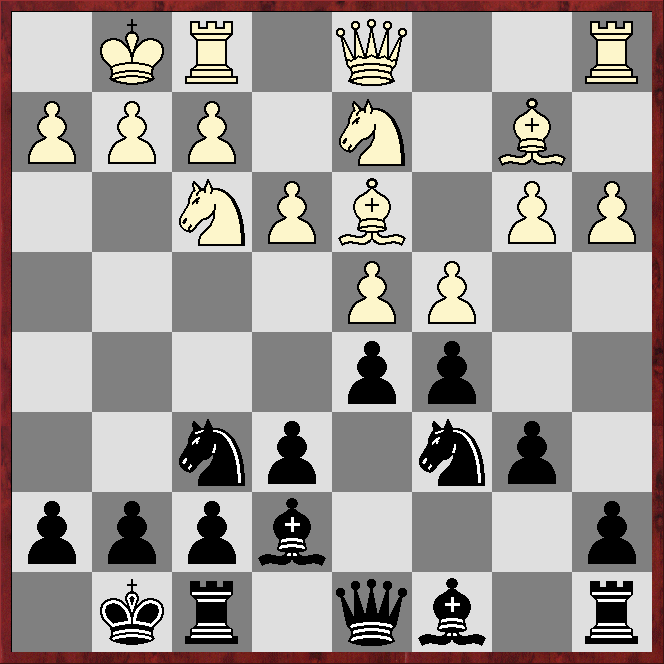
Now both sides have castled, how would you assess the position?
*****
*****
*****
*****
*****
White's extra central space and lead in development give a slight edge, according to Stockfish17.1 and Dragon1.
10...c5 11.Qc2 cxd4 12.Nxd4 b6?
Better is 12...Nf6.
How can White exploit Black's last move?
*****
*****
*****
*****
*****
13.Qe4
White has the upper hand after this, according to the engines, but they prefer 13.R(either)-d1 and 13.Bxe6!? fxe6 14.Nxe6  Qe8 15.Nc7 etc.
13...Rb8 14.Bd3
Again the engines like R(either)-d1, but not 14.Bxe6?? as Black has 14...Nc5.
14...Nf6 15.Qf4 Bb7 16.Bc2 Ned5 17.Nxd5 Qxd5 18.f3??
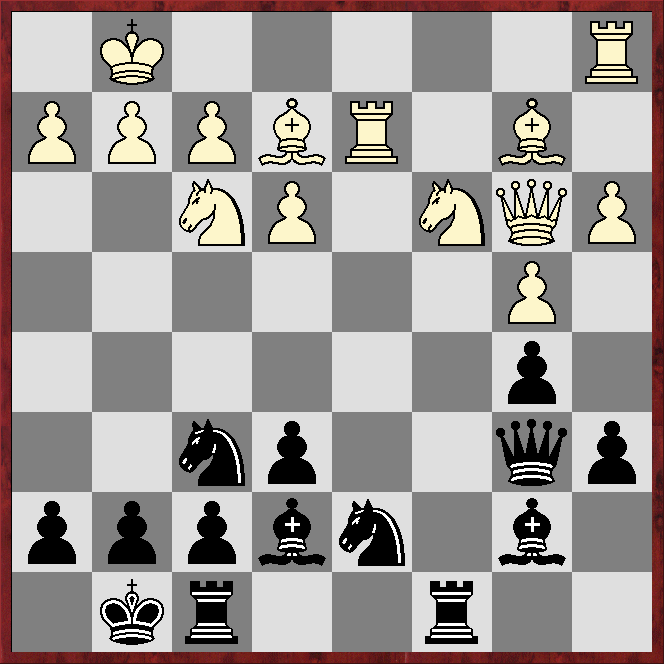
Spotting one threat (18...Qxg2#), but missing:
18...e5
The game finished:
19.Be4 exf4 0-1
LESSON: don't stop thinking when you have spotted an opponent's threat - the most dangerous moves have more than one idea.

Saturday, 21 February 2026

Weimar Round Seven

Achim Heller (2048) - Spanton (1939)
QGD
1.d4 d5 2.Nf3 e6 3.c4 Nf6 4.e3!? b6!? 5.b3 Bb7 6.Bd3 Bd6!?
Varying from 6...Nbd7, which I played in our game last month at Mariánské Lázně,
7.0-0 0-0
Now both sides have castled, how would you assess the position?
*****
*****
*****
*****
*****
With a near-symmetrical pawn-structure, and pieces posted similarly, it is perhaps not surprising Stockfish17.1 and Dargon1 reckon the game is equal.
8.cxd5!?
Much more popular is 8.Bb2, but the engines prefer the text.
8...Nxd5!?
All 79 games to reach the position in ChessBase's 2026 Mega database feature 8...exd5, but the engines agree the text is just as good.
9.Nbd2 Nb4!? 10.Be2 c5 11.Nc4 cxd4!?
Trading the bishop-pair for easy development.
12.Nxd6 Qxd6
How should White capture on d4?
*****
*****
*****
*****
*****
13.Qxd4!
This is best, according to the engines, just ahead of 13.Nxd4, but they reckon 13.exd4?! favours Black.
13...Qxd6 14.Nxd6 Rd8 15.a3 Nd5 16.Bb2 Nc6 17.Nxc6 Bxc6 18.Rac1 Bb7
Not 18...Rac8?? 19.Ba6.
19.Rfd1 Rac8
How would you assess this queenless middlegame?
*****
*****
*****
*****
*****
Having the bishop-pair on an open board gives White a slight edge, according to the engines.
20.Bf3 Rxc1 21.Rxc1 Rc8 22.Rc4 b5 23.Rxc8+ Bxc8
And what about this minor-piece ending?
*****
*****
*****
*****
*****
Bishops are the only long-range pieces left on the board, and having two-versus-one gives at least a slight edge, and probably the upper hand, according to the engines.
24.e4 Nf6
The engines prefer 24...Ne7.
25.Be2 a6
Stockfish17.1 for quite a long time favours 25...Nxe4!?, even though, after 26.Bxb5, the players' have rival majorities, a factor that usually suits bishops much more than knights.
26.f3
And here Stockfish17.1, but not Dragon1, prefers 26.Bxf6!?
26...Kf8 27.Kf2
Stockfish17.1 still likes capturing on f6.
27...Ke7
The engines strongly dislike this, suggesting 27...Nd7 or 27...Bb7.
28.g4 g6 29.Ke3 Nd7 30.Bc3 e5 31.a4 bxa4 32.Bb4+ Ke8 33.bxa4 Nb6?!
The engines reckon this leaves White with a winning advantage. They suggest 33...f6, 33...g5 or 33...Nb8.
34.a5 Nd7 35.Bd6 f6 36.Bc4 Nf8!?
This is the engines' top choice, but White has a strong reply.
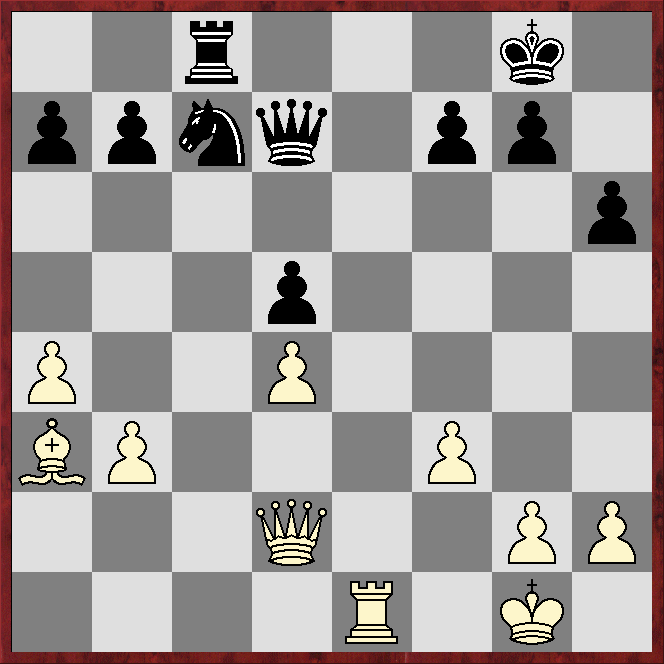
What should White play?
*****
*****
*****
*****
*****
37.g5! fxg5
Black's reply is forced, but now White gets a protected passed pawn.
38.Bxe5 Ne6 39.Kd2 Kd7 40.Kc3 Kc6 41.Kb4 Kd7
Not 41...Nc5?? as that loses the knight to 42.Bd5+
42.Bb3 Bb7 43.Bd5 Bc8
The engines prefer 43...Bc6!?, but agree 44.Bc4 gives White the upper hand, whereas 44.Bxc6+? Kxc6 is fine for Black.
44.Kc4 Ke7 45.Bc6 Nd8 46.Bd5 Ne6 47.Ba8!? Bc7 48.Kd5 Bb5 49.Bd6+ Kd7 50.e5?
The engines reckon White should play 50.Bg3.
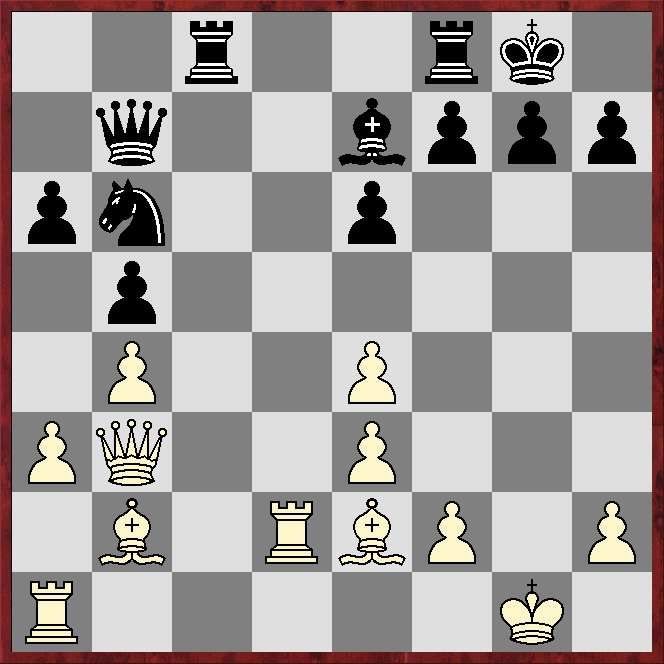
Black to play and draw
*****
*****
*****
*****
*****
50...Nd8?
It seems White cannot make progress after a move of the h pawn (one or two squares) or after 50...Ba4. The text is a mistake because now the white king cannot be prevented from advancing.
51.Kc5 Nf7 52.Be4 Nd8 53.Bd5 Ne6+ 54.Kb6 Nd8 55.Bb8 Be2 56.Bd6 Bb5 57.Bg8 h5 58.Bd5 g4!? 59.fxg4 hxg4 60.Be4 Ke6 61.Kc5 g5 62.Bc7 Nf7 63.Bd5+ Ke7 64.e6 Nh6 65.Bd6+ Ke8 66.Be4 Ng8 67.Bc6+
The bishop-pair has done its job - the rest is easy for White
*****
*****
*****
*****
*****
67...Bxc6 68.Kxc6 Nf6 69.Kb6 Ne4 70.Bb4 Kd8 71.Kxa6 Kc7 72.Kb5 Nf6 73.a6 Ne8 74.Ba5+ Kb8 75.Bb6 Nf6 76.Kc6 1-0

Tuesday, 20 January 2026

Mariánské Lázně 50+ Round Four

FACED a German.

Achim Heller (2038) - Spanton (1915)
QGD
1.d4 d5 2.c4 e6 3.Nf3 Nf6 4.e3!?
This somewhat innocuous-looking move could be said to be the continuation of champions in that it has been tried by Steinitz, Alekhine, Tal, Karpov, Kasparov, Anand, Carlsen and other very strong players.
The position occurs 20,770 times in ChessBase's 2026 Mega database
*****
*****
*****
*****
*****
4...b6!?
This is fifth-most popular, behind 4...Nbd7, 4...c5, 4...c6 and especially 4...Be7.
5.b3 Bb7
Possible is 5...Bb4+ 6.Nbd2 Bc3!?, but the minor inconvenience caused to White is probably not worth it.
6.Bd3!?
Holding back on developing the queen's bishop, for a reason that will soon become clear.
6...Nbd7 7.0-0 Be7 8.Ba3!?
This is the point. White wants to swop his bad bishop (hemmed in by the white centre pawns) for Black's good bishop, but only after Black has spent a tempo developing the dark-square bishop.
8...0-0
With both sides having castled, how would you assess the position?
*****
*****
*****
*****
*****
White has two pawns on the fourth rank against Black's one, but Black has a slight lead in development, a lead that will grow after an exchange on e7. After that exchange, White will be left with the technically better bishop, but the pawn-structure is by no means fixed, so it is not possible to say whether that will be a significant factor. Chances are equal, according to Stockfish17.1 and Dragon1.
9.Bxe7
Dragon1, but not Stockfish17.1, prefers 9.Bb2!?
9...Qxe7 10.Ne5
The engines do not like this, preferring development with 10.Nc3 or 10.Nbd2.
10...Nxe5 11.dxe5 Nd7 12.f4 f6 13.exf6 Rxf6
The engines prefer 13...Nxf6.
14.Nd2 Raf8 15.g3?!
This is slow, and weakens the long light-square diagonal. The engines suggest developing the queen to c2, or to e2, either immediately or after 15.Qh5 g6.
15...e5 16.Re1?!
The engines suggest 16.cxd5 exf4 17.Ne4, but reckon Black gets an advantage by sacrificing the exchange: 17...fxg3! 18.Nxf6+ Rxf6, after which the white king is very exposed, eg 19.Qe2 (19.hxg3?? Qxe3+)  gxh2+ 20.Kh1 (forced) Bxd5+ 21.e4 Bb7, when Black has three pawns for the exchange.
16...exf4 17.exf4
Even worse is 17.gxf4?, eg 17...dxc4 18.Bxc4+ Kh8 19.Bd3 (covering g6) Rxf4! (other moves also win) 20.exf4 Qc5+ 21.Kf1 Rxf4+.
17...Qc5+ 18.Kg2!?
Now 18...dxc4+ can be answered by 19.Be4.
How should Black proceed?
*****
*****
*****
*****
*****
18...Rh6?
Black has a large advantage after 18...Rd6, eg 19.Qc2 (this is best, according to the engines) dxc4+ 20.Be4 c3! 21.Nf3 Bxe4 22.Rxe4 Nf6.
19.Qf3?
The engines reckon the game is equal after 19.cxd5.
How can Black exploit White's last move?
*****
*****
*****
*****
*****
19...Qd4!
A relatively quiet move, but it introduces the threat of 20...Ne5, and the even stronger 20...Nc5.
20.Qe3
Probably best is 20.Rad1, but 20...Nc5 simultaneously attacks d3 and protects b7.
20...dxc4+
Even stronger is 20...Qxe3! 21.Rxe3 d4+ 22.Rf3 Re8, when the engines point out that threats include 23...Re3 and 23...Nc5, as well as simply taking the exchange.
21.Be4 Bxe4+?!
This loses much of Black's advantage. Instead the engines give 21...Qxe3! 22.Rxe3 Re8 23.Rae1 Rhe6 24.bxc4 Nf6 25.Kf3 Nxe4 26.Nxe4, when material is equal, but they reckon Black is winning, eg 26...h6 27.f5!? Rc6! 28.Ke2 Rf8 (28...Rxc4?? 28.Nf6+) 29.Nd2 Rxf5 gains a pawn. White could try 27.h4, but then 27...Rxe4! 28.Rxe4 h5 leaves White hopeless, eg 29.R1e3 Kf7 30.a4 Kf6 with ...Kf5 to come. Another try is 27.g4, covering the f5 square, but the engines give 27...g5!, when there comes 28.f5 Re5 29.a3 Kf7 30.R1e2 (30.a4 Bc6 31.R1e2 a5 32.Re1 R5e7 33.R1e2 Bxa4 wins an important pawn) Bc6 31.Re1 a6 32.R1e2 b5 33.cxb5 axb5 34.h3 Bd5 35.Re1 Rxe4!? 36.Rxe4 c5 37.Re2 c4 38.Re1 Rxe4!? 39.Rxe4 c3 etc.
22.Nxe4 Qxe3 23.Rxe3 cxb3 24.axb3
How would you assess this late-middlegame position?
*****
*****
*****
*****
*****
Black is a pawn up, and has a 3-1 farside majority, but White's pieces are better coordinated, and it is hard to mobilise the black majority. The engines for quite some time give Black a slight edge, but Stockfish17.1 comes to view the game as equal.
24...a5 25.Rd1 Nf6
Threatening 26...Rxh2+!
26.Nf2?!
The engines prefer exchanging on f6, or allowing Black to exchange on e4 after, for example, 26.h4.
26...Re8 27.Rxe8+ Nxe8 28.Ng4?!
The engines prefer 27.Ne4, preventing 27...Rd6.
28...Rd6 29.Re1
Exchanging rooks makes Black's task easier.
29...Kf8 30.Ne5 Rd2+ 31.Kf3!? Nf6
31...Rxh2? lets White force a draw with 32.Nd7+ Kf7 33.Ne5+ Kf8 34.Nd7+ etc, as 33...Kg8?? loses to 34.Ng4.
32.h3 Nd7!?
Going for a rook-and-pawn ending seems the best way to make progress, despite the well-known drawing potential of such endings.
33.Ke4?!
This is almost certainly the wrong way to enter the ending.
33...Nxe5!?
Also strong is 33...Nc5+ 34.Ke3 Rb2.
34.fxe5
Or 34.Kxe5 Rd3.
How would you assess this rook-and-pawn ending?
*****
*****
*****
*****
*****
White's passed pawn is probably more of a weakness than an asset, and meanwhile Black has 3-1 on the queenside. The engines reckon Black is roughly the equivalent of a rook up.
34...Ke7 35.h4 Ke6 36.Re3 Rd5 37.Kf4 b5 38.h5 b4 39.g4 Rc5 40.Re1 Rc3 41.Ra1 Rxb3 42.Rxa5 Rc3 43.Ra6+ Ke7 44.Ra7 Ke6 45.Ra6+
AH offered a draw.
45...Kd7 46.h6 Rc4+?
Much better is 46...g6, or even, according to the engines, 46...g5+!? After the latter, play might continue 47.Kxg5 b3 48.Ra7 Rc6, when the only way to stop the b pawn is with 49.Ra1, but then comes 49...Ke6 etc.
White to play and draw
*****
*****
*****
*****
*****
47.Kg5?
After 47.Kf5 the position is completely equal, according to the engines, eg 47...g6+ 48.Kf6 Rf4+ (only move as White threatens 49.e6+) 49.Kg7 b3 50.Ra1 (not 50.Kxh7?? b2) Rxg4 51.Kxh7 c5 52.Kg7 Rh4 53.h7 c4 54.Kf6! (54.h8=Q? Rxh8 55.Kxh8 c3 wins for Black) b2 55.e6+ Kc7 56.Rb1 c3 57.e7 c2 58.e8=Q cxb1=Q, after which Black is a rook up, but the black king cannot escape checks from the white queen. Black could try 47...gxh6, but 48.Rxh6 draws easily enough, eg 48...b3 49.Rxh7+ Kc6 50.Rh1 b2 51.Rb1 Rb4 52.Kf6 Kd7 53.e6+ Ke8 54.g5 Rf4+ 55.Ke5 Rb4 56.g6 Ke7 57.g7 Rg4 58.Rxb2.
Black to play and win
*****
*****
*****
*****
*****
47...gxh6+!
The only winning move, whereas 47...g6 transposes to the previous note after 48.Kf6.
48.Rxh6 b3 49.Rxh7+ Ke6
If the white king were on f5 instead of g5, 49...Ke6 would not be possible, and the game would be drawn.
50.Rh3 Rb4 51.Rh1 b2 52.Rb1 c5 53.Kh5
I cannot read my writing here - it is possible 53.Kh6 was played.
53...c4 54.g5 c3 55.g6 Rb7 0-1

Saturday, 5 July 2025

Bischofsgrün Round Nine

I WAS downfloated.

Achim Heller (2036) - Spanton (1954)
Queen's Gambit Declined
1.d4 d5 2.Nf3 e6 3.c4 Nf6 4.e3!?
More popular are 4.Bg5!?, 4.g3 and especially 4.Nc3, but there are 13,345 examples of the text in ChessBase's 2025 Mega database.
How should Black respond?
*****
*****
*****
*****
*****
4...Bb4+
Stockfish17 and Dragon1 suggest 4...Be7 or 4...b6.
5.Nbd2!?
This scores 65% in Mega25.
5...0-0 6.a3 Be7 7.b3 c5 8.Bd3 Nc6 9.Bb2 b6 10.0-0
Now both sides have castled, how would you assess the position?
*****
*****
*****
*****
*****
Space is equal, and the pawn-structure almost symmetrical. The white king's bishop is more active than its opposite number, but the white queen's knight less so than its opposite number. The engines reckon the game is equal.
10...Bb7 11.Qe2 Re8 12.Rfd1 Bf8!? 13.Rac1 Rc8
Michael de Verdier (2276) - Sergey Ivanov (2530), Swedish Team Championship 2010, went 13...cxd4 14.exd4 g6 15.c5!? bxc5 16.dxc5 e5 17.Bb5, with a slight edge for White, according to the engines (but 0-1, 57 moves).
14.cxd5 Nxd5?!
Michał Olszewski (2543) - Fabrizio Bellia (2376), Bratto (Italy) 2010, saw 14...exd5 15.Ba6!? Bxa6 16.Qxa6 Qe7 17.Ne5 Nb8!?, with an equal game, according to the engines (but 1-0, 48 moves).
After the text the engines reckon White is winning.
15.dxc5 Bxc5 16.b4 Be7 17.Nc4 Bf6?
The engines reckon Black had to play something like 17...Rf8, 17...Rc7 or 17...a6, but agree White is winning.
18.b5?!
This is enough for a comfortable advantage, but stronger is 18.Bxf6, when Black has three ways to recapture, but all are deeply unpleasant:
A) 18...Qxf6 19.Nd6 Nc3 20.Rxc3 Qxc3 21.Nxb7;
B) 18...Bxf6 19.Bxh7+ and 20.Rxd8;
C) 18...gxf6 19.e4! Nf4 20.Qe3.
18...Nb8?!
Almost certainly better is 18...Na5!?
19.Nfe5
Also still good is Bxf6.
19...Nd7?
19...Qe7, or even 19...Bxe5!?, keeps the game going.
20.Nxf7?!
Even stronger is 20.Bxh7+! (20.Nxd7 is also better than the text) Kxh7 21.Qh5+ Kg8 22.Nxf7 Qe7 23.Ncd6 g6 (otherwise 24.Qh8#) 24.Qxg6+ Kf8, when White has a winning attack, eg 25.Qh6+ Kg8 26.Bxf6 Qxf6 27.Qxf6 N7xf6 28.Nxc8 Rxc8 29.Rxc8+ Bxc8 30.Nd6, with an advantage worth about a rook, according to the engines.
20...Kxf7 21.Nd6+ Kg8??
Easily the worst of three possible king moves. After 21...Kf8 22.Nxc8 Bxb2 23.Qxb2 Bxc8 24.Bxh7 White has the upper hand (Dragon1) or is at least slightly better (Stockfish17).
22.Rxc8!?
Also very strong is 22.Qh5.
22...Bxc8 23.Qh5 Nf8?!
23...h6 is a modest improvement, but 24.Qf7+ Kh8 25.Qxe8+ Qxe8 26.Nxe8 Bxb2 27.Nd6 wins easily enough.
24.Qf7+ Kh8 25.Nxe8 Qe7
Forced - White threatened 26.Qxf8#.
26.Qxe7 Bxe7 27.Nxg7
The game finished:
27...Kg8 28.Nh5 Ng6 29.Bc4 Nc7 30.Nf6+ 1-0

Tuesday, 8 April 2025

Botvinnik Toppled

MIKHAIL Botvinnik, in his book One Hundred Selected Games, includes four games from his 1940 match against long-time training partner Viacheslav Ragozin.
The latter did not win a game in that match, but the following year, when they played five more games, Ragozin managed to win one, and I thought it would be interesting to look at how that happened.

Botvinnik - Ragozin
Queen's Gambit Declined
1.d4 d5 2.c4 e6 3.Nc3 Nf6 4.Bg5 Be7 5.Nf3 h6 6.Bxf6!?
More popular in ChessBase's 2025 Mega database is 6.Bh4, but Stockfish17 and Dragon1 marginally prefer the text at first, although they come to fluctuate between the two moves.
6...Bxf6 7.Qd3!?
This continuation has found few followers, although Jan Timman played it in a 1998 rapid game.
7...0-0 8.e4
White is not being subtle
*****
*****
*****
*****
*****
8...dxe4
Ivan Ivanišević (2611) - Stelios Halkias (2588), Serbian Team Championship 2010, went 8...dxc4!? 9.Qxc4 c6 10.e5 Be7 11.Bd3 b6 12.Be4!? Bb7 13.Rd1!? Nd7 14.h4!? b5 15.Qb3 Qb6 16.0-0, with equal chances, according to the engines (½–½, 28 moves).
9.Qxe4!?
By transposition the game has reached a position occurring 28 times in Mega25.
9...c5 10.0-0-0!?
This is the move Botvinnik has apparently been leading up to. It is not liked by the engines.
10...cxd4 11.Nxd4 Qb6 12.Bd3 Rd8?!
Probably better is 12...g6, which was seen in two subsequent games.
13.Nb3!? Nd7?!
The engines prefer other moves, including, again, ...g6.
14.Qh7+ Kf8 15.Rhe1 Ne5 16.c5!? Qc7
There is no time to snap off the white bishop as 16...Nxd3+? 17.Rxd3 Qc7 can be met by 18.Rxd8+ Qxd8 19.Rd1, eg 19...Qc7 20.Rd6 Bxc3 21.bxc3 a5 22.Nd4!? with what seems a winning attack.
17.Bc2 Bd7?!
Even here the engines suggest 17...g6!?, or first exchanging a pair of rooks and then ...g6, even though White has Qxh6+.
How should White proceed?
*****
*****
*****
*****
*****
18.Rd6?
The engines reckon both 18.Ne4 and 18.f4 win, whereas after the text they give Black the upper hand.
18...Be8?
This is much inferior to 18...Bc6, according to the engines.
19.Nd5!? exd5 20.Rxf6! gxf6 21.Qxh6+ Ke7 22.f4 d4 23.fxe5 fxe5
White is the exchange down, but has a winning move, according to the engines
*****
*****
*****
*****
*****
24.Be4?
The engines reckon 24.Qh4+! wins, eg 24...f6 25.Rf1 Qc6 26.Na5 Qa6 27.Bd3! b5 28.a4!? Rac8 29.b4 Qe6 30.axb5 with a continuing attack. They also prefer other moves to the text, including 24.Rf1 and 24.Bd3.
24...a5!? 25.g4 Ra6 26.Qh4+ f6 27.g5 a4!? 28.Qh7+ Bf7 29.g6 Rf8
This difficult game has reached a completely equal position, according to the engines, but it is White to play and lose
*****
*****
*****
*****
*****
30.gxf7?
Now the black king is safe (better was 30,Nxd4! Qxc5+ 31.Nc2), but after ...
30...axb3
... the white king is open to attack.
Botvinnik resigned as there is nothing better than 31.a3, when 31...Qxc5+ is good enough, but even better is first 31...Rxf7 as ...Qxc5+ cannot be stopped.

Monday, 29 April 2024

Winning Chess

THE Tegernsee Senioren Cup was won by the top seed, Austrian international master Harald Schneider-Zinner (2335).
His score of +6=3-0 meant he finished a half-point ahead of the field of 181 players.
Perhaps his most important win came in round eight, with black against then joint-leader Gottfried Schumacher (2102), a German Fide master.

Schumacher (2102) - Schneider-Zinner (2335)
Queen's Gambit Declined
1.d4 Nf6 2.Nf3 d5 3.c4 e6 4.Nc3 Be7 5.e3
The somewhat passive, or at least slow, 5.e3 is probably the oldest continuation in the position, dating back to 1881 in ChessBase's 2024 Mega database
*****
*****
*****
*****
*****
Seven years were to pass before Johannes Zukertort introduced 5.Bf4 in a loss to Amos Burn at the British Chess Association congress in London.
And another four years passed before Salomon (aka Samuel) Lipschütz played 5.Bg5 in a draw against Jackson Showalter in their match for the US championship.
5...0-0 6.Bd3 dxc4 7.Bxc4 a6
Black plans to both expand on the queenside with ...b5, in the process gaining a tempo on White's light-square bishop, and to pressure the white centre with ...c5 and ...Bb7.
How should White meet this plan?
*****
*****
*****
*****
*****
8.a3
The stem game, Abram Rabinovich - Dawid Janowski, Prague 1908, saw White prevent Black's expansion with 8.a4, the game continuing 8...c5 9.0-0 Nc6 10.dxc5 Bxc5 11.Qe2 Qc7 12.e4 Ng4!? with a slight edge for Black, according to Stockfish16 and Komodo14.1 (0-1, 37 moves).
Most popular in Mega24 is 8.0-0, reaching a position Hikaru Nakamura played with white in at least three online blitz games in 2020, winning all three. A typical continuation runs 8...b5 9.Bd3 Bb7, when most popular in Mega24 is 10.a3, but Nakamura (2763) preferred 10.Qe2!? in his blitz win over Sanan Sjugirov (2663).
8...c5 9.0-0 b5 10.Be2!?
The engines reckon this and 10.Ba2 are roughly equal in value, but they are not so keen on 10.Bd3, the point seeming to be that in many lines White plays dxc5, when, with the black queen's knight developed to d7, ...Nxc5 hits White's light-square bishop.
10...Nbd7 11.dxc5 Nxc5 12.b4
How would you assess this near-symmetrical position?
*****
*****
*****
*****
*****
The white queen's knight is more actively placed than its black counterpart, but the latter can go to b6, from where it will eye the important c4 and d5 squares. Meanwhile White's dark-square bishop will be obstructed on b2. Nevertheless it is White to move, and that can be important in symmetrical (and near-symmetrical) positions. The engines reckon the position is equal.
13.Bb2 Bb7 14.Qb3 Qb6 15.Rfd1 Rac8 16.Rd2!?
The engines prefer completing development with 16.Rac1, claiming Black is slightly better after the text.
How should Black respond?
*****
*****
*****
*****
*****
16...Bxf3!?
This seems to be a novelty. Known is 16...Rfd8, while the engines suggest, among other moves, 16...Bc6!? (Stockfish16) and 16...h6 (Komodo14.1.
17.gxf3!?
This is Stockfish16's choice. Komodo14.1 marginally prefers 17.Bxf3 Ne5 18.Be2 Nc4 19.Bxc4 Rxc4 20.Rad1.
17...Qb7 18.Ne4?!
The engines suggest 18.f4!?, fighting for the e5 square, or 18.Rad1.
18...Nxe4 19.fxe4 Nb6
White's bishop-pair does not fully compensate for the damaged pawn-structure, according to the engines
*****
*****
*****
*****
*****
20.Rad1!?
Hoping activity will compensate for being a pawn down, but the engines prefer defending the pawn, either directly with 20.f3 or 20.Bd3, or indirectly with 20.Bd4.
20...Qxe4 21.Ba1?!
Perhaps hoping to set up a battery on the long dark diagonal, but Black will always have ...Bf6, and anyway the process is slow. The engines suggest 21.Rd4, but give Black at least the upper hand.
21...Bf6
Even stronger, according to the engines, is 21...Qg6+ with ...Nc4 likely to follow.
22.Rd6?
The engines give 22.Qd3 Qh4 23.Bxf6 Qxf6 24.Qd4, albeit preferring Black.
22...Bxa1 23.Rxb6
Or 23.Rxa1 Nd5!?, when White's lack of coordination spells trouble, eg 24.Re1!? Rc3 25.Qb2 Qg6+ 26.Kh1 Qf5 with strong pressure, or 24.Rxa6 Nc3 (the reason why the engines suggest 24.Re1!?) 25.Qb2 Qg6+ 26.Kh1 Qf5 27.f3 Rfd8, after which White has regained the sacrificed pawn but still suffers from poor coordination.
23...Rc3?!
Black is winning after this, according to the engines, but much stronger is their suggestion of 23...Be5.
24.Qa2
After 24.Qb1! Qxb1 25.Rxb1 Rxa3 Black is two pawns up, but opposite-coloured bishops and the weakness of a6 give White hope, eg 26.Bf3 Bf6 27.Bb7 Rb8 28.Rxa6 Rxa6 29.Bxa6, when White has won back a pawn and there is a long way to go before Black can hope to exploit the extra kingside pawn.
24...Rc2 25.Qxa1 Rxe2 26.Qd4 Qf3?!
Much stronger is 26...Qg6+, and if 27.Kf1 then 27...Qc2, when White cannot defend both f2 and d1.
27.Rf1 Rc8 28.Qe5?
Necessary is 28.Qf4, when 28...Qxf4 29.exf4 Re4 30.Rxa6 Rxf4 leaves Black a pawn up in a rook-and-pawn ending, which is far from clear.
28...Rxf2! 0-1

Thursday, 17 November 2022

Brno Game Six

Stefan Arndt (2176) - Spanton (1771)
QGD
1.d4 d5 2.Nf3 e6 3.c4 Nf6 4.e3
Magnus Carlsen has played this, and 4.Bg5 and 4.g3 and 4.Nc3.
4...c5 5.cxd5 exd5 6.Bb5+ Bd7 7.Bxd7+ Qxd7 8.0-0
If 8.Ne5 the analysis engines Stockfish15 and Komodo13.02 reckon the simplest way to equalise is 8...Qe6, eg 9.Qb3 b6 10.Nc3 Bd6 11.Qb5+ Nbd7, and if 12.f4!? they give Black at least a slight edge after 12...0-0.
8...Nc6 9.b3 cxd4 10.Nxd4 Be7 11.Bb2 0-0
Now both sides have castled, how would you assess the position?
*****
*****
*****
*****
*****
Black has a lead in development and has more space in the centre, but the latter is thanks to having an IQP, although it is an isolani that is not under pressure. The engines give White a slight edge.
12.Nd2 Rac8 13.N2f3 Rfd8 14.a3 Ne4 15.Rc1 Nxd4!?
White has two knights that would both like to occupy the d4 square, so it might seem strange to make an exchange that removes the redundancy, but the specifics of the position allow Black to get a comfortable game this way.
16.Nxd4 Rxc1 17.Qxc1 Rc8 18.Qd1 Bf6 19.f3?!
Komodo13.02 has this move as its top choice, at least for a while, but Stockfish15 disagrees for reasons that will become obvious.
19...Nc3 20.Qd2 Bxd4 21.exd4
Not 21.Qxd4?? Ne2+.
21...Nb5 22.Re1 h6 23.a4 Nc7 24.Ba3 ½–½
Stockfish15 gives Black the upper hand, while Komodo13.02 concedes Black has a slight edge
Would I have played on against someone rated 400 points lower than me instead of 400 points higher? Almost certainly.
Would I have played on had this been a single-round day instead of a double-rounder? I hope so.
Instead I made the 'pragmatic' decision to take the half-point (and 8.4 Fide elo) and save my energy for the afternoon's game.

Wednesday, 30 December 2020

Garry Kasparov's Forgotten Weapon Against The Queen's Gambit (part two)

GARRY Kasparov is well-known for playing asymmetrical defences against 1.d4, ie starting with 1...Nf6 and often continuing with the King's Indian or Grünfeld.
At the September 1982 Interzonal in Moscow, which he won with a score of 10pts out of 13 (1.5pts clear of the field), putting him on the road to the world championship, Kasparov faced 1.d4 three times, always replying 1...Nf6.
At the Olympiad the following month in Luzern, he again faced 1.d4 three times and again always replied 1...Nf6.
Then came game two of his Candidates' quarter-final match against Alexander Beliavsky.

Beliavsky (2570) - Kasparov (2690)
Candidates Quarter-Final (Moscow) Game 2 1983
1.d4 d5!?
The first time, at least in ChessBase's 2021 Mega database, that Kasparov met 1.d4 with 1...d5. If nothing else, it must have rendered Beliavsky's preparation for the white pieces null and void.
2.c4 e6 3.Nc3
So we reach the starting point of what this series is about - what to do if you are a 1.d4 d5 2.c4 e6 player as Black but do not want to face the QGD Exchange when White is not committed to playing Nf3.
Kasparov's style with the black pieces, as several commentators have noted, is one in which he would rather have an unbalanced position with counterplay than a theoretically more-or-less equal position, but one in which White has the initiative.
So continuing 3...Nf6 4.cxd5 exd5 would be alien to Kasparov's style. Indeed, throughout his career he never met 1.d4 d5 2.c4 e6 3.Nc3 with 3...Nf6.
Instead, in this, his first ever 1.d4 d5 game as Black, Kasparov revived the Tarrasch Defence.
3...c5!?
Statistically, this is an improvement on 3...Nf6. The latter scores a miserable 39% in Mega21, while 3...c5 scores 45%, which is about average for Black in large databases.
4.cxd5
This is played 72% of the time in Mega21.
4...exd5 5.Nf3 Nc6
Shamkovich & Schiller in Play The Tarrasch (Pergamon 1984) state: "When heading for the Tarrasch it is important to remember the dictum that knights should be developed in alphabetical order!" Actually, there seems nothing wrong with 5...Nf6, but the text is a lot more popular.
6.g3
This move was introduced by Carl Schlecter at Prague 1908 and quickly became White's main weapon against the Tarrasch.
6...Nf6 7.Bg2 Be7
Other moves are possible, eg 7...Be6, but according to Shamkovich & Schiller "it is much too early to commit the (queen's) bishop to a particular post."
8.0-0
Black can be said to have lost a tempo after 8.dxc5 Bxc5, which is indeed the continuation favoured by the analysis engines Stockfish12 and Komodo11.01 In practice, games usually transpose to one of the main lines after the further moves 9.0-0 0-0 (more on this later).
8...0-0 9.Bg5
9.dxc5 Bxc5 would transpose to the previous note, although Black has the added option of 9...d4!? The text is the absolute main line in Mega21.
Shamkovich & Schiller comment: "White eschews subtlety in favour of a direct attack on the black centre. He threatens Bxf6 followed by Nxd5."
9...cxd4
The main alternative, 9...c4!?, is preferred by the engines.
A solid alternative, liked by Komodo11.01 but not by Stockfish12, is 9...Be6!?, when 10.Rc1 cxd4 11.Nxd4 Rc8? 12.Nxe6 fxe6 13.Bh3 gave White a large advantage in Burak Akguc (unrated) - Spanton (2065), Hastings Challengers 1997-98 (but ½–½, 53 moves). Black can improve with 11...Nxd4, but White can probably improve before that with 10.dxc5 Bxc5 11.Rc1.
10.Nxd4 h6
We are still very much in theory - there are almost 4,000 games with this move in Mega21.
11.Be3
I will cover the important alternative 11.Bxf6 in part four.
11...Re8
Decision time for White
This is possibly the first point at which either player needed a serious think.
*****
*****
*****
*****
*****
12.Qa4
White's important alternatives will be covered later.
12...Bd7!? 13.Rad1
White can win a pawn with 13.Nxd5!? Nxd5 14.Bxd5, but then comes the forcing 14...Nb4 15.Qb3 Nxd5 16.Qxd5 Bh3 17.Qxd8 Raxd8, when Black is considered by theory (and the engines) to have enough compensation for a pawn.
13...Nb4 14.Qb3 a5
"Black must play aggressively on the queenside to offset White's central pressure," according to Shamkovich & Schiller.
15.Rd2!?
This move has been widely criticised, but it is the choice of the engines.
The main line runs 15.a4 Rc8 16.Ndb5 Be6 17.Bd4 Bc5 with what the engines reckon is an even position (White can hardly play 18.Bxf6?! Qxf6 19.Bxd5 Bxd5 20.Nxd5 Nxd5 21.Qxd5 because Black equalises the material and gains an initiative with 21...Rxe2).
Note that the d pawn was shown to be immune in Rafael Vaganian - Borislav Ivkov, USSR-Yugoslavia Match (Odessa) 1975, which saw 15.Nxd5? Nbxd5 16.Bxd5 Nxd5 17.Qxd5 Bh3, when 18.Qxd8 fails to 18...Raxd8 19.Rfe1 Bb4.
15...a4 16.Qd1 a3 17.Qb1
The engines like 17.Qb3!? Qa5 18.bxa3 Qxa3 19.Nxd5 Nfxd5 20.Bxd5 Nxd5 21.Qxd5, when White is a pawn up but Black's bishop-pair and White's kingside light-square weaknesses give obvious compensation.
17...Bf8 18.bxa3
This is Komodo11.1's choice.
Stockfish12 prefers 18.Nb3, which was played in Vitaly Kunin (2494) - Ernst Weinzetti (2327), Oberwart (Austria) 2006, which continued 18...Qc8 19.Rc1 Bf5 20.Qa1 axb2 21.Qxb2 Rxe3!? 22.fxe3 Qe6, when Black had full compensation for the exchange, according to the engines (but 1-0, 34 moves).
18...Rxa3 19.Qb2 Qa8 20.Nb3!?
Unblockading an IQP is not a decision to be taken lightly, although the move is Stockfish12's choice. Kasparov called the move dubious, suggesting 20.Ndb5 (Komodo11.01's choice) Bxb5 21.Nxb5 Rxa2 22.Qb3, which he and the engines call equal. One possible continuation runs 22...Rxd2 23.Bxd2 Qa5 24.Nd4, re-establishing the blockade, when Black is a pawn up but has two weak pawns, and White has a pair of bishops on an open board - still equal, according to the engines.
20...Bc6 21.Bd4
This is Beliavsky's idea - the dark-square bishop becomes the blockader, indirectly adding pressure against d5.
21...Ne4 22.Nxe4
The engines prefer 22.Bxe4!? dxe4 23.Be3, claiming equality.
22...dxe4 23.Ra1
Kasparov in Mega21 gives as better 23.Nc5!? e3!? 24.Bxc6 exf2+ 25.Bxf2 Nxc6 with a slight edge for Black.
23...Bd5 24.Qb1?
The engines reckon White needs to block the e4 pawn with 24.e3, the point being Black cannot reply, as in the game, by occupying the newly created outpost at d3 as 24...Nd3? loses to 25.Rxd3! If Black tries to set up ...Nd3 with 24...b6, similar to what happens in the game, White has 25.Nc1 and is only a little worse.
24...b6
Now Black is threatening to play ...e3.
25.e3 Nd3 26.Rd1
The engines prefer 26.Nc1, which Kasparov said can be met by 26...Ne1, when one line given by the engines runs 27.Qxb6 Nf3+ 28.Bxf3 exf3 - White is a pawn up but Black is better, according to the engines.
As Kasparov points out, 26.Bxb6? loses to 26...Bb4 27.Rc2 (stopping ...Bc3) Bxb3.
26...b5 27.Bf1 b4 28.Bxd3!?
This gets rid of the strong knight but opens the h1-a8 diagonal, which may be a greater evil.
28...exd3 29.Qxd3 Rxa2 30.Rxa2 Qxa2 31.Nc5
Not 31.Rb1? Be4.
After the text, material is level but White is positionally lost - it is just a question of whether Black will win by pushing the b pawn or by exploiting the weak light squares around the white king.
The game finished:
31...Bf3 32.Ra1 Qd5 33.Qb3 Qh5 34.Nd3 Bd6 35.Ne1 Bb7 36.Rc1 Qf5 37.Rd1 Bf8 38.Qb1 0-1
White lost on time as he made his 38th move. Kasparov gives a likely continuation as 38...Be4 39.Qb3 h5, when Black has a large advantage.

Tuesday, 29 December 2020

Garry Kasparov's Forgotten Weapon Against The Queen's Gambit

ANYONE who is happy, when having the black pieces, to play 1.d4 d5 2.c4 e6 faces something of a dilemma if White continues with the main move 3.Nc3.
Black then usually plays 3...Nf6, at which point the commonest move in ChessBase's 2021 Mega database is 4.Bg5, which scores 59%, ie about four percentage points above White's usual score in large databases.
But there is worse to come - White can play 4.cxd5, the Exchange Variation, which scores a phenomenal 65%, the usual continuation being 4...exd5 5.Bg5.
It is instructive to compare this with White's second-most popular continuation at move three, namely 3.Nf3.
After the further moves 3...Nf6 4.cxd5 exd5, White's score plummets to 50%.
In other words, statistically speaking, White has lost the advantage of having the first move.
In practice White more often follows up 3.Nf3 Nf6 with 4.Nc3.
Black then has a large choice of respectable replies, including 4...Be7, 4...c6, 4...Bb4, 4...Nbd7, 4...c5 and 4...dxc4, each of which occurs at least 5,000 times in Mega21.
Most popular is 4...Be7, when White can again enter the Exchange Variation, but by now 5.cxd5 exd5 6.Bg5 scores only 56%, falling to 52% if Black responds with 6...c6.
True, 56% is marginally higher than White's usual average across all openings, but it is a significant drop from the 65% of 3.Nc3 Nf6 4.cxd5.
One of the main reasons the Exchange Variation with 3.Nc3 scores so much better than with an early Nf3 is that the former allows White to play the king's knight to e2.
This opens new possibilities for White, including a central advance with f3 and e4, which can be particularly effective as White in the Exchange Variation has a 2-1 central pawn-majority.
Another reason is that Nf3 played too early lets Black render the Exchange Variation largely harmless by more-or-less forcing off light-square bishops, as the following ICCF correspondence game illustrates.
James Cairney (1983) - Spanton (unrated)
2nd British Webserver Team Tournament 2013
1.d4 d5 2.c4 e6 3.Nc3 Nf6 4.cxd5 exd5 5.Nf3!?
It would be over-the top to call this a mistake, but it scores just 45% in Mega21.
Black can now plan on playing ...Bf5, occupying the diagonal usually taken by the white light-square bishop.
5...c6
An immediate 5...Bf5!? may even be possible, the idea being that 6.Qb3 can be met by 6...Nc6 with sharp play.
6.Qc2
More popular is 6.Bg5, but Black can reply 6...Bf5, when 7.Qb3 Qb6 8.Bxf6 gxf6 is not considered particularly promising for White.
6...g6
My modern analysis engines, Stockfish12 and Komodo11.01, prefer a bishop move, eg 6...Be7, 6...Bd6 or 6...Bg4, but are fine with the text once shown it.
7.Bg5
Black is at least equal, and maybe even a tad better, after 7.e3 Bf5.
The text also sets a mini-positional trap that has snared grandmasters.
7...Bg7
The problem with 7...Bf5?! is that 8.Qb3 is awkward to meet since 8...Qb6?? is a gross blunder due to 9.Bxf6. Black's most-popular reply in Mega21 is 8...b6?, but 9.e4! dxe4 10.Ne5 Be6 11.Bc4 Qe7 12.d5 was catastrophic for Black in Péter Lukács (2460) - Jakab Attila (2396), Budapest GM-B 2002 (1-0, 15 moves). Black probably has nothing better than 8...Bc8, when 9.e4 is again strong.
Massively more popular than the text is 7...Be7, but 7...Bg7, which has been played by Euwe, Ragozin, Dreev and Negi, seems fine.
8.e3 Bf5 9.Bd3
Black is posed no problems by 9.Qb3 Qb6 10.Be2.
9...Bxd3 10.Qxd3 Nbd7 11.0-0
I see from my notes that two of my engines at the time, Stockfish3 and Houdini1.5a, reckoned White is slightly better, but Junior10 called the position equal. Today's engines, Stockfish12 and Komodo11.01, agree with Junior10.
11...0-0 12.Rfc1
White is preparing the dreaded Minority Attack, but, theoretically speaking, Black has nothing to fear here.
12...a5 13.Na4 Qe7 14.Bh4 Rfe8 15.a3 Qe6 16.Bxf6!?
This is Stockfish12's choice.
16...Bxf6 17.Qb3!?
The choice of both Stockfish12 and Komodo11.01, but it looks strange to me. Certainly, obstructing the b2 pawn does not help White's Minority Attack.
17...Ra7!?
This appears slightly awkward, but is a reasonably economical way of defending b7 and a5.
18.Nc3 Qf5 19.Rc2 g5!?
The classic black answer to a Minority Attack is to stabilise the queenside and counterattack on the other flank.
20.Re2 g4 21.Nd2 a4! 22.Qd1
22.Nxa4?! Bxd4.
22...Qg6 23.e4!
This central counterattack is also the choice of Stockfish12 and Komodo11.01.
23...Nb6
23...Bxd4 24.exd5 Rxe2 25.Qxe2 Bxc3 26.dxc6 bxc6 27.bxc3 was given by Houdini1.5a as equal, although Komodo11.01 - but not Stockfish12 - reckons White has a small edge.
24.exd5
Black seems fine after 24.e5 Bg5.
24...Rxe2 25.Qxe2 Nxd5
Not an easy position to assess
*****
*****
*****
*****
*****
White has an IQP, which is blockaded by a black knight, but otherwise the white position is sound, and the black kingside attack has been stopped in its tracks. Black's pawns are a little loose and the black rook is passive and not coordinated with the other black pieces, but the bishop bears down on the d4 target. My modern engines reckon the position is equal, and I believe that was also the verdict of my engines seven years ago.
26.Rd1 Nxc3!?
This unisolates d4 but gives White another isolani at a3. It also lets Black play ...b5 to protect a4 without worrying about the c pawn being backward on a half-open file, simultaneously solving the difficulty of the out-of-play black rook. However, White gets an initiative.
27.bxc3 b5 28.Qe8+ Kg7 29.Re1
Not 29.Qxc6?? Qc2, but after the text the c6 pawn is threatened.
29...Bg5 30.Nf1 f5 31.Qc8 Re7
Forced, otherwise White has 32.Re6.
32.Rxe7 Bxe7
Queen and knight can make a better team than queen and bishop, but here the bishop has targets and the white queen and knight are widely separated. However, the black king is much the more exposed, and the engines agree the position is still level.
33.Qd7 Qf6 34.Ne3 Kf8
After the natural-looking 34...Kg6!?, White can cause problems with 35.d5, although it is not clear that White gets a substantial advantage.
35.Nxf5
But not 35.Qxf5?? Qxf5 36.Nxf5 Bxa3, and the a4 pawn is too strong.
35...Bxa3 36.Qc8+ Kf7 37.Qd7+ Kg6!?
37...Kf8 repeats the position. The text keeps the game going, with both players walking a tightrope.
38.Ng3 Bf8 39.Qxg4+ Kf7 40.Qd7+ Kg8 41.d5 a3 42.dxc6
White has won two pawns, but the a pawn is a monster that can promote with check. The game is still level, according to the engines.
42...Qd6 43.Qg4+?!
White can force a draw by 43.Nf1 Qxd7 (other moves lose) 44.cxd7 Be7 45.Nd2. The text may also draw, but is less clear, and is dodgy from a practical view as Black keeps his passed pawn while White will lose his, meaning White cannot realistically win.
43...Kh8 44.Qe2 Qxc6 45.Qe5+ Kg8 46.Qg5+ Qg6!?
Black can force a repetition with 46...Kh8, or try for more in another way with 46...Kf7 47.Qh5+ Qg6 48.Qf3+ Qf6. But after the latter it seems both 49.Qh5+ and 49.Qb7+ draw, eg 49.Qb7+ (during the game I thought this was the surer draw for White, but now I am not so certain) Be7 50.Qxb5 a2 51.Qa4 Qe6 52.Ne4! Qxe4 53.Qxa2+, when White has queen and four pawns versus queen, bishop and one pawn. My engines at the time reckoned Black has the upper hand, but I could see no way to create winning chances, and my modern engines agree.
47.Qxb5 a2
White has engineered a new passed pawn (two actually, including the f pawn) and restored his two-pawn advantage, but the black passer has reached seventh heaven. Stockfish12 and Komodo11.01 reckon the game is level.
48.Qc4+ Qf7 49.Qg4+ Kh8 50.Qd4+ Bg7 51.Qd8+ Qg8 52.Qa5 h6 53.h4
It is interesting that both players have time to make quiet pawn moves. 52...h6 creates a square for the black king at h7, while 53.h4 removes the possibility of a back-rank mate and lets the white king move up to h2 if Black threatens a back-rank check to support the a pawn promoting.
53...Qe6
For a long time Stockfish12 shows 53...Qb3 as winning, but after I play through the moves 54.Qa8+ Kh7 55.Qe4+ Kg8 56.Qa8+ it agrees with Komodo11.01 that the game is drawn, eg 56...Bf8 57.Kh2 Qa3 58.Qd5+ Kh8 59.Nf5 a1=Q 60.Qd4+ Kh7 61.Qd7+ Be7 62.Nxe7 Q1xc3 63.Nf5+ and White has a perpetual.
54.Kh2?!
Komodo11.01 reckons this draws, but that is far from clear, as will be seen. However, 54.Ne4!? probably does draw, assuming 54...Qxe4 55.Qxa2 does not give Black winning chances after 55...Qxh4 or 55...Bxc3, which does seem to the case (I presume White's drawing chances are enhanced by the black h pawn's queening square being the opposite colour to the black bishop).
54...Be5 55.Qa3 Kg7 56.Qa5 h5 57.Qa3?
This loses.
Komodo11.01 gives 57.Kg1, and if 57...Kg6, which I have in my notes, it continues 58.Qa4 (I only had 58.Kh2, which it seems is definitely winning for Black), after which Stockfish12 switches between various moves, all of which at one time or another it reckons win for Black, but Komodo11.01 always manages to defend valiantly, sometimes with an assist from Stockfish12. There are several lines in which White can allow Black a second queen but still draw with perpetual check.
57...Bc7 0-1
Best-play seems to be something like 58.Qa8 (58.Qa4 Qd5 transposes) Qg8 59.Qa4 Qd5 60.f4 Kf8 (the king heads to the queenside for shelter!) 61.Qa3+ Ke8 62.Qa4+ Kd8 63.Qa3 Bxf4 (or 63.Ne2 Qa5 64.Qd1+ Kc8 65.Qa1 Qa4 66.c4 Qc2 67.Qh8+ Kb7 etc) 64.Qf8+ Kd7 65.Qg7+ Kc6 66.Qg6+ Kc5 67.Qa6 Bxg3+ 68.Kg3 Qd6+ etc.

White can make it an Exchange Variation as early as move three, but this approach is innocuous too.
Wolfgang Vullhorst (1820) - Spanton (2034)
Bad Wörishofen 2007
1.d4 d5 2.c4 e6 3.cxd5 exd5 4.Nc3 c6
The immediate 4...Bf5!? may be playable, intending to meet 5.Qb3 with 5...Nc6.
5.Qc2 g6 6.Bf4
This is the normal move in the position, but maybe White should try 6.e4!?, although it involves accepting an IQP that is already under restraint.
6...Bd6
I rejected 6...Bf5 because I wanted to oppose the active white bishop, and 6...Bf5 7.Qb3 more-or-less obliges Black to play ...Qb6, ruling out a quick ...Bd6. Nevertheless, 6...Bf5 is the main line.
7.Bxd6 Qxd6 8.e3
8.e4 dxe4 9.Nxe4 Qe7 is at least equal and may be a tad better for Black, according to Stockfish12 and Komodo11.01.
8...Bf5 9.Bd3 Ne7 10.Bxf5 Nxf5 11.Nf3 Nd7 12.b4
WV offered a draw.
12...0-0 13.Qb3
13.b5 cxb5 14.Nxb5?! Qb4 15.Nc3 Rfc8 is good for Black, although the engines reckon 14.Qb3 keeps the game equal.
13...b5!
This is a common positional ploy in the Exchange Variation when White no longer has a light-square bishop. White's Minority Attack is halted, and Black creates an outpost at c4 that, if needed, can be occupied by a knight, thus covering the newly backward c pawn.
14.0-0 a5 15.a3 Qe7 16.bxa5!? Rxa5 17.Qb4?
17.a4 keeps White's disadvantage to a minimum.
17...Rfa8 18.Rac1!?
The engines reckon 18.Qxe7 Nxe7 19.Nb1 is objectively better, but it is horribly passive.
18...Rxa3
Black is a protected passed pawn up and has the more-active rooks. I went on to win (although only after blundering my advantage away and having to, in effect, win the game a second time).

So what has all this to do with Garry Kasparov? That is what I will come to in part two of this series.

Tuesday, 8 September 2020

Champion Of Champions (part 11)

HERE is the tournament bracket after the first two quarter-finals.

Round of 16               Quarter-Finals          Semi-Finals
1. Steinitz
v----------------------------Carlsen
16. Carlsen (+102.5)
                                    v................................Tal
8.Tal (+8.5)
v----------------------------Tal (+79.5)
9.Petrosian

6. Botvinnik (+66)
v----------------------------Botvinnik (+18.5)
11. Fischer
                                    v.................................Botvinnik
13. Kasparov
v----------------------------Alekhine
4. Alekhine (+21.5)

3. Capablanca
v----------------------------Kramnik
14. Kramnik (+12)
                                     v................................
5. Euwe
v----------------------------Karpov
12. Karpov (+11.5)

7. Smyslov (+18)
v----------------------------Smyslov
10. Spassky
                                     v................................
15. Anand
v----------------------------Lasker
2. Lasker (+50.5)

Semi-Finals
Match Three: Kramnik v Karpov
Game One
Vladimir Kramnik - Anatoly Karpov
Queen's Indian
1.d4 Nf6 2.c4 e6 3.Nf3 b6
Karpov was well-known for preferring the Queen's Indian ver transposing to a Queen's Gambit Declined with 3...d5.
4.g3 Ba6 5.b3 Bb4+ 6.Bd2 Be7 7.Bg2 c6 8.Bc3 d5 9.Ne5 Nfd7 10.Nxd7 Nxd7 11.Nd2 0-0 12.0-0 Rc8 13.e4 c5 14.exd5 exd5 15.dxc5 dxc4 16.c6 cxb3 17.Re1 b2
Karpov has played 17...b2 and 17...Bb5 twice each, scoring a win and a loss with the text but just a draw with 17...Bb5, so 17...b2 is chosen on tiebreak.
18.Bxb2 Nc5 19.Nc4 Bxc4 20.Qg4 Bf6
Kramnik has not faced 2...Bf6, but we have reached a new record for depth in this tournament
Stockfish11 and Komodo11.01 agree the position is very good for White, giving Kramnik an averaged score of +111.5.

Game Two
Anatoly Karpov - Vladimir Kramnik
QGD
1.d4 Nf6 2.c4 e6 3.Nf3 d5 4.Nc3 c6
Kramnik has played the text 78 times in ChessBase's 2020 Mega database, 11 more than 4...Be7.
5.e3 Nbd7 6.Qc2 Bd6 7.Bd3
Karpov has played this 28 times. seven more than 7.Be2.
7...0-0 8.0-0 dxc4 9.Bxc4 b5
Kramnik has played this and 9...a6 five times each, but scored much better with the former.
10.Be2 Bb7 11.a3
Karpov has played this and 11.Rd1 twice each, but scored much better with the former.
11...a6 12.Rd1 c5 13.dxc5 Nxc5 14.b4 Nce4 15.Nxe4 Bxe4 16.Qd2 Be7 17.Bb2 Rc8 18.Qxd8
This position was agreed drawn in Karpov (2710) - Kramnik (2751),  Siemens Giants Rapid (Frankfurt) 1999
The engines agree the position is very even, giving Kramnik an edge of +6.5, cementing his match victory.
Here is the updated tournament bracket.

Round of 16               Quarter-Finals          Semi-Finals
1. Steinitz
v----------------------------Carlsen
16. Carlsen (+102.5)
                                    v................................Tal
8.Tal (+8.5)
v----------------------------Tal (+79.5)
9.Petrosian

6. Botvinnik (+66)
v----------------------------Botvinnik (+18.5)
11. Fischer
                                    v.................................Botvinnik
13. Kasparov
v----------------------------Alekhine
4. Alekhine (+21.5)

3. Capablanca
v----------------------------Kramnik (+118)
14. Kramnik (+12)
                                     v................................Kramnik
5. Euwe
v----------------------------Karpov
12. Karpov (+11.5)

7. Smyslov (+18)
v----------------------------Smyslov
10. Spassky
                                     v................................
15. Anand
v----------------------------Lasker
2. Lasker (+50.5)

Wednesday, 2 September 2020

Champion Of Champions (part five)

HERE is the updated tournament bracket after four matches.

Round of 16               Quarter-Finals
1. Steinitz
v----------------------------Carlsen
16. Carlsen (+102.5)

8.Tal (+8.5)
v-----------------------------Tal
9.Petrosian

6. Botvinnik (+66)
v-----------------------------Botvinnik
11. Fischer

13. Kasparov
v-----------------------------Alekhine
4. Alekhine (+21.5)

3. Capablanca
v--------------------------
14. Kramnik

5. Euwe
v--------------------------
12. Karpov

7. Smyslov
v--------------------------
10. Spassky

15. Anand
v--------------------------
2. Lasker

Round of 16
Match Five: Capablanca v Kramnik
Game One
José Capablanca - Vladimir Kramnik
Spanish Four Knights Rubinstein
1.e4!?
This is surprising, but there are 393 of Capablanca's games with 1.e4 in ChessBase's 2020 Mega database compared with 306 for 1.d4.
1...e5 2.Nf3 Nc6
This easily beats 2...Nf6 - 253 games to 105.
3.Bb5 Nf6 4.Nc3!? Nd4
No games in Mega20 with Capablanca facing 4...Nd4
The engines Stockfish11 and Komodo11.01 give Capablanca an averaged advantage of +25.5, which should make for a tense second game.

Game Two
Vladimir Kramnik - José Capablanca
QGD Orthodox
1.d4 Nf6 2.c4 e6 3.Nf3 d5
Capablanca preferred this over 3...b6 by 25 games to 20.
4.Nc3 Nbd7 5.Bg5
Kramnik has played this and 5.cxd5 four times each, scoring 75% in both cases, but recording a much better rating performance with the text (+116 compared with +61 for 5.cxd5).
5...Be7
Kramnik has not faced 5...Be7 so this is far as we can go
The engines give Kramnik an averaged advantage of +37.5, meaning he wins the match with a score of +12.
Here is the updated tournament bracket.

Round of 16               Quarter-Finals
1. Steinitz
v----------------------------Carlsen
16. Carlsen (+102.5)

8.Tal (+8.5)
v----------------------------Tal
9.Petrosian

6. Botvinnik (+66)
v----------------------------Botvinnik
11. Fischer

13. Kasparov
v----------------------------Alekhine
4. Alekhine (+21.5)

3. Capablanca
v----------------------------Kramnik
14. Kramnik (+12)

5. Euwe
v--------------------------
12. Karpov

7. Smyslov
v--------------------------
10. Spassky

15. Anand
v--------------------------
2. Lasker

Tuesday, 4 August 2020

Champion Repertoire (part 12)

ANATOLY Karpov was world champion from 1975 to 1985, and arguably from 1993 to 1999 via the separate Fide world title.
A repertoire based on his games emphasises positional mainlines in hardcore mainline openings.
White
Open 1.d4 (although Karpov preferred 1.e4 in his younger days, he has almost twice as many games with 1.d4 in ChessBase's 2020 Mega database), aiming for a set-up with Nf3 against attempts to play the Nimzo-Indian, ie 1...Nf6 2.c4 e6 3.Nf3.
If Black goes for a Queen's Indian: 3...b6, counter-fianchetto with 4.g3, meeting the mainline 4...Ba6 with 5.b3 Bb4+ 6.Bd2 Be7 7.Bg2 c6 8.Bc3. Against 4...Bb7 5.Bg2 Be7 play the slightly unusual 6.Nc3, meeting 6...Ne4 with 7.Bd2 and meeting 6...0-0 7.0-0 Ne4 with 8.Qc2 (Karpov also played 8.Bd2 and 8.Nxe4, but scored 20 percentage points more with 8.Qc2). Against 4...Bb4+ play 5.Bd2.
If Black makes it a Queen's Gambit Declined with 3...d5, play 4.Nc3, meeting 4...Be7 with 5.Bg5, generally avoiding playing the Exchange Variation. Against 4...c6 play 5.e3, meeting the main reply 5...Nbd7 with 6.Qc2. Against 4...dxc4 play 5.Qa4+. Against 4...Bb4 play 5.Bg5 h6 6.Bxf6 Qxf6, reaching a position from which Karpov had most success, albeit from a small sample-size, with the slightly unusual 7.Qb3.
Against the Bogo-Indian: 3...Bb4+ play 4.Bd2, meeting 4...Qe7 and 4...a5 with 5.g3 and meeting 4...Bxd2+ 5.Qxd2 d5/0-0 with 6.g3. Against 4...c5 play 5.Bxb4 cxb4 6.g3.
Against the Benoni: 2...c5 play 3.d5, meeting 3...e6 with 4.Nc3 exd5 5.cxd5 d6 6.e4 g6 7.Nf3 Bg7 8.h3 0-0 9.Bd3. Against the Benko Gambit: 3...b5 play 4.cxb5 a6 5.bxa6, meeting 5...g6 with 6.Nc3 and continuing 7.e4 against 6...Bxa6 and 6...Bg7. Against 5...Bxa6 play 6.Nc3, transposing to a line already considered after 6...g6 7.e4.
Against 2...g6 play 3.Nc3, meeting the King's Indian: 3...Bg7 4.e4 d6 with 5.f3 and meeting the Grünfeld: 3...d5 with 4.cxd5 Nxd5 5.e4 Nxc3 6.bxc3 Bg7 7.Be3 c5 8.Qd2.
Against the Budapest Gambit: 2..e5 play 3.dxe5 Ng4 4.Bf4 Nc6 5.Nf3 Bb4+ 6.Nbd2 Qe7 7.e3.
Against the Slav: 1...d5 2.c4 c6 play 3.Nf3 Nf6 4.e3. Against 2...e6 play 3.Nc3, transposing to lines already considered after 3...Nf6 4.Nf3 and 3...Be7 4.Nf3 Nf6 5.Bg5.
Against the Tarrasch: 1...d5 2.c4 e6 3.Nc3 c5 play 4.cxd5 exd5 5.Nf3 Nc6 6.g3.
Against the Queen's Gambit Accepted: 2...dxc4 play 3.e4 e5 4.Nf3 exd4 5.Bxc4. If 3...Nf6 play 4.e5 Nd5 5.Bxc4 Nb6 6.Bd3.
Against the Chigorin: 2...Nc6 play 3.Nf3, and against the Albin Countergambit: 2...e5 play 3.dxe5 d4 4.Nf3 Nc6 5.a3.
Against 1...e6 Karpov mainly switched to a French with 2.e4, but scored much better rating-wise, and with a higher percentage score, by playing 2.c4, which will nearly always transpose to lines already considered. If Black makes it a delayed Dutch with 2...f5, play a fianchetto set-up with g3, which was also Karpov's favourite answer to 1...f5.
Against 1...d6 and 1...g6 Karpov liked to head for a Classical Pirc or Classical Modern with 2.e4, 3.Nc3 and 4.Nf3.
Black v 1.e4
Play 1...e5 with the aim of meeting the mainline Spanish: 2.Nf3 Nc6 3.Bb5 a6 4.Ba4 Nf6 5.0-0 Be7 6.Re1 b5 7.Bb3 d6 8.c3 0-0 9.h3 with 9...Bb7 10.d4 Re8. Meet 11.Nbd2 with 11...Bf8 12.a4 h6 13.Bc2 exd4 14.cxd4 Nb4 15.Bb1 c5. Today 12.d5 is probably most popular - Karpov liked meeting it with 12...Nb8 13.Nf1 Nbd7. Meet 11.Ng5 with 11...Rf8. If White continues with the main move 12.Nf3, and a draw by repetition is not satisfactory, avoid 12...Re8 and instead play 12...Nd7, when the main line runs 13.Nbd2 exd4 14.cxd4. The only time Karpov reached this position he continued with the unusual 14...Nb4!?, which for quite some time is Stockfish11's top choice (the normal move is 14...Bf6).
White has many alternatives to following the main line of the Spanish, an important one, at least at club level, being the Mordern Exchange Variation: 4.Bxc6 dxc6 5.0-0, against which Karpov scored 80% by heading for a queenless middlegame with 5...f6 6.d4 exd4 7.Nxd4 c5, meeting both 8.Nb3 and 8.Ne2 with 8...Qxd1.
Also important at club level is 5.Qe2, against which play 5...b5 6.Bb3 Bc5, and the closely related 5.0-0 Be7 6.Qe2, against which Karpov played 6...b5 7.Bb3, usually continuing 7...0-0 8.c3 d6 or 7...d6 8.c3 0-0.
Against the Deferred Exchange: 5.0-0 Be7 6.Bxc6 play 6...dxc6 7.d3 Qd6!? but meet 7.Nc3 with 7...Nd7.
Against the Italian Game: 3.Bc4 play 3...Bc5, meeting the traditional mainline 4.c3 Nf6 5.d4 with 5...exd4 6.cxd4 Bb4+. If 7.Bd2 play 7...Bxd2+ 8.Nbxd2 d5 9.exd5 Nxd5. If 7.Nc3 play 7...Nxe4 8.0-0 Bxc3 9.d5 Ne5!? If 5.d3 play 5...d6 6.0-0 0-0. Meet 4.d3 and 4.0-0 with 4...Nf6, both lines usually transposing to those with 4.c3 and 5.d3. There is only one game with Karpov facing the Evans Gambit: 4.b4 - he took the pawn with 4...Bxb4 and, after 5.c3, retreated the bishop to a5.
Against the Scotch: 3.d4 exd4 4.Nxd4 Karpov mostly played 4...Nf6.
Against the Scotch Four Knights: 3.Nc3 Nf6 4.d4 exd4 5.Nxd4 he mostly played 5...Bb4, and against the Spanish Four Kinghts: 4.Bb5 he mostly played 4...Bb4.
Against the Vienna: 2.Nc3 he liked 2...Nf6, meeting 3.f4 d5 4.fxe5 Nxe4 5.Nf3 with 5...Be7 and meeting 3.g3 with 3...d5.
Against the Bishop's Opening: 2.Bc4 he narrowly preferred 2...Nc6 over 2...Nf6.
Karpov usually accepted the King's Gambit: 2.f4, but after 2...exf4, with which he scored 67%, he varied his response the three times he faced 3.Nf3 and the two times he faced 3.Bc4. There is not enough to give a repertoire recommendation but, for what it is worth, Karpov won - against a 2634 -the only time he declined the gambit with 2...d5.
Black v 1.d4 and Others
Aim for a Nimzo-Indian: 1...Nf6 2.c4 e6 3.Nc3 Bb4, meeting 4.e3 with 4...c5, meeting 4.Qc2 with 4...0-0, meeting 4.Nf3 with 4...b6, meeting 4.f3 with 4...d5, meeting 4.Bg5 h6 5.Bh4 with 5...c5, meeting 4.a3 with 4...Bxc3+ 5.bxc3 c5 and meeting 4.Qb3 with 4...c5.
Against 3.Nf3 play a Queen's Indian: 3...b6, meeting 4.g3 with 4...Ba6, meeting 4.a3 with 4...Bb7, meeting 4.Nc3 with 4...Bb4 (transposing to the Nimzo-Indian line 4.Nf3 b6) and meeting 4.e3, 4.Bf4 and 4.Bg5 with 4...Bb7.
Against 3.g3 play 3...d5 with transposition to a mainline Catalan after 4.Bg2 Be7 5.Nf3 0-0 6.0-0 or 4.Nf3 Be7 5.Bg2 0-0 6.0-0. Karpov liked to continue 6...dxc4, meeting 7.Qc2 and 7.Qa4 with 7...a6 and meeting 7.Ne5 and 7.Nc3 with 7...Nc6.
Against 2.Nf3 Karpov normally played 2...e6 with obvious transpositional possibilities. If 3.Bg5 he marginally more often played 3...h6 over 3...c5, scoring almost equally well with both moves. If 3.Bf4 he did best with 3...Be7, varying on whether he followed up with ...c5, ...b6 or ...d5.
Against the Trompowsky: 2.Bg5 Karpov scored best with 2...d5.
Against the English: 1.c4 Karpov scored best with 1...e5, usually meeting 2.Nc3 with 2...Nf6 3.g3 Bb4 4.Bg2 0-0. But his most common reply to 2.g3 was 2...g6, happily meeting 3.d4 with 3...d6!? 4.dxe5 dxe5 5.Qxd8+ Kxd8 and meeting 3.Bg2 Bg7 4.Nc3 with 4...Ne7.
Against 1.Nf3 he generally replied 1...Nf6 and 2...e6, but if White went for a King's Indian Attack set-up with 2.g3 he preferred 2...d5 3.Bg2 c6 4.0-0, scoring best by continuing 4...Bg4.
In two games against 1.b3 he played 1...d5.

Here is one of Karpov's earliest games with 1.d4.
Karpov - Boris Spassky
Candidates Semi-Final (Leningrad) 1974, Game 11
Queen's Gambit Declined
1.d4 Nf6 2.c4 e6 3.Nf3 d5
Karpov wrote in My Best Games (RHM Press 1978): "An interesting psychological moment. White has not allowed the Nimzo-Indian and Spassky, for his part, refrained from playing the quiet Queen's Indian Defence. Maybe he did not think his opponent was ready for every opening beginning with d4, for in serious play I had opened with the queen's pawn only five times in my life."
4.Nc3 Be7 5.Bg5 h6 6.Bh4 0-0 7.e3 b6
Black has committed to a queenside fianchetto
This is known as the Tartakower Variation, which is easily most popular plan after 7.e3.
8.Be2!?
The main line goes 8.cxd5 Nxd5 9.Bxe7 Qxe7 10.Nxd5 exd5 11.Rc1, which Fischer used to beat Spassky in their 1972 world championship match.
8...Bb7 9.Bxf6!?
Giving up the bishop-pair may look strange, but Karpov has a concrete plan in mind. First he ensures Black cannot meet cxd5 with ...Nxd5, which keeps the long light-square diagonal open for the black queen's bishop.
9...Bxf6 10.cxd5
Now Black has an unpleasant choice between 10...Bxd5!?, after which 11.Nxd5 deprives him of his bishop-pair and leaves queenside light-square weaknesses (this is probably playable but is very unpopular), and ...
10...exd5
... after which the long light-square diagonal is blocked and, as Matthew Sadler points out in Queen's Gambit Declined (Everyman Chess 2000), Black has kingside light-square weaknesses (f5 is no longer defended by a pawn and h7 is no longer defended by the king's knight). In addition the black c pawn is backward and Black does not look ready to play ...c5 any time soon.
11.0-0
More popular today is 11.b4 but Carlsen and Kramnik have preferred the text.
11...Qd6!?
There are six more popular moves than this in Mega20, but that does not mean the text is necessarily bad.
12.Rc1
The game Korchnoi - Antonio Medina García, Palma de Mallorca 1972, went 12.Qc2 Nc6 13.Rc1 a6 14.a3 Rfe8 15.Rfd1 with an unclear position (1-0, 35 moves).
12...a6
Karpov: "13.Nb5 must be prevented."
13.a3 Nd7 14.b4 b5 15.Ne1
This is an inaccuracy, according to Karpov. He gave "15.Nd2!, followed by Nb3 and possibly Na5," the idea being to prevent ...a5.
15...c6!?
Karpov awarded this move an exclamation mark, but it is not liked by Stockfish11 or Komodo11.01, who reckon White can now get an initiative with 16.e4!? dxe4 17.Nxe4.
16.Nd3 Nb6?!
Karpov gives this a question mark, saying 16...a5 equalises "easily (by) opening the a file and practically eliminating all his weaknesses."
17.a4 Bd8!?
Karpov says Spassky hoped to significantly weaken the castled position of the white king "but this (manoeuvre) will definitely destroy the interaction among his own pieces." Karpov reckoned best is 17...Rad8.
18.Nc5 Bc8 19.a5 Bc7 20.g3 Nc4 21.e4 Bh3 22.Re1 dxe4 23.N3xe4 Qg6 24.Bh5!
Karpov: "After 24.Bxc4? bxc4 25.Rxc4 f5! and 26...f4, Black gets a very strong attack."
24...Qh7
Karpov says 24...Qf5 is bad because after 25.Rc3 "Black has no good defence to g4."
25.Qf3 f5?
Karpov reckoned that after 25...Qf5 White has a "considerable advantage" but not one that is simple to convert.
26.Nc3 g6 27.Qxc6 gxh5 28.Nd5
The black king is suddenly clearly more endangered than its white counterpart.
28...f4 29.Re7 Qf5 30.Rxc7 Rae8 31.Qxh6 Rf7 32.Rxf7 Kxf7 33.Qxf4 Re2 34.Qc7+ Kf8 35.Nf4 1-0