Thursday, 13 July 2023

European Senior Team (65+) Round Two

Peter R Wood (England 65+ 2 - 1944) - Spanton (England 65+ 3 - 1800)
Board Three
QGD Semi-Tarrasch
1.d4 d5 2.Nf3 e6 3.c4 Nf6 4.Nc3 c5 5.e3!?
The main move is 5.cxd5, but Magnus Carlsen has often played the text.
5...Nc6 6.a3
Carlsen has reached the position after 5...Nc6 eight times in ChessBase's 2023 Mega database, always playing 6.cxd5!?, but the text is more common.
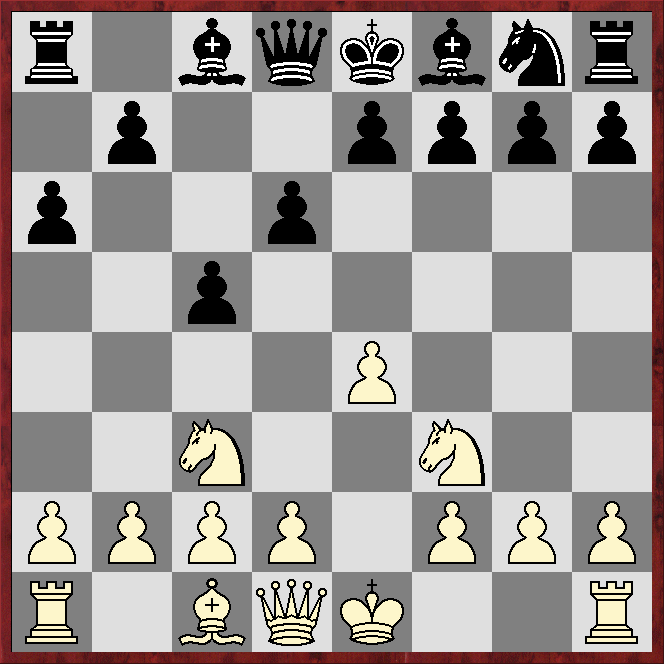
6...a6
There are 2,186 examples of this position in Mega23 - how should White continue?
*****
*****
*****
*****
*****
7.dxc5
This is by far and away the most popular continuation.
7...Bxc5 8.b4 Ba7 9.Be2!?
The mainline in Mega23 runs 9.Bb2 0-0 10.Qc2 Qe7 11.Rd1 Rd8 12.Be2 dxc4 13.Rxd8+ Nxd8 14.Bc4 b5 15.Bd3 Bb7 with equality, according to Stockfish16 and Komodo14.1.
9...0-0 10.0-0 dxc4 11.Qxd8
Robert Kempiński (2510) - Bernhard Schmidt (2275), Biel (Switzerland) 1996, went 11.Bxc4 b5 12.Bd3 Qe7 13.Bb2 Bb7 14.Ne4 Nxe4 15.Bxe4 Rac8 16.Rc1 with maybe a slight edge for White, according to the engines (Komodo14.1 is sure of it, but Stockfish16 fluctuates between equality and plus-over-equals). Kempiński went on to win in 25 moves.
11...Rxd8 12.Bxc4 b5 13.Be2!?
This may be a novelty, the known move being 13.Bb3.
How would you assess this queenless middlegame?
*****
*****
*****
*****
*****
The position is symmetrical, apart from the positions of the king's bishops and rooks. During the game both players thought Black, who is to move, is better, but the engines call the game completely equal.
13...e5!?
And now they reckon White is slightly better, or at least has the better side of equality.
How should White proceed?
*****
*****
*****
*****
*****
14.Rd1
Best, according to the engines is 14.a4!?, eg 14...Nxb4 15.axb5 e4 16.Ng5 axb5 17.Ngxe4 Nxe4 18.Nxe4, after which Black's passed pawn may be more of a weakness than a strength. The engines suggest 14...bxa4 15.Rxa4, and either 15...Bb7 or 15...h6, albeit preferring White.
14...Bf5 15.Bb2 e4 16.Ne1 Be6 17.Rxd8+ Rxd8 18.Rd1 Rxd1 19.Bxd1 Kf8?!
Almost certainly better is 19...Bf5, but best, according to the engines, is 19...Bb8!?, the idea being to meet 20.Bc2 with 20...Be5.
20.Bc2 Bf5
How does White get an advantage?
*****
*****
*****
*****
*****
21.g4?!
Both 21.Ne2 and 21.Nf3!? give at least a slight edge, according to the engines.
21...Bxg4
Possibly even better is 21...Nxg4!? 22.Nxe4 Nge5.
22.Nxe4 Nxe4 23.Bxe4 Bd7 24.Nd3 f5 25.Bd5 g6 26.Ne5
White gains the bishop-pair with 26.Nc5 Bxc5 27.dxc5, but would then have four pawn-islands against Black's two.
26...Nxe5 27.Bxe5 Bc8 28.Kg2 Bb6 29.Kf3 Bd8 30.Ke2 ½–½
FULL TEAM RESULT
Stephen Orton (2133) 1-0 Richard Freeman (1987)
John Quinn (2061) ½ David Tucker (1898)
Peter R Wood (1944) ½ Tim Spanton (1800)
Stephen M Williams (1793) 0-1 Robert Kane (1723)
England 65+ 2 2-2 England 65+ 3

All-England Clash

IN the second round of the European Senior Team Championship today the side I am playing for has been drawn against England's second team, and once again we have black on odd boards.

England 65+ 2 v England 65+ 3
Stephen Orton (2133) v Richard Freeman (1987)
John Quinn (2061) v David Tucker (1898)
Peter R Wood (1944) v Tim Spanton (1800)
Stephen M Williams (1793) v Robert Kane (1723)

Meanwhile my collection of chess pens has grown

Wednesday, 12 July 2023

European Senior Team (65+) Round One

Norbert Sprotte (SC Kreuzverg eV - 2162) - Spanton (England 65+ 3 - 1800)
Board Three
Réti
1.Nf3 d5 2.c4 d4 3.e3 Nc6 4.exd4 Nxd4 5.Nxd4 Qxd4 6.Nc3 Be6?!
Probably a novelty, and almost certainly not a good one. The black queen is a target, and the c7 square is weak, which is why the main move in ChessBase's 2023 Mega database is 6...c6, after which play normally runs 7.d3 Nh6!? 8.Be3 Qd8 9.d4 Nf5 with equality, according to Stockfish16 and Komodo14.1.
7.d3 Nf6
How should White proceed?
*****
*****
*****
*****
*****
8.Nb5!?
After the obvious 8.Be3, Black has 8...Qd7, when White is certainly better, but the text may give a slightly bigger advantage.
How should Black respond?
*****
*****
*****
*****
*****
8...Qb6!?
Not 8...Qd7? 9.Bf4, but possible is 8...Qe5+, when 9.Qe2 Qxe2+ 10.Bxe2 Kd7 avoids material loss, while 9.Be2 c6 10.d4 can be met by 10...Qb8.
9.Be3
The engines fluctuate between this and 9.Bf4, but most of the time prefer the text.
9...Qa5+ 10.Qd2
I was concerned about 10.b4!?, and it seems rightly so. After 10...Qxb4+ 11.Bd2 Qc5 12.d4 Qb6 13.Bf4 Qa5+ 14.Qd2 Qxd2+ 15.Kxd2 White will get his pawn back and, according to the engines, have the upper hand.
10...Qxd2+ 11.Bxd2
The engines prefer this to 11.Kxd2.
11...Kd7 12.Bf4 c6 13.Nc7 Rc8 14.Nxe6 Kxe6
How would you assess this queenless middlegame?
*****
*****
*****
*****
*****
White has the bishop-pair, and Black has lost castling rights, but the black king is not unduly endangered. Komodo14.1 gives White the upper hand, but Stockfish16 only awards White a slight edge.
15.g3 Kd7 16.Bh3+
This check is easily met, after which the bishop does not have much of a future on the h3-c8 diagonal, so perhaps 16.Bg2 is better.
16...e6 17.0-0-0 Bd6 18.Be3 Ke7 19.Kb1
If 19.Bxa7 then 19...Ra8 and 20...Rxa2.
19...c5 20.Bg2
White still has chances of an edge after 20.Rde1!?, according to the engines.
20...b6 21.h3
Preventing the annoying ...Ng4.
21...Rhd8 22.g4
White can stop Black's next with 22.f4, but 22...Nh5 23.Bf2 g6 seems fine for Black.
22...Be5 23.f4 Bd4 24.Bc1 Rd6 25.Bf3
Played so the pawn-push g5 cannot be met by ...Nh5.
25...Rcd8 26.Rhe1 Kf8 27.f5 e5
The engines reckon the game is completely equal after 27...exf5.
28.g5 Ne8 29.Rf1 Nc7 30.Be4 b5 31.h4 Rb8 32.Rh1 Rdb6 33.Rh2 bxc4!?
This lets White get rid of the backward e pawn, but increases the pressure on White's queenside.
34.dxc4 Rb4 35.Rc2 a5 36.h5 a4 37.h6!? gxh6 38.g6!?
Raising the stakes. The engines suggest 38.Rh1!? or 38.a3!?, but reckon 38.gxh6?! Ne8 favours Black.
38...hxg6 39.fxg6
What should Black play?
*****
*****
*****
*****
*****
39...Bxb2!?
This seems to be a sound sacrifice, in the sense that it does not let White grab an advantage, but the engines reckon 39...Ne6 gives better chances of a slight edge.
40.Rxb2!?
Komodo14.1 reckons the text and 40.Bxb2 give complete equality, but Stockfish16 marginally prefers the latter, although 40.Bxb2 a3 41.Rd7 (41.Rf1 is no better, according to the engines) Rxb2+ 42.Kc1 Na6 43.Rxf7+ Kg8 (forced) seems equal, and if 44.Bd5 then 44...Nb4.
40...Rxb2+ 41.Bxb2 a3 42.Rd7 Rxb2+ 43.Kc1 fxg6!?
This and 43...Na6 are completely equal, according to the engines, but the text leads to a more imbalanced position.
44.Rxc7 Rxa2 45.Kb1 Re2 46.Bxg6 e4 47.Rxc5 Kg7 48.Bh5 Rb2+ 49.Ka1 Kf6 50.Ra5 Rc2 51.c5 Ke5 52.Kb1 Rc3
The game has been tense since the piece sacrifice at move 43, but has never veered from complete equality, according to Stockfish16, although Komodo14.1 did briefly prefer White.
53.Ra6 Rxc5 54.Rxh6 Kd4 55.Bd1 Kc3 56.Rh2 Rb5+ 57.Ka2 e3 58.Rc2+ Kd3 59.Be2+ ½–½
FULL TEAM RESULT
Klaus Lehmann (2218) 1-0 Richard Freeman (1987)
Andreas Bachmann (2189) ½ David Tucker (1898)
Norbert Sprotte (2162) ½ Tim Spanton (1800)
Michael Streiger (1934) 1-0 Robert Kane (1723)
SC Kreuzberg eV 3-1 England 65+ 3

Unwanted Drama

SUDDEN illness caused a late withdraw from the England 65+ third team, but a reshuffle among the other England teams means we have been given a new board one.
Our line-up now is: 1 Richard Freeman (1987), 2 David Tucker (1898), 3 Tim Spanton (1800), 4 Robert Kane (1723 and captain).
The final line-ups for all 18 teams in the 65+ tournament can be seen here.
There are 10 teams in the 50+ tournament, which means it has become an all-play-all.
Last night quite a few of us tried the open-air restaurant at our Stary Młyn hotel, and it turned out to be superb, partly thanks to its setting beside a waterhole, but mainly because of the quality of the food (the price of about £9 for a main course did not hurt).
View from the restaurant
The mural is a tribute to Andrzej Szwajkert from Inowrocław, which is about 175 miles away.
Better known under his alias of Jędruś - 'manly' or 'strong' in Polish - he was one of the youngest resistance fighters in the 1944 Warsaw Uprising.
Jędruś worked mainly as a paramedic, but also handed out Molotov cocktails during battles, spied on German movements and collected abandoned weapons.
He bled to death is his father's arms after being hit by shrapnel from a tank shell on September 29 - 11 days short of his 11th birthday.

Tuesday, 11 July 2023

Getting To Świdnica

MOST England players caught today's 13:25 Ryanair flight from Stansted to Wrocław (approximate pronunciation: Vroet-swaff), although not everyone managed to get to the airport in time.
By coincidence our onward transport from Wrocław to Świdnica (approximate pronunciation: Shvid-neat-ser) was also late.
Wrocław airport is modern, and a pleasant place to kill 20 minutes or so
There was plenty of time to settle into our hotels and, for those of us not staying at the venue, to walk the 600m to the tournament room.
Spacious playing conditions, but watch out for those cables from the electronic boards
The proof of the pudding will be in the playing, but there is little to complain about so far.
It's a thumbs-up from me

Team Chess

AM flying to Poland today for the European seniors team championship, being held in the Silesian city of Świdnica.
The nine-round tournament is divided into two categories, 50+ and 65+, with a time control of 40 moves in 90 minutes, plus 30 minutes to finish, and a 30-second increment throughout.
Matches are played over four boards, but teams are allowed to have five players to rotate appearances.
There are 10 teams in the 50+, and 18 in the 65+, with England's first teams seeded No1 in both sections, which is hardly surprising when they include seven grandmasters.
I am playing for England's 65+ third team, the line-up being: 1 David Tucker (1898), 2 Tim Spanton (1800), 3 Colin Costello (1881), 4 Robert Kane (1723 - captain).
The full team listings can be seen at 65+ and 50+.

Monday, 10 July 2023

Lessons From Prague 9

IN round nine with white, after six moves of the Modern Defence, 1.e4 g6 2.d4 Bg7 3.Nc3 c6!? 4.f4 d5 5.e5 Nh6 6.Nf3 f6, I reached the following position.
How should White proceed?
*****
*****
*****
*****
*****
*****
*****
*****
Stockfish15.1 and Komodo14.1 reckon White is at least slightly better.
White's advantage stems from having more central space, and that space advantage can be maintained without effort by developing a bishop or, as Stockish15.1 suggests, by 7.h3.
Instead I played 7.exf6?!, and after 7...exf6 the engines reckon Black is at least level.
I had originally intended continuing 8.Qe2+, thinking White must have an edge after 8...Qe7 9.Qxe7+ Kxe7.
Not only is an such edge doubtful - the black king has a safe square at f7 - but Black can instead play 8...Kf7, when the line-up of white king and queen on the e file, with the white king unable to immediately castle, can only favour Black.
LESSON: when surrendering an advantage, in this case's White's extra central space, one must be sure of getting something tangible, and of at least equal value, in return.

Sunday, 9 July 2023

Lessons From Prague 8

IN round eight with Black I faced the Grand Prix Attack in the Sicilian, reaching the following position after the moves 1.e4 c5 2.Nc3 Nc6 3.f4 g6 4.Nf3 Bg7 5.Bc4 e6 6.0-0 Nge7 7.Qe1!? Nd4!? 8.Nxd4 cxd4 9.Nb5!?
How should Black proceed?
*****
*****
*****
*****
*****
*****
*****
I played 9...0-0?!, after which 10.Nd6 (the game saw White push his e pawn) is at least equal.
What Black should play is 9...d5 10.exd5 exd5, which I rejected because if White captures for a second time on d5 and Black replies 11...Qxd5??, White wins with 12.Nc7+.
I missed, although I knew the idea from similar lines in the Sicilian, that after 11.Bxd5?? Black has the zwischenzug 11...a6, winning one of White's fifth-rank pieces.
LESSON: I knew the right idea in the diagrammed position, but failed to recall it at the board. Nevertheless Black's ninth move was obviously going to be critical, and it was incumbent on me to devote enough time to properly work out what was going on.

Saturday, 8 July 2023

Lessons From Prague 7

IN round seven I reached the following promising position with black.
White has just captured on e5
*****
*****
*****
*****
*****
*****
*****
*****
*****
Both players have three pieces in play, but White has also castled and so has a slight lead in development.
However it is Black to move, and the simple and safe 11...0-0 gives Black at least equality, according to Stockifsh15.1 and Komodo14.1.
Instead I played the greedy-ish 11...Qc7?!, putting pressure on e5 and c4.
Even if White were obliged to play the retreat 12.Nf3?!, it is far from clear that Black can afford to grab a pawn with 12...Qxc4?!, after which the black queen will be harassed and Black still has to spend a tempo on castling.
My opponent played 12.a3, which is enough for at least a slight edge, while 12.Qa4+ may be even better.
The game continued 12...Nc6 13.Nxc6 bxc6 14.d3, after which I really should have castled.
Instead I grabbed an open file with 14...Rb8?, after which 15.Nd2 put White in position to take advantage of the unfortunate line-up of black pieces on the h2-b8 diagonal.
LESSON: delaying castling in fairly open positions is a risky business. One must be sure the potential gain from another manoeuvre, or from a combination, outweighs the possible tactical disadvantages.

Friday, 7 July 2023

Pimlico Final

I MISSED rounds three and four of the Pimlico summer tournament because I was playing in Prague, but I did play in last night's fifth and final round.

Matthias Lataille (1797) - Spanton (1932)
Sicilian Closed
1.e4 c5 2.Nc3 Nc6 3.Bb5 Nd4 4.Nf3!?
White offers the bishop-pair in return for getting a sizeable lead in development. More popular is 4.Bc4, but Magnus Carlsen has played the text and it is liked by Stockfish16 and Komodo14.1.
4...Nxb5 5.Nxb5 a6 6.Nc3 d6
How should White proceed?
*****
*****
*****
*****
*****
7.d4!?
Normally when an opponent has the bishop-pair it makes sense to keep lines closed. But here that strategy would gradually let Black catch up in development. If Black were then able to open the position, the bishops would come into their own. There is a similar trade-off in variations of the Chigorin, although there it is Black who swops off one or both bishops. Contrast this with the Exchange Variation of the Spanish, many lines of the Rossolimo in the Sicilian and many lines of the Nimzo-Indian, where structural damage rather than time is compensation for the bishop-pair.
7...cxd4 8.Qxd4 Bg4
The mainline in ChessBase's 2023 Mega database runs 8...e5!? 9.Qd3 h6 10.Nd2!? Nf6 11.Nc4 Be6 with equal chances, according to the engines, which give 9.Qb4!? as an improvement for White.
9.Nd2
The engines suggest an apparent novelty in 9.Qb4!?, claiming at least a slight edge for White.
9...Nf6 10.0-0 e6 11.Re1 Be7 12.Nf1 0-0
Now both sides have castled, how would you assess the position?
*****
*****
*****
*****
*****
White's advantage in development has slowly disappeared, and Black has a typical Open Sicilian 2-1 pawn-majority on the central two files. But White has more space in the centre, and the Black bishops are not doing much - the dark-squared bishop is passive while the light-squared bishop will be a target for White's pieces. The engines reckon the position is equal.
13.Bg5
The threat is 13.Bxf6, and if 13...Bxf6 then 14.e5 wins a piece. But the engines prefer the consistent 13.Ng3
13...Bh5 14.Ng3 Bg6 15.Rad1 Qa5 16.Bd2 Qc5?!
The engines strongly dislike this, claiming Black is at least slightly better after 16...Qc7.
17.Qxc5 dxc5
Black's pawn-majority on the central two files has gone, and the position is completely equal, according to the engines
*****
*****
*****
*****
*****
18.f3 Rfd8 19.Be3 b5 20.b3 Rac8 21.Rxd8+ Rxd8 22.Rd1 Rxd1+ 23.Nxd1 Nh5!?
More circumspect is 23...Nd7.
24.Nxh5 Nxh5 25.c4
The black c pawn is a target.
25...f5 26.e5 f4!?
This pawn sacrifice is probably OK but the engines prefer 26...bxc4 27.bxc4 g5, eg 28.Nb2 f4 29.Bf2 Bg6 30.Na4 Bd3 31.Bxc5 Bxc5+ 32.Nxc5 Bxc4 with equality.
27.Bxf4 Bg6 28.Be3 Bb1 29.Nc3 Bd3 30.cxb5 axb5 31.Kf2 b4?!
Probably better is 31..c4, or starting to get the king into play with 31...Kf7.
32.Na4 c4?
Black may be holding after 32...Bb1.
33.bxc4?
Winning is 33.Nb2, when Black can do nothing about the threatened 34.Nxc4.
33...Bxc4 34.Bc5 Bxc5+ 35.Nxc5 Bxa2 36.Nd3 b3 37.Ke3
Black to play and draw
*****
*****
*****
*****
*****
37...g5?
Both 37...Kf7 and 37...Bb1 seem to draw, eg 37...Kf7 38.Kd2 Kg6 39.Kc1 b2+ 40.Kxb2 Bc4 41.Ne1 Kf5 42.Kc3 Ba6 43.Kd4, after which White's extra pawn is of little value, according to the engines.
38.Kd2 Kf7 39.Kc1 Ke7?
Again Black should sacrifice the b pawn to free the bishop. After 39...b2+ 40.Kxb2 the black king is not as well placed as in the previous note, which means 40...Bc4 can be met by 41.Kc3, but that is better than the hopeless text.
40.Kb2 Kd7 41.Nc5+ Kc6?
Black is lost anyway, but this makes it easy.
The game finished:
42.Nxe6 Kd5 43.Nxg5 h6 44.e6 Kd6 45.Nf7+ Kxe6 46.Nxh6 Kf6 47.Ng4+ Kg5 48.Nf2 1-0