Showing posts with label Pimlico Summer. Show all posts

Friday, 7 July 2023

Pimlico Final

I MISSED rounds three and four of the Pimlico summer tournament because I was playing in Prague, but I did play in last night's fifth and final round.

Matthias Lataille (1797) - Spanton (1932)
Sicilian Closed
1.e4 c5 2.Nc3 Nc6 3.Bb5 Nd4 4.Nf3!?
White offers the bishop-pair in return for getting a sizeable lead in development. More popular is 4.Bc4, but Magnus Carlsen has played the text and it is liked by Stockfish16 and Komodo14.1.
4...Nxb5 5.Nxb5 a6 6.Nc3 d6
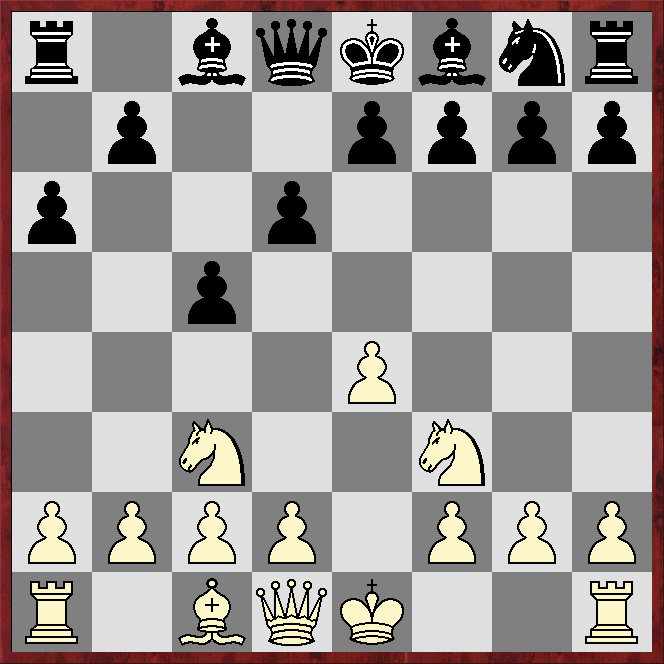
How should White proceed?
*****
*****
*****
*****
*****
7.d4!?
Normally when an opponent has the bishop-pair it makes sense to keep lines closed. But here that strategy would gradually let Black catch up in development. If Black were then able to open the position, the bishops would come into their own. There is a similar trade-off in variations of the Chigorin, although there it is Black who swops off one or both bishops. Contrast this with the Exchange Variation of the Spanish, many lines of the Rossolimo in the Sicilian and many lines of the Nimzo-Indian, where structural damage rather than time is compensation for the bishop-pair.
7...cxd4 8.Qxd4 Bg4
The mainline in ChessBase's 2023 Mega database runs 8...e5!? 9.Qd3 h6 10.Nd2!? Nf6 11.Nc4 Be6 with equal chances, according to the engines, which give 9.Qb4!? as an improvement for White.
9.Nd2
The engines suggest an apparent novelty in 9.Qb4!?, claiming at least a slight edge for White.
9...Nf6 10.0-0 e6 11.Re1 Be7 12.Nf1 0-0
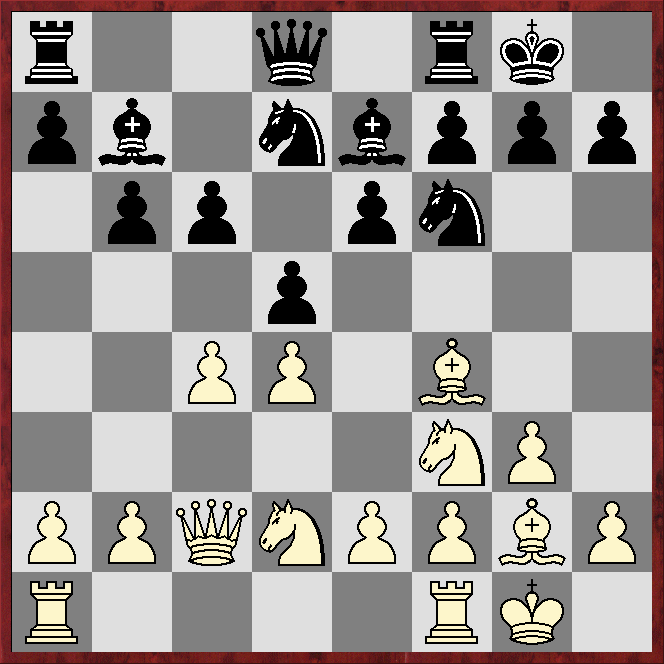
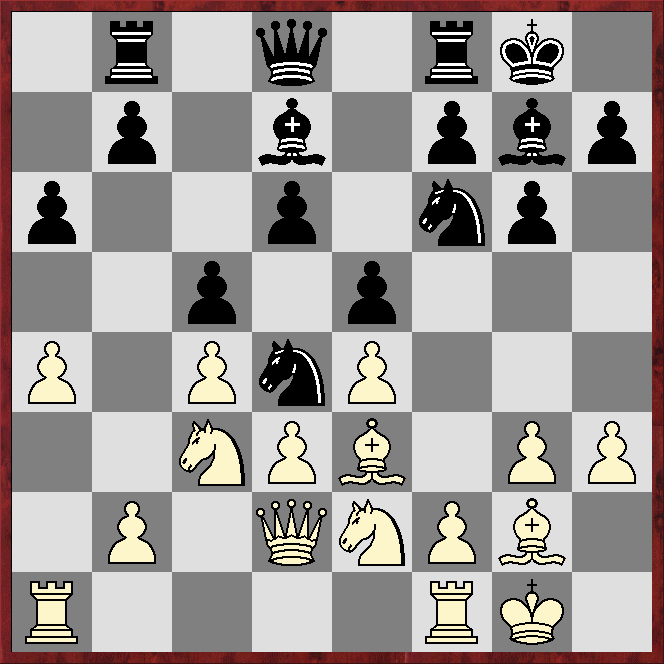
Now both sides have castled, how would you assess the position?
*****
*****
*****
*****
*****
White's advantage in development has slowly disappeared, and Black has a typical Open Sicilian 2-1 pawn-majority on the central two files. But White has more space in the centre, and the Black bishops are not doing much - the dark-squared bishop is passive while the light-squared bishop will be a target for White's pieces. The engines reckon the position is equal.
13.Bg5
The threat is 13.Bxf6, and if 13...Bxf6 then 14.e5 wins a piece. But the engines prefer the consistent 13.Ng3
13...Bh5 14.Ng3 Bg6 15.Rad1 Qa5 16.Bd2 Qc5?!
The engines strongly dislike this, claiming Black is at least slightly better after 16...Qc7.
17.Qxc5 dxc5
Black's pawn-majority on the central two files has gone, and the position is completely equal, according to the engines
*****
*****
*****
*****
*****
18.f3 Rfd8 19.Be3 b5 20.b3 Rac8 21.Rxd8+ Rxd8 22.Rd1 Rxd1+ 23.Nxd1 Nh5!?
More circumspect is 23...Nd7.
24.Nxh5 Nxh5 25.c4
The black c pawn is a target.
25...f5 26.e5 f4!?
This pawn sacrifice is probably OK but the engines prefer 26...bxc4 27.bxc4 g5, eg 28.Nb2 f4 29.Bf2 Bg6 30.Na4 Bd3 31.Bxc5 Bxc5+ 32.Nxc5 Bxc4 with equality.
27.Bxf4 Bg6 28.Be3 Bb1 29.Nc3 Bd3 30.cxb5 axb5 31.Kf2 b4?!
Probably better is 31..c4, or starting to get the king into play with 31...Kf7.
32.Na4 c4?
Black may be holding after 32...Bb1.
33.bxc4?
Winning is 33.Nb2, when Black can do nothing about the threatened 34.Nxc4.
33...Bxc4 34.Bc5 Bxc5+ 35.Nxc5 Bxa2 36.Nd3 b3 37.Ke3
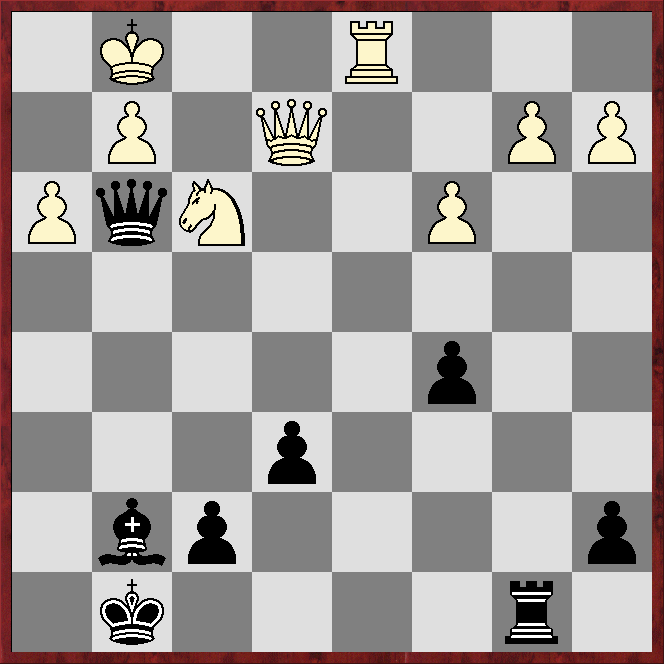
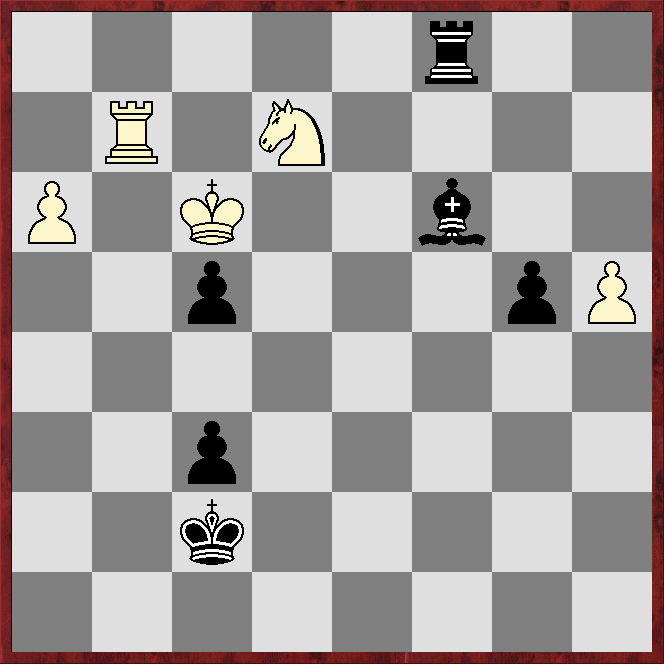
Black to play and draw
*****
*****
*****
*****
*****
37...g5?
Both 37...Kf7 and 37...Bb1 seem to draw, eg 37...Kf7 38.Kd2 Kg6 39.Kc1 b2+ 40.Kxb2 Bc4 41.Ne1 Kf5 42.Kc3 Ba6 43.Kd4, after which White's extra pawn is of little value, according to the engines.
38.Kd2 Kf7 39.Kc1 Ke7?
Again Black should sacrifice the b pawn to free the bishop. After 39...b2+ 40.Kxb2 the black king is not as well placed as in the previous note, which means 40...Bc4 can be met by 41.Kc3, but that is better than the hopeless text.
40.Kb2 Kd7 41.Nc5+ Kc6?
Black is lost anyway, but this makes it easy.
The game finished:
42.Nxe6 Kd5 43.Nxg5 h6 44.e6 Kd6 45.Nf7+ Kxe6 46.Nxh6 Kf6 47.Ng4+ Kg5 48.Nf2 1-0

Friday, 16 June 2023

Pimlico Summer Round Two

PLAYED last night.

Spanton (1959) - John M Bennett (2112)
Pirc
1.e4 d6 2.d4 g6 3.Nc3 Bg7 4.f4 Nf6 5.Nf3 0-0 6.Bc4!?
Provocative. The mainline in ChessBase's 2023 Mega database runs 6.Bd3 Nc6 (6...Na6!? is almost as popular) 7.0-0 Bg4 8.Be3 e5 with an equal position, according to Stockfish15.1 and Komodo14.1.
6...Nxe4!?
The engines like this, even though Black has spent a tempo on ...d6.
How should White respond?
*****
*****
*****
*****
*****
7.Nxe4
The engines prefer 7.Bxf7+!? Rxf7 8.Nxe4 with what they reckon is an equal position.
7...d5 8.Bd3 dxe4 9.Bxe4 Nd7
The engines reckon Black has a slight edge after 9...c5!?
10.c3 Nf6 11.Bd3 b6!?
This may be a novelty. Known moves are 11...c5!? and 11...Qd6!?
12.0-0 Bb7 13.Qe2 c5!?
Black is willing to accept split queenside pawns in return for chipping away at White's pawn centre and getting a half-open b file.
14.dxc5 bxc5 15.f5!? Nd5?!
The engines give 15...c4!?, claiming 16.Bxc4 gxf5 gives Black a slight edge (Stockfish15.1) or at least equality (Komodo14.1).
16.fxg6 hxg6
How should White proceed?
*****
*****
*****
*****
*****
17.Bxg6!?
The engines reckon 17.Ng5 gives White at least a  slight edge.
17...Qd6?
Black completely equalises with 17...fxg6 18.Qe6+ Kh8, according to the engines, when White has a perpetual with 19.Qh3+ etc or can try for more with 19.Ng5. After the latter one line runs 19...Rxf1+ 20.Kxf1 Qf8+ 21.Kg1 Qf6 22.Qh3+ Kg8 23.Qh7+ Kf8 24.Bd2 Ba6 25.Re1, when White has a pawn and an attack for a bishop, giving complete equality, according to the engines.
Also better than the text is 17...Nxc3!?, although the engines prefer White.
18.Bd3 Rad8 19.Rd1?!
Probably better is 19.Ng5.
19...Nf4 20.Bxf4 Qxf4 21.Rf1!?
Not 21.Qxe7? Bxf3 22.gxf3 Rfe8 23.Qxc5 Qxf3, and probably no better is the complicated 22.Bh7+!? Kxh7 23.Rxd8 Be5! 24,gxf3 (only move) Qxh2+ 25.Kf1 Bg3!? 26.Qe4+ Kg7, after which the engines reckon Black is winning.
21...e6 22.Rad1
The engines prefer 22.Rf2 or 22.Rae1.
22...Rd5
Black equalises (Stockfish15.1) or is only slightly worse (Komodo14.1) after 22...c4.
23.Nd2 Qh4 24.Nf3 Qg4
If repeating with 24...Qf4, then both 25.Rde1 and 25.g3 give the upper hand, according to the engines.
25.h3 Qg3?
Black has nothing better than 25...Qf4, according to the engines.
26.Be4?
Even stronger is 26.Qe4, eg 26...Rb8 27.Qh7+ Kf8 28.Nh4 Rg5 29.Rf2 with a continuing attack.
26...Rxd1 27.Rxd1 Bxe4 28.Qxe4 Rb8 29.Qe2
How would you assess this late-middlegame?
*****
*****
*****
*****
*****
White is a pawn up and Black has two isolanis, but White is a little passive and Black has pressure against the white queenside. The engines reckon White has the upper hand (Komodo14.1) or a slight edge (Stockfish15.1).
29...Qf4 30.Qd2 Qf6 31.Qe2 Qf4 32.Qd2 Qf6 33.Qf2 Qf5 34.Qg3?!
White is much better after 34.Rd2 or 34.Qh4, according to the engines.
How should Black proceed?
*****
*****
*****
*****
*****
34...e5?
The engines reckon Black has to plunge in and grab the b pawn with 34...Rxb2! It looks scary after 35.Rd8+ Kh7 36.Ng5+ Kh6 37.Qh4+, but 37...Kg6 leaves White without a convincing continuation, and the position is completely equal, according to the engines.
Also better than the text, according to the engines, is the passive 34...Rf8?!, but Black's compensation for a pawn has vanished.
35.Nh4 Qf4
Not 35...Qc2? 36.Rf1 (or 36.Qg4).
36.Qxf4 exf4 37.Rd2 Bf6 38.Nf3 Kg7 39.Kf2 a5 40.a4!? Re8 41.Re2 Rb8 42.Ne1?!
This comes to be Stockfish15.1's top choice, after it is shown the move, but almost certainly a better practical choice is 42.Ke1. I rejected it because of 42...Rxb2?? 43.Rxb2 Bxc3+, missing 44.Rd2.
42...Bh4+ 43.Kf1?
Correct is 43.Kf3 Bxe1 44.Rxe1 Rxb2 45.Re4 with a winning rook-and-pawn ending, according to the engines, but there is some way to go before the full point can be harvested.
43...Rd8
What should White play?
*****
*****
*****
*****
*****
44.g3!?
Giving back the pawn is the only way not to lose, according to the engines, which reckon 44.Re4 Rd1 45.Re2 c4 46.Re4 f5 47.Re2 Kf6 48.Re8 Bg3 leaves Black with an advantage worth more than a rook. But no matter how many more moves are inputted, White can keep shuffling the rook on the e file and Black cannot seem to make progress.
44...Bxg3
Not 44...fxg3? 45.Nf3.
45.Kg2 Rd1 46.Nf3 f6 47.b4!? cxb4 48.cxb4 axb4 49.Rb2 Rc1 50.Nd4
There seems nothing wrong with 50.Rxb4, eg 50...Rc2+ 51.Kg1 is fine for White.
50...Be1 51.Kf3?
Simple and good is 51.Ne6+ followed by 52.Nxf4.
51...Bc3 52.Rg2+
Not much better is 52.Rc2 Rf1+ 53.Ke4 Re1+ 54.Re2 Ra1 55.Ne6+ Kf7 56.Nxf4 b3 etc.
52...Kf7 53.Ne2?!
The engines give 53.Nb3 Rb1 54.Nd2 Ra1 55.Kxf4 Rxa4, but reckon Black is winning.
How should Black continue?
*****
*****
*****
*****
*****
53...Rc2?!
This may be good enough, but easier is 53...Rf1+ 54.Rf2 (54.Ke4 f3) Rxf2+ 55.Kxf2 Bd2, after which the b pawn wins for Black.
54.Rg1 b3?
But this definitely throws away the win. The engines give 54...Bd2 55.Rb1 Ra2 56.Nxf4 Rxa4 57.Nd3 Bc3, after which Black is obviously better but White's pieces are actively placed.
55.Rb1 b2 56.Nxc3 Rxc3+ 57.Kxf4 Rb3 58.a5 Rb4+ 59.Kf5 Rb5+ 60.Kf4 Rxa5 61.Rxb2
I offered a draw.
61...Ra3+ 62.Kf5 ½–½

Friday, 9 June 2023

Transport To Pimlico

CAUGHT the Central Line to Victoria yesterday and walked the rest of the way to the Churchill Gardens social club, where the Pimlico summer tournament is being held in two sections over five consecutive Thursday evenings.

Pascoe Rapacci (1745) - Spanton (1959)
Open
Scotch
1.e4 e5 2.Nf3 Nc6 3.d4 exd4 4.Nxd4 Qf6!?
Not a particularly popular continuation, but there are 3,800 examples of the move in ChessBase's 2023 Mega database
*****
*****
*****
*****
*****
Often the game will transpose to normal 4...Bc5 lines, eg by 5.Be3 Bc5, 5.Nxc6 Bc5 or 5.Nb5!? Bc5. However 4...Qf6!?, as well as possibly confusing White, has the independent point that 5.Nb3 will not come with tempo, as it does after 4...Bc5. On the other hand, after the text 5.Nb3 will prevent Black putting the dark-square bishop on the a7-g1 diagonal.
5.Nf3!?
This is only sixth-most popular in Mega23, but is the top choice of Stockfish15.1 and Komodo14.1, although they do fluctuate if other moves are entered and then retracted. There is no doubt the text is a major loss of time. It as if, after 4.Nxd4, White had offered to return the king's knight to f3 in exchange for giving Black two tempi (...Qf6 and a move to come). Naturally there is more to it than that - White hopes to show the black queen is misplaced and ripe for harassment by White's minor pieces and/or pawns.
5...Bb4+!? 6.c3
Not the only move by any means. Possibilities include 6.Nc3!?, the point being 6...Bxc3+ 7.bxc3 Qxc3 8.Bd2 gives White the bishop-pair and open lines for a pawn. Also reasonable is 6.Nbd2, but 6.Bd2? runs into 6...Qxb2.
6...Be7!?
This may be a novelty. Normal is 6...Bc5, after which 7.Bg5 Qg6 8.Bd3 Ne5 seems fine for Black. The mainline in Mega23 runs 7.Be2 d6 8.0-0 Nge7 9.Bg5 with what the engines reckon is at least a slight edge for White.
7.Bd3 Ne5?!
Probably better is 7...d6, but the engines reckon White has the upper hand.
8.Nxe5 Qxe5 9.Nd2
Also strong is 9.f4, and if 9...Qc5 then 10.Qe2 with Be3 to come.
9...d5 10.Nf3 Qh5
How should White proceed?
*****
*****
*****
*****
*****
11.Nd4?!
Probably best is 11.exd5, when 11...Qxd5 12.0-0 looks promising for White. Perhaps Black should make a sacrifice of it with 11...Nf6!? 12.c4, although White is not forced to hold on to the pawn and could just develop.
11...Qxd1+ 12.Kxd1 dxe4 13.Bxe4 Nf6 14.Bf3 Bg4 15.Re1 Bxf3+ 16.Nxf3 0-0-0+ 17.Kc2 Bc5
Black has equalised.
18.Bg5!?
More straightforward is 18.Be3 Bxe3 19.Rxe3 Rhe8 20.Rae1 Rxe3 21.Rxe3.
18...Bxf2 19.Bxf6 gxf6 20.Re7 Rd7 21.Rxd7 Kxd7 22.Rd1+ Kc8
How would you assess this rook-and-minor-piece ending?
*****
*****
*****
*****
*****
Normally rook and bishop make a better team than rook and knight, and Black is a pawn up. But Black's shattered kingside means the knight should have few problems finding a good post, and the engines reckon the position is completely equal.
23.Nd4!? Rd8 24.Nf5 Rxd1!? 25.Kxd1 Kd7 26.Ke2 Bc5 27.Kd3 Ke6 28.Ke4 Bf8!?
Passivity is rarely wise, and here it puts Black in danger. The engines suggest gaining queenside space with 28...a5.
29.c4
Getting white pawns off dark squares makes sense, but the engines reckon 29.Nd4!? gives White a slight edge. I intended replying 29...Kd7, but 30.Kf5 gives White two well-placed pieces while Black's position, despite the small amount of material left on the board, has a slightly cramped feel.
29...c6 30.Nd4+ Kd7 31.Kf5 Bc5 32.Nb3 Be7?!
More passivity. Better seems to be 32...Bd6, eg 33.Kxf6 Bxh2 34.Nc5+ Kc7 35.Kxf7, although the position looks easier for White to play.
After 32...Be7?! it is White to play and gain the upper hand, or at least a slight edge, according to the engines
*****
*****
*****
*****
*****
33.Ke4?!
The king was well-placed on f5. The engines give 33.h4 b5 34.cxb5 cxb5 35.h5, one line continuing 35...a6 36.Nd2 Bc5!? 37.Kxf6 Bd4+ 38.Kxf7 Bxb2, after which the strength of the white king seems to more than compensate for Black having bishop-v-knight in a position with rival pawn-majorities.
33...Bd6 34.h3 b6
If 34...Be5 then 35.Nc5+.
35.Nd4?!
The engines reckon the game is completely equal after this, as it is after, say, 35.Nc1, but the text gives White chances to go wrong in a pawn-ending a pawn down.
35...Be5
White to play and draw
*****
*****
*****
*****
*****
36.b3
There seem to be two drawing moves, 36.b4! and 36.g4!
After 36.b4! Bxd4 37.Kxd4 Ke6 38.c5 b5 39.Ke4 it seems Black cannot make progress, eg 39...f5+ 40.Kf4 Kf6 41.g3 h6 42.g4! fxg4 43.hxg4 Ke6 44.Ke4 with complete equality.
After 36.g4! c5 37.Nb5 a6 38.Nc3 again Black apparently cannot make progress, eg 38...Bxc3 39.bxc3 Ke6 40.Kf4.
36...Bxd4 37.Kxd4 Ke6 38.Ke4
Perhaps 38.b4 is a tad better, but 38...f5 is strong.
38...f5+ 39.Kf4 Kf6 40.b4 a6 41.a4 b5 42.axb5
How should Black recapture?
*****
*****
*****
*****
*****
42...axb5?
White has a draw after this. Correct is 42...cxb5, eg 43.c5 Ke6 with ...Kd5 and ...a5 to come. Alternatively 43.cxb5 axb5 wins for Black in a similar way as to what happens in the game (when White misses a draw).
43.c5 h6
White to play and draw
*****
*****
*****
*****
*****
44.h4?
Both 44.g3 and 44.g4!? draw, eg 44.g4!? fxg4 45.hxg4 Ke6 46.Ke4 f5+ (what else?) 47.gxf5 Kf6 48.Kf4 h5 49.Ke4 h4 50.Kf4 h3 51.Kg3 Kxf5 52.Kxh2 Ke4 53.Kg4 Kd4 54.Kf5 Kc4 55.Kc6 Kxb4 56.Kd6 and both sides will queen their one surviving pawn.
44...Ke6 45.Kf3
The white king will have to withdraw sooner or later, and 45.g4 fxg4 46.Kxg4 f5+ is equally hopeless.
45...Ke5 46.Ke3 f4+ 47.Kd3 h5 48.Ke2 Kf5 49.Kf3 f6 50.Kf2 Kg4 51.Ke2 Kg3 52.Kd3 Kxg2 53.Ke4 f3 54.Kf5 f2 55.Kxf6 f1=Q+ 0-1

Thursday, 1 June 2023

Summer Chess

THE 11th annual Pimlico summer tournament starts next week, held over five consecutive Thursday evenings at the Churchill Gardens social club in London SW1.
There are two sections, open and U1800 ECF, with a time limit of 75minutes plus a 30-second increment.
There does not appear to be a tournament website, but details and entries are via controller Nick Faulks (nw.faulks@outlook.com), with two half-point byes allowed.

Friday, 22 July 2022

Summer's Over

PLAYED last night in the fifth and final round of the open section of the Pimlico Summer Congress, held over five consecutive Thursday evenings.

Paul Dupré (1969) - Spanton (1955)
QGD Tarrasch
1.d4 d5 2.c4 e6 3.Nc3 Nf6 4.Bg5 c5!?
Now 5.cxd5 cxd4 is the Dutch Gambit, and 5.cxd5 Qb6 is the Peruvian Gambit, but this game eventually transposes to a mainline of the Tarrasch Defence.
5.Nf3 Nc6?!
Probably better is 5...cxd4.
6.cxd5!?
Stockfish15 and Komodo13.02 prefer this to the commoner 6.e3.
6...exd5
How should White proceed?
*****
*****
*****
*****
*****
7.g3?!
Stockfish15 gives 7.Bxf6 gxf6 8.e3, claiming Black's smashed kingside gives White the upper hand despite Black's bishop-pair. Komodo13.02 narrowly prefers the clam 7.e3.
7...cxd4 8.Bxd4 Be7
Perhaps stronger is the more-aggressive 8...Bc5, one point being 9.Bxf6?! Qxf6 10.Nxd5? Qxd4 looks very good for Black, eg 11.Nxc7+ Ke7! 12.Qxd4 Bxd4 13.Nxa8?! Bxb2 14.Rb1 Bc3+, although Black is temporarily the exchange down.
9.Bg2 0-0 10.0-0
There are 4,533 games with this position in ChessBase's 2022 Mega database
*****
*****
*****
*****
*****
10...h6 11.Be3 Nxd4?!
The mainline in Mega22 runs 11...Re8 12.Rc1 Bf8!? 13.Nxc6 bxc6 14.Na4 Bd7 15.Bc5!? Bxc5 16.Nxc5 with what the engines reckon is an equal position, although there are many promising alternatives, especially for White, along the way, eg the engines prefer 13.Qb3!? to capturing on c6.
12.Qxd4
Even better, according to the engines, is 12.Bxd4, eg 12...Be6 13.Qb3 with pressure.
12...Be6 13.Rfd1 Qa5 14.a3
Not 14.Nxd5?? Nxd5 15.Bxd5 Rfd8 etc.
14...Rfd8 15.b4 Qa6 16.Bf4?!
The engines reckon White should play 16.Qd3 or 16.Qd2, in each case claiming an edge for White.
16...Rac8 17.b5?
This is weakening. The engines prefer 17.Qd3 Qxd3 18.Rxd3 d4, giving Black a slight edge (but not 18...Bf5? as White has 19.Nxd5).
17...Qa5 18.Bd2
This is best, according to the engines, but Black is on top.
18...Rc4
What should White play?
*****
*****
*****
*****
*****
19.Nxd5
This is Komodo13.02's choice but Stockfish15 narrowly prefers 19.Qd3, when 19...Qc7 leaves Black with much the better game, according to both engines.
19...Rxd4 20.Bxa5
Not 20.Nxe7+?? as, after 20...Kf8 the capture 21.Bxa5 loses to 21...Rxd1+ etc.
20...Rxd1+ 21.Rxd1 Rxd5 22.Bxd5 Nxd5 23.e4 Nb6?!
Almost certainly better is 23...Nf6, after which White has two pawns hanging, and if 24.e5 then 24...Nd5 is strong.
24.Bb4
Now Black probably still has an edge after 24...Bg4 or 24...Bxb4, but not 24...Bg5?? 25.f4 etc.
Black to play and lose
*****
*****
*****
*****
*****
24...Kf8?? 1-0

Friday, 15 July 2022

Summer In Pimlico

PLAYED last night in the open tournament of the Pimlico Summer congress.

Adam Sixsmith (1698) - Spanton (1955)
Pimlico Round Four*
Catalan
1.d4 d5 2.c4 e6 3.Nf3 Nf6 4.g3 Bb4+ 5.Bd2 Be7
The point of this fairly well-known manoeuvre is to 'misplace' the white dark-square bishop, the argument being it belongs on b2 to support action on the e5 square. The mainline in ChessBase's 2022 Mega database after 4.g3 runs 4...Be7 5.Bg2 0-0 6.0-0, when Black can continue along Closed Catalan lines with 6...c6 7.Qc2 b6 8.Nbd2 Bb7 9.b3 Nbd7 10.Bb2 Rac8.
This position occurs 826 times in Mega22, with White scoring a very respectable 57%
It will be instructive to compare this position with the one reached after the same number of moves in last night's game.
6.Bg2 0-0 7.0-0 c6 8.Qc2 b6 9.Bf4
The bishop redeploys to a more active square, one point being to free d2 for the queen's knight.
9...Bb7 10.Nbd2 Nbd7
This position occurs 142 times in Mega22, with White scoring an excellent 59%
Comparing the two diagrams, we can see Black in the more-popular line has the extra move ...Rc8, while White has played b3 and Bb2 instead of Bf4 (Bd2 having, as it were, disappeared from the record). Despite what I wrote at move five, the statistics suggest the more-popular line is a better try for Black, (this is borne out by rating performance as well as just win-loss numbers). Food for thought.
11.Rac1 Rc8 12.Rfe1!?
This is strongly disliked by the engines. Stockfish15 gives 12.a3 Re8 13.b4 c5 14.dxc5 bxc5 15.b5, claiming equality. Komodo13.02 prefers 12.Ne5 Nh5 13.Nd3 Nxf4 14.Nxf4, also reckoning the position is equal.
12...Re8
12...c5!? is enough for at least a slight edge, according to the engines, eg 13.Bg5!? dxc4 14.Qxc4 h6 15.Be3 Ng4.
13.Ne5 Nh5 14.Ndf3 Nxf4 15.gxf4
Black is slightly better, according to the engines
The rest of the game is a classic example of the higher-rated player only looking for ways to win while the lower-rated opponent only looks for ways to avoid defeat. Consequently chances for the latter to gain a sometimes-substantial advantage are missed by both sides.
15...f5?
This prevents a quick e4 or f5, not that White necessarily wants to play either pawn thrust, but leaves a serious hole at e5 and does the black light-square bishop no favours.
16.Nxd7 Qxd7 17.Ne5 Qd8
There is no question of the bishop-pair being an advantage in this position - the knight is too strong and there are too many pawns on the board
18.e3 g5!?
The engines prefer the more-conservative 18...Bd6.
19.Nd3
The engines reckon White should try for an initiative on the queenside, eg 19.Qa4!? a6 20.cxd5 cxd5 21.Rxc8 Qxc8, followed by switching to kingside play with 22.Qd1!?
19...g4
The engines prefer 19...gxf4 20.exf4!? Bf6 with approximate equality.
20.c5
20.Qa4 a6 21.Qb3 gives White an advantage, according to the engines.
20...b5?!
Almost certainly not 20...bxc5? 21.Nxc5, but the engines reckon this is a good time to activate the light-square bishop with 20...Ba6!?, and if 21.Nb4 then 21...Bc4 22.b3 bxc5 seems to give Black at least equality.
21.b4
Possibly stronger is the engines' 21.a4, when Black is more-or-less obliged to reply 21...a6, leaving all eight black pawns on light squares.
21...a5 22.a3
The engines prefer 22.a4 with queenside pressure.
22...Ra8 23.Ra1 Ra6
Closing the queenside with 23...a4 may be better.
24.Ra2
The engines like more-active queenside play with 24.a4!?, the point being Black's bishops are not well-placed for action on the a and b files.
24...Qa8 25.Rea1 Qa7?
This loses, according to the engines, although they reckon White is well on top after, for example, 25...a4 26.f3
How should White proceed?
*****
*****
*****
*****
*****
26.Kf1
White is better after this, according to the engines, but 26.a4!?, threatening 27.axb5 is very strong, eg 26...bxa4 27.Rxa4 axb4 28.Rxa6 Bxa6 29.Nxb4, or 26...axb4 27.axb5 Rxa2 28.Rxa2 Qb8 28.b6, or 26...Ra8 27.axb5 cxb5 28.bxa5.
26...Ra8 27.Nc1?!
Almost certainly too passive. 27.f3 leaves Black badly placed for kingside play, and if 27...axb4 then simply 28.Nxb4.
27...Qb8 28.Ke2 Kh8 29.f3 h5 30.Kd3?!
The king heads for safety on the queenside, but it is a long-winded process that gives Black time to reorganise for kingside play. The engines prefer 30.Nd3 or 30.gxf4.
30...Qf8 31.Kc3 Qh6 32.Qf2 Rg8 33.Nd3 Bf6 34.Kb3?!
This gives Black a tempo to shut the queenside.
34...a4+ 35.Kc3 Ra7 36.Rh1 h4 37.Raa1 h3 38.Bf1 Bc8 39.Be2 Bh4 40.Qf1 Rag7
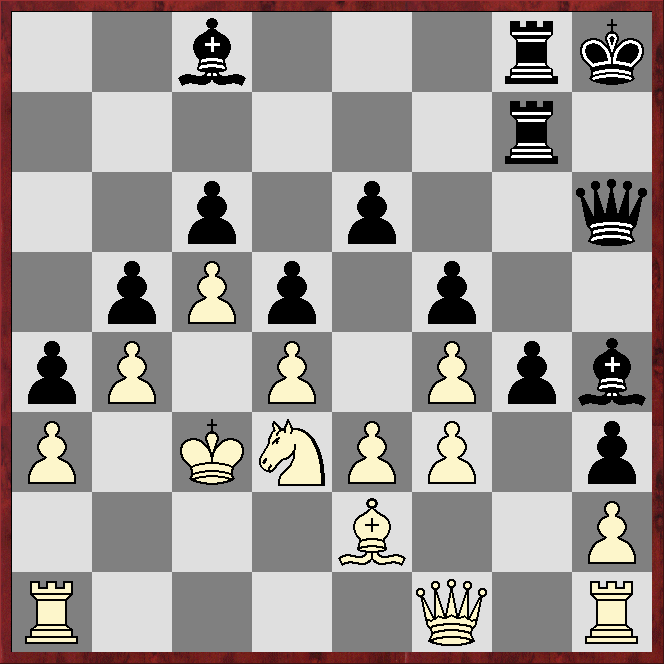
All the black pieces, except for the light-square bishop, are concentrated on the kingside, and the black position looks threatening, but the engines reckon White has an edge
*****
*****
*****
*****
*****
41.Ne5 Bb7?
Black had to play 41...gxf3 42.Qxf3 Bd7.
42.Kd3?
42.fxg4 fxg4 43.Rg1 wins, eg 43...Qh5 44.Rxg4 Rxg4 45.Bxg4 Rxg4 46.Qf3 etc.
42...Bf6?
42...gxf3 more-or-less equalises.
43.Qf2?
Again fxg4 is strong, eg 43...fxg4 44.Rg1 Bxe5 45.fxe5 g3 46.Qf6! Qxf6 47.exf6 Rg6 48.f7 Rf8 49.Rxg3 Rxg3 50.hxg3 Rxf7 51.Rh1 Rh7 52.Rh2 etc The engines reckon 47...Rf7!? is better, but 48.Rxg3 Rxg3 49.hxg3 Rxf6 50.Rh1 is still good for White.
43...Bxe5 44.fxe5 g3 45.hxg3 Rxg3
What should White play?
*****
*****
*****
*****
*****
46.Rag1?
46.f4 is fairly obvious and good, but 46.Bf1!? probably also holds, according to the engines.
Black to play and win
*****
*****
*****
*****
*****
46...f4?
The right idea, but the wrong move-order. Correct is 46...Rxg1 47.Rxg1 Rxg1 48.Qxg1 h2 49.Qh1 f4! (threatening 50...Qg6+ and 51...Qg1), eg 50.e4 Qh4 51.Bf1 Qf2 52.Bg2 Qg1 53.Ke2 Bc8 54.Kd3 Bd7 55.Ke2 Be8 etc.
White to play and draw
*****
*****
*****
*****
*****
47.e4??
The engines reckon 47.Bf1! gives dead-eye equality. The text is catastrophic.
47...dxe4+ 48.Kxe4 Qg6+ 49.Kxf4
Black to play and win
*****
*****
*****
*****
49...Rxg1?
I had meant to play 49...Qg5+ 50.Ke4 Rxg1+?, when White does not have an immediate Qh4+, but after 51.Rxg1 Qxg1 White has a draw with 52.Qh4+ Kg7 53.Qf6+ etc.
Winning is 49...Qh6+ 50.Ke4 Rxg1 51.Rxg1 Rxg1 52.Qxg1 h2 53.Qh1 Qg6+ etc. So in the previous line White also has a win with 50...Qg6+ followed by 51...Qh6+ and 52...Rxg1 etc.
50.Qh4+ Kg7 51.Qe7+?
51.Rxg1 Qxg1 52.Qf6+ draws.
51...Qf7+
After the text AS tried to play 52.Rxg1+ till I pointed out he was in check (0-1, 63 moves).
*I took half-point byes in rounds two and three because of other chess commitments.

Friday, 24 June 2022

Time For Pim

PLAYED last night in the first round of the open tournament of the Pimlico Summer congress, which is being held over five consecutive Thursday evenings.

Spanton (1983) - Robin Sarfas (1784)
English Symmetrical Botvinnik
1.c4 c5 2.Nc3 Nc6 3.g3 g6 4.Bg2 Bg7 5.d3 d6 6.e4 Nf6!?
An interesting moment to break the symmetry. Most popular in ChessBase's 2022 Mega database is 6...e6.
7.Nge2 0-0 8.0-0 a6 9.h3 Rb8 10.a4
There are 1,146 games with this position in Mega22.
10...Bd7
This is popular, but the mainline runs 10...Ne8!? 11.Be3 Nc7 12.d4 cxd4 13.Nxd4 Ne6 14.Nde2, slightly favouring White, according to Stockfish15 and Komodo13.02.
11.Be3 e5 12.Qd2?!
Much more popular is 12.f4, as after the text ...
12...Nd4
... threatens an unpleasant fork.
How should White respond?
*****
*****
*****
*****
*****
13.Bxd4
The engines give 13.Rab1!? even though this allows 13...Bxh3, when they continue 14.Bg5 (14.Bxh3?? Nf3+), reckoning 14...Nxe2+ 15.Qxe2 Be6 16.b4 leaves Black at best only slightly better.
13...cxd4 14.Nd5 Nxd5 15.cxd5 b5 16.b3?!
Probably better is 16.axb5, although 16...Bxb5 leaves Black with the upper hand.
16...bxa4 17.bxa4 a5
Black is winning, according to the engines.
18.f4 Rb4 19.fxe5 dxe5
Even stronger might be 19...Bxe5!?
20.Qc2 f5 21.Kh2 Qb6 22.Rfc1 Rc8?
Very strong is 22...fxe4 23.dxe4 Rb2.
How should White proceed?
*****
*****
*****
*****
*****
23.Qd2
The engines give 23.Qxc8+! Bxc8 24.Rxc8 Bf8 (forced) 25.exf5 gxf5 26.Rf1, when Black is still better but White has serious counterplay.
23...Rb8 24.exf5 gxf5 25.Qg5 Qd6 26.Rc6!?
Desperation, but it becomes Stockfish15's top choice for a short while.
26...Bxc6 27.dxc6 Rb2 28.Qh5 Rc2 29.Rf1 Qg6 30.Bd5+ Kh8 31.Qf3 Qd6 32.Bc4 e4 33.Qh5 Qg6 34.Qxg6 hxg6
Probably even better is 34...Rxe2+, but the text is plenty good enough.
The game finished:
35.Rf2 e3 36.Rg2 Be5 37.Bb5 g5 38.Kg1 f4 39.gxf4 gxf4 40.Rg5 Rg8 41.Rxg8+ Kxg8 42.Bc4+ Kg7 43.Nxd4? Bxc4 0-1

Thursday, 1 July 2021

Summer's Off

WELL, maybe not the whole summer, at least from a chess viewpoint, but the Pimlico summer tournament in London has been cancelled for the second year running..
I have just received the following from organiser Nick Faulks:

First of all, I must thank the many players who indicated that they would have liked to play in a 2021 Pimlico Summer Tournament, and to others who sent helpful responses.
I am reminded that I have failed to report that, following the Government's decision to delay Summer for another month, the decision was taken to abandon hope of putting on this event. I don't imagine this will come as a surprise.
In the light of more encouraging recent developments, I am optimistic that our leagues will take place in 2021/22. Final details are now being confirmed with club captains.

Saturday, 8 May 2021

New Tournament Calendar Listings

TIM Wall seems very confident the Northumbria Masters will go ahead in August, so I have added a link to my tournament calendar below.
And Hastings has announced it will run from Wednesday December 29 to Sunday January 9, including a 10-round Masters.

Jul 1 - Aug 5 Pimlico Summer Tournament. To be held over six consecutive Thursday evenings at the Lalgra community hall in Pimlico, Westminster. Details may appear online later but so far organiser Nick Faulks has said the event which, despite its name, is usually divided into three tournaments, will be restricted to 54 entrants

Jul 9-11 25th 4NCL Congress, Woodland Grange, Leamington Spa, Warwickshire. https://www.4ncl.co.uk/

Sep 10-12  26th 4NCL Congress, Woodland Grange, Leamington Spa, Warwickshire.


Sep 24-26 57th Northumberland Congress, North Shields, Tyne & Wear. https://northumberlandchess.wixsite.com/congress

Oct 1-3 Castle Chess are holding a twice-postponed congress at the Lysses House Hotel, Fareham, Hants. I can find no information at http://www.castlechess.co.uk/ but the likely format is an open, an U155 and an U115. Organiser Tony Corfe has announced: "Each player will be required to bring their own chess set and each player will make moves on their own board, just as you would if you are playing against a blind player."

Nov 20-21 Return of 4NCL divisional fixtures, starting with Division 3 South at Milton Keynes, Buckinghamshire, Division 3 Central at Leamington Spa, Warwickshire, and Division 3 North at Doncaster, South Yorkshire. https://www.4ncl.co.uk/

Dec 29 - Jan 9 Dates of individual events will be announced later, but the 10-round Masters will presumably end on Friday January 7, leaving the following Saturday and Sunday (and the Friday evening) for weekend tournaments. http://www.hastingschess.com/caplin-hastings-congress-2021-22/

Friday, 30 April 2021

Tournament Calendar Updated

THE 4NCL have added a second OTB event, in September, with details promised later.

Jul 1 - Aug 5 Pimlico Summer Tournament. To be held over six consecutive Thursday evenings at the Lalgra community hall in Pimlico, Westminster. Details may appear online later but so far organiser Nick Faulks has said the event which, despite its name, is usually divided into three tournaments, will be restricted to 54 entrants

Jul 9-11 25th 4NCL Congress, Woodland Grange, Leamington Spa, Warwickshire. https://www.4ncl.co.uk/

Sep 10-12  26th 4NCL Congress, Woodland Grange, Leamington Spa, Warwickshire.

Sep 24-26 57th Northumberland Congress, North Shields, Tyne & Wear. https://northumberlandchess.wixsite.com/congress

Oct 1-3 Castle Chess are holding a twice-postponed congress at the Lysses House Hotel, Fareham, Hants. I can find no information at http://www.castlechess.co.uk/ but the likely format is an open, an U155 and an U115. Organiser Tony Corfe has announced: "Each player will be required to bring their own chess set and each player will make moves on their own board, just as you would if you are playing against a blind player."

Nov 20-21 Return of 4NCL divisional fixtures, starting with Division 3 South at Milton Keynes, Buckinghamshire, Division 3 Central at Leamington Spa, Warwickshire, and Division 3 North at Doncaster, South Yorkshire. https://www.4ncl.co.uk/

Saturday, 13 July 2019

Pimlico Summery

THE fifth and final rounds of the Pimlico Summer tournaments - open, U150 and U120 - were held on Thursday.
I knew I would be away (at the South Wales International in Bridgend), so I took a half-point bye - permissible if asked for at the start.
This gave me a final score of 4/5, but where this would leave me in the standings was anyone's guess.
Top-board with the white pieces on Thursday was Dominic Gibbs (177), who was on 3.5/4 and was the only player who could overtake me.
But he lost  to Michael St J Brown (166), who was on 3pts and thus finished level with me on 4pts.
Richard Black (188) and Nick Faulks (172), who was the main organiser, could also have caught me as they were both on 3pts, but their game was drawn.
The result is that my score of +3=1-0 (plus a 0.5pt bye) saw me come equal-first with just one other player, and I should be getting £90 in prize money.

Friday, 5 July 2019

A Caro-Kann Tabiya

PLAYED last night in the fourth round of the Pimlico Summer open section, which is being held over five consecutive Thursday evenings.
Spanton (171) - Anders Lundback (162)
Caro-Kann Classical
1.e4 c6 2.d4 d5 3.Nc3 dxe4 4.Nxe4 Bf5 5.Ng3 Bg6 6.h4 h6 7.Nf3 Nd7 8.h5 Bh7 9.Bd3 Bxd3 10.Qxd3 e6
This is overwhelmingly the most-popular move in ChessBase's 2019 Mega database.
Grandmaster Joe Gallagher in Starting Out: The Caro-Kann (Everyman Chess, 2002) says 10...e6, 10...Ngf6 and 10...Qc7 are "interchangeable if Black is going to castle queenside, but if he wants to remain flexible on the future home of his king, then 10...e6 and 10...Ngf6 are the better options."
Put like this, it is hard to understand why any strong player would choose 10...Qc7, but it has been a frequent choice of Epishin and has also been played by Korchnoi and Khalifman.
11.Bd2
The most-popular move, but inaccurate, according to Gallagher. He explains: "This move is considered slightly inferior to Bf4 because Black has an easier time in the lines where he castles kingside. The point is that with the bishop on d2, White will have to waste time with Qe2 if he wants to play Ne5, whereas with the bishop on f4 it is possible to play this at once."
What Gallagher means, I believe, is that with the bishop on d2, White would not want to play Ne5 because, after ...Nxe5, dxe5 Qxd3, the queens come off, White gets a backward d pawn and Black gets the d5 square as an outpost for his king's knight. But with the bishop on f4, …Nxe5 can be met by Bxe5.
11...Ngf6 12.0-0-0 Be7
A popular tabiya in the Caro-Kann Classical
There are more than 3,500 games with this position in Mega19. Most popular is 13.Kb1, although Gallagher suggests it is "too slow to cause Black difficulties." In Starting Out he uses a game that saw 13.Qe2 - "White prepares to play Ne5" - the third-commonest move. Other choices by strong players include 13.c4, 13.Rhe1, 13.Rde1 and 13.Nf1!? My choice is second-most popular with almost 1,300 games.
13.Ne4 Nxe4 14.Qxe4 Nf6 15.Qe2 Qd5
Gallagher gives this an exclamation mark. Black's queen attacks a2 and adds to the pressure on h5.
16.c4 Qe4 17.Rhe1!?
Gallagher says "17.Be3 b5! is very dangerous for White," while 17.Qxe4 Nxe4 18.Be3 "is no longer considered a realistic winning attempt."
17...Qxe2 18.Rxe2 0-0-0
The critical and seemingly good 18...Nxh5! was tried in Tim Dean (-) - Zhichao Li (2028), Edmonton Closed 2005. There followed 19.d5 cxd5 20.cxd5 0-0 21.dxe6 fxe6 22.Rxe6 Rac8+ 23.Kb1 Bc5, with an equal position (but 0-1, 49 moves).
19.Ba5 b6 20.Bc3 Bd6
20...Nxh5?! 21.Ne5.
21.Ne5 Bxe5 22.Rxe5 Ng4 23.Re2 Nf6
A tacit offer of a draw.
24.g4 Rd7
If 24...Nxg4, then 25.Rg1 Nf6 26.Rxg7 Nxh5 27.Rxf7 Rd7 28.Rxd7 Kxd7 29.d5 with advantage. This line is pretty forcing, but Black could try 26...Rh7 27.Rxh7 Nxh7, although White's resulting rook-and-bishop combo has good chances of outplaying Black's rook-and-knight.
25.f3 Rhd8 26.Rde1
How would you assess this position, and how should Black proceed?
*****
*****
*****
*****
*****
White's space advantage and superior minor piece (there is a lot of pawns on the board, but the knight is unlikely to find a good outpost) give an advantage - worth from 0.4 pawns (Komodo9) to about 0.75 pawns (Stockfish10). But much manoeuvring is in prospect and there is no need for Black to panic.
26...c5?
A mistaken bid for freedom.
27.dxc5 bxc5 28.Re5 Rd3
The engines suggest Black's best may be to sac the exchange by 28...Rc7!? 29.Ba5 Rd4 30.Bxc7 Rxc4+ 31.Kb1 Kxc7, but then 32.Rc1 forces an exchange of rooks, leaving Black with a pretty hopeless knight-versus-rook ending.
29.Rxc5+ Kb7 30.Ba5 R8d7 31.Rb5+
The engines want White to play the passive 31.Rf1!? I rejected it because of 31...Re3, missing that Black is hardly in a position to double rooks on White's third rank as White replies Rc7+.
31...Ka6 32.Bc3 Rxf3 33.Ree5 Rf1+ 34.Be1??
Self-pinning is very rarely a good idea, and here it is catastrophic. I rejected the winning 34.Kc2 because, after 34...Rf2+ 35.Kb3 Rb7, White's attack has come to an end. This is true - up to a point. White's queenside attack is over, but White can switch to the kingside with 36.g5, eg 36...hxg5 37.Rxg5 Rxb5 38.cxb5+ Kb7, when the engines continue 39.Bxf6 gxf6 40.Rg7 with a large advantage.
34...Nxg4 35.Re2
A humiliating retreat, but the only way to stay in the game as 35.Re4??, for example, hoping for 35...Nf6?? 37.Re3, fails to 35...Nf2.
35...Rc7?!
The engines prefer an immediate 35...Rb7, with a small edge to Black after 36.Ra5+ Kb6. The drawback of the text will be explained later.
36.b3 Rb7
There is a better chance for a tiny edge, according to the engines, with 36...Nf6 or the pin-breaking 36...Rf5!?
37.Ra5+ Kb6 38.Kc2?!
More accurate is 38.Kb2. The point is that if Black proceeds with 38...Rf3, which the engines recommend after the text, White has 39.Rg2.
38...a6
The engines prefer 38...Rf3, when 39.Rg2?? now loses to 39...Ne3+. This seems to be why the engines did not like Black's 35th - it gave White a tempo to free the b2 square for his king!
39.c5+ Ka7 40.Bc3 e5?!
40...Rb5 41.Ra4 Nf6 42.Rc4 is dead equal, according to the engines, despite Black's pawn-plus.
41.b4?!
The simple 41.Bxe5 Nxe5 (not 41...Re7?? 42.Bb8+) 42.Rxe5 is slightly better for White.
41...Rf5?
The rook-and-pawn ending after 41...Rb5 42.Rxb5 axb5 43.Bxe5 Nxe5 44.Rxe5 is even, according to the engines, but looks easier for White to play.
Also reasonable was 41...f6, although White remains more active thanks to his queenside play.
42.c6?
Better was 42.Rd2, threatening Rd6, eg 42...Rf6 43.a4 (threatening 44.b5) Rc7 44.Kb3, with strong pressure.
42...Rc7
Black may also hold with 42...Rb5!?, the engines giving 43.c7 Kb7 44.Rxa6 Kxc7 45.a4 Rd5 46.Ra7+ Kb8! (better than advancing the king, apparently) 47.Re7, with a position hard to assess (the engines vary from preferring White to reckoning Black has equality).
43.b5 Kb6 44.bxa6 Ka7?
Black is in trouble after this. The engines give best play as 44...Rf6 45.Ra4 Rfxc6 46.a7! Rxa7 (46...Rxc3?! costs Black the exchange, although he does get two pawns for it) 47.Rb4+ Kc7 48.Rxg4 Rxa2+ 49.Kd1 Rxe2 50.Ba5+ Kd7 51.Kxe2, when White has rook, bishop and pawn versus rook and four pawns - equal, according to the engines.
45.Re4 Nf6 46.Rc4 Rxh5
White is also winning after 46...Rf4 47.Rxf4 exf4 48.Bd4+ Ka8 49.Bxf6 gxf6 50.Rc5.
47.Bxe5 Rxe5
Not much better is 47...Rc8, eg 48.Kb3 Rh3+ 49.Ka4 Rd3 50.Rb5 h5 (Black has no useful moves) 51.Bb8+!
48.Rxe5 Kxa6 49.Re3 Kb6 50.Rb3+ Ka5 51.Rb7 Ne8 52.Kb3 1-0

Friday, 28 June 2019

Compensation For The Exchange

ONE of the trickiest things to evaluate in chess is how much compensation is needed when sacrificing the exchange.
Some books give the impression exchange sacrifices are available in almost every game.
But at club level they are rare birds indeed - the exchange is often lost, but seldom sacrificed.
Depending on whom you take as your authority, the exchange is worth somewhere between 1.5 and 1.75 pawns, with the latter figure being more commonly favoured.
One of the problems at club level is that most players still use the traditional piece-value table: P-1, N-3, B-3, R-5, Q-9.
This creates several anomalies, eg giving up bishop and knight for rook and pawn on f7 would seem to be an even trade - 6pts each - and so should favour the player giving up the bishop and knight as the opponent loses castling rights. In practice, this is nearly always a bad trade.
Another anomaly is that a minor piece is no stronger than three pawns - again this is rarely the case in the opening or the middlegame (although in an ending it all depends on the placement of the remaining material).
The traditional table also gives the impression that two pawns are needed to compensate for the exchange.
I prefer to use a table discovered - the right word, I believe - by international master (now grandmaster) Larry Kaufman.
He used a computer to analyse almost 300,000 games, coming up with the following average piece values: P-1, N-3.25, B-3.25, R-5, Q-9.75 (his full article, which is a fascinating read, can be seen here: https://www.chess.com/article/view/the-evaluation-of-material-imbalances-by-im-larry-kaufman).
The values are not hugely different from the traditional ones, and it is nice to see confirmation of the amazing coincidence that knights and bishops, despite being very different in their actions, have the same average strength. Think how difficult it would be to devise a game from scratch with such a feature.
But while knight and bishop are on average equal, two bishops are better than knight and bishop or two knights. Kaufman's computer analysis showed that on average the bishop-pair is worth half a pawn.
This new table immediately clears up the anomalies mentioned above. Giving up bishop and knight for rook and pawn is now losing 6.5pts for 6pts. Actually, taking into account that the bishop-pair is lost, it is actually giving up 7pts for 6pts - rarely will positional factors compensate for that.
Similarly, three pawns are no longer worth a bishop (as with all material evaluations, the caveat "on average" is implied).
Getting back to sacrificing the exchange, it can be seen that the sacrificer is giving up 1.75pts. So getting a pawn for the exchange loses 0.75pts. And if the winner of the exchange has had to give up the bishop-pair, the material deficit is just 0.25pts.
In other words, giving up the exchange when you have a pawn and the bishop-pair as compensation is almost an even trade - the placement of the remaining material on the board is likely to determine whether the sacrifice is sound.
All of this is a preamble to my game last night in round three of the Pimlico Summer open tournament.
Black to make his 17th move in Richard Black (188) - Spanton (171)
*****
*****
*****
*****
*****
My main analysis engines want Black to play around the knight, eg Stockfish10 gives 17...Qc6 18.b4 Be6 19.Qd3 with a slight edge to White. But I felt I had to get rid of the monster.
17...Bf8!? 18.Bg5 Bxd6
18...Be7 19.Bxe7 seemed positionally hopeless to me.
19.Bxd8
White takes the exchange. I was actually more worried about 19.cxd6!?
19...Bxc5
For the exchange, Black has a pawn and the bishop-pair - as discussed above, this is almost full material compensation. Positionally, at first glance, Black might even seem to be better as White has doubled and isolated b pawns. However, Black has problems smoothly completing development, and this gives White the initiative.
20.Bf6?!
This natural-looking move is not liked by the engines, and their reasoning will soon become apparent.
20...Bd4 21.Qd2 Qf5 22.Bg5
Intending to get rid of the bishop-pair by playing Be3, but the manoeuvre Bd8-f6-g5 has cost White a tempo.
22...Be6
Stockfish10 and Komodo9 slightly prefer 22...Bd7!? The point after 23.Be3 is to continue 23...Bc6 24.Bxe3 Rd8, when Black has lost the bishop-pair but gained active pieces.
23.Be3 Rd8 24.f4?!
This looks weakening. The engines prefer 24.Rfe1, eg 24...Bxb3 25.Qb4 Bd5 26.Bxd4 Qg5 27.g4 exd4 28.Qxd4, when only White can reasonably hope to win, but Black seems to have decent drawing chances.
24...Bxb3
I rejected 24...Qe4 because of 25.Rae1 exf4 26.Rxf4??, missing that Black can simply take the rook on f4 because White's bishop is pinned.
25.fxe5 Qxe5 26.Bxd4 Qxd4+ 27.Qxd4 Rxd4 28.Rac1 Be6
Could I have played 28...a5 and tried to activate my queenside majority? Stockfish10 is at first quite keen on the idea, but its evaluation soon changes to =. Komodo9 also quite likes the move, but reckons the position remains even. To me, 28...a5 looked rather loosening.
29.Rfd1 Rb4 30.Rd2 h5 31.Rc3 Kg7 32.Kf2 Kf6 33.Ke3 Ke5 ½–½

Friday, 21 June 2019

Knight v Bishop

I WAS on top board last night in round two of the open section of the Pimlico Summer congress, which is being held over five consecutive Thursdays.
Black has just played 34...Ke7-d6 and offered a draw in Spanton (171) - Gergely Kiss (207)
*****
*****
*****
*****
*****
*****
*****
Normally a bishop outplays a knight in an ending with rival pawn-majorities. But here White can stop Black activating his queenside majority, after which it is just a question of whether White can win or only draw with his kingside majority. Bearing in mind that Black's bishop is fairly bad - four out of six black pawns are on light squares - Black's practical chances of holding this ending are very low.
35.Kd4 Be2 36.Nc3 Bf3 37.a4 bxa4 38.Nxa4 Bd1 39.Nc5 Bf3 40.Nb7+
40.e5+ is probably a quicker way to win, but there is no harm in probing with the knight as Black cannot prevent White coming back to the e5+ idea.
40...Ke6 41.Nd8+ Kd7 42.Nf7 Ke6 43.Nd8+
I got cold feet about 43.Nh8 because of 43...f5, when 44.Nxg6 seems to be the only way to keep winning chances. White then has to be certain he is winning after both 44...fxe4?! and 44...Bxe4. I was not sure, but I was fairly confident that returning the knight to the queenside would win.
43...Kd7 44.Nb7 Ke6 45.Nc5+ Kd6 46.Nd3 Ke6 47.Ke3 Bg2?
This speeds defeat, as does 47...Bg4? 48.Nf2. Black had to play 47...Bd1 or 47...Bh1, but in each case White wins slowly but comfortably, eg 47...Bd1 48.Nc5+ Kd6 49.Na6 Ba4 50.Kd4 Bc2 51.e5+ fxe5 52.fxe5+ Kd7 (52...Ke6 53.Nxc7 Kf5 54.e6 Kf6 55.Kc5) 53.Ke3 Bf5 54.Kf4 Bc2 55.Nb8+.
48.f5+ gxf5
If 48...Kf7, then 49.Nf4.
49.Nf4+ 1-0

Friday, 14 June 2019

Pim O'Clock

THE annual Pimlico Summer congress, held over five consecutive Thursdays, began last night with a full complement of 64 entries.
It is split into three sections - open, U150 and U120 - with a time limit of 75 minutes plus a 15-second increment.
Combined with a 6.30pm start, this means the vast majority of games are over before 9pm.
Paul Carlucci (154) - Spanton (171)
Colle-Zukertort
1.d4 d5 2.Nf3 Nc6
The fourth-most popular move in ChessBase's 2019 Mega database, and the worst-scoring percentage-wise among the top 10 replies. Nevertheless it has been tried by strong players including Carlsen and Rapport.
3.e3
The Colle route. More popular these days is the London System with 3.Bf4, while 3.c4 transposes into a mainline of the Chigorin.
3...Bg4 4.Be2 Nf6
Rapport and Morozevich have preferred 4...e6, which was played all the way back in 1882 by Winawer in a win over Blackburne. I guess the two moves will normally transpose.
5.0-0 e6 6.b3 Bd6
Morozevich chose 6...Ne7!? in a 1995 rapidplay win against Malaniuk (both players had ratings just above 2600). There are no other examples of the move in Mega19, and analysis engines Stockfish10 and Komodo9 disapprove, but it is dangerous to rely on engines' positional judgments in the opening.
7.Bb2 0-0 8.Ne5 Bf5!?
There is a lot to be said for 8...Bxe2. It exchanges White's good bishop, but also develops White's queen to a decent square.
 9.c4
An obvious alternative is 9.Nxc6 bxc6, but Black will be able to dissolve his doubled pawns. The engines continue 10.Nd2 (Stockfish10) or 10.c4 (Komodo9), with Black in each case replying 10...c5.
9...Nd7?!
The engines are not keen on this, preferring 9...Ne7 (Stockfish10) or 9...dxc4 (Komodo9). My idea, after a move such as 10.f4, was to evict White's knight with 10...f6, but then 11.Nxc6 bxc6 leaves Black looking vulnerable to a kingside pawn-storm.
10.Nxd7!?
This surprised me. The engines reckon it is enough for a slight edge, but they prefer 10.Nxc6 or 10.f4. Note that after 10.Nxc6 bxc6 White can prevent undoubling by 11.c5!?
10...Qxd7 11.Bd3?!
An old rule-of-thumb has it that when you have a bad bishop - in this case White's dark-square bishop, which is shut in by White's central pawns - you should not trade your good bishop. True, the dark-square bishop is doing a useful job in helping control the e5 square, and the coming exchange develops White's queen to a good square, but I do not believe these factors compensate for White's vulnerability on the light squares.
11...Bxd3 12.Qxd3 f5 13.a3
Black to make his 13th move
The stage is set for a battle of rival attacks - White on the queenside, Black on the kingside. Regardless of the merits of the two attacks, there will always be the realisation in both players' minds that White is playing for a long-term positional advantage while Black is playing for mate.
13...Rf6
I rejected 13...f4 because 14.Nd2 prevents an effective ...f3 as Black is not in a position to sac the exchange with 14...f3? 15.Nxf3 Rxf3?
14.c5!?
This comes to be Stockfish10's choice, at least for a while, but Komodo9 is unimpressed. As usual, pushing on like this is double-edged - it is certainly consistent with White's plan of queenside expansion, and it drives Black's bishop to an inferior square, but it means Black's kingside attack is less likely to be inconvenienced by central counterplay.
14...Be7 15.b4 Raf8
The engines do not like this, but I felt committed to playing on the kingside, and I wanted to be able to meet b5 with ...Nd8 without obstructing the a8 rook's route to joining the attack.
16.f4 h6?!
This may be too slow. I wanted to play 16...g5 but thought White was doing OK after 17.fxg5 Rg6 18.h4? h6 19.gxh6 Rxh6? 20.g3, which may be true. However, 19...Bxh4 is a major improvement.
17.Bc3?!
Komodo9 is happy with this move - for a while it is the engine's second choice - but if the idea is to stop b5 being met with ...Na5, then the idea is misplaced as 17.b5 Na5? 18.Nd2 will leave Black's queenside in disarray after a later Bc3 (indeed Stockfish10 reckons Black's best after 18.Nd2 is to sac a pawn with 18...Nc4 etc). However, having said all that, 17.Bc3?! does make the bishop better-placed for defensive duties on the kingside.
17...g5 18.fxg5?!
It was probably better to leave Black to open lines with an eventual ...gxf4 as g2 will be easier to defend than h2. Black could also push on with ...g4, but then will find it very difficult to open any lines on the kingside.
18...hxg5 19.b5 Nd8 20.Nd2 Rh6 21.Nf3 Bf6
White faces a tricky defence
*****
*****
*****
*****
*****
22.Ra2?
Best seems to have been 22.Be1. The point is that if play proceeds as in the game with 22...g4 23.Ne5 Bxe5 24.dxe5 Qh7, White defends h2 with 25.Bg3. The text also envisages a defence of h2, but at great positional cost.
22...g4 23.Ne5?!
Komodo9 prefers 23.Ne1 (but not 23.Nd2? Qh7) although Stockfish10 is unsure; either way, Black is well on top.
23...Bxe5 24.dxe5 Qh7 25.g3 Nf7
White's light-square weaknesses (see note to White's 11th move) mean he is lost despite the material balance.
26.e4!?
Objectively this cannot be good, but trying for counterplay may be White's best practical choice.
26...dxe4 27.Qd7 Ng5
Also tempting was 27...Rd8!? but there is no need to complicate.
28.Qxh7+ Rxh7 29.Rd1 Nf3+ 30.Kh1 f4
Simpler is 30...Kf7 (or 30...Kg7), meeting 31.Rd7+ with 31...Kg6, but the text also wins.
31.Be1
This is Stockfish10's choice for a while, but the engines come to agree that best was 31.gxf4, when Black has a pleasant choice between 31...Rxf4, 31...Rh3, 31...g3 and several other moves.
31...Nxe1 32.Rxe1 f3 33.Kg1 Rd8 34.Rf2 Rd4 35.Kf1 Rh5 (0-1, 45 moves)