Showing posts with label Scotch Opening. Show all posts

Wednesday, 8 July 2026

Magdeburg Round Three

Hans Hauke (1838) - Spanton (2039)
Scotch
1.e4 e5 2.Nf3 Nc6 3.d4 exd4 4.Nxd4 Bc5 5.Nb3 Bb6 6.Nc3 Nf6 7.Bd3
More popular are 7.Bg5 and especially 7.Qe2. After the latter, the main line in ChessBase's 2026 Mega database runs 7...0-0 8.Bg5 h6 9.Bh4 a5!? 10.a4 Nd4!? 11.Qd3!? Nxb3 12.cxb3, with a slight edge for White, according to Stockfish18 and Dragon1.
After 7.Bd3, how should Black respond?
*****
*****
*****
*****
*****
7...d6
This is the commonest continuation in Mega26, but it seems Black can play the 'great equaliser' in double e-pawn openings, ie 7...d5!?, and if 8.Bg5, then 8...h6! (not 8...Bxf2+?? 9.Kxf2 Ng4+? 10.Qxg4), as 9.Bxf6 Qxf6 is fine for Black, thanks to the threat to f2. 
8.h3!?
This seems a little slow, to me, but it has been the choice of  the highest-rated players to reach the position, and it scores an excellent 66% in Mega26.
8...Be6 9.Na4!?
This seems to be a novelty. The engines are not keen on going after the bishop-pair in this way, presumably because it costs time.
9...d5!?
The engines agree this classic central counter to flank play is the best continuation.
10.Nxb6 axb6 11.Bg5?
The engines give 11.exd5 Qxd5 12.0-0 0-0-0!?, awarding Black a slight edge.
11...dxe4 12.Be2
Or 12.Bxf6 Qxf6 13.Bxe4 Qxb2.
12...Qxd1+ 13.Bxd1
White has the bishop-pair, but Black's extra pawn and lead in development add up to a winning advantage, according to the engines
*****
*****
*****
*****
*****
13...0-0 14.c3!?
This is Stockfish18's top choice for quite some time, while Dragon1 suggests 14.Nd2. However, both engines fluctuate, with 14.a3!?, 14.Nc1!? and 14.0-0 also being favoured at one time or another. If 14.0-0, then best may be 14...Bxb3 15.cxb3 h6!?, with an advantage for Black that the engines reckon is the equivalent of being up two pawns.
14...Bc4 15.a3!? Ne5 16.Nc1!?
This is the engines' top choice, narrowly ahead of 16.Bc2, but if such a retreat really is the best move. it only shows how desperate is White's position.
16...Rfe8 17.Be3 Rad8 18.b3 Bd3 19.Ne2?!
The engines' 19.c4 is probably better, but leaves Black well on top.
19...Nd5 20.Rc1
Again, c4 may be best, whereas 20.Bd2?! is well met by 20...Nf3+!
20...Nxe3!?
Eliminating the bishop-pair is perhaps the most solid way to maintain Black's advantage.
21.fxe3 Bxe2!?
The engines like 21...Ba6!?, and if 22.0-0!?, then 22...Rxd1!?
22.Kxe2!?
This may be marginally better than 22.Bxe2.
22...Nd3 23.Ra1 Re5 24.b4
This is Stockfish18's top choice; Dragon1 prefers 24.Bc2.
24...Rg5 25.g4 h5 26.Rg1 hxg4 27.hxg4 Ne5 28.Kf2 Rd2+ 29.Ke1
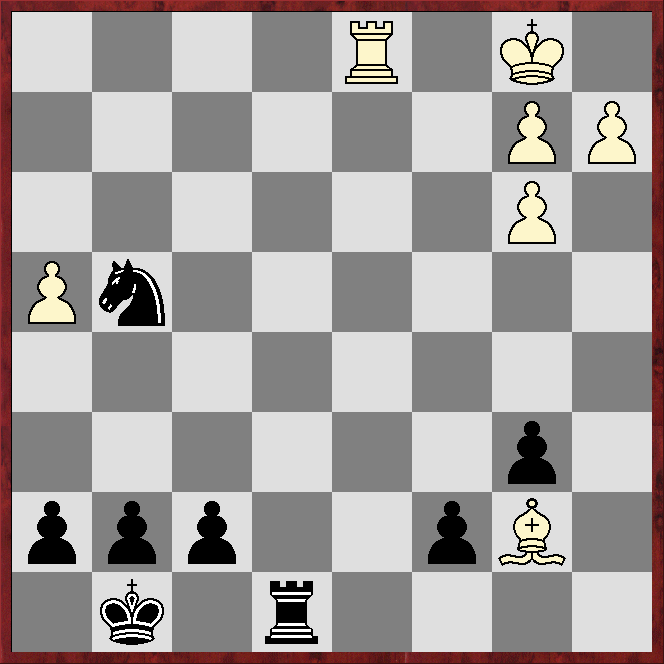
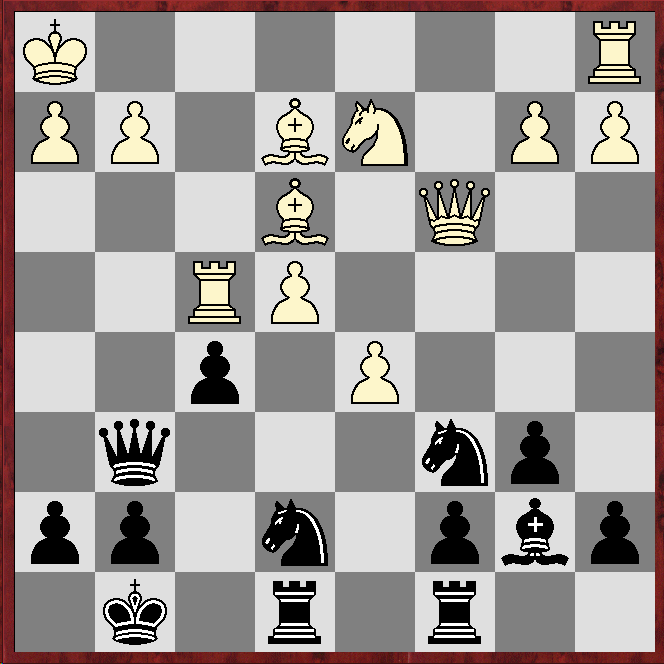
As I went to make my next move, HH started to hold out his hand, but withdrew it when he saw me pick up the d2 rook - he said after the game he had been about to resign as Black has a mate
*****
*****
*****
*****
*****
29...Rh2
There is no mate, but Black does not need one.
30.Be2?!
This loses in short order. but after the best move, 30.Kf1, Black is well on top.
30...Nf3+ 31.Bxf3 exf3 32.Kf1 f2 33.Rg2 Rh1+ 0-1

Saturday, 7 March 2026

Miniatures 27

IN this occasional series I am going through my decisive games of 20 moves or fewer.

Thomas Hauptmann (166 BCF) - Spanton (147 BCF)
Guernsey 1990
Scotch
1.e4 e5 2.Nf3 Nc6 3.d4 exd4 4.Nxd4 Bc5 5.Nb3
This was the main move 36 years ago, but has been massively overtaken by the Kasparov-popularised 5.Be3. Nevertheless, in ChessBase's 2026 Mega database it scores 56%, two percentage points more than 5.Be3, and also two more than the other popular continuation, 5.Nxc6.
5...Bb6 6.Nc3 Nf6 7.Bd3
More popular are 7.Bg5 and especially 7.Qe2!?, but the text has also been played by grandmasters.
7...d6 8.0-0
This game is the first in Mega26 to reach this position
*****
*****
*****
*****
*****
8...Bg4
Stockfish17 and Dragon1 suggest 8...h6 or 8...Ne5!?
9.Qe1
Subsequently, 9.Be2 became slightly more popular, but the text is probably better.
9...0-0
Now both sides have castled, how would you assess the position?
*****
*****
*****
*****
*****
The most significant factor in the position is probably White's central space advantage. The engines give White a slight edge.
10.Be3 Bxe3 11.Qxe3 Re8 12.Qg3 Qd7
The engines prefer 12...Be6 or 12...Nb4!?
13.h3 Bh5?!
Probably the wrong retreat.
14.f4 Re7?
The engines give 14...h6, but much prefer White.
15.Qh4 Rae8 16.Nd5 Nxd5 17.exd5 Be2?!
'Better', but still losing, is 17...Nb4.
18.Qxh7+ 1-0
LESSON: the game could be dismissed as being simply decided by tactical mistakes, but the underlying factor was that White's central dominance made Black's position harder to play.

Wednesday, 17 December 2025

League Chess

PLAYED on board one (of eight) for Battersea 2 against Charlton in London League Division Three last night.

Julian Morrison (2046) - Spanton (1904)
Scotch
1.e4 e5 2.Nf3 Nc6 3.d4 exd4 4.Nxd4 Qf6!?
The usual moves are 4...Nf6 and especially 4...Bc5, but the text often transposes to lines involving the latter continuation.
5.Be3
Magnus Carlsen has played the text and the independent 5.Nf3!?
5...Bc5 6.c3 Nge7 7.Nf5!?
A rare try. The Main moves are 7.Be2, 7.g3 and especially 7.Bc4.
How should Black respond?
*****
*****
*****
*****
*****
7...Bxe3
This is the commonest continuation in ChessBase's 2026 Mega database, but Stockfish17.1 and Dragon1 like 7...d6!?, when they reckon 8.Bxc5 Bxf5 9.exf5 dxc5 gives Black the upper hand.
8.Nxe3 0-0 9.Bc4 b6 10.Nd2 Ne5 11.Be2 Bb7 12.0-0
Now both sides have castled, how would you assess the position?
*****
*****
*****
*****
*****
White has more space in the centre, but Black has a lead in development. The engines reckon the position is equal.
12...d5?!
This apparent-novelty lets White activate his kingside pawn-majority, whereas 12...N5g6 prevents this, or at least greatly slows it down, as 13.f4? can be met by 13...Nxf4!, when the pin on the knight is not dangerous as White is obliged to spend a tempo moving his light-square bishop.
13.f4 N5g6
The engines prefer 13...d7 or 13...Qh6!?
14.e5 Qc6 15.Nb3 Rad8
Possibly better is 15...Qd7, and if 16.Nd4 then 16...c5 as 17.Nb5 can be met by 17...f6!?, although the engines reckon 18.Nd6 is enough for at least a slight edge.
16.Nd4 Qe8!?
Perhaps 16...Qd7 is better, even though it allows 17.Bg4 with tempo (it is not clear the bishop is best-placed on g4).
17.Bd3 Nc6?
The engines reckon 17...c5 or 17...Bc8 is required.
18.Qh5!?
This is Stockfish17.1's top choice; Dragon1 prefers 18.Ng4 or 18.Qe1.
18...Nxd4 19.cxd4 f6?!
The engines suggest 19...Qa4!?, but agree White is winning after, for example, 20.Nf5.
20.Nf5 Bc8 21.Nh4 f5!?
This loss-of-a-pawn is more-or-less forced.
22.Nxf5 Bxf5 23.Bxf5
Black is 'only' a pawn down for the time-being, but White's attack continues
*****
*****
*****
*****
*****
23...Qf7 24.Bd3 Rfe8 25.Rac1 Rc8!? 26.Rc6 Nf8 27.Qxf7+ Kxf7 28.Ba6 Rcd8 29.Rxc7+ Re7 30.Rxe7+ Kxe7 31.f5 Nd7 32.Rc1 Nb8 33.Rc7+ Rd7 34.Rxd7+ Kxd7
Or 34...Nxd7 35.Bb7.
35.Bb7 1-0
This defeat ended a 12-game over-the-board unbeaten streak (+6=6-0) in which I performed 99 elo above my average rating for those games of 1895.
Battersea 2 won the match 4.5-3.5.
My Battersea Season 2025-6
Date       Event  Colour  Rating  Opp's Rating  Score  Season's Perf
16/9/25   CLL       W       1936         1952             0           1552
18/9/25   CLL       W       1936         1797             =           1675
16/10/25 CLL       W       1889         2047             0           1665
23/10/25 CLL       B        1889         1823             1           1805
18/11/25  LL         W       1891         1980             =           1840
20/11/25  CLL      W       1891         1866             1            1911
25/11/25  BCC     B        1891         1817             1            1955
9/12/25    LL         W       1904         1982             1            2008
16/12/25  LL         B        1904         2046             0            1968
CLL: Central London League
LL: London League
BCC: Battersea club championship
I also have a win-by-default in the Central London League

Tuesday, 27 May 2025

Bodensee Senioren Round Three

FACED a German.

Michaël Dittmar (1808) - Spanton (1937)
Scotch
1.e4 e5 2.Nf3 Nc6 3.d4 exd4 4.Nxd4 Bc5 5.Nb3
I can remember when this used to be the main continuation, but today it lags well-behind 5.Be3, and probably also 5.Nxc6. However, in ChessBase's 2025 Mega database it scores two percentage points better than the other two moves.
5...Bb6 6.Nc3 Nf6 7.Qe2!?
This looks strange at first, but it scores 57% in Mega25, the idea being to quickly castle long and attack on the kingside.
How should Black respond?
*****
*****
*****
*****
*****
7...0-0!?
Castling into it? Maybe, but it is hard to believe Black has made a mistake in the preceding moves, so unless short castling is itself a mistake, this must be satisfactory.
8.Be3
Slightly more popular in Mega25 is 8.Bg5, when the main line runs 8...h6 9.Bh4 a5!? 10.a4 Nd4 11.Qd3 Nxb3 12.cxb3 c6 13.0-0-0, with a slight edge for White, according to Stockfish17 and Dragon1.
8...Re8 9.f3 Qe7?!
This takes away support for the move ...d5, which is probably what Black should be prioritising. With that in mind, the engines suggest 9...Ne7!?, while most popular in Mega25 is the immediate 9...d5!?, when the main line runs 10.0-0-0 d4 11.Bg5 Be6, reaching a position the engines at first reckon favours White, but which they come to rate as equal.
10.0-0-0 d6
White has the upper hand, according to the engines
*****
*****
*****
*****
*****
11.Kb1!? Be6 12.h4?!
Apparently a novelty, and probably not a good one. Nenad Ferčec (2460) -Tamás Fodor Jr (2502), Pula (Croatia) 2012, went 12.g4 Ne5? (better is 12...Nd7, according to the engines) 13.Nd4 Bc4?! 14.Qg2 Bxf1 15.Qxf1 Bxd4 16.Bxd4 Ng6 17.h4, when the engines reckon White is winning (but ½–½, 39 moves).
12...d5!?
It has taken two tempi to get there, but if the move is sound, it should just about equalise. Dragon1 reckons it is the best move, but Stockfish17 fluctuates between the text and 12...Rad8.
How should White respond?
*****
*****
*****
*****
*****
13.Bxb6
There is nothing in 13.exd5 Nxd5 14.Nxd5 Bxd5 15.Bxb6 axb6 16.Qxe7 as Black has 16...Nxe7 - but not 16...Rxe7? 17.Rxd5 Re1+ 18.Nc1 Nb4 as White has 19.Rd7 Nxa2 (19...Rxa2?? 20.Rd8+ Re8 21.Rxe8#)) 20.Bc4! Rxh1 21.Bxa2!
However the engines give 13.Bg5!? d4 14.Na4 h6!? 15.Qe1!? Qd6!? with an unclear position that may slightly favour White.
13...axb6 14.g4?
This is definitely bad, but playable is 14.e5!? Nh5 15.Qf2, when 15...Nxe5 wins a pawn, but White has decent-looking compensation and certainly practical chances. However, simplest is 14.exd5 Nxd5 15.Nxd5 Bxd5, which reaches the same equal position as in the first note to White's 13th move.
14...dxe4 15.Nxe4 Nxe4
Even stronger is 15...Bxg4!, one point being 16.Nxf6+ can be met by 16...Qxf6.
16.Qxe4 Bxb3 17.cxb3!?
The engines like this way of recapturing.
17...Qxe4+ 18.fxe4 Rxe4 19.Rg1?!
The engines strongly dislike this, preferring 19.g5.
19...Rae8 20.Bc4 Ne5?!
Probably best is 20...Kf8, unpinning the f pawn and negating back-rank mating threats.
21.Bd5 Rxg4 22.Rxg4 Nxg4 23.Bxb7
How would you assess this rook-and-minor-piece ending?
*****
*****
*****
*****
*****
Black has an extra pawn and the better pawn-structure. But White has the better minor piece for cooperating with a rook and for playing with rival pawn-majorities. The engines reckon Black has the upper hand (Dragon1) or at least a slight edge (Stockfish17).
23...Ne5
The engines suggest sorting out the back-rank problems with 23...Kf8, 23...g6 or 23...h6.
24.Bg2!?
White should probably immediately set about creating a passed pawn, starting with 24.a4.
24...f6 25.b4 Kf7 26.a4 Ke7 27.a5 bxa5?!
Probably better is 27...c6.
28.bxa5 c6
White is still a pawn down, but no longer has doubled pawns and has the much more advanced passer, leading the engines to call the position completely equal
*****
*****
*****
*****
*****
29.Ka2
Not 29.b4? Rb8 30.Rd4 c5 etc.
29...Rb8 30.b3?
But now 30.Rd4 was fine, as was 30.a6 (30...Ra8 31.Bf1).
30...Rb5 31.b4
Best, but White is losing a second pawn.
31...Rxb4 32.Ka3 Rb7
After 32...Rxa4? 33.a6 Black is struggling for a draw (but should get it, according to the engines), while 32...Rb5 33.Ka4 Nc4? (better is 33...Rb2, transposing to the same position as in the game's 33...Rb2) 34.Bxc6 Rxa5 35.Kb4 Rh5 36.Kxc4 Rxh4+ is also equal, according to the engines, but with plenty of play in the position with Black's rook and three pawns battling White's rook and bishop.
33.Ka4
Possibly slightly better is 33.Bf1.
33...Rb2!? 34.Bf1 Ra2+ 35.Kb4 c5+ 36.Kb5
Hopeless is 36.Kxc5 Rxa5, after which White has no compensation for being two pawns down. Indeed, with all remaining pawns on one side of the board, the knight is probably the better minor piece despite the presence of rooks.
36...c4 37.a6 c3 38.Rc1 Rb2+ 39.Ka4 Kc2
How should White proceed?
*****
*****
*****
*****
*****
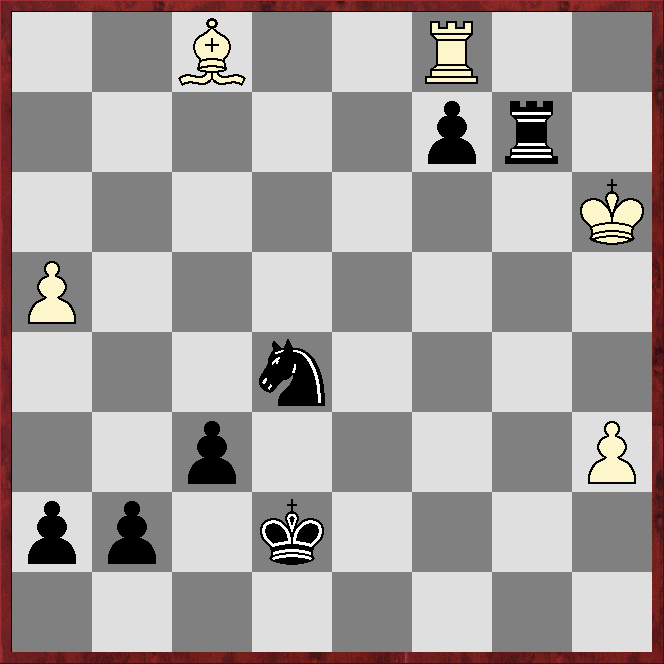
40.Ka3?
White needed to move the bishop, while keeping it covering the a pawn, so both 40.Be2 and 40.Bb5 draw, according to the engines, but 40.Bg2?? loses to 40...Ra2+ 41.Kb5 Nd3 etc.
Black to play and win
*****
*****
*****
*****
*****
40...Rb1!
The only winning move, although at first glance it may seem as if Black cannot stop the a pawn. but that is not so.
41.Rxc2 Rxf1 42.a7 Ra1+ 43.Ra2 Nc4+
The move MD missed.
The game finished:
44.Kb3 Rxa2 45.Kxa2 Nb6 46.Kb3 Kd6 0-1

Monday, 5 May 2025

4NCL Final Weekend: Game Three

PLAYED on board three (of six) for Wessex B against Shropshire & Friends in division four of the Four Nations Chess League today.

Richard Bryant (1912 ECF/1835 Fide) - Spanton (1976 ECF/1937 Fide)
Max Lange Attack
1.e4 e5 2.Nf3 Nc6 3.d4 exd4 4.Bc4 Bc5 5.0-0 Nf6 6.e5
The first four games to reach this position in ChessBase's 2025 Mega database were won by Max Lange with white
*****
*****
*****
*****
*****
6...d5 7.exf6 dxc4 8.Re1+ Be6
This is the main move, but Dragon1 prefers 8...Kf8!?
9.Ng5!?
Lange - Eugen von Schmidt, Magdeburg 1853, went 9.fxg7 Rg8 10.Ng5 Qe7?! (probably better is 10...Qd5) 11.Nxe6 fxe6 12.Qh5+ Kd7 13.Bh6, when material is level, but Dragon1 and Stockfish17 reckon White is winning (1-0, 23 moves).
9...Qd5
Not 9...Qxf6? 10.Nxe6 fxe6 11.Qh5+ and 12.Qxc5.
10.Nc3!? Qf5
Not 10...dxc3?? 11.Qxd5 as the e6 bishop is pinned.
11.Nce4 0-0-0
Probably not 11...gxf6?! 12.g4!? Qg6 13.Nxe6 fxe6 14.Nxc5.
12.Nxe6
The main line in Mega25 runs 12.g4!? Qe5!? (12...Qd5? 13.fxg7 Rhg8 14.Nf6) 13.Nxe6 fxe6 14.fxg7 Rhg8 15.Bh6 d3 16.c3, with at least a slight edge for White, according to the engines.
12...fxe6 13.fxg7?!
White should probably transpose to the previous note with 13.g4!? Qe5 (forced) 14.fxg7.
13...Rhg8 14.Bh6?!
More common is 14.Nxc5 Qxc5, and now 15.Bh6 or 15.Qg4.
The engines suggest an apparent-novelty, 14.Ng3!?, but reckon 14...Qf6 leaves Black with the upper hand.
How should Black proceed?
*****
*****
*****
*****
*****
14...Bb4!?
How should White respond?
*****
*****
*****
*****
*****
15.Qf3!?
This is not satisfactory for White, but it seems there is no good answer.
Csaba Papp Zoltán (2350) - Zoltán Schlusnik (2265), Hungarian Team Championship 1998, saw 15.Re2 Qg6 16.a3 d3 17.cxd3 cxd3 18.Re3 Qxh6 19.axb4 Qxg7, with a winning advantage for Black, according to the engines (0-1, 35 moves).
Petr Buchníček (2270) - Stanislav Marek (-), Slovak Championship (Prešov) 1997, went 15.Ng3 Qg6, after which White faces ruinous material loss (0-1, 24 moves).
Both 15.Bd2 and 15.Nd2 can be met by 15...c3, again with a winning position for Black.
15...Qxf3 16.gxf3 Bxe1 17.Nf6?!
This probably makes matters worse. Best, according to the engines, is 17.Rxe1, when Black has several strong moves, including 17...Rfd8!?
17...Ne5 18.Nxg8 Rxg8 19.Bf4 Nxf3+ 20.Kf1
Or 20.Kg2 Nh4+ 21.Kh3 (21.Kg3 Nf5+) Ng6.
20...Bd2!? 21.Bg3 Bh6 22.Ke2 Ng5
Black is knight and pawn up, and about to win a second pawn
*****
*****
*****
*****
*****
23.Be5 Bxg7 24.Bxg7 Rxg7 25.Rg1 e5 26.h4 Ne6 27.Rxg7 Nxg7 28.Kf3 Kd7 0-1
Wessex B won the match 4-1 (Shropshire & Friends suffered a -1 penalty for defaulting late on bottom board).

Monday, 9 September 2024

Lessons From Torquay II: Take Your Time

I LOST in round two in 14 moves.
The rot started as early as move seven in the following position from a Scotch.
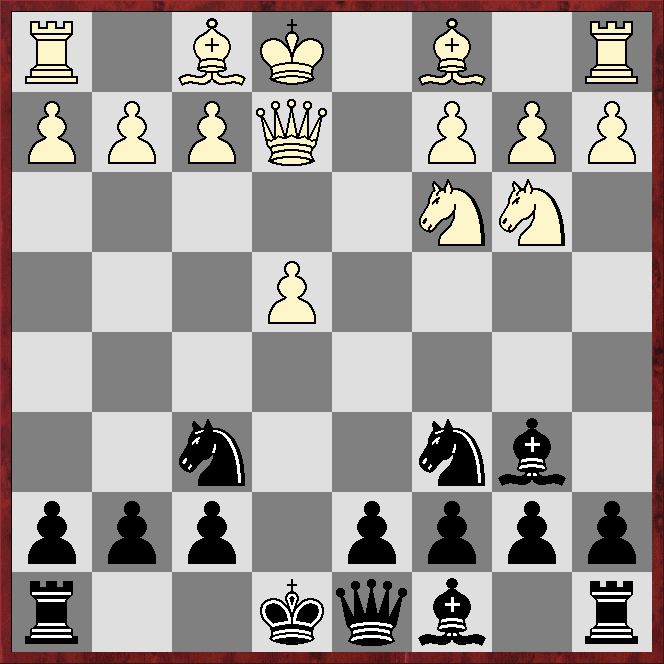
White has just played 7.Qe2!?
*****
*****
*****
*****
*****
*****
*****
The engines suggest 7...a5, which advances on the part of the board where White is probably going to castle, and 7...0-0, which introduces the possibility of quickly bringing a rook to the half-open e file.
Grandmasters have also played 7...d6, which restrains the e pawn as well as opening a diagonal for Black's light-square bishop.
I played 7...Qe7?!, apparently putting pressure on e4.
But the pressure is largely illusory as, after 8.Bg5, Black should avoid 8...h6?, since White has 9.d5!
I had originally planned to continue 9...Qxe4??, but that loses the queen after 10.Nxf6+ etc.
Instead I played 9...Qe5, but after 10.Nxf6+ gxf6 the engines reckon Black is already lost.
The time control was 90 minutes, with a 30-second increment.
From my scoresheet I can see that, after 10 moves, my opponent had 65 minutes left, while I had 85 minutes.
In other words, despite being out of theory in a sharp position, I had used just 7.5 minutes.
LESSON: all the time in the world will not save a completely lost position.

Monday, 2 September 2024

Riviera Round Two

Russell James (2149 ECF/2052 Fide) - Spanton (1931 ECF/1980 Fide)
Scotch
1.e4 e5 2.Nf3 Nc6 3.d4 exd4 4.Nxd4 Bc5 5.Nb3 Bb6 6.Nc3 Nf6 7.Qe2!?
This is the most popular continuation in ChessBase's 2024 Mega database.
How should Black respond?
*****
*****
*****
*****
*****
7...Qe7?!
The mainline in Mega24 runs 7...0-0 8.Bg5 h6 9.Bh4 a5!? 10.a4 Nd4 11.Qd3!? Nxb3 12.cxb3 c6!? 13.0-0-0, with an edge for White, according to Stockfish16.1 and Dragon1 (the latter is the keener on White's position).
8.Bg5
Black already seems to be in trouble.
8...h6?
The engines suggest 8...Qe6!?, but give White the upper hand.
9.Nd5! Qe5
Not 9...Qxe4?? as the black queen is lost after 10.Nxf6+.
10.Bxf6
This is much better than 10.f4? Qxb2.
10...gxf6 11.0-0-0 d6 12.f4 Qe6 13.Qh5
Even stronger, according to the engines, are 13.Qe1!? and 13.f5!?
13...Ne7?
Best seems to be the deeply unappealing 13...Kf8.
White to play and win the black queen
*****
*****
*****
*****
*****
14.Nd4! 1-0

Sunday, 23 June 2024

Bischofsgrün Round Three

Manfred Herbold (2105) - Spanton (1942)
Scotch Four Knights
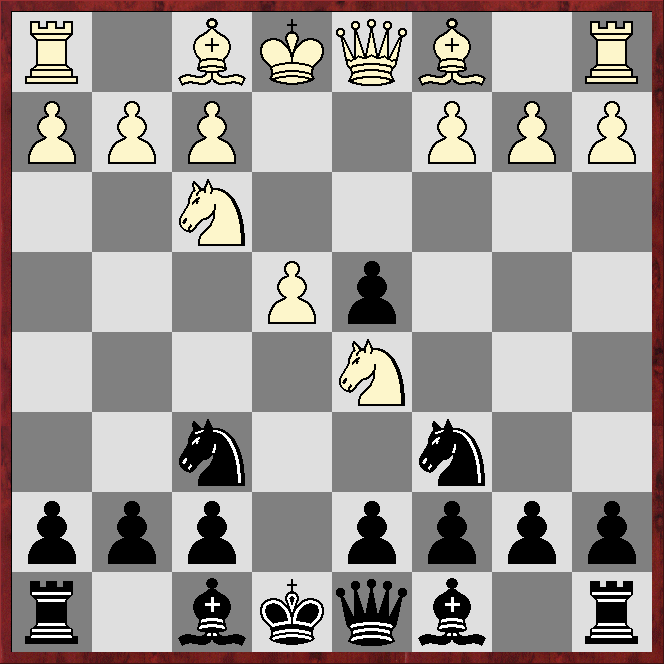
1.Nc3 Nf6 2.e4 e5 3.Nf3 Nc6 4.d4 exd4 5.Nd5!?
This is the Belgrade Gambit, first played by Kurt Richter in the 1938 Germany-Austria match at Berlin, where he lost to Albert Becker. The gambit was taken up and apparently given its name by a Yugoslav player, although sources vary as to whom.
How should Black respond?
*****
*****
*****
*****
*****
5...Be7
Richter-Becker went 5...Nxd5 6.exd5 Bb4+ 7.Bd2 Qe7+ 8.Be2 d3!? 9.cxd3 Bxd2+ 10.Qd2 Nb4 11.0-0 0-0, with at least a slight edge for Black, according to Stockfish16 and Komodo14.1 (0-1, 32 moves).
Grabbing the pawn with 5...Nxe4 is possible, eg 6.Bd3!? (the engines prefer this over the commoner 6.Qe2) Nc5 7.0-0 Ne6!? 8.Re1, when White has sufficient compensation for two pawns, according to the engines.
The text is the most popular move in ChessBase's 2024 Mega database.
6.Nxd4 Nxd4 7.Qxd4 Nxd5 8.exd5 Bf6 9.Qe4+ Qe7 10.Qxe7+ Kxe7!? 11.Bd3 Kd6!?
This may be too ambitious. Black should perhaps be content with 11...Re8 or 11...d6.
How should White proceed?
*****
*****
*****
*****
*****
12.c4
The engines suggest 12.0-0!? or 12.Bf4+, eg 12.Bf4+ Be5 13.Bxe5+ Kxe5 14.0-0-0, with what they reckon is a slight edge for White.
12...Re8+ 13.Kd1 Ke7 14.Re1+ Kf8 15.Rxe8+ Kxe8 16.Kc2 Kf8 17.Bf4
17.Bxh7!? g6 18.Bh6+ Bg7 19.Bf4 is completely equal, according to the engines.
17...d6 18.h3 Bd7 19.Re1 Re8 20.Rxe8+ Bxe8 21.b4 Ba4+ 22.Kd2 h5 23.Bf5 Ke7 24.Bc8 b6 25.b5 g6 26.g4 hxg4 27.hxg4 Bd4 28.Bg5 Bf6 29.Be3 Kd8 30.Bb7 ½–½

Friday, 8 December 2023

Benidorm U2000 Round Five

FACED a Spain-registered junior (born 2008).

Mark Hladiy (1576) - Spanton (1743)
Scotch
1.e4 e5 2.Nf3 Nc6 3.d4 exd4 4.Nxd4 Bc5 5.Be3 Qf6 6.c3 Nge7 7.f3!?
The main moves are 7.Be2, 7.g3 and especially 7.Bc4.
How should Black respond?
*****
*****
*****
*****
*****
7...0-0
This is the commonest continuation in ChessBase's 2024 Mega database, but Stockfish16 and Komodo14.1 reckon Black is already able to play the central break ...d5.
8.Be2 b6
Again the engines like ...d5.
9.0-0 Bb7 10.Qd2!?
This may be a novelty, and is the top choice of the engines. Known moves are 10.b4 and 10.a3.
10...d5 11.Bg5?
The engines give 11.b4 Bd6 and then Bg5.
How can Black exploit White's last move?
*****
*****
*****
*****
*****
11...Bxd4+?!
Black is at least slightly better after this, but the engines point out the strength of 11...Nxd4!, eg 12.cxd4 Qxd4+ 13.Qxd4? Bxd4? 14.Kh1 Bxb2. White can improve with 13.Kh1, but will be a pawn down and under pressure.
12.Kh1
The engines' evaluations fluctuate, but possibly a tad better is 12.cxd4 Qxd4+ 13.Be3, when White is a pawn down but has the bishop-pair.
12...Qg6
Possibly better is the engines' 12...Qd6.
13.cxd4 f6!? 14.Be3 dxe4 15.fxe4
Can Black safely capture the e pawn?
*****
*****
*****
*****
*****
The engines gives 15...Qxe4 as their top move, although White gets an initiative, eg 16.Nc3 Qg6 17.Bd3.
15...Rad8 16.Qc3
The engines reckon White has at least the better side of equality after 16.d5!? Ne5 17.Nc3.
16...Rfe8
Again the engines reckon ...Qxe4 is best.
17.Nd2 Rc8?
Horribly passive. The engines give 17...Na5, one point being 18.Qxc7 Bxe4 19.Nxe4 Nd5!? seems good for Black. They prefer 18.Rf4, claiming at least a slight edge for White.
18.Rf4 f5 19.d5
Even stronger seems to be continuing to build the attack with 19.Raf1.
What should Black play?
*****
*****
*****
*****
*****
19...Ne5!
The best move in a horrible position, according to the engines.
20.Qxe5
Better may be the engines' 20.Bd4!?, but the position is complicated.
20...Nxd5 21.Qd4 Nxf4 22.Bxf4 fxe4
Black has rook and two pawns, one of which is passed, for bishop and knight (White also has the bishop-pair on an open board), but who is better?
*****
*****
*****
*****
*****
Komodo14.1 gives White a slight edge; Stockfish16 reckons White is winning.
23.Bc4+
The engines prefer immediately blockading the passed pawn with the queen.
23...Kh8 24.Re1?
This lets Black open the diagonal of the black light-square bishop, with strong effect. Better is 24.Qe3, or defending g2, for example with 24.Rg1, but not 24.Be3? Rcd8 25.Qc3 Rd3!
24...e3 25.Nf3 Re4
White is busted.
26.Qd3 Rxf4 27.Qxg6 0-1 (Time)

Friday, 9 June 2023

Transport To Pimlico

CAUGHT the Central Line to Victoria yesterday and walked the rest of the way to the Churchill Gardens social club, where the Pimlico summer tournament is being held in two sections over five consecutive Thursday evenings.

Pascoe Rapacci (1745) - Spanton (1959)
Open
Scotch
1.e4 e5 2.Nf3 Nc6 3.d4 exd4 4.Nxd4 Qf6!?
Not a particularly popular continuation, but there are 3,800 examples of the move in ChessBase's 2023 Mega database
*****
*****
*****
*****
*****
Often the game will transpose to normal 4...Bc5 lines, eg by 5.Be3 Bc5, 5.Nxc6 Bc5 or 5.Nb5!? Bc5. However 4...Qf6!?, as well as possibly confusing White, has the independent point that 5.Nb3 will not come with tempo, as it does after 4...Bc5. On the other hand, after the text 5.Nb3 will prevent Black putting the dark-square bishop on the a7-g1 diagonal.
5.Nf3!?
This is only sixth-most popular in Mega23, but is the top choice of Stockfish15.1 and Komodo14.1, although they do fluctuate if other moves are entered and then retracted. There is no doubt the text is a major loss of time. It as if, after 4.Nxd4, White had offered to return the king's knight to f3 in exchange for giving Black two tempi (...Qf6 and a move to come). Naturally there is more to it than that - White hopes to show the black queen is misplaced and ripe for harassment by White's minor pieces and/or pawns.
5...Bb4+!? 6.c3
Not the only move by any means. Possibilities include 6.Nc3!?, the point being 6...Bxc3+ 7.bxc3 Qxc3 8.Bd2 gives White the bishop-pair and open lines for a pawn. Also reasonable is 6.Nbd2, but 6.Bd2? runs into 6...Qxb2.
6...Be7!?
This may be a novelty. Normal is 6...Bc5, after which 7.Bg5 Qg6 8.Bd3 Ne5 seems fine for Black. The mainline in Mega23 runs 7.Be2 d6 8.0-0 Nge7 9.Bg5 with what the engines reckon is at least a slight edge for White.
7.Bd3 Ne5?!
Probably better is 7...d6, but the engines reckon White has the upper hand.
8.Nxe5 Qxe5 9.Nd2
Also strong is 9.f4, and if 9...Qc5 then 10.Qe2 with Be3 to come.
9...d5 10.Nf3 Qh5
How should White proceed?
*****
*****
*****
*****
*****
11.Nd4?!
Probably best is 11.exd5, when 11...Qxd5 12.0-0 looks promising for White. Perhaps Black should make a sacrifice of it with 11...Nf6!? 12.c4, although White is not forced to hold on to the pawn and could just develop.
11...Qxd1+ 12.Kxd1 dxe4 13.Bxe4 Nf6 14.Bf3 Bg4 15.Re1 Bxf3+ 16.Nxf3 0-0-0+ 17.Kc2 Bc5
Black has equalised.
18.Bg5!?
More straightforward is 18.Be3 Bxe3 19.Rxe3 Rhe8 20.Rae1 Rxe3 21.Rxe3.
18...Bxf2 19.Bxf6 gxf6 20.Re7 Rd7 21.Rxd7 Kxd7 22.Rd1+ Kc8
How would you assess this rook-and-minor-piece ending?
*****
*****
*****
*****
*****
Normally rook and bishop make a better team than rook and knight, and Black is a pawn up. But Black's shattered kingside means the knight should have few problems finding a good post, and the engines reckon the position is completely equal.
23.Nd4!? Rd8 24.Nf5 Rxd1!? 25.Kxd1 Kd7 26.Ke2 Bc5 27.Kd3 Ke6 28.Ke4 Bf8!?
Passivity is rarely wise, and here it puts Black in danger. The engines suggest gaining queenside space with 28...a5.
29.c4
Getting white pawns off dark squares makes sense, but the engines reckon 29.Nd4!? gives White a slight edge. I intended replying 29...Kd7, but 30.Kf5 gives White two well-placed pieces while Black's position, despite the small amount of material left on the board, has a slightly cramped feel.
29...c6 30.Nd4+ Kd7 31.Kf5 Bc5 32.Nb3 Be7?!
More passivity. Better seems to be 32...Bd6, eg 33.Kxf6 Bxh2 34.Nc5+ Kc7 35.Kxf7, although the position looks easier for White to play.
After 32...Be7?! it is White to play and gain the upper hand, or at least a slight edge, according to the engines
*****
*****
*****
*****
*****
33.Ke4?!
The king was well-placed on f5. The engines give 33.h4 b5 34.cxb5 cxb5 35.h5, one line continuing 35...a6 36.Nd2 Bc5!? 37.Kxf6 Bd4+ 38.Kxf7 Bxb2, after which the strength of the white king seems to more than compensate for Black having bishop-v-knight in a position with rival pawn-majorities.
33...Bd6 34.h3 b6
If 34...Be5 then 35.Nc5+.
35.Nd4?!
The engines reckon the game is completely equal after this, as it is after, say, 35.Nc1, but the text gives White chances to go wrong in a pawn-ending a pawn down.
35...Be5
White to play and draw
*****
*****
*****
*****
*****
36.b3
There seem to be two drawing moves, 36.b4! and 36.g4!
After 36.b4! Bxd4 37.Kxd4 Ke6 38.c5 b5 39.Ke4 it seems Black cannot make progress, eg 39...f5+ 40.Kf4 Kf6 41.g3 h6 42.g4! fxg4 43.hxg4 Ke6 44.Ke4 with complete equality.
After 36.g4! c5 37.Nb5 a6 38.Nc3 again Black apparently cannot make progress, eg 38...Bxc3 39.bxc3 Ke6 40.Kf4.
36...Bxd4 37.Kxd4 Ke6 38.Ke4
Perhaps 38.b4 is a tad better, but 38...f5 is strong.
38...f5+ 39.Kf4 Kf6 40.b4 a6 41.a4 b5 42.axb5
How should Black recapture?
*****
*****
*****
*****
*****
42...axb5?
White has a draw after this. Correct is 42...cxb5, eg 43.c5 Ke6 with ...Kd5 and ...a5 to come. Alternatively 43.cxb5 axb5 wins for Black in a similar way as to what happens in the game (when White misses a draw).
43.c5 h6
White to play and draw
*****
*****
*****
*****
*****
44.h4?
Both 44.g3 and 44.g4!? draw, eg 44.g4!? fxg4 45.hxg4 Ke6 46.Ke4 f5+ (what else?) 47.gxf5 Kf6 48.Kf4 h5 49.Ke4 h4 50.Kf4 h3 51.Kg3 Kxf5 52.Kxh2 Ke4 53.Kg4 Kd4 54.Kf5 Kc4 55.Kc6 Kxb4 56.Kd6 and both sides will queen their one surviving pawn.
44...Ke6 45.Kf3
The white king will have to withdraw sooner or later, and 45.g4 fxg4 46.Kxg4 f5+ is equally hopeless.
45...Ke5 46.Ke3 f4+ 47.Kd3 h5 48.Ke2 Kf5 49.Kf3 f6 50.Kf2 Kg4 51.Ke2 Kg3 52.Kd3 Kxg2 53.Ke4 f3 54.Kf5 f2 55.Kxf6 f1=Q+ 0-1

Saturday, 25 March 2023

4NCL Weekend Four: Game One

PLAYED on board one (of six) for Wessex Some Stars B against Oxford 4 in division four this afternoon.

Cyril Foster (1798 ECF/1710 Fide) - Spanton (1976 ECF/1835 Fide)
Scotch
1.e4 e5 2.Nf3 Nc6 3.d4 exd4 4.Nxd4 Qf6!?
This is only fifth-most popular in ChessBase's 2023 Mega database, but even so there are 3,800 examples of the move.
How should White respond?
*****
*****
*****
*****
*****
5.Nf3!?
Given enough time, this becomes the top choice of Komodo14.1, although Stockfish15.1 prefers the mainline 5.Be3.
5...Qg6!?
Applying immediate pressure against e4 (and g2), while vacating f6 for the king's knight. The engines prefer 5...Bb4+!? or 5....Bc5.
6.Nc3 Bb4 7.Bd2!?
An interesting pawn sacrifice, but perhaps 7.Bd3!? is even stronger, one point being 7...Qxg2?! can be met by 8.Rg1 Qh3 9.Rxg7, so Black should probably decide between 7...d6 and 7...Bxc3+.
7...Bxc3 8.Bxc3 Qxe4+
The engines reckon 8...Nf6!?, which does not appear in Mega23, gives equality.
9.Be2 Nf6 10.0-0 0-0
Nina Mediankova - Svetlana Struchkova, Moscow Women's Championship 1981, saw 10...Qe7? 11.Re1 0-0 12.Bd3 Qd8 13.Ng5 with a large advantage for White (1-0, 17moves).
11.Bd3 Qg4 12.Bxf6!?
Giving up the bishop-pair, but wrecking Black's kingside.
12...gxf6 13.Re1 d5!?
The pawn is loose on d5 but prevents the white king's rook using the e4 square.
How should White proceed?
*****
*****
*****
*****
*****
14.Qd2
I was more concerned about 14.c4!? dxc4 15.Re4, but the engines prefer the text.
14...Bd7 15.h3 Qg7
White has a mating sequence after 15...Qb4? 16.Qh6, while 15...Qh5?! 16.Qf4 is also good for White, according to the engines.
16.Re3!? Rfe8
Not 16...Bxh3? 17.Nh4 with Rg3 to come.
17.Rae1 Rxe3 18.Qxe3
What should Black play?
*****
*****
*****
*****
*****
18...Nb4?
Not 18...Re8? 19.Qxe8+! etc, nor 18...Bxh3? 19.Qe8+! etc, but best may be 18...Kh8!?, eg 19.Kh2 Rg8 20.g3 Qf8, although the engines reckon White has more than enough for a pawn.
19.Qe7 Nxd3 20.cxd3 Bc6?!
Probably better is 20...Be6, or counterplay with 20...Bf5!?
21.Nd4 Qg5 22.Nxc6 bxc6 23.Re3
The weakness of Black's king, together with the numerous black pawn-weaknesses, mean White is winning despite being a pawn down
*****
*****
*****
*****
*****
23...Qh6 24.Rg3+ Kh8 25.Qxf7 Rc8 26.b3!?
Hardly necessary, but it is a sign of how much better White stands that spending a tempo like this does not alter the fundamental assessment that White is winning.
26...Qf8 27.Qe6 Rd8?! 28.Qxc6
Even stronger is 28.Rg8+! Qxg8 29.Qxf6+ Qg7 30.Qxd8+.
28...Qd6 29.Qc1 Rg8?!
The engines are happy enough with this, but better practical chances were probably to be had in keeping the rooks on.
30.Rxg8+ Kxg8 31.Qe3 c5
Queens stay on the board after 31...Kf7!?, but then 32.Qxa7 gives White a second extra pawn, which also happens to be passed.
32.Qg3+ Qxg3 33.fxg3 Kf7 34.g4 Ke6 35.Kf2 Ke5 36.Ke3 a5 37.a4 h6 38.g3 Kd6 39.Kf4 c4!?
A desperate last try.
40.bxc4 dxc4 41.dxc4 Kc5 42.Kf5 Kb4 43.c5!
Best, although 43.Kxf6 should also win.
43...Kxc5 44.Kxf6 Kb4 45.g5 hxg5 46.Kxg5 a4 47.h4 1-0

Friday, 20 January 2023

Mariánské Lázně Game Seven

Stef van Kesteren (1862) - Spanton (1895)
Scotch
1.e4 e5 2.Nf3 Nc6 3.d4 exd4 4.Nxd4 Qf6!?
This can have independent significance, but after ...
5.Be3 Bc5
... the game has transposed to normal 4...Bc5 lines, except Black has avoided the variation 4...Bc5 5.Nb3. Whether Black should be trying to avoid that variation is another matter.
6.c3 Nge7 7.Bc4 0-0 8.0-0 b6!?
This is fourth-most popular in ChessBase's 2023 Mega database. The mainline runs 8...Bb6 9.Na3 d6 10.Nac2 with an equal position, according to Stockfish15 and Komodo13.02.
How should White respond?
*****
*****
*****
*****
*****
9.Nxc6
The 8...b6!? variation is fairly new - the oldest game in Mega23 is from 1992 - and no consensus has emerged over how White should proceed. The main move in Mega23 is 9.f4!?, but the slightly surprising 9...d5!? seems a good reply, eg 10.exd5 Na5 11.Bd3 Bb7 12.Nc2 Nxd5 13.Bxc5 bxc5, which occurred in Johan-Sebastian Christiansen (2506) - Vladimir Vusatiuk (2321), Pardubice (Czechia) 2018, and was slightly better for Black, according to the engines (but ½–½, 30 moves). The engines flick between several ninth moves for White, including the text, which is second-most popular in Mega23.
9...Qxc6 10.Bxc5 Qxc5 11.Qxd4!?
This is the point of White's play - inviting Black to give White a classical centre with 11...Qxd4 12.cxd4, although it is debatable how strong that would be in the absence of queens and four minor pieces.
11...Bb7!? 12.Qxc5
Almost certainly not 12.Qxd7?! Qxc4 13.Qxe7 Rfe8, after which Black regains the sacrificed pawn and has an initiative based on better development.
12...bxc5
How would you assess this queenless middlegame?
*****
*****
*****
*****
*****
White's pawn-structure is better, but Black has pressure against e4 and no weaknesses that are easy to get at. The engines reckon the position is equal.
13.Nd2 Rfe8 14.Rae1!?
Alexandre Danin (2598) - Vladislav Nozdrachev (2463), Kaluga (Russia) 2013, went 14.Rfe1 Ng6 15.b4!? a5!? 16.a3 acb4 17.axb4 Rxa1 18.Rxa1 cxb4 19.cxb4 Kf8 with a draw in 35 moves. The idea of the text, presumably, is to support kingside expansion.
14...Nc6 15.Bd5
White may be slightly better after 15.f4, according to the engines.
15...Rab8 16.Bxc6?!
This is probably bad, not so much because the white bishop was better than the black knight, although it was, but because the only minor pieces left on the board after the trade are a black bishop and a white knight, and the former is the better piece.
16...Bxc6 17.b3 d6 18.f3 a5
Who stands better?
*****
*****
*****
*****
*****
The position is equal, according to the engines, but I believe Black's position is much easier to play, ie Black will attack on the queenside, while it is not clear what White can do to win the initiative.
19.c4 Rb7 20.Re3 f6 21.Rfe1 a4 22.bxa4?!
White temporarily gains a pawn, but after Black recaptures on a4 White will be under pressure.
22...Ra8 23.Rb3 Rba7 24.Reb1 Kf7 25.Rb8 Rxa4 26.Rxa8 Rxa8 27.Rb2 Ke6 28.Kf2 Ke5 29.Ke3 Ra3+ 30.Nb3 Bb7 31.g3 Ba6 32.Rc2 Ra4 33.Nd2 Rb4?!
According to the engines, Black has a large advantage after 33...f5.
34.h4 Bc8 35.a3 Ra4 36.Rc3 Ba6 37.f4+ Ke6 38.g4 g6 39.f5+ Kf7 40.fxg6+ hxg6 41.Kf4 Bc8 42.Nf3 Be6 43.Nd2 Ke7 44.g5 f5?
Black should hold tight with, for example, 44...Kf7, after which it is Black, if anyone, who has a small edge. After the text Black is probably lost.
45.exf5 Bxf5 46.h5 Kf7 47.h6 Ra8?!
This almost certainly makes matters worse, although 47...d5 48.Ke5 is not a great improvement.
48.Rb3 Ke7 49.Ne4 Bxe4 50.Kxe4 Ke6 51.Rf3 Ra4
Desperately trying for counterplay, but this is one rook-and-pawn ending that is definitely not drawn.
The game finished:
52.Rf6+ Kd7 53.Rxg6 Rxc4+ 54.Kd3 Rh4 55.Rg7+ Ke6 56.h7 Kd5 57.Rxc7 Rh3+ 58.Ke2 Ke4 59.g6 Rh2+ 60.Kf1 Ke3 61.Kg1 Rh6 62.Re7+ Kd4 63.Re6 Kd5 64.g7 Rxe6 65.g8=Q 1-0

Thursday, 19 January 2023

Mariánské Lázně Game Six

Spanton (1895) - Johann Loibl (1677)
1.Nc3/Scotch
1.Nc3 e5 2.Nf3 Nc6 3.d4 exd4 4.Nxd4 Bc5!?
This is second in popularity to 4...Nf6 in ChessBase's 2023 Mega database.
5.Nf5!?
The text, 5.Nxc6 and 5.Be3!? are the top choices of Stockfish15 and Komodo13.02.
5...Qf6 6.e4
There are 365 examples of this position in Mega23, normally being reached via a Scotch move-order: 1.e4 e5 2.Nf3 Nc6 3.d4 exd4 4.Nxd4 Bc5 5.Nf5!? Qf6 6.Nc3
*****
*****
*****
*****
*****
6...Nge7 7.Be3 Bb4!? 8.Nxe7 Bxc3+!? 9.bxc3 Qxe7
Now the flurry of tactics is over, how would you assess the result of the opening?
*****
*****
*****
*****
*****
White has the bishop-pair on a board with an open centre but lots of pawns. White also has more space in the centre, but three isolated pawns, two of which are doubled. The engines reckon chances are even.
10.Bd3 d6 11.0-0 Ne5!?
This may be a novelty. The engines slightly prefer castling.
12.Rb1
The engines reckon 12.f4!? Nxd3 13.cxd3 gives White an edge.
12...Nxd3 13.cxd3 b6 14.Rb5!?
The rook embarks on an interesting excursion, but perhaps developing with 14.Re1 or 14.Qd2 is better.
14...Bd7 15.Rg5 f6 16.Rg3 0-0-0!?
More or less committing to castling long.
How should White respond?
*****
*****
*****
*****
*****
17.f4
The engines give 17.h4!? 0-0-0 18.c4 with an unclear position, but one they reckon is equal.
17...0-0-0
Black is better after 17...h4, according to the engines.
18.f5 Be8!?
The engines still like ...h4.
19.Qb3 h4 20.Rgf3?
Necessary seems to be 20.Rh3 or 20.Rg4.
How can Black exploit White's last move?
*****
*****
*****
*****
*****
20...Bh5?!
Missing the strength of 20...d5, when 21.exd5? loses to 21...Bh5. The engines flick between several moves, but eventually more or less settle on 21.d4, when 21...dxe4 is good, but best seems to be 21...h3!?, eg 22.exd5 hxg2 23.Re1 Qe4 with strong play.
21.R3f2 d5 22.Qa4?!
Probably better is 22.c4!?, and if 22...dxe4 then 23.d4!?
22...Kb7 23.Re1 Be8 24.Qb3 Bf7 25.exd5?!
This helps Black's play in the centre, but White has major problems in any case.
25...Rxd5 26.c4 Re5 27.d4 Re4
Also strong is winning a pawn by 27...Bxc4 etc.
28.Rff1 Qd7?
This lets White off the hook. The engines like 28...h3, but even more 28...Bxc4.
29.Qd3?
Both 29.d5 and 29.Bf2 leave Black with a much smaller advantage, according to the engines.
29...Rhe8 30.Bf2 Qc6
This is probably enough for an edge, but Black can grab a pawn with 30...Qxf5, and if 31.Bxh4 then the engines point out 31...Qg6! is very good, for example 32.Bg3? loses to 32...Rxe1, while 32.Rxe4 Qxe4 33.Qxe4+ Rxe4 34.Bf2 is met by 34...Bxc4, when White has nothing better than the passive 35.Ra1.
31.Rxe4 Rxe4?!
Probably better is 31...Qxe4, when White seems to have too many weaknesses to defend.
32.Rc1 Qe8 33.Qf3 Kb8 34.h3!?
The engines like this safety-first move - White's back rank is more vulnerable than it might appear at first glance.
34...Bh5 35.Qa3 Re2 36.c5 Bf7 37.cxb6 axb6 38.Qc3 Qd7 39.a3!?
The engines prefer grabbing the h4 pawn, or protecting the a pawn with 39.Rxc2.
39...Bd5 40.Qd3?
It was necessary to defend the second rank with 40.Rc2.
40..Ra2
Opposite-coloured bishops are well known for their drawing tendencies in endings, but in middlegames that is rarely the case, and here it could not be more obvious who has the better bishop
*****
*****
*****
*****
*****
41.Qc3 Qd6 42.Ra1 Rxa1+ 43.Qxa1 Qf4 44.Qe1 Qg5
White cannot prevent mate and defend all the weak white pawns.
45.Qe8+ Kb7 46.Qg6 Qc1+ 47.Kh2
Now 47...Qxa3 wins, eg 48.Bxh4 Qe7 followed by pushing the b pawn. Instead the game saw:
47...Qf4+ ½–½

Tuesday, 27 December 2022

Dama Negra Game Two

Carlos Freire Boudon (1366) - Spanton (1895)
Scotch
1.e4 e5 2.Nf3 Nc6 3.d4 exd4 4.Nxd4 Qf6!? 5.Be3 Bc5 6.c3 Nge7
By a slightly unusual move-order the game has reached a mainline tabiya of the Scotch
*****
*****
*****
*****
*****
*****
7.Be2!?
Most popular are 7.Bc4 and 7.g3, but there are 1,562 examples of the text in ChessBase's 2023 Mega database.
7...0-0 8.0-0 b6?!
Rather as in many lines of the Sicilian, if Black can get in ...d5 in the Scotch without suffering immediate punishment then Black has probably at least equalised, and that is the case here (and on the previous move). After 8...d5 my main analysis engines, Stockfish15 and Komodo13.02, give 9.Nxc6 Qxc6 10.Bxc5 Qxc5 11.Nd2 Be6 with what they reckon is equality.
9.Qd2 Bb7 10.Nb5?!
This lets Black off the hook. Almost certainly better is 10.b4, which is not in Mega23 but causes Black huge problems as 10...Bd6 runs into 11.f4 with a strong initiative.
10...Bxe3 11.Qxe3 Rac8 12.Nd2 a6 13.Nd4 d5
At last. Now the tension in the centre makes each move more critical.
What should White play?
*****
*****
*****
*****
*****
14.Bf3?!
The game is equal, according to the engines, after both 14.Rfe1 and 14.Nxc6 Qxc6 15.Bf3.
14...Rfe8 15.g3?!
The white bishop will look good on g2 but the procedure probably takes too much time. One line given by the engines runs 15.exd5!? Ne5!? 16.Be4 Nxd5 with what they reckon is a slight edge for Black.
15...Ne5?!
Black is much better, according to the engines, after 15...Nxd4!? 16.Qxd4 Qxd4 17.cxd4 Nc6!?
16.Bg2 c5 17.Ne2
The knight is placed more actively with 17.N4f3, but the engines prefer Black after 17...Rcd8.
17...Rcd8
Black is fully developed and generally more active
*****
*****
*****
*****
*****
18.f4?
Trying for counter-activity, but White's position is not ready for this. The engines suggest 18.Nf4, but give Black at least a slight edge.
18...Ng4 19.Qf3 dxe4 20.Nxe4 Bxe4 21.Qxe4 Nf5 22.Qf3 Nge3 23.Rf2 Nxg2 24.Kxg2!?
This is best, according to the engines, although they reckon all three recaptures lose.
24...Qg6 25.Qb7?!
Best may be 25.Kh1, but 25...h5 adds to the pressure, as does 25...Re3.
25...Rd2 26.Ng1?
This speeds the end, but White's game cannot be saved, eg 26.Qxa6 Ne3+ 27.Kg1 Qe4 28.Re1 Rd1 29.Rxd1 Nxd1 30.Rg2 Ne3 31.Rf2 Qb1+ etc.
26...Ne3+ 0-1